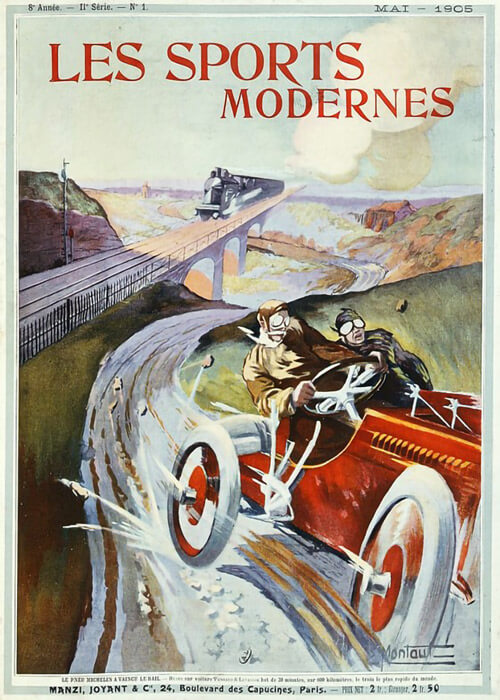
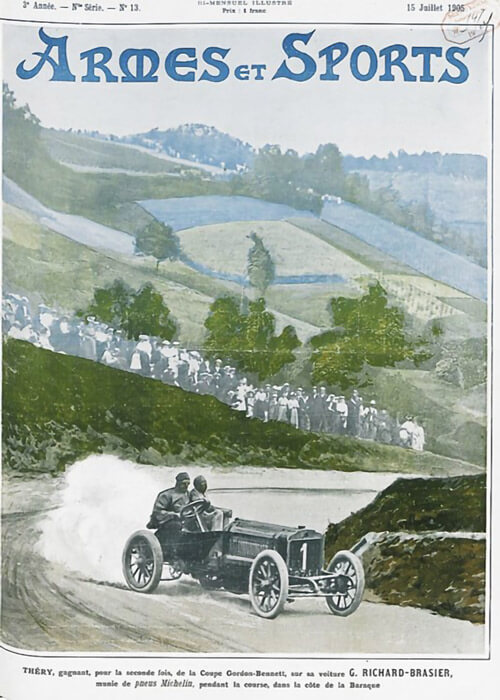
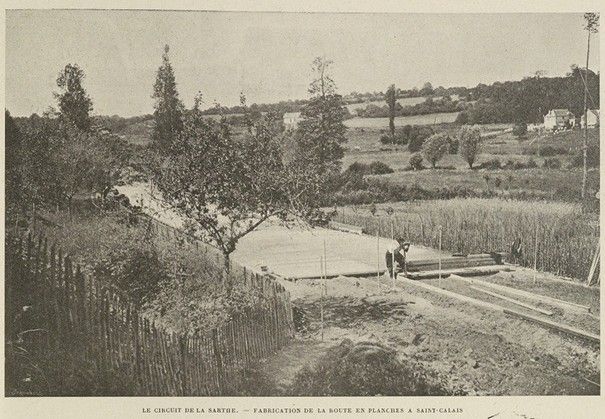
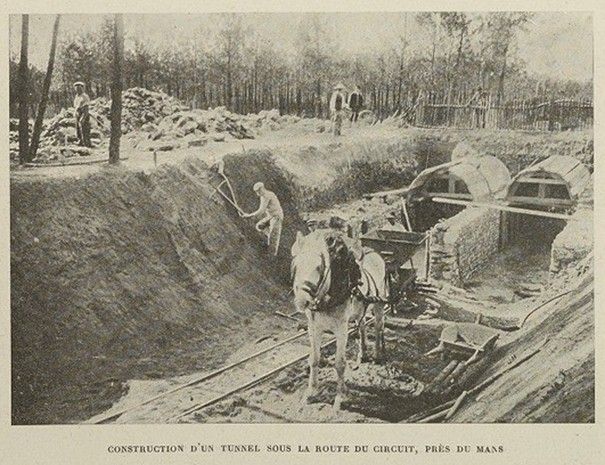
The first ever French Grand Prix on the la Sarthe circuit was extensively reported by many French automotive magazines. So too, La Vie illustrée, dedicating two articles to that event. This first one, covers informations on the course itself (consisting mainly of open roads) as well as it’s construction work, A part of the course ran through a lightly swamped area, hence the road was reinforced by means of wooden planks. It is even mentioned proudly that, only some days nefore the event, no less than 34 cars are enlisted to participate, bearing in mind that this two-day event will cover a total distance of something more than 1200 kilometers; similar to the early city-to-city races.
Text and photos with permission of the Bibliothèque nationale de France- gallica.bnf.fr https://www.bnf.fr/fr
Compiled by motorracinghistory.com. Translation by deepL.com
La Vie Illustrée, Vol. 9, No. 402, June 29, 1906
THE A.C.F. GRAND PRIX — THE SARTHE CIRCUIT
La Vie Sportive
The A.C.F. Grand Prix — Like the Gordon-Bennett Cup, which it has replaced, the A.C.F. Grand Prix is the biggest motor race of the year.
This time the battle will be particularly exciting; we have no comparative data on the cars entered. Each country, for its part, does not know the true worth of its cars, as it has not had the national qualifying rounds that once preceded the Bennett Cup to gauge their performance. This time, there is only an international free-for-all in which each will fight for its chance with every means at its disposal: France with ten brands, Italy with two, and Germany with one.
It should therefore come as no surprise to see the competition today confined to three nations, now that the representation of the contenders is proportional to the size of the national automotive industry. As it stands, the field is impressive; it consists of thirty-four cars, namely: three Brasier, three Darracq, three Lorraine-Dietrich, three Panhard-Levassor, three Bayard-Clément, three Renault frères, three Hotchkiss, two Grégoire, one Gobron, and one Vulpès for France; three Fiat and three Itala for Italy; and finally three Mercedes for Germany.
Although this is a speed race, the course is particularly long, covering no less than 1,248 kilometers — a fact now known to all — on the famous Circuit de la Sarthe, which has been the subject of so much discussion and measures 104 kilometers. The event is spread over two days during which the competitors will have to complete twelve laps of the circuit, six times per day.
On Wednesday morning, their cars will be returned to them just as the race begins. On the first day, the starting order will be determined by a draw, as in previous years, and is as follows:
1. Lorraine-Diétrich. — 2. Fiat. — 3. Renault frères. — 4. Darracq. — 5. Brasier. — 6. Vulpès. — 7. Gobron. — 8. Itala. — 9. Grégoire. — 10. Panhard-Levassor. — 11. Vulpès. — 12. Hotchkiss. — 13. Bayard-Clément.
Then the second and third cars from each “stable” will start after them in the same order, but with this difference from previous years: instead of being numbered consecutively, they will bear an initial—A, B, or C—to distinguish each “jockey.”
On the second day, each vehicle will depart in the order in which it finished the previous day; the first at 6:00 a.m., and the others with a delay equal to the number of minutes they lost during the first stage. This method will make it very easy to follow the race without having to engage in the tedious task of calculating times—a task performed a hundred times a day, so frantically, that no one can agree on the results.
There is no need to go into technical details here regarding ignition, engine speed, cooling, etc., which would interest only a very small minority of readers. It is worth, however, providing a general overview of the cars entered, indicating their weight and engine power. Here it is:
———————— WEIGHT HORSEPOWER
Lorraine-Dietrich — 1005 130
Fiat ——————- 995 135
Renault frères —— 985 105
Darracq ————– 860 125
Brasier ————— 1000 105
Mercédès ———— 990 125
Gobron-Brillé ——- 1000 110
Itala —————— 1000 110
Grégoire ————- 750 70
Panhard-Levassor — 1005 130
Vulpès —————- 1000 120
Hotchkiss ————- 1000 125
Bayard Clément —– 1000 125
It is worth noting that the lightest cars are the Grégoires, which have only 70 horsepower for 750 kg. and the Darracqs, which have a formidable power output of 125 horsepower for a weight of 860 kilograms. One is tempted to consider both the power and the lightness of these cars — which can certainly reach fantastic speeds — as exaggerated. Fortunately, the race cars built by Mr. Darracq have already proven themselves, and we can be confident in their performance.
Even more than top speed, average speed is of great importance in a race as long as the one at hand, and it seems to us that the 100- and 105-horsepower engines are all the more sufficient given that the gigantic engines have already caused quite a few setbacks for those who have tried them.
Unlike the Auvergne circuit, the venue for the last Bennett Cup, the Circuit de la Sarthe consists almost exclusively of straightaways. Since speed is the greatest factor in damage, one can imagine how difficult it will be to reach the finish line without a breakdown.
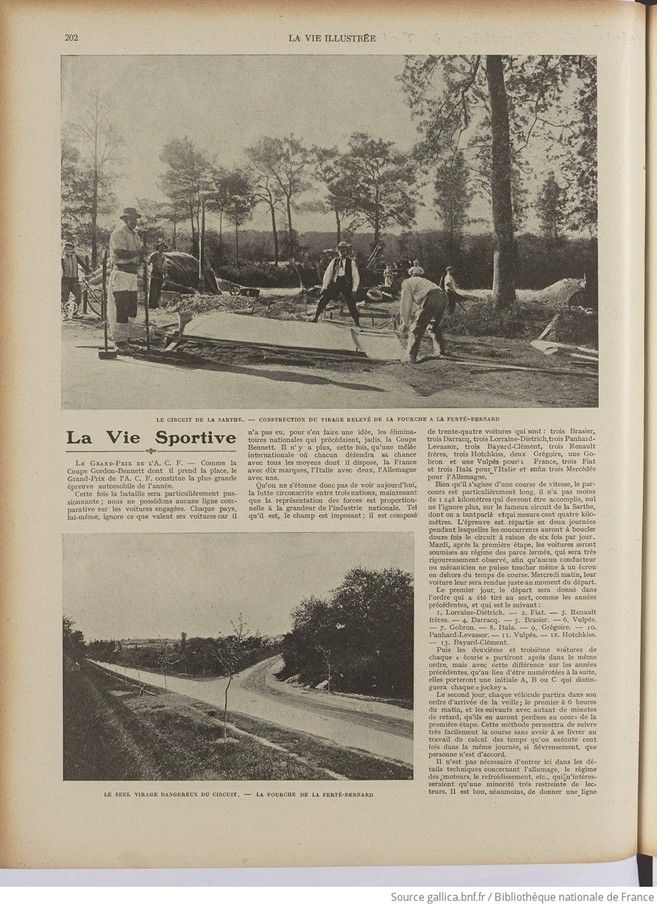
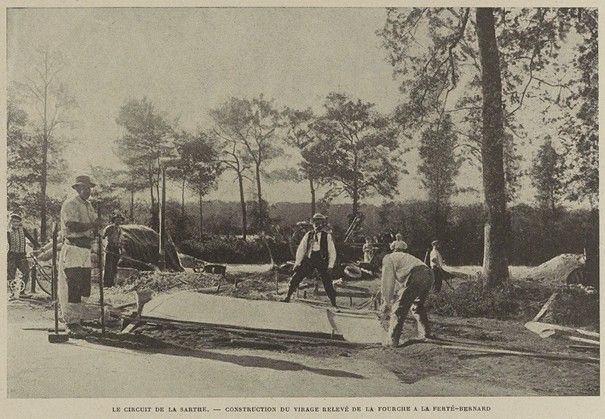
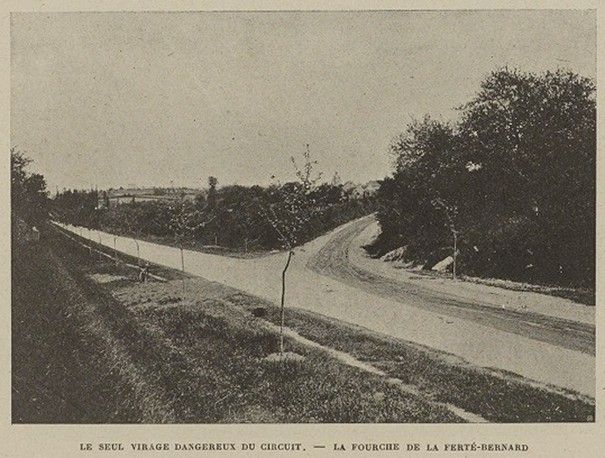
The circuit is triangular in shape, and the road is so well-designed that one would not note any terrain-related hazards worth mentioning, had it not been for the decision to create a dangerous turn by raising the level of the Fourche curve.
The road has been narrowed on the outside; the bend forms a steep embankment where one could slide off, and on the inside there are four trees into which cars could crash!
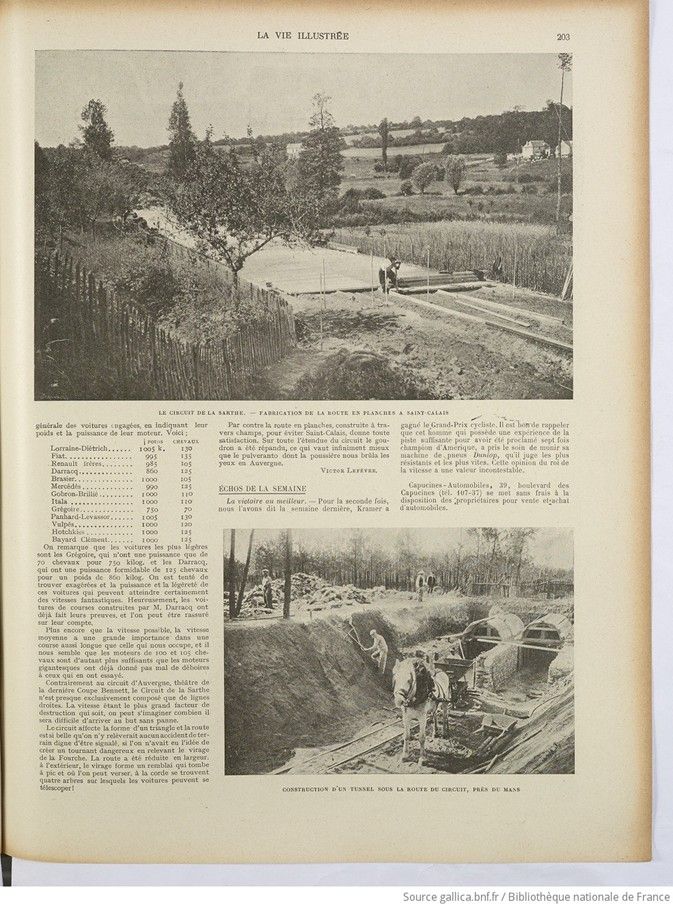
On the other hand, the boardwalk built across the fields to bypass Saint-Calais is entirely satisfactory. Tar has been laid along the entire length of the circuit, which is infinitely better than the pulveranto, whose dust stung our eyes in Auvergne
Victor Lefèvre.
Photos.
Page 0.
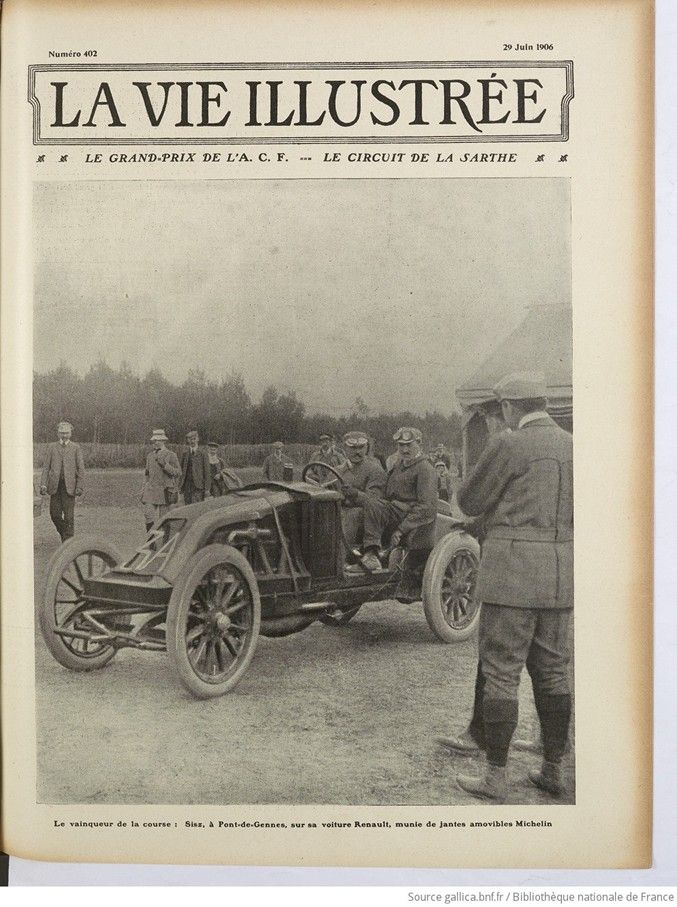
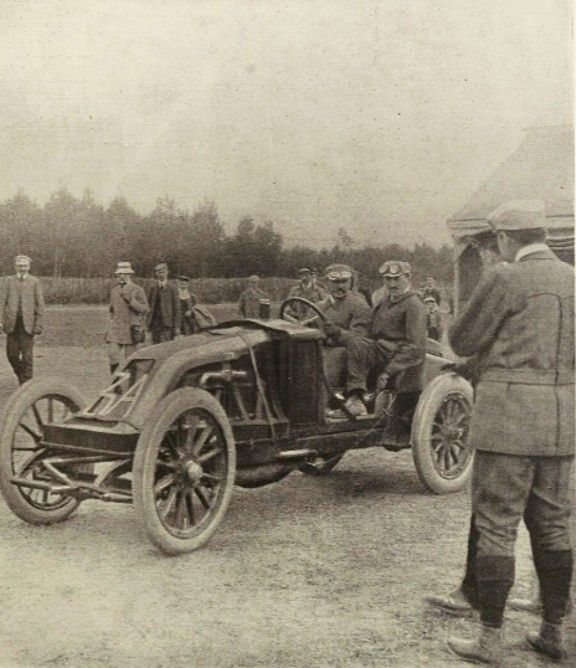
The race winner: Sisz, at Pont-de-Gennes, in his Renault car, equipped with Michelin removable rims
Page 202.
THE SARTHE CIRCUIT. — CONSTRUCTION OF THE ELEVATED FOURCHE CURVE AT LA FERTÉ-BERNARD
THE ONLY DANGEROUS CURVE ON THE CIRCUIT. — THE FOURCHE CURVE AT LA FERTÉ-BERNARD
Page 203.
THE SARTHE CIRCUIT. — CONSTRUCTION OF THE PLANK ROAD AT SAINT-CALAIS
CONSTRUCTION OF A TUNNEL UNDER THE CIRCUIT ROAD, NEAR LE MANS
Page 204.
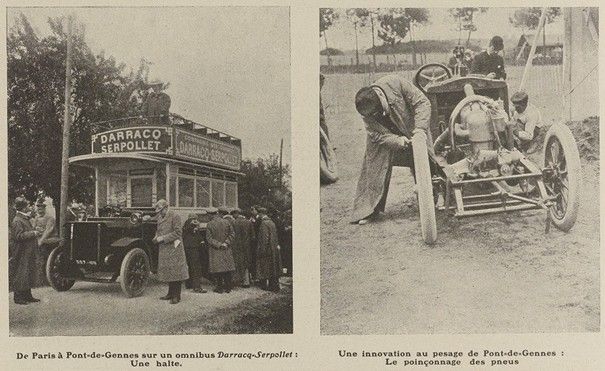
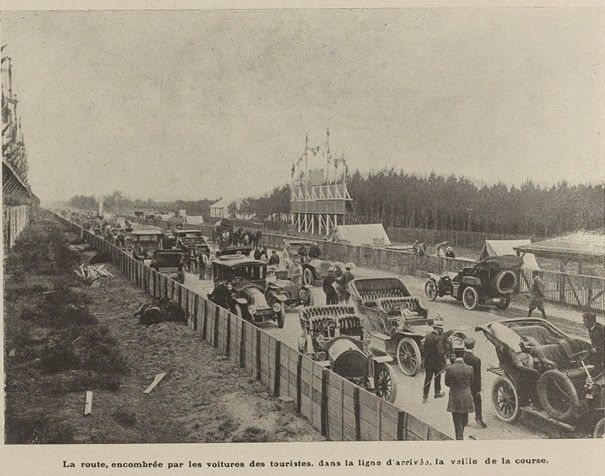
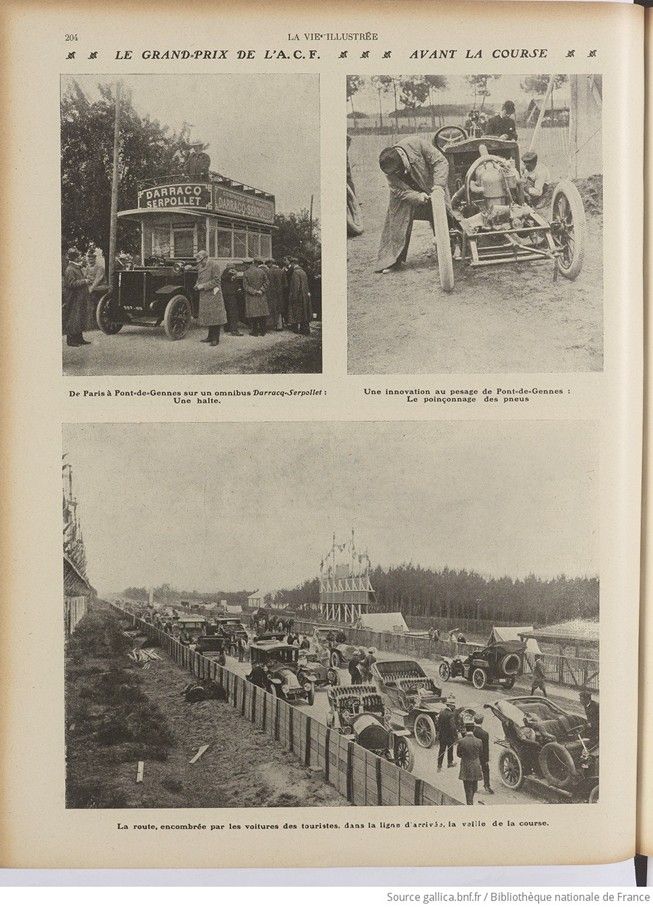
THE A.C.F. GRAND PRIX – BEFORE THE RACE
From Paris to Pont-de-Gennes in a Darracq-Serpollet omnibus: A stop.
An innovation at the Pont-de-Gennes weigh-in: Tire punching
The road, crowded with tourists’ cars, at the finish line, the race’s end.
Page 205.
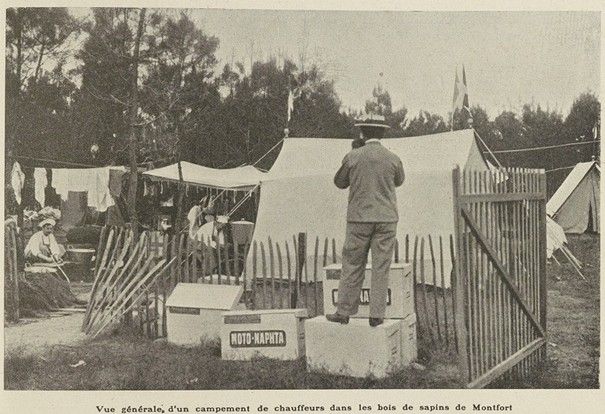
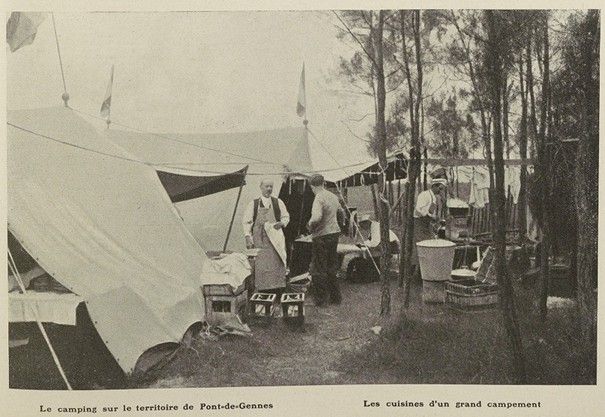
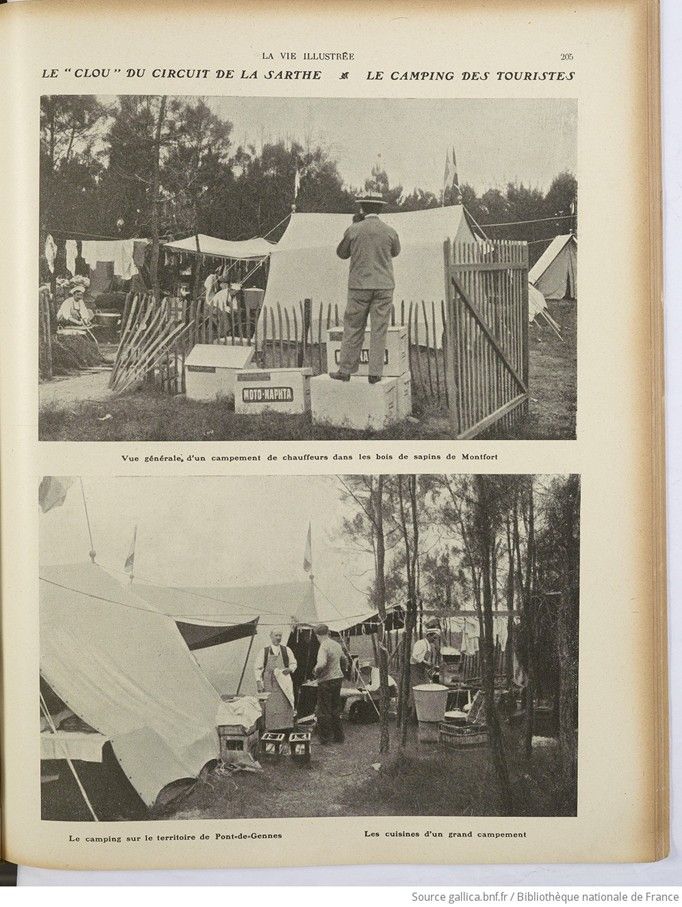
THE “HIGHLIGHT” OF THE SARTHE CIRCUIT – THE TOURIST CAMPING GROUND
General view of a drivers’ camp in the pine woods of Montfort The campground in the Pont-de-Gennes area – The kitchens of a large camp