This 1929 Indianapolis 500 would be the last Indianapolis race withnthe then known regulations. From next year on, 1930 would be quite different. This year unfortunately, took the life of Bill Spencer who crashed into the wall eartly in the race. The firs deadly casualty since 1919.
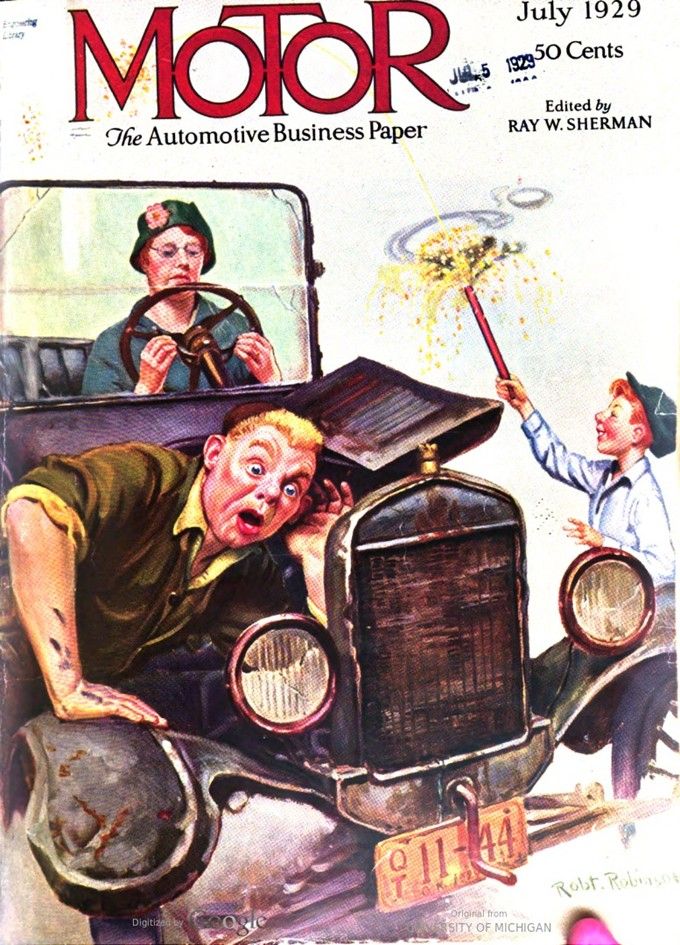
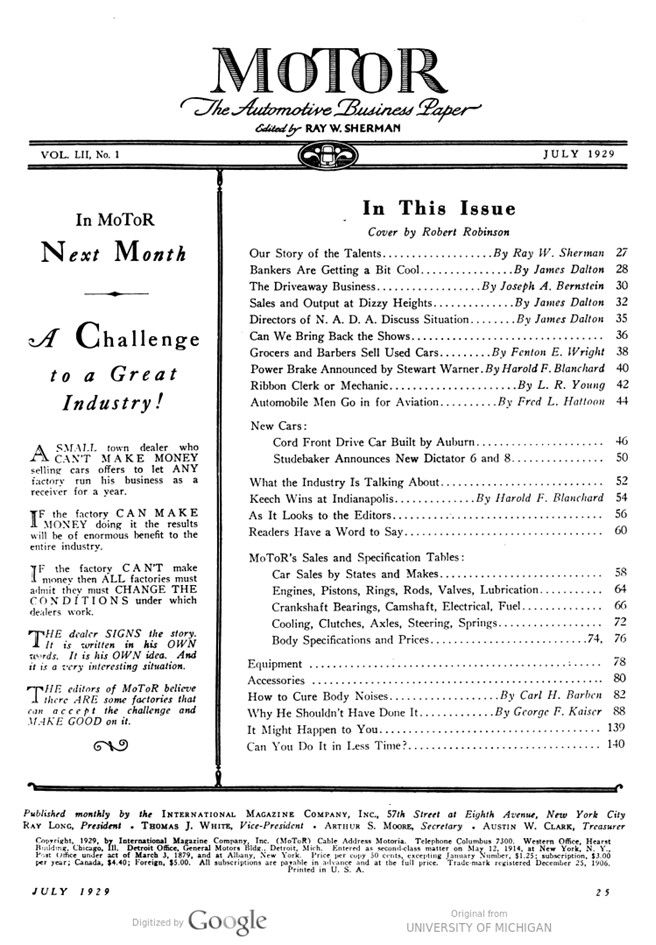
Text and jpegs by courtesy of hathitrust.org www.hathitrust.org, compiled by motorracinghistory.com
MoToR, Vol. LII, 52, No. 5, July 1929
KEECH Wins at INDIANAPOLIS
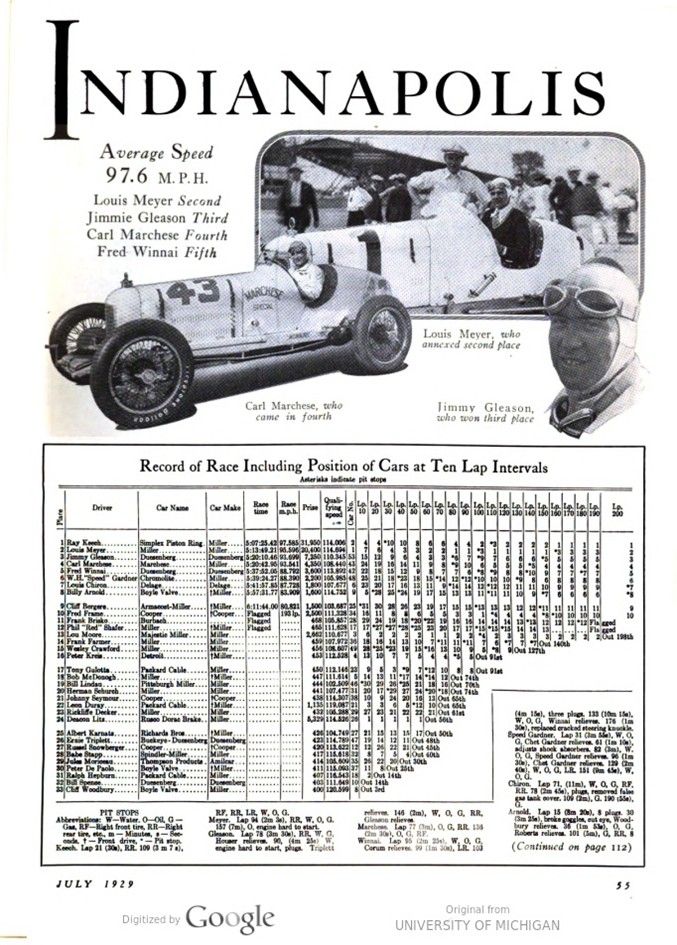
Average Speed 97.6 M. P. H. – Louis Meyer Second – Jimmie Gleason Third – Carl Marchese Fourth – Fred Winnai Fifth
By Harold F. Blanchard Technical Editor of MOTOR
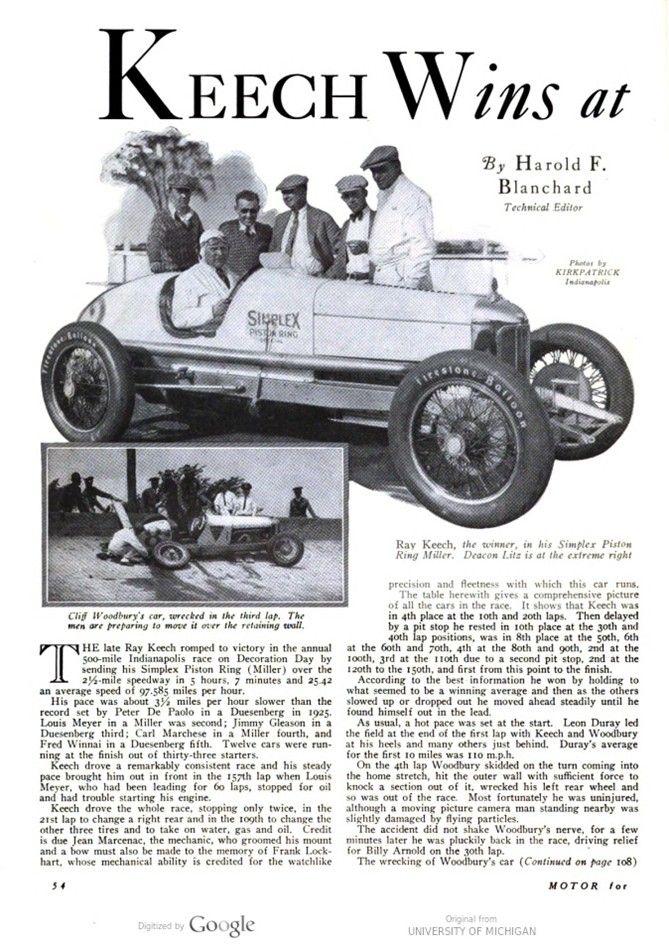
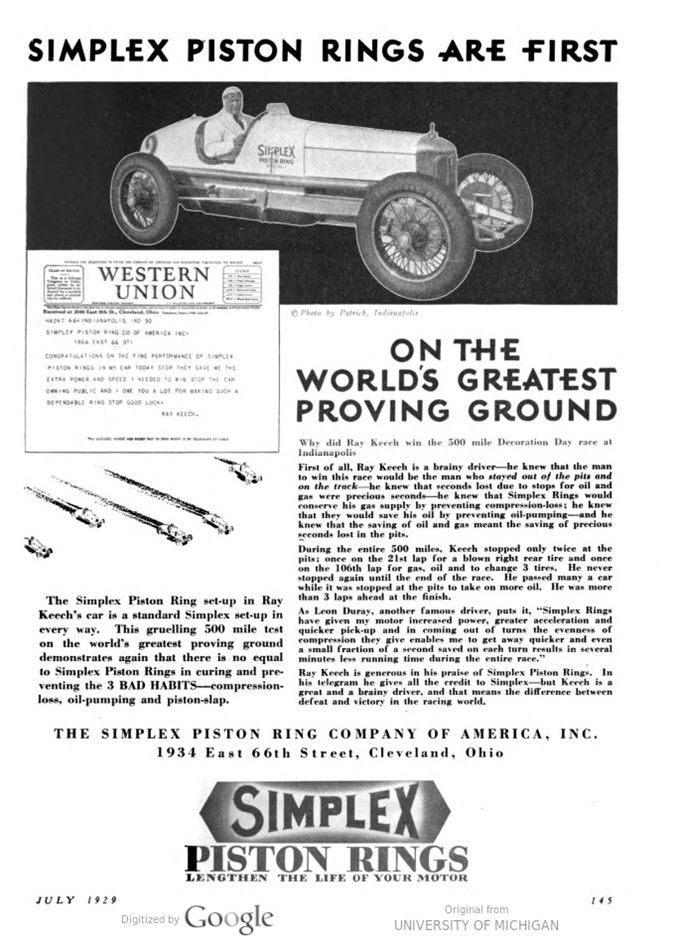
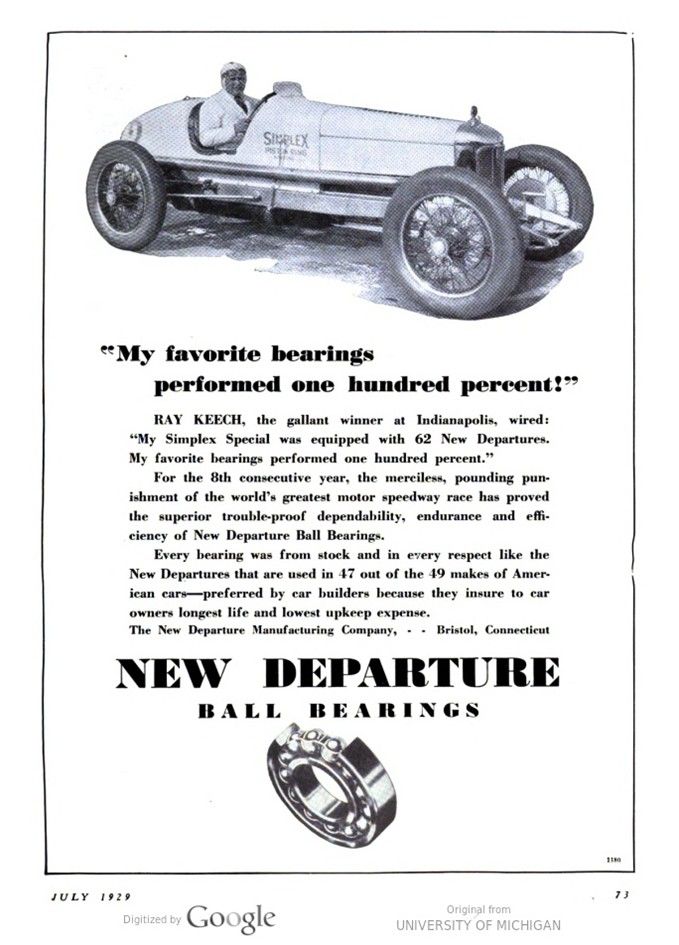
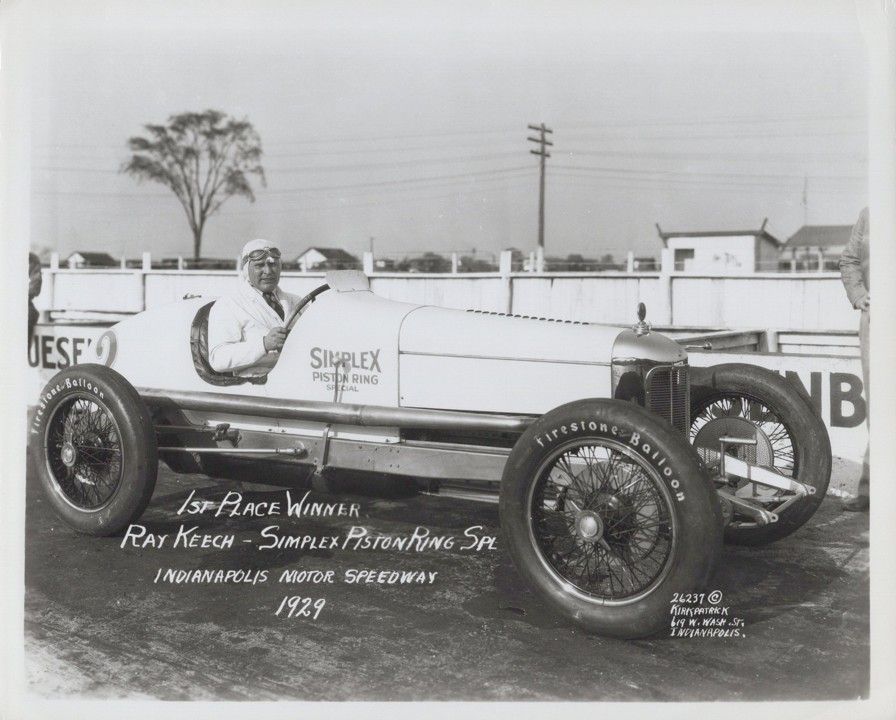
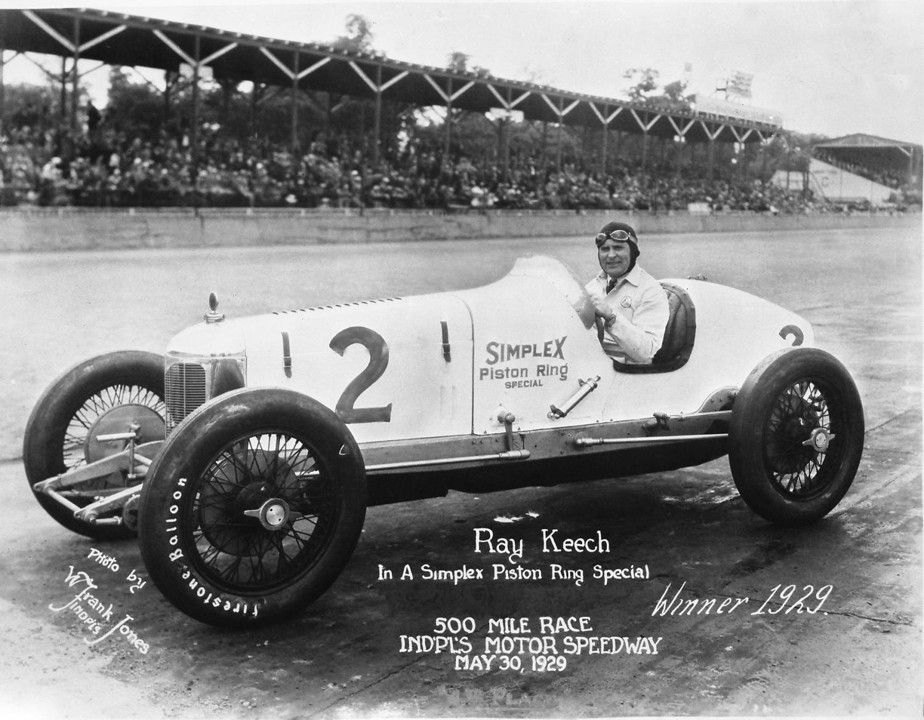
THE late Ray Keech romped to victory in the annual 500-mile Indianapolis race on Decoration Day by sending his Simplex Piston Ring (Miller) over the 22-mile speedway in 5 hours, 7 minutes and 25.42 an average speed of 97.585 miles per hour.
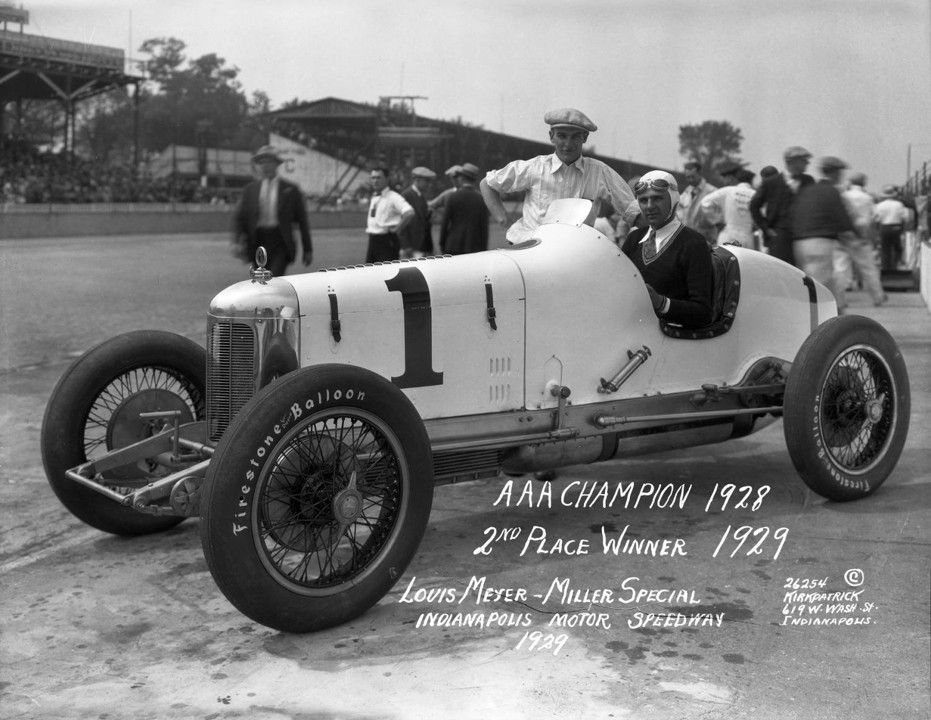
His pace was about 3½ miles per hour slower than the record set by Peter De Paolo in a Duesenberg in 1925. Louis Meyer in a Miller was second; Jimmy Gleason in a Duesenberg third; Carl Marchese in a Miller fourth, and Fred Winnai in a Duesenberg fifth. Twelve cars were running at the finish out of thirty-three starters.
Keech drove a remarkably consistent race, and his steady pace brought him out in front in the 157th lap when Louis Meyer, who had been leading for 60 laps, stopped for oil and had trouble starting his engine.
Keech drove the whole race, stopping only twice, in the 21st lap to change a right rear and in the 109th to change the other three tires and to take on water, gas and oil. Credit is due Jean Marcenac, the mechanic, who groomed his mount and a bow must also be made to the memory of Frank Lockhart, whose mechanical ability is credited for the watch-like precision and fleetness with which this car runs. The table herewith gives a comprehensive picture of all the cars in the race. It shows that Keech was in 4th place at the 10th and 20th laps. Then delayed by a pit stop he rested in 10th place at the 30th and 40th lap positions, was in 8th place at the 50th, 6th at the 60th and 70th, 4th at the 80th and 90th, 2nd at the 100th, 3rd at the 110th due to a second pit stop, 2nd at the 120th to the 150th, and first from this point to the finish.
According to the best information he won by holding to what seemed to be a winning average and then as the others slowed up or dropped out he moved ahead steadily until he found himself out in the lead.
As usual, a hot pace was set at the start. Leon Duray led the field at the end of the first lap with Keech and Woodbury at his heels and many others just behind. Duray’s average for the first 10 miles was 110 m.p.h.
On the 4th lap Woodbury skidded on the turn coming into the home stretch, hit the outer wall with sufficient force to knock a section out of it, wrecked his left rear wheel and so was out of the race. Most fortunately he was uninjured, although a moving picture camera man standing nearby was slightly damaged by flying particles.
The accident did not shake Woodbury’s nerve, for a few minutes later he was pluckily back in the race, driving relief for Billy Arnold on the 30th lap.
The wrecking of Woodbury’s car regrettably eliminated one of the strongest contenders for he had made the fastest time in the qualifying trials – 120.599 m.p.h.
During the 8th lap fickle Fate first frowned, then smiled on Deacon Litz, sending him careening into first place. The Flying Deacon was following Duray and Hepburn with Duray leading. Approaching the north turn at high speed the Deacon reached for his hand brake lever but could not find it. (It had fallen off.) Meanwhile he was bearing down rapidly on Keech and Hepburn. It looked like a bad mixup. There wasn’t room for him to pass them to the right. So in spite of the fact that his car was going too fast for the turn he had to pull down off the bank toward the flat apron. His car skidded sideways but he righted it after a noble struggle and during this battle, still skidding, he shot by the two leaders into first place, a position he held until the 56th lap when he burned a rod.
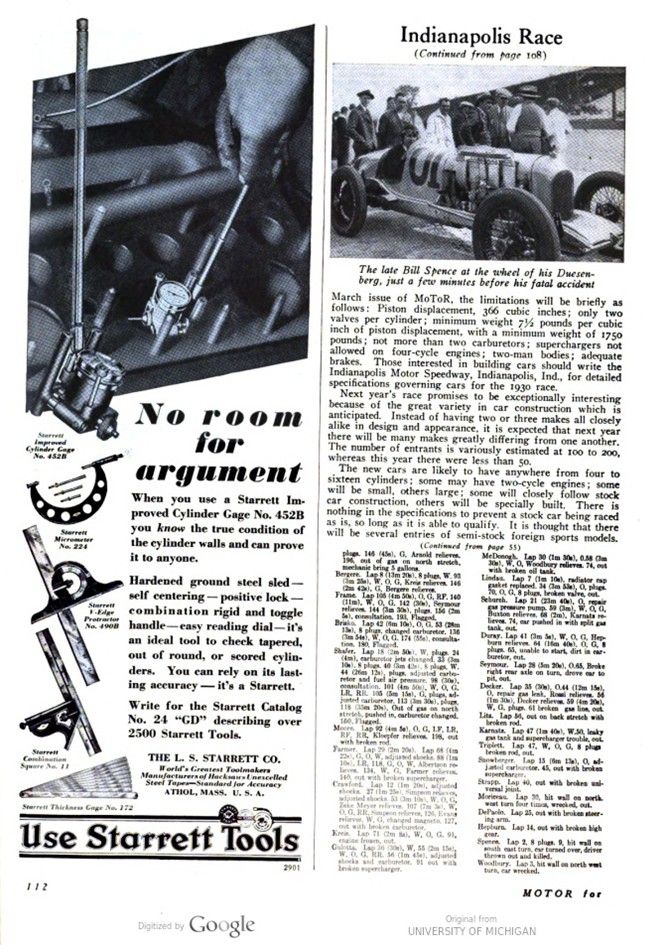
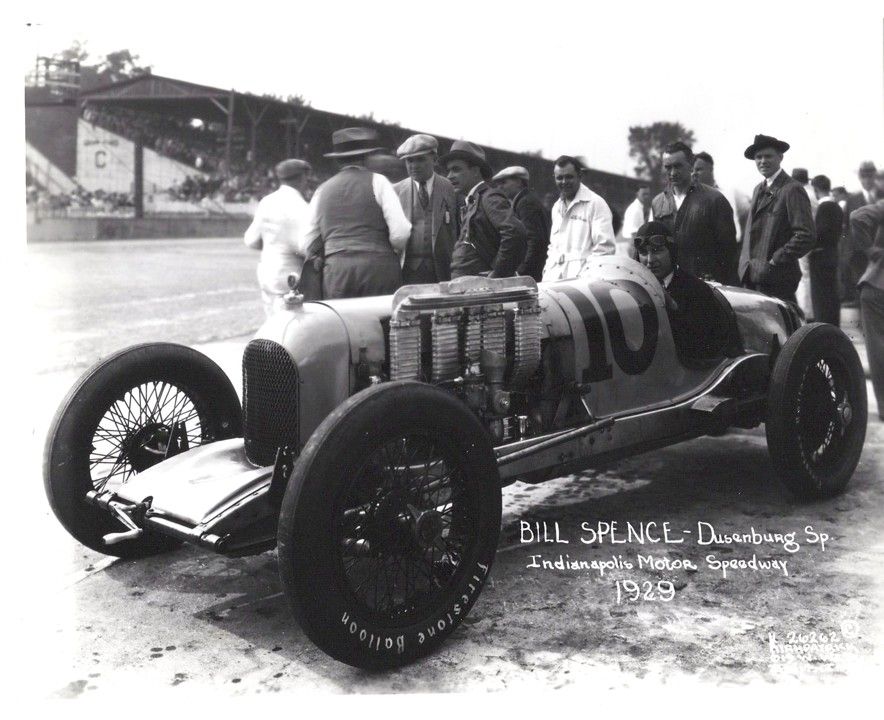
The first fatality since 1919 at an Indianapolis race occurred in the 9th lap when Bill Spence skidded into the wall on the southeast turn. The car capsized, the driver was thrown out, fractured his skull and died on the way to the hospital. Outside of this regrettable incident there were no hospital cases. While several other drivers took bad skids all came out unscathed.
THE leaders throughout the race were as follows: Duray laps 1-7; Litz laps 8-56, Lou Moore laps 57-60; Louis Meyer laps 61; Lou Moore laps 62-79; Louis Meyer laps 80-94; Fred Frame laps 95-105; Ray Keech laps 106-108; Louis Meyer laps 109-157; Ray Keech laps 158-200.
The hard luck prize must be awarded to Lou Moore, who threw a connecting rod in the 198th lap while running in second place. He was up among the leaders all through the event. At the end of the 10th lap he was 6th, then moved up to 2nd position for more than 40 laps, gained first place for nearly 20 laps, had second for 20 laps, dropped to 4th for a few laps, held third for about 40 laps, then second for 40 more laps, until within less than 5 miles of the finish.
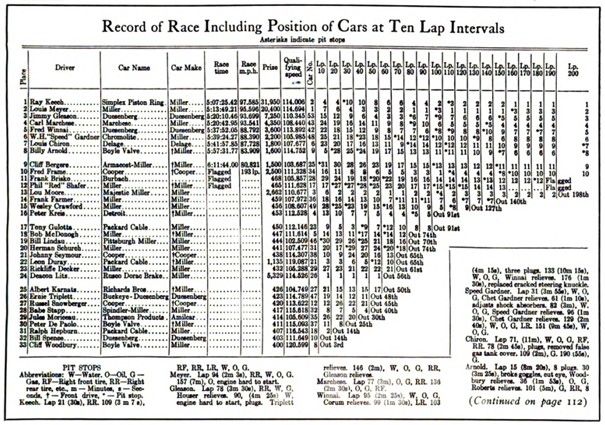
Driver Car Name Car Make Race Race time m.p.h. Qualfying speed Prize
Cars out before and during qualification were: 16-Miller. Zeke Meyer. Unable to qualify-dark-flagged. 19-Boyle. Valve. Chet Gardner. Burned out connecting rod while attempting to qualify; too late to repair. 24-Duesenberg. Bob Robinson. Not ready. Did not attempt to qualify. 33-White. Myron Stevens. Wrecked in practice. Too late to repair. 41-Duesenberg. Thane Houser. Broke supercharger drive. Too late to repair and qualify. 44-Miller. Phil Pardee. Wrecked car after qualifying; too late to repair. 45-Miller. Sam Greco. Unable to qualify. 51-Green. Joe Baker. Not ready. 52-Rausie. Steve Smith. Not ready. 54-Duesenberg. Frank Swigert. 35th car in qualification. 55-Hoefle. Ralph S. Miller. Not ready. 56-Miller. Henry Turgeon. Not ready. Talbot. G. F. Comotti. Withdrawn.
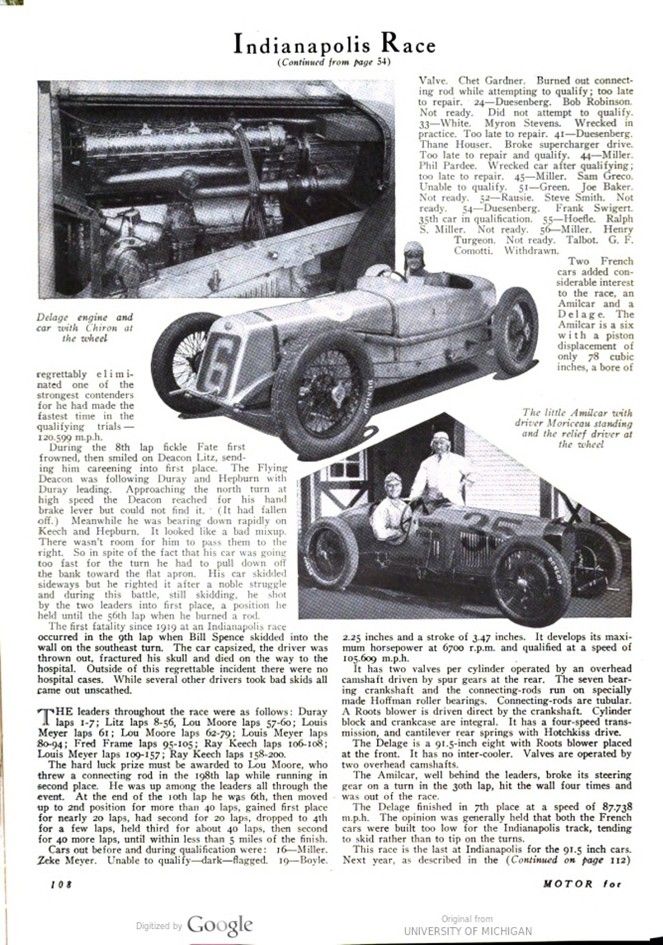
Two French cars added considerable interest to the race, an Amilcar and a Delage. The Amilcar is a six with a piston displacement of only 78 cubic inches, a bore of 2.25 inches and a stroke of 3.47 inches. It develops its maximum horsepower at 6700 r.p.m. and qualified at a speed of 105.609 m.p.h.
It has two valves per cylinder operated by an overhead camshaft driven by spur gears at the rear. The seven bearing crankshaft and the connecting-rods run on specially made Hoffman roller bearings. Connecting-rods are tubular. A Roots blower is driven direct by the crankshaft. Cylinder block and crankcase are integral. It has a four-speed transmission, and cantilever rear springs with Hotchkiss drive.
The Delage is a 91.5-inch eight with Roots blower placed at the front. It has no inter-cooler. Valves are operated by two overhead camshafts.
The Amilcar, well behind the leaders, broke its steering gear on a turn in the 30th lap, hit the wall four times and was out of the race.
The Delage finished in 7th place at a speed of 87.738 m.p.h. The opinion was generally held that both the French cars were built too low for the Indianapolis track, tending to skid rather than to tip on the turns.
This race is the last at Indianapolis for the 91.5 inch cars. Next year, as described in the March issue of MOTOR, the limitations will be briefly as follows: Piston displacement, 366 cubic inches; only two valves per cylinder; minimum weight 7½ pounds per cubic inch of piston displacement, with a minimum weight of 1750 pounds; not more than two carburetors; superchargers not allowed on four-cycle engines; two-man bodies; adequate brakes. Those interested in building cars should write the Indianapolis Motor Speedway, Indianapolis, Ind., for detailed specifications governing cars for the 1930 race.
Next year’s race promises to be exceptionally interesting because of the great variety in car construction which is anticipated. Instead of having two or three makes all closely alike in design and appearance, it is expected that next year there will be many makes greatly differing from one another. The number of entrants is variously estimated at 100 to 200, whereas this year there were less than 50.
The new cars are likely to have anywhere from four to sixteen cylinders; some may have two-cycle engines; some will be small, others large; some will closely follow stock car construction, others will be specially built. There is nothing in the specifications to prevent a stock car being raced as is, so long as it is able to qualify. It is thought that there will be several entries of semi-stock foreign sports models.
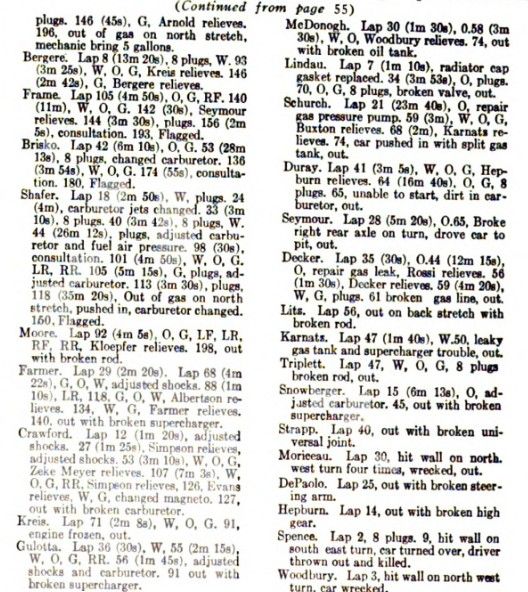
PIT STOPS
Abbreviations: W-Water, O-Oil, G Gas, RF-Right front tire, RR-Right rear tire, etc., m-Minutes, s-Seconds, t-Front drive, *-Pit stop.
Keech. Lap 21 (308), RR. 109 (3 m 7 8), RF, RR, LR, W, O, G.
Meyer. Lap 94 (2m 38), RR, W, O, G. 157 (7m), O, engine hard to start.
Gleason. Lap 78 (3m 30s), RR, W, G, Houser relieves. 90, (4m 258) W, engine hard to start, plugs. Triplett relieves. 146 (2m), W, O, G, RR, Gleason relieves.
Marchese. Lap 77 (3m), O, G, RR. 136 (2m 30s), O, G, RF.
Winnai. Lap 95 (2m 25s), W, O, G, Corum relieves. 99 (1m 30s), LR. 103 (4m 158), three plugs. 133 (10m 158), W, O, G, Winnai relieves. 176 (1m 308), replaced cracked steering knuckle.
Speed Gardner. Lap 31 (3m 558), W, O, G, Chet Gardner relieves. 61 (1m 10s), adjusts shock absorbers. 82 (3m), W. O, G, Speed Gardner relieves. 96 (1m 308), Chet Gardner relieves. 129 (2m 408), W, O, G, LR. 151 (9m 458), W, O, G.
Chiron. Lap 71, (11m), W, O, G, RF, RR. 78 (2m 458), plugs, removed false gas tank cover. 109 (2m), G. 190 (558), G.
Arnold. Lap 15 (8m 20s), 8 plugs. 30 (3m 258), broke goggles, cut eye, Woodbury relieves. 36 (1m 53s), O, G, Roberts relieves. 101 (5m), G, RR, 8 plugs. 146 (45s), G, Arnold relieves. 196, out of gas on north stretch, mechanic bring 5 gallons.
Bergere. Lap 8 (13m 20s), 8 plugs, W. 93 (3m 25s), W, O, G, Kreis relieves. 146 (2m 42s), G, Bergere relieves.
Frame. Lap 105 (4m 50s), O, G, RF. 140 (11m), W, O, G. 142 (30s), Seymour relieves. 144 (3m 30s), plugs. 156 (2m 58), consultation. 193, Flagged.
Brisko. Lap 42 (6m 10s), O, G. 53 (28m 138), 8 plugs, changed carburetor. 136 (3m 54s), W, O, G. 174 (55s), consultation. 180, Flagged.
Shafer. Lap 18 (2m 50s), W, plugs. 24 (4m), carburetor jets changed. 33 (3m 10s), 8 plugs. 40 (3m 42s), 8 plugs, W. 44 (26m 12s), plugs, adjusted carburetor and fuel air pressure. 98 (30s), consultation. 101 (4m 50s), W, O, G. LR, RR. 105 (5m 15s), G, plugs, adjusted carburetor. 113 (3m 30s), plugs, 118 (35m 20s), Out of gas on north stretch, pushed in, carburetor changed. 150, Flagged.
Moore. Lap 92 (4m 5s), O, G, LF, LR, RF, RR, Kloepfer relieves. 198, out with broken rod.
Farmer. Lap 29 (2m 20s). Lap 68 (4m 22s), G, O, W, adjusted shocks. 88 (1m 10s), LR, 118, G, O, W, Albertson relieves. 134, W, G, Farmer relieves. 140, out with broken supercharger.
Crawford. Lap 12 (1m 20s), adjusted shocks. 27 (1m 25s), Simpson relieves, adjusted shocks. 53 (3m 108), W, O, G, Zeke Meyer relieves. 107 (7m 38), W, O, G, RR, Simpson relieves, 126, Evans relieves, W, G, changed magneto. 127, out with broken carburetor.
Kreis. Lap 71 (2m 88), W, O, G. 91, engine frozen, out.
Gulotta. Lap 36 (30s), W, 55 (2m 15s), W, O, G, RR. 56 (1m 45s), adjusted shocks and carburetor. 91 out with broken supercharger.
McDonogh. Lap 30 (1m 30s), 0.58 (3m 30s), W, O, Woodbury relieves. 74, out with broken oil tank.
Lindau. Lap 7 (1m 10s), radiator cap gasket replaced. 34 (3m 538), O, plugs. 70, O, G, 8 plugs, broken valve, out.
Schurch. Lap 21 (23m 40s), O, repair gas pressure pump. 59 (3m), W, O, G, Buxton relieves. 68 (2m), Karnats relieves. 74, car pushed in with split gas tank, out.
Duray. Lap 41 (3m 58), W, O, G, Hepburn relieves. 64 (16m 40s), O, G, 8 plugs. 65, unable to start, dirt in carburetor, out.
Seymour. Lap 28 (5m 20s), 0.65, Broke right rear axle on turn, drove car to pit, out.
Decker. Lap 35 (30s), 0.44 (12m 158), O, repair gas leak, Rossi relieves. 56 (1m 30s), Decker relieves. 59 (4m 20s), W, G, plugs. 61 broken gas line, out.
Litz. Lap 56, out on back stretch with broken rod.
Karnata. Lap 47 (1m 40s), W.50, leaky gas tank and supercharger trouble, out.
Triplett. Lap 47, W, O, G, 8 plugs broken rod, out.
Snowberger. Lap 15 (6m 13s), O, adjusted carburetor. 45, out with broken supercharger.
Strapp. Lap 40, out with broken universal joint.
Moriceau. Lap 30, hit wall on north. west turn four times, wrecked, out.
DePaolo. Lap 25, out with broken steering arm.
Hepburn. Lap 14, out with broken high gear.
Spence. Lap 2, 8 plugs. 9, hit wall on southeast turn, car turned over, driver thrown out and killed.
Woodbury. Lap 3, hit wall on northwest turn, car wrecked.
Photos.
Page 54 (Photos by KIRKPATRICK Indianapolis)
Cliff Woodbury’s car, wrecked in the third lap. – The men are preparing to move it over the retaining wall. – Ray Keech, the winner, in his Simplex Piston Ring Miller. – Deacon Litz is at the extreme right
Page 55. Record of Race Including Position of Cars at Ten Lap Intervals – Asterisks indicate pit stops
Driver Car Name Car Make Race Race time m.p.h. Qualfying speed Prize
Louis Meyer, who annexed second place – MARCHESE SPECIAL, Carl Marchese, who came in fourth – Jimmy Gleason, who won third place
Page 108. Delage engine and car with Chiron at the wheel – The little Amilcar with driver Moriceau standing and the relief driver at the wheel
Page 112. The late Bill Spence at the wheel of his Duesenberg, just a few minutes before his fatal accident