Text and jpegs by courtesy of hathitrust.org www.hathitrust.org, compiled by motorracinghistory.com
Motor Age, Vol. LIV, 54, No. 16, October 18, 1928
Comer Killed in Crash at Salem – Fred Comer is Killed at Rockingham Race
Spills Stop Classic at 50 Miles; Keech, Gleason, Evans Injured – WOODBURY WINNER
Fred Comer is Killed at Rockingham Race – Woodbury Wins Flagged Contest Replete With Thrills and Spills
By Nelson Riley – Staff Correspondent MOTOR AGE
ROCKINGHAM SPEEDWAY, SALEM, N. H., Oct. 13-Fred Comer, the „Kansas Cyclone,“ veteran of many great races, was killed today, 20 minutes after the start of the annual 200-mile race and Ray Keech, holder of the world’s mile speed mark, and Jimmy Gleason were injured.
The race only went 34 minutes before the astounding number of bad spills forced the officials to stop the proceedings for the day, and there was not a murmur of dissent in the vast crowd. The distance covered was 62½ miles. The officials decided to call it a fifty-mile race and as Cliff Woodbury, the 32-year-old driver from Chicago, holder of the dirt track record of the American Automobile Association and the proud daddy of three daughters, was leading at that time, he will collect one-third of the winner’s share.
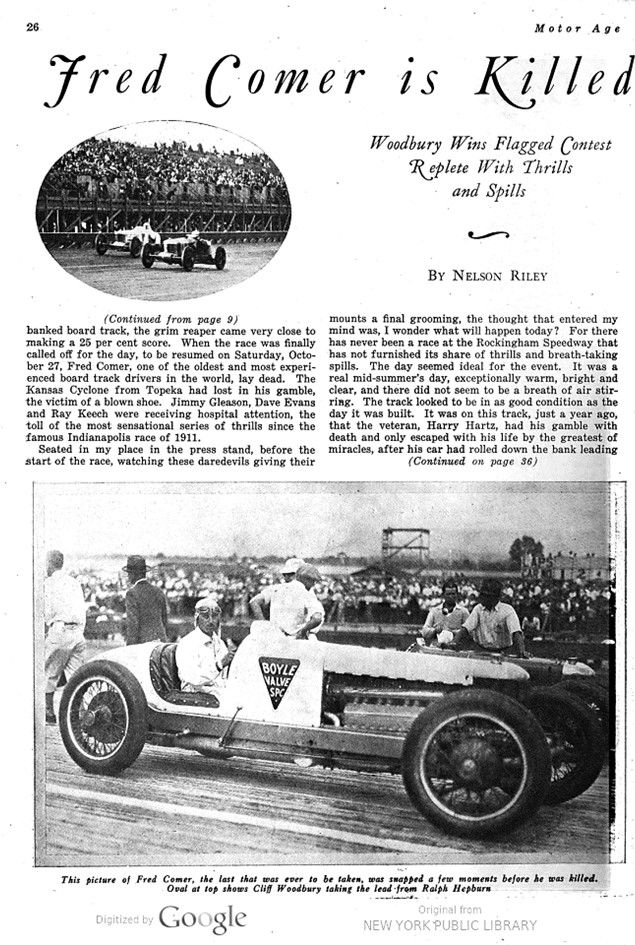
During the brief time that 17 of the world’s most daring race drivers were tossing dice with death on the 1¼-mile banked board track, the grim reaper came very close to making a 25 per cent score. When the race was finally called off for the day, to be resumed on Saturday, October 27, Fred Comer, one of the oldest and most experi- enced board track drivers in the world, lay dead. The Kansas Cyclone from Topeka had lost in his gamble, the victim of a blown shoe. Jimmy Gleason, Dave Evans and Ray Keech were receiving hospital attention, the toll of the most sensational series of thrills since the famous Indianapolis race of 1911.
Seated in my place in the press stand, before the start of the race, watching these daredevils giving their mounts a final grooming, the thought that entered my mind was, I wonder what will happen today? For there has never been a race at the Rockingham Speedway that has not furnished its share of thrills and breath-taking spills. The day seemed ideal for the event. It was a real mid-summer’s day, exceptionally warm, bright and clear, and there did not seem to be a breath of air stirring. The track looked to be in as good condition as the day it was built. It was on this track, just a year ago, that the veteran, Harry Hartz, had his gamble with death and only escaped with his life by the greatest of miracles, after his car had rolled down the bank leading into the home stretch, a mass of flames, with Hartz, who suffered injuries which kept him on a hospital cot for six months, wedged inside of it. On July 4, Cliff Berger turned over in the same spot, but escaped without a scratch. Both were victims of an air pocket.
However, no matter what my imagination might have pictured, I could not have conceived the series of events which should pile up in front of my eyes before the race was 25 minutes old.
The story of what occurred in the race reads like the wildest of movie films. And when it was decided to call a halt by a committee of drivers and officials, there was not a dissenting voice in the great crowd of more than 35,000 that filed out in awed silence.
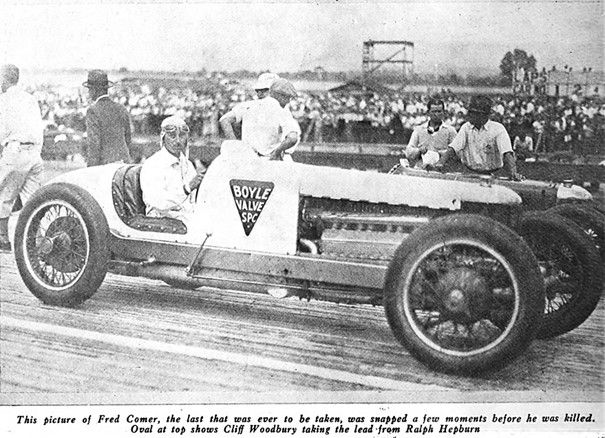
At the very start of the race it was seen that the drivers were setting a pace which would mean the lowering of the present record figures. Things began to look interesting. Competition was at its height. But a pall of gloom fell over the crowd almost at once as Fred Comer, one of the oldest of the board track drivers, rounded the bank leading into the home stretch. His car was seen to wobble as though a tire had gone. It flashed down the bank to the flat of the stretch. In the twinkling of an eye it had turned over, carrying Comer with it-twice it repeated its performance. When it finally came to a standstill, the wheels were pointing skyward and Comer was underneath with a crushed chest.
A peculiar thing about it was that Comer was driving the car which was entered by Cliff Woodbury, the winner, having swapped seats with him just a few minutes before the start of the race. While Comer lay beneath Woodbury’s machine, Woodbury was fighting to hold a slim lead, being pressed very hard by Ralph Hepburn, the Bostonian.
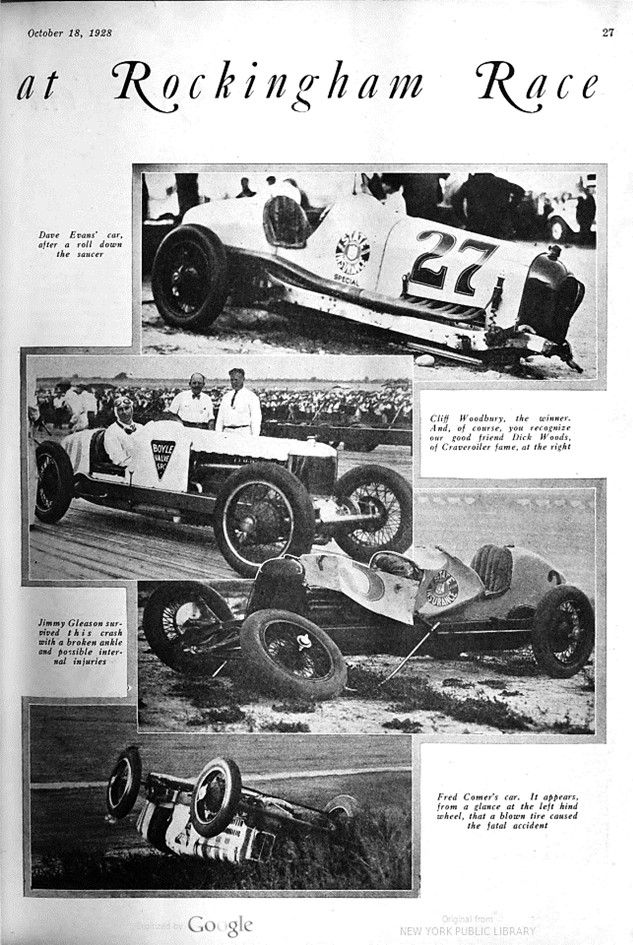
The crowd had just settled back, not knowing that the spill had been fatal, and was beginning to take an interest in things again, when Jimmy Gleason, the Philadelphian, riding at the head of a closely packed trio and making his forty-fifth lap, suddenly swirled off the track into the iron guard rail, sending his car back several feet and throwing it to the inside of the track. The car leaped into the air like something alive, throwing Gleason on to the track, and almost together car and driver rolled down the track. Ray Keech, almost directly behind, tried to clear the rolling Gleason. Bob McDonough, directly in his rear, also just touched Keech, but got away clean and keeping his car right side up drove on to the sand at the inner edge of the track and dismounted.
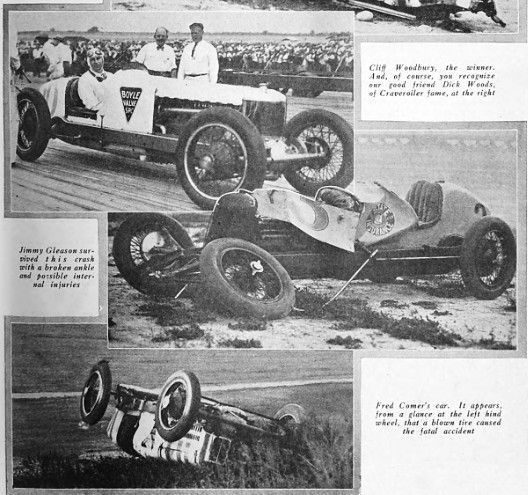
Lou Moore, second at Indianapolis this year, the third member of the trio, was right on the heels of Mc-Donough and also grazed Keech. His car turned over, throwing Moore on to the track, but righted itself in the dirt. Moore got up nonchalantly and went to the aid of Gleason, who by this time was being cared for by the pit attendants. Gleason was taken to the hospital, where he is suffering from a broken ankle, a sprained wrist and possible internal injuries, but he will recover.
Keech in this situation showed rare judgment, coolness and courage. Keeping four wheels on the track, he rode cleanly off the boards and across the 10 feet of dirt and straddled the steel rail which is placed at the inside of the track for protection. Never once did he leave his seat. He was not seriously hurt.
I thought that the fates had played enough pranks for one afternoon, but such was not the case. It seemed that the machines were possessed of a desire to have revenge on these drivers who were punishing them by pushing them to world record figures, and the third spill was indeed a heartbreaker. This came on the 58th mile and happened almost in the spot where Hartz had met trouble. Like the previous accident which had just happened to Gleason, fate again chose the stretch almost in front of the officials stand and press box to play her final prank. Smiling Dave Evans, cheerful under every condition, was to play the leading role. He hit the air pocket to which I have referred. His car jumped several feet into the air, and landing on the track, started for the steel plated guard rail. It hit the rail with such force that it completely loosened the front wheels and axles from the rest of the car and sent them spinning down the track.
Evans‘ experience as a former cowboy in his native state of Texas must have stood him in good stead in this spot. That’s the only way I can account for his actions in this supreme crisis. Imitating a rodeo rider throwing himself from a falling horse, he took a beautiful dive from his car, and rolled barrel-like, half-way down the stretch, with his car 10 feet away. It was a rolling race between the man and the machine, and the man, going at incredible speed, was winner by a good margin. Reaching the dirt his luck held and he was thrown to his feet. Raising his hands as though in thanksgiving for his miraculous escape, he walked to those who were coming to his assistance, amid a thunderous roar of applause. He had not a broken bone and, although he had multiple minor injuries and a good supply of slivers, from his trip on the boards, he was still the Smiling Dave Evans of Texas.
Meanwhile the yellow flag for the drivers to slow down had been waved, but none of the drivers appeared to notice it and finally the white flag, signaling the men to stop for consultation, was waved. This not being respected, the checkered flag denoting the finish was hoisted. The drivers and the executive committee met on the track and decided to continue the race October 27th, thus giving the drivers an opportunity to repair their cars and the management a chance to go over the track, and repair it, if necessary.
The entire distance covered by the contestants was only 62½ miles, at which time Woodbury was trying to hold his lead from Ralph Hepburn, followed by Stapp, Batten and Bergere. In the second group, but also very much in the race, were Billy Arnold and Leon Duray, the latter driving his famous Black Streak, Earl Devore, Deacon Litz and Meyers were in this group. The time for the distance was 32 minutes and 3 seconds, but this does not give any kind of an idea of the speed at which the drivers were going as they had slowed down on several occasions because of the accidents.
In a summary we might say that it was a speedy race and showed some wonderfully clever driving, particularly in the manner in which the drivers avoided the cars wrecked on the track.
At 50 miles, the positions were Woodbury, Hepburn, McDonough and Moore. This order was maintained until the Gleason spill, when Moore, McDonough and Keech were put out of the running.
Photos.
Page 26. This picture of Fred Comer, the last that was ever to be taken, was snapped a few moments before he was killed. Oval at top shows Cliff Woodbury taking the lead from Ralph Hepburn (BOYLE VALVE SPC)
Page 27. Dave Evans‘ car, after a roll down the saucer (STATE SPECIAL) – Jimmy Gleason survived this crash with a broken ankle and possible internal injuries
Cliff Woodbury, the winner. And, of course, you recognize our good friend Dick Woods, of Craveroiler fame, at the right (BOYLE VALVE SPC) – Fred Comer’s car. It appears, from a glance at the left hind wheel, that a blown tire caused the fatal accident