After the 1910 Savannah Grand Prize was assured very late, only less than a month was left for preparation. Meaning shortening the course; 17.5 miles now versus the 25 miles of 1908. Then reorganizing the grandstand, parking lots and the more. Here’s a short summary.
Text and jpegs by courtesy of hathitrust.org www.hathitrust.org, compiled by motorracinghistory
MOTOR AGE Vol. XXIII, No. 16, October 20, 1910
Savannah Prepares For Grand Prix
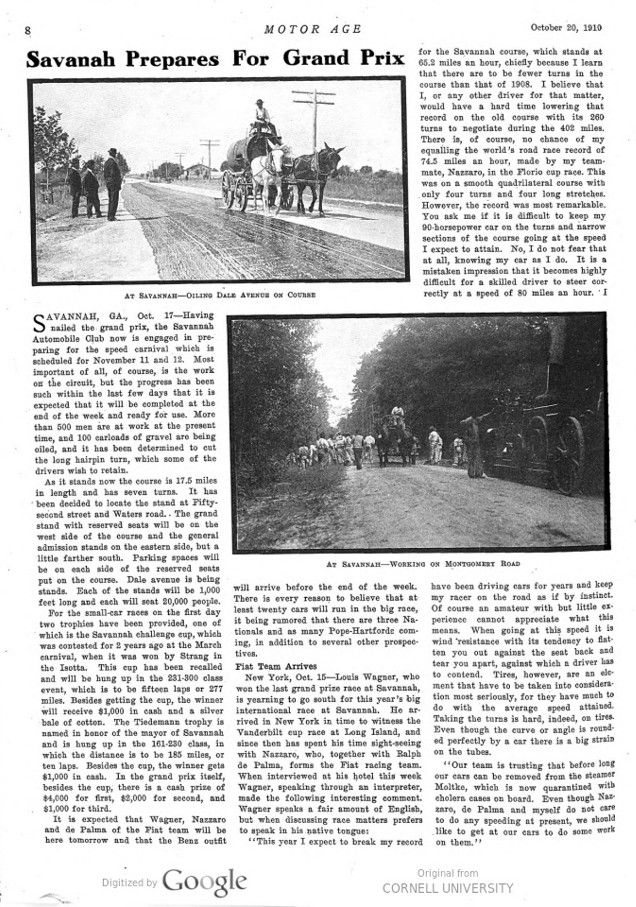
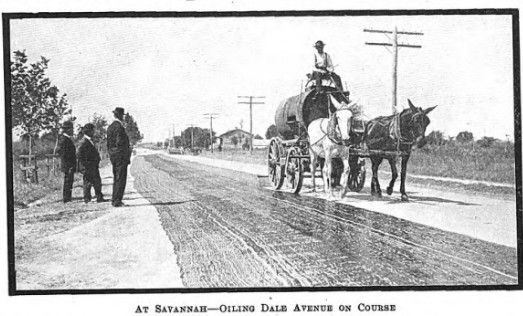
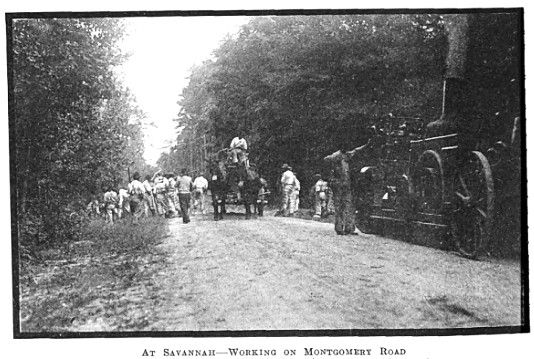
SAVANNAH, GA., Oct. 17 – having nailed the grand prix, the Savannah Automobile Club now is engaged in preparing for the speed carnival which is scheduled for November 11 and 12. Most important of all, of course, is the work on the circuit, but the progress has been such within the last few days that it is expected that it will be completed at the end of the week and ready for use. More than 500 men are at work at the present time, and 100 carloads of gravel are being oiled, and it has been determined to cut the long hairpin turn, which some of the drivers wish to retain.
As it stands now the course is 17.5 miles in length and has seven turns. It has been decided to locate the stand at Fifty-second street and Waters road. The grand stand with reserved seats will be on the west side of the course and the general admission stands on the eastern side, but a little farther south. Parking spaces will be on each side of the reserved seats put on the course. Dale avenue is being stands. Each of the stands will be 1,000 feet long and each will seat 20,000 people.
For the small-car races on the first day two trophies have been provided, one of which is the Savannah challenge cup, which was contested for 2 years ago at the March carnival, when it was won by Strang in the Isotta. This cup has been recalled and will be hung up in the 231-300 class event, which is to be fifteen laps or 277 miles. Besides getting the cup, the winner will receive $1,000 in cash and a silver bale of cotton. The Tiedemann trophy is named in honor of the mayor of Savannah and is hung up in the 161-230 class, in which the distance is to be 185 miles, or ten laps. Besides the cup, the winner gets $1,000 in cash. In the grand prix itself, besides the cup, there is a cash prize of $4,000 for first, $2,000 for second, and $1,000 for third.
It is expected that Wagner, Nazzaro and de Palma of the Fiat team will be here tomorrow and that the Benz outfit will arrive before the end of the week. There is every reason to believe that at least twenty cars will run in the big race, it being rumored that there are three Nationals and as many Pope-Hartfords coming, in addition to several other prospectives.
Fiat Team Arrives
New York, Oct. 15 – Louis Wagner, who won the last grand prize race at Savannah, is yearning to go south for this year’s big international race at Savannah. He arrived in New York in time to witness the Vanderbilt cup race at Long Island, and since then has spent his time sight-seeing with Nazzaro, who, together with Ralph de Palma, forms the Fiat racing team. When interviewed at his hotel this week Wagner, speaking through an interpreter, made the following interesting comment. Wagner speaks a fair amount of English, but when discussing race matters prefers to speak in his native tongue:
„This year I expect to break my record for the Savannah course, which stands at 65.2 miles an hour, chiefly because I learn that there are to be fewer turns in the course than that of 1908. I believe that I, or any other driver for that matter, would have a hard time lowering that record on the old course with its 260 turns to negotiate during the 402 miles. There is, of course, no chance of my equaling the world’s road race record of 74.5 miles an hour, made by my teammate, Nazzaro, in the Florio cup race. This was on a smooth quadrilateral course with only four turns and four long stretches. However, the record was most remarkable. You ask me if it is difficult to keep my 90-horsepower car on the turns and narrow sections of the course going at the speed I expect to attain. No, I do not fear that at all, knowing my car as I do. It is a mistaken impression that it becomes highly difficult for a skilled driver to steer correctly at a speed of 80 miles an hour. I have been driving cars for years and keep my racer on the road as if by instinct. Of course, an amateur with but little experience cannot appreciate what this When going at this speed it is wind resistance with its tendency to flat- ten you out against the seat back and tear you apart, against which a driver has to contend. Tires, however, are an element that have to be taken into consideration most seriously, for they have much to do with the average speed attained. Taking the turns is hard, indeed, on tires. Even though the curve or angle is rounded perfectly by a car there is a big strain on the tubes.
„Our team is trusting that before long our cars can be removed from the steamer Moltke, which is now quarantined with cholera cases on board. Even though Nazzaro, de Palma and myself do not care to do any speeding at present, we should like to get at our cars to do some work on them.“
Photos.
AT SAVANNAH – OILING DALE AVENUE ON COURSE / AT SAVANNAH – WORKING ON MONTGOMERY ROAD