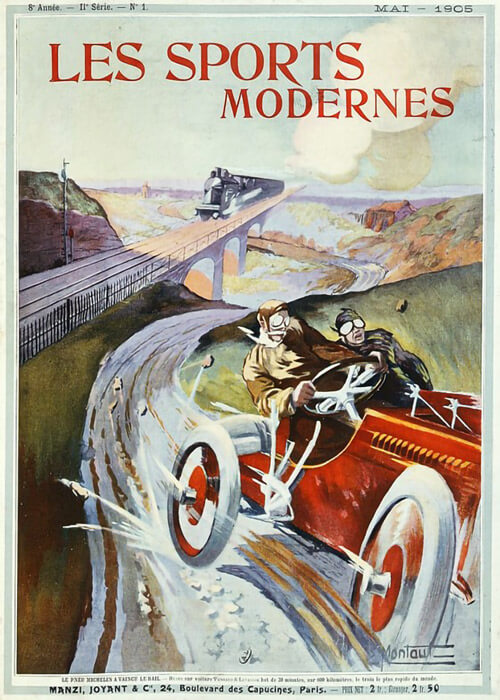
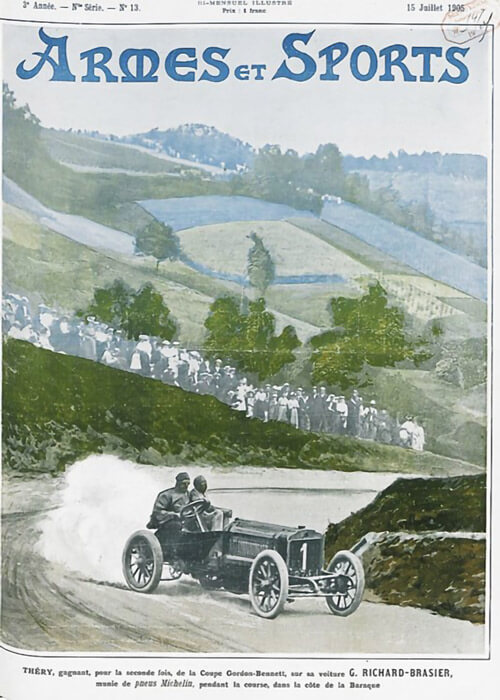
This second article in Le Sport Universel Illustré on the Paris-Berlin race begins with the notice, that the French government has banned open road races from then on, because of safety concerns. This was not all too wrong, as even in this race, a young boy was killed, despite the „abundance of precautions“ that were taken. In the end, the author Franz Reichel utters his worries, when inexperienced automobilists would drive around in vehicles with ….. 58 hp. A massive value in those days. As for the race; only 47 cars out of the 110 competitors reached Berlin, after a route of some 1200 kilometers; quite a figure to think about, isn’t it? And, what’s striking after all, is the importance of those days race successes for the automotive industry.
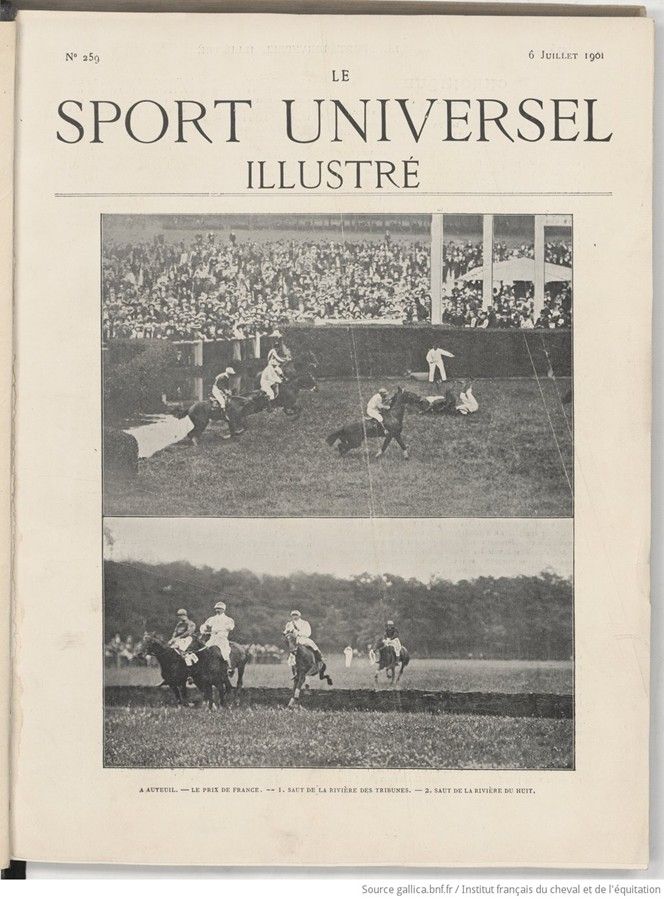
With permission of the Bibliothèque national francais – gallica.bnf.fr
Text and photos compiled by motorracinghistory.com. Translation by DeepL.com
Le Sport Universel Illustré – Vol. 6, No. 259, July 6, 1901
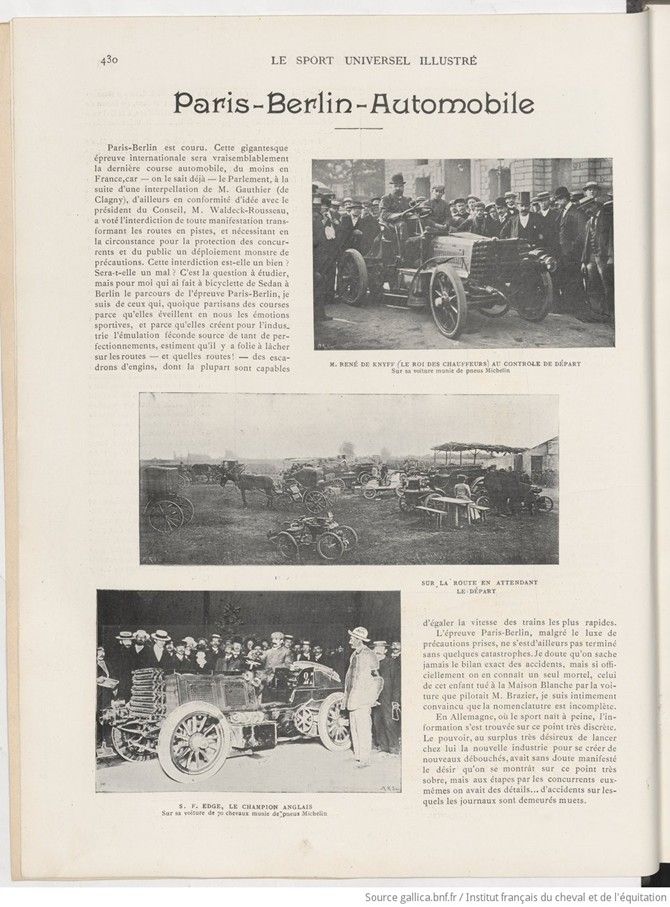
Paris – Berlin – Automobile
The Paris-Berlin race has taken place. This massive international event will likely be the last automobile race, at least in France, because — as we already know — the Parliament, following a motion by Mr. Gauthier (de Clagny), who was in fact in agreement with the Prime Minister, Mr. Waldeck-Rousseau, has voted to ban any event that turns roads into racetracks and, under such circumstances, requires a massive deployment of safety measures to protect competitors and the public. Is this ban a good thing? Will it be a bad thing? That is the question to be examined, but as for me, having cycled from Sedan to Berlin on a bicycle, I am among those who, although supporters of races because they stir sporting emotions within us and because they create for industry a fruitful emulation that is the source of so many improvements, believe it is madness to unleash on the roads — and what roads! — squadrons of vehicles, most of which are capable of matching the speed of the fastest trains.
The Paris-Berlin race, despite the abundance of precautions taken, did not end without a few disasters. I doubt we will ever know the exact toll of accidents, but while officially only one fatality is known — that of the child killed at the Maison Blanche by the car driven by Mr. Brazier — I am firmly convinced that the list is incomplete.
In Germany, where the sport is barely in its infancy, the media has been very discreet on this point.
The government, moreover, eager to launch this new industry at home to create new markets, had no doubt expressed a desire for restraint on this matter, but at the stages, the competitors themselves provided details… of accidents about which the newspapers remained silent.
The final stage from Hanover to Berlin was rife with mishaps, for several very good reasons. The relatively short route — 298 kilometers — was dreadful overall: dusty, bumpy, and narrow; for the competitors, it was the final push, and it was the decisive moment to outdo one another in daring to secure their place. Most were somewhat on edge from the struggle of the previous two days, and their nervousness was heightened by the excitement caused by the prospect of the finish, the cheers, and the triumph.
Despite the countless precautions taken, the signs posted in towns and villages, and the newspaper notices urging the public to keep the road clear, despite the police forces deployed to contain the crowds, despite the four thousand cyclists equipped with flags tasked with signaling to people the arrival of the competitors, and to the competitors the approach of dangerous sections and built-up areas, accidents occurred more frequently than has been reported, more frequently than will ever be known.
A car race is a feasible event on a route like that of Paris–Bordeaux. For years, the Paris–Bordeaux and Bordeaux–Paris route has been a classic itinerary, dedicated since 1891 to cycling and automobile races. The road is, on the whole, smooth, wide, and excellent; it is not heavily congested with cities or built-up areas; the local population is well-informed; they are accustomed to these events; they know how to take the necessary precautions on their own, and races that on other routes are causes of complaints and grievances for the crowds are, for them on their own route, a cause for celebration.
Nothing of the sort in the Paris-Berlin race. It seemed as though the organizers had taken pleasure in scattering difficulties and seeking out the most dangerous route imaginable. Of the 110 starters, 47 reached the finish line. This is a remarkable result, in my opinion, and I admire it because, after completing the course, I felt that if twenty competitors finished the race, it would be cause for surprise. Indeed, one cannot imagine a greater variety of obstacles; it was a veritable automobile steeplechase. An incredible number of towns and villages, particularly in Germany, all the way to Hanover; the crossing of the Ardennes, a route full of uneven terrain, hills, long, rapid, winding descents, interspersed with railroad crossings, and strewn with sharp turns; from Minden (Westphalia) onward, mediocre, poor, and dreadful roads; cobblestones in the towns — and what cobblestones! — cobblestones on the roads; dust, thick as a carpet; in truth, taken as a whole, an unsporting route, a disjointed route. When one considers that it was on such a route that so many vehicles were launched — capable of reaching speeds equal to or exceeding those of rapids, with nothing to keep them in check — it seems like a dream.
Paris-Berlin was certainly a grand event; it captured the imagination by the enormity of the effort, by the choice of the starting point, by the choice of the finishing point. Paris! Berlin! Two enemy capitals linked by the automobile; and by the patronage secured: the President of the Republic, the Emperor of Germany, the King of the Belgians, and the Grand Duke of Luxembourg had awarded prizes for the race. Incidentally, I note that the Emperor of Germany did not go out of his way, and that the cup he offered is a work of art of little artistic or commercial value. It went to Fournier. The object may be valuable for its provenance, and perhaps one day it will find its way into an automobile museum, but if I were facing a financial crisis, I would not count on it to get me out of trouble.
Some cynics — and I am one of them — have overlooked the sensational aspect of the event to focus only on what might shock us, us French people. Sport has no homeland…but industrial and commercial sport does. We must not delude ourselves and must be fully convinced that in Germany, Paris-Berlin was considered first and foremost as a means to capture the public’s attention and draw it toward the new mode of transportation. It was a commercial and industrial operation because, in the automotive field, the Germans are far behind our manufacturers, who, with French ingenuity — so creative, so impulsive — have produced marvels.
Apart from the products from Cannstadt and Mainz, what Germany produces is virtually nonexistent. They are ten years behind us; they are still at the ABCs of the automobile; the products of theirs that I saw during my bicycle trip are nothing but pure and simple imitations of our products, and they are so well aware of their inferiority that they resort, at great expense, to our engineers to perfect their machinery.
I certainly won’t be the one to blame the Germans for wanting to create a new source of jobs and wealth. The question remains whether it was in our interest, as French people, to help them in their initiative, and whether it was wise and prudent of us to run — so to speak — the risk of creating competition for ourselves. The German is not a creator; he is an assimilator. He takes from others whatever he finds to be good. He is right. He finds it difficult to give up his ideas, but tenacious, hardworking, and, forced by the appalling density of his German population to struggle obstinately to provide for his needs, he achieves remarkable results through methodical work. This was clearly seen at the 1900 Exposition, where Germany proved so formidable in mechanical engineering..
Paris-Berlin was, thank God, a triumph for French industry. All the bicycles that completed the course were French-made. Will this sporting success win our manufacturers across the Rhine the clientele they hope for…perhaps, but who knows? And I agree with our colleague Albert-Petit of „Le Vélo„, who wrote the other day, before the race:
What will remain of all this?
Germans are practical people.
They will not be swayed by the fantasy of a single result. If a sensational performance occurs, they will gladly pay tribute to it, but from the perspective of the spread of the automobile and its widespread use, what would matter most would be to see the greatest number of entered vehicles reach the finish line.
In this regard, the touring car race may be more important than the other. The speed race is a feat of strength, a display of flair. The touring car race is a demonstration of what the automobile can deliver in everyday use. The general public will be won over more by proof of reliable operation and smooth running than by the spectacle of a terrifying speed machine whose handling requires skills that few drivers can claim to possess.
What will be the ratio of finishers to starters? This is no trivial matter in the eyes of the Germans, who are all statisticians.
At first, in the great outburst of enthusiasm that will greet the winner, little thought will be given to those who did not finish. But the next day, when it is time for reflection and a cool head, we will take stock of the injured, those left stranded, and the disabled repatriated by train. If there are too many, the impact of our cars’ feats will not be complete and will not be lasting.
Our manufacturers will receive more compliments than orders. They deserve to receive both.
I hope that events will prove us both spectacularly wrong, and it is with deep, sincere joy that I will see the Germans remain dependent on our automobiles and bring their gold to us. That will be all the more reason to take back the five billion in detestable memories that have left their mark — painful for us, glorious for them — in every city across the Rhine, where squares and monuments are nothing but stone or bronze memorials dedicated to perpetuating their victory of 1870, our defeat, which was for the German people the surest source of their strength, their greatness, and their prosperity.
And on that note — without wishing to display excessive chauvinism — it seemed to those who adhere to a discreet and genuine patriotism that the organizers should, out of propriety, have avoided the painful association of these names: Sedan, Bazeilles, and Berlin — by giving the race a different route. All roads lead to Rome; there are certainly many that lead to Berlin.
Let us address the organization of the race more directly. It was not as perfect as one might initially imagine. The newspapers were fair-minded and showed little harshness in their criticism. The task imposed on the German organizers was, it is true, considerable, and all the more so since it was a debut for them. They made a tremendous effort, but their intentions were thwarted by their inexperience. In Aachen and Hanover, despite a massive deployment of personnel, the finish lines were crowded with spectators, and I personally witnessed appalling disorder. In Bertin, the finish took place at the Trab-Rennbahn Westend — the trotting track — where the organization, though admittedly simple, was otherwise excellent. At the stage finishes, the competitors were escorted to the parking areas by military cyclists.
Everywhere in Germany, the welcome was friendly, sometimes even warm. The French flag fluttered in the wind alongside the German flag, and the Marseillaise greeted the arrival of our troops. These displays moved some people. Goodness, let’s not exaggerate: the Germans bear no grudge against us. It’s in their interest to make us forget… our situation is different. Yet those competitors who understand a little German may have heard remarks in the crowd that dampened their sense of satisfaction… for nothing can convey the high opinion Germans have of themselves today, and the low opinion they have of the French.
In Aachen, the organizing committee, subsidized by the city, treated the competitors to a massive and splendid banquet. In Hanover, things were handled even better, thanks to the generous initiative of the Continental Tire Company, represented by Messrs. Tischbein and Seligman, who hosted a magical banquet at the Hotel Kastens at their own expense and organized a special train for the use of journalists and race followers. In Berlin, numerous celebrations had been organized. A banquet at the Kaiserhof, a gala at the Opera, a banquet at the French Embassy — where the ambassador, harboring some Teutonic grudges, excluded a few French journalists — a visit to Potsdam, and other festivities.
Grand speeches to boot! Congratulations, with everyone rejoicing over the rapprochement of the two peoples through the automobile, as if such a rapprochement were possible as long as the question of Alsace and Lorraine remained unresolved…a telegram from the Emperor…all for show!
The race consisted of three stages. Paris-Aachen, Aachen-Hanover, Hanover-Berlin, a total of approximately 1,200 kilometers. At the start given at Fort Champigny, 110 competitors lined up… and dwindled from stage to stage, from breakdown to breakdown, and from accident to accident.
Here is the overall ranking of the top finishers in each category.
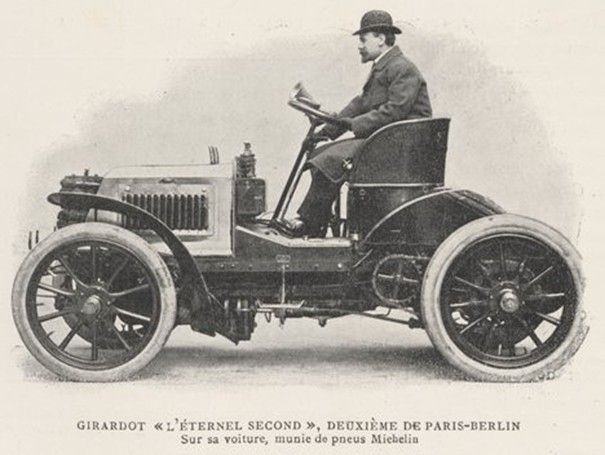
Cars: 1 – Henri Fournier in 17 hrs. 3 mins. 43 secs.; 2 – Girardot in 18 hrs. 9 mins. 58 secs.; 3 – René de Knyff in 18 hrs. 12 mins. 57 secs.
Light Cars: 1 – E. Giraud in 20 hrs. 54′ 52“; 2 – Sincholle in 23 hrs. 32′ 53”; 3 – Teste in 23 hrs. 33′ 5“4.
Microcars: 1 – L. Renault in 20 hrs. 33′ 50”; 2 – Grus in 24 h. 2′ 15“; 3 – L. Morin in 30 h. 52′ 1”.
Motorcycles: 1 – Osmont in 20 h. 18′ 48“; 2 – Bardeau in 22 h. 5′ 08”; 3 – Cormier in 23 hrs. 29′ 57″.
Fournier drove a remarkable race, confirming himself as an outstanding driver with prudent daring and a sure touch. This victory, following the Paris-Bordeaux race, crowns him king of the drivers… a title that will not be taken from him for a long time.
There are many feats we would like to highlight; but we lack the space today. There are remarkable performances to analyze, such as that of Mr. Labbey, an amateur and medical student, who, on a Korn tricycle — a vehicle excellent for its many qualities — put in a performance well worth noting, behaving admirably, as a mere amateur, alongside the professionals — gentlemen or not — of the automobile world. We will return to this.
And now, what are we to do? Parliament has just banned automobile races by a vote of eloquent unanimity; it is certain that no authorization will be granted. As I said at the beginning of this column: is this a good thing? Is it a bad thing? It is certain that racing is an admirable means of publicity, and it is to racing that we owe, in France, the prodigious expansion of the automobile in terms of its rapid growth and its improvements; to deny the past benefits of racing would be to deny the obvious, but can we not also think, on the other hand, that we have gone too far, and that we have not known, with our devilish French temperament, how to stay within proper limits?
For several months now, wise people have been crying “daredevil.” They saw too early — and were not forgiven for it — that by turning roads into racetracks, an entire population, its habits disrupted, would revolt and protest against what they consider a perpetual infringement on freedom.
Racing, in truth, was not the problem; what can be held against it is that it has instilled in a certain segment of the public a nostalgia, a passion, and a snobbery for speed. Every beginner, every novice driver wants to go fast, madly fast. What this beginner wants is not a car that will allow him a sufficient and delightful 30 kilometers per hour; what he wants…is a speed demon, a racing machine, two seats, twenty horsepower, the lightning train, terror ahead and behind him, the crash at the end.
The dangerous one is not the racer who travels on prepared tracks, where his arrival is announced and expected; it is the tourist-racer, that driver on the loose who is unplanned and who hurtles down the roads at breakneck speed, causing anxiety and terrifying the rural populations, these people accustomed for centuries to tranquility, to the safety of the fields, and who, forced to abandon their ways, must shut the barn doors, bring the children inside, and no longer leave their chickens, geese, ducks, or dogs on the road…for any moment now — when? who knows? — the whirling automobile will pass by and the slaughter of the birds will begin, anonymous and all the more abhorrent.
What is frightening is to think that tomorrow, any clumsy fool could, with a few thousand-franc bills, become the owner of Fournier’s car and drive, inexperienced, a vehicle with a whopping… 58 horsepower. Think about it… it’s disconcerting.
And are the manufacturers really sure they’re on the right track? The speeds achieved are useless, since they’re only possible in races. In any case, one cannot go any faster. What is needed now that the engines are perfect is to fine-tune the machine for practical use, and thus make it available to everyone, not just a few.
The masses are afraid of the automobile. We must make it appealing and safe for them.
FRANTZ REICHEL.
Photos.
Page 430.
MR. RENÉ DE KNYFF (THE KING OF DRIVERS) AT THE STARTING LINE In his car fitted with Michelin tires
ON THE ROAD WAITING FOR THE START.
S. F. EDGE, THE ENGLISH CHAMPION In his 70-horsepower car fitted with Michelin tires
Page 431.
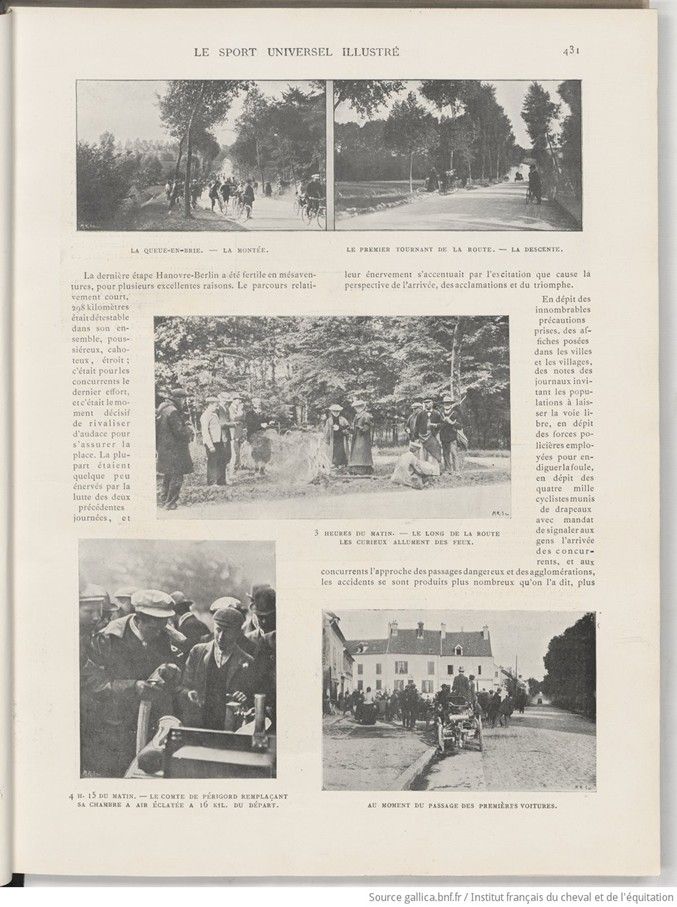
LA QUEUE-EN-BRIE. — THE CLIMB.
THE FIRST BEND IN THE ROAD. — THE DESCENT.
3 A.M. — ALONG THE ROAD, ONLOOKERS LIGHT FIRES.
4:15 A.M. — THE COUNT OF PERIGORD REPLACING HIS BURST TIRE 16 ILOMETERS FROM THE START.
AS THE FIRST CARS PASS BY.
Page 432.
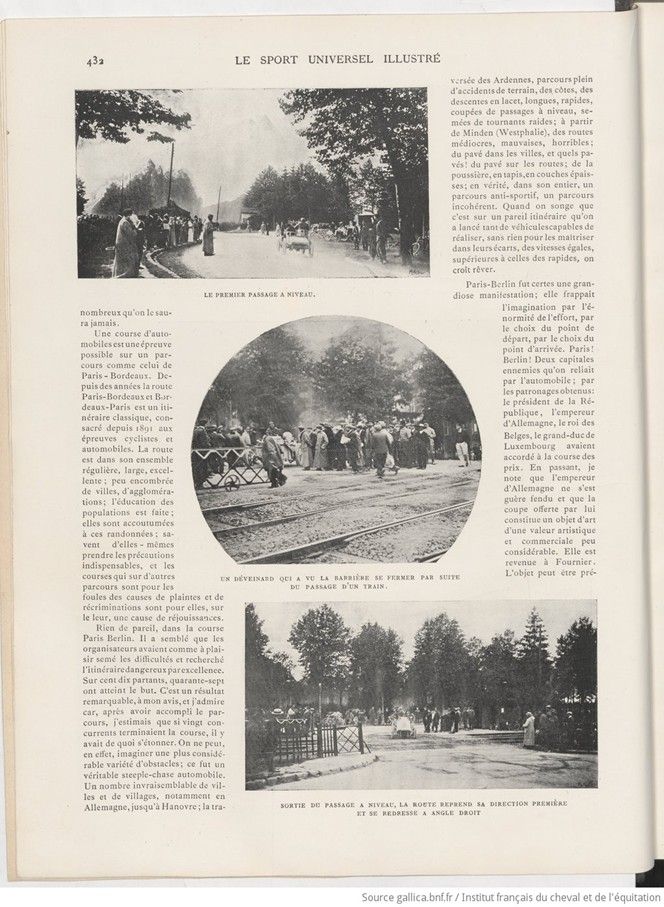
THE FIRST RAILROAD CROSSING.
A LUCKY ESCAPEE WHO SAW THE BARRIER CLOSE FOLLOWING THE PASSAGE OF A TRAIN.
EXITING THE LEVEL CROSSING, THE ROAD RESUMES ITS ORIGINAL DIRECTION AND STRAIGHTENS OUT AT A RIGHT ANGLE.
Page 433.
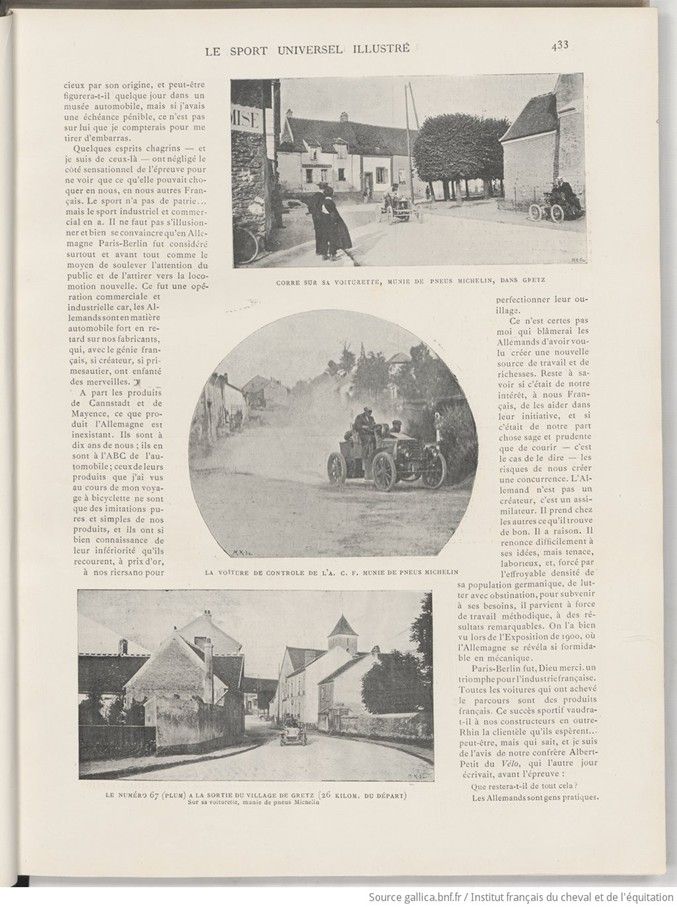
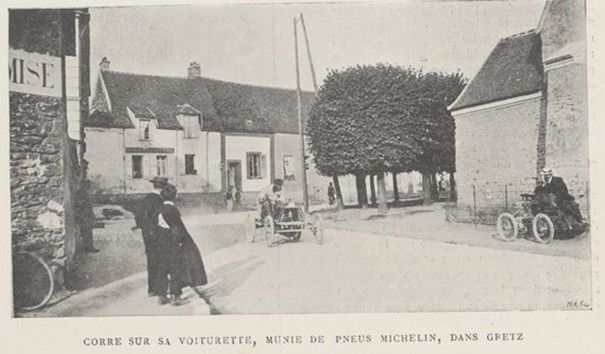
RACING IN HIS SMALL CAR, EQUIPPED WITH MICHELIN TIRES, IN GRETZ
THE A.C.F. CONTROL CAR, EQUIPPED WITH MICHELIN TIRES
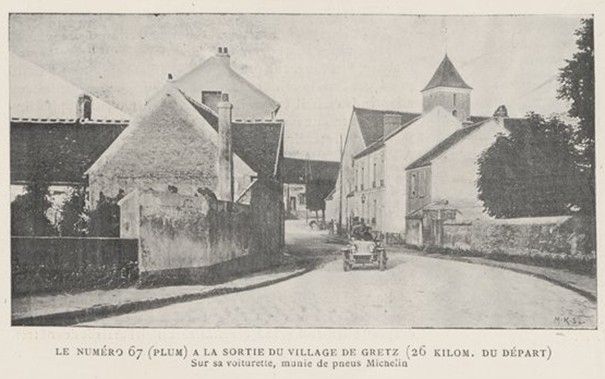
NUMBER 67 (PLUM) AT THE OUTSKIRTS OF THE VILLAGE OF GRETZ (26 KM FROM THE START) In his car, equipped with Michelin tires
Page 434.
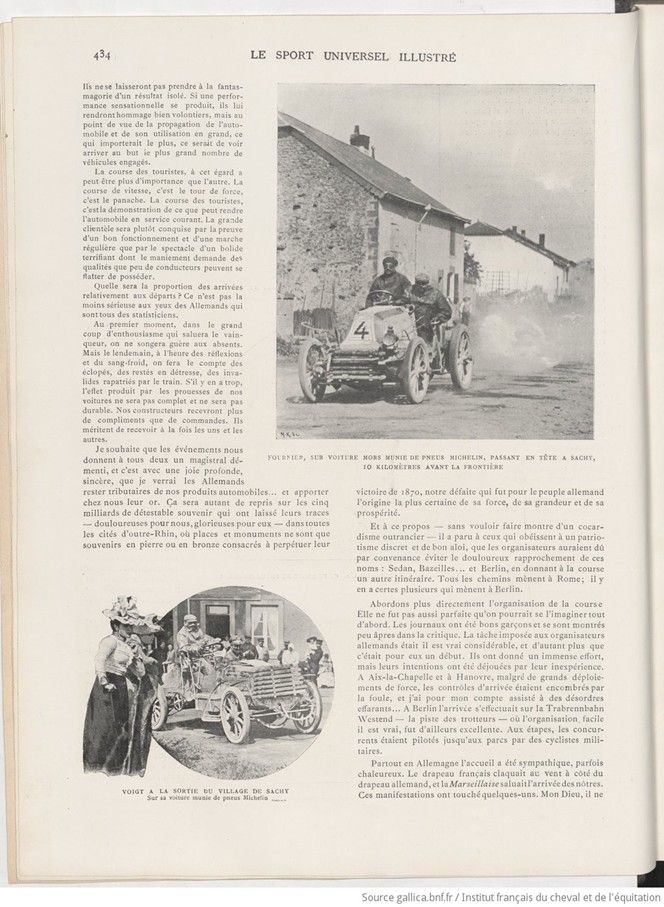
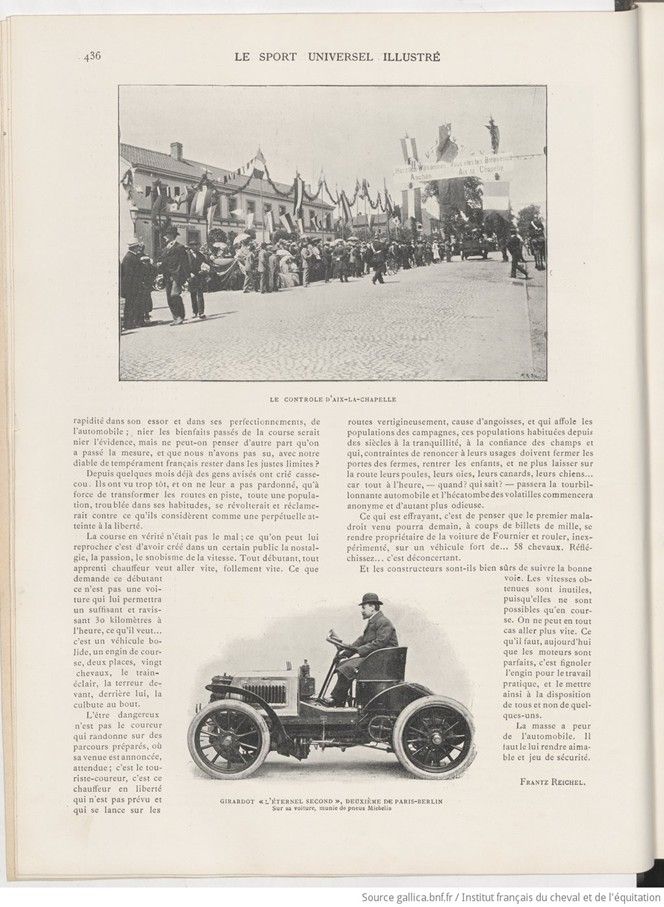
FOURNIER, IN A MORS CAR EQUIPPED WITH MICHELIN TIRES, LEADING AT SACHY, 10 KILOMETERS FROM THE BORDER
VOIGT AT THE OUTSKIRTS OF THE VILLAGE OF SACHY In his car equipped with Michelin tires
Page 435.
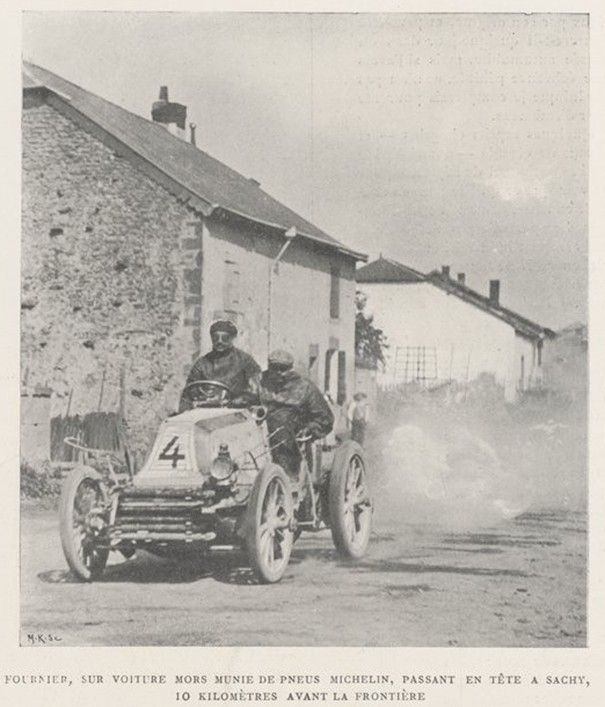
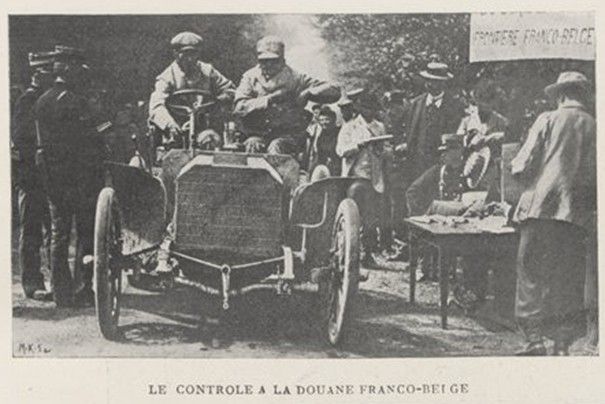
THE CHECK AT THE FRANCO-BELGIAN BORDER
MR. LABBEY, ON HIS KORN TRICYCLE, EQUIPPED WITH MICHELIN TIRES
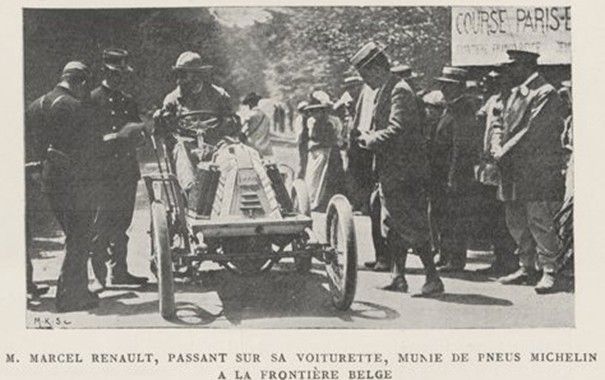
MR. MARCEL RENAULT, PASSING BY IN HIS SMALL CAR, EQUIPPED WITH MICHELIN TIRES
AT THE BELGIAN BORDER
Page 436.
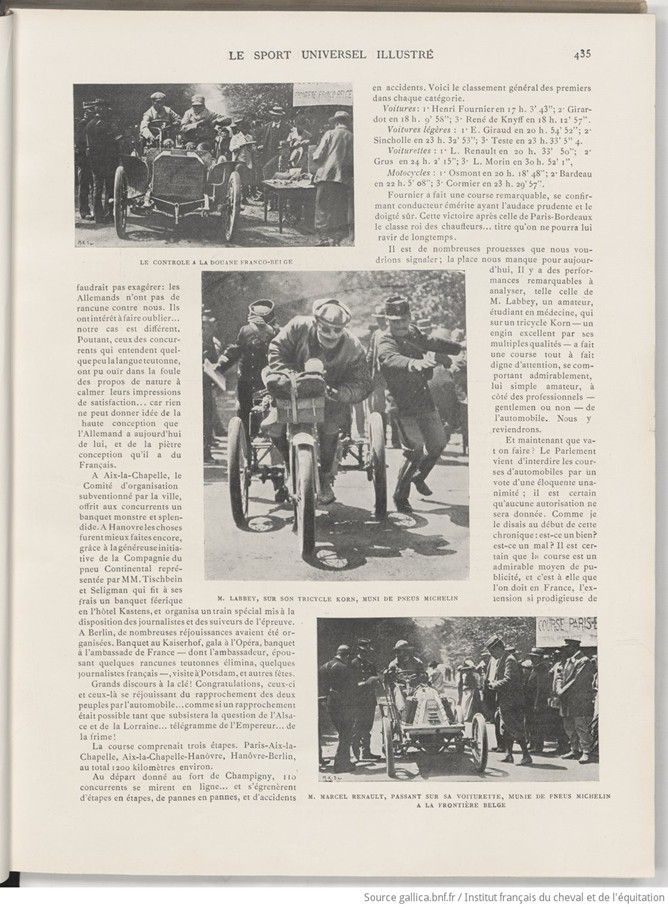
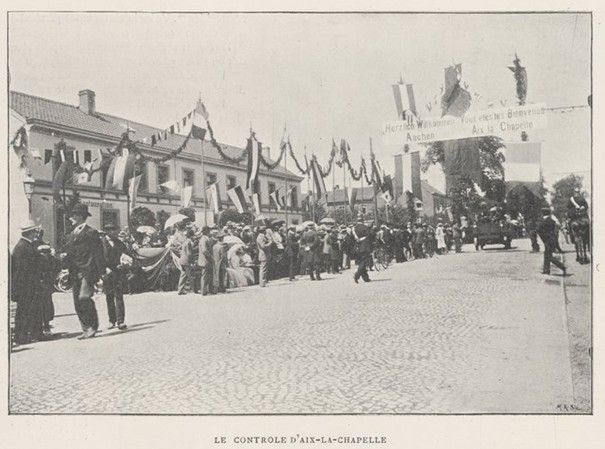
THE CHECKPOINT AT AACHEN GIRARDOT “THE ETERNAL RUNNER-UP,” SECOND IN PARIS-BERLIN In his car, equipped with Michelin tires