Text and jpegs by courtesy of hathitrust.org www.hathitrust.org, compiled by motorracinghistory.com
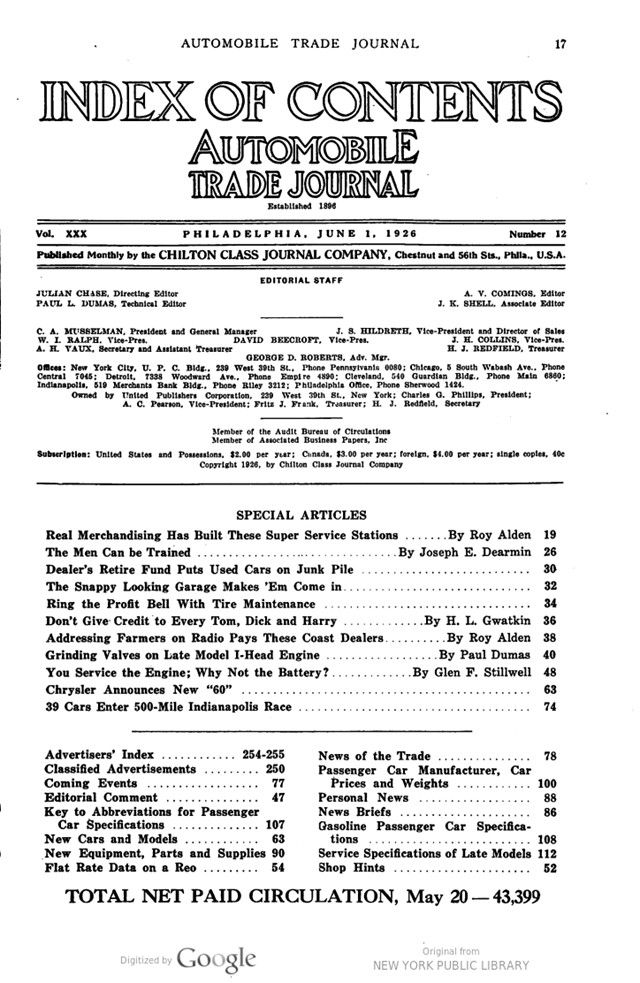
Automobile Trade Journal, Vol. 30, No. 12, June 1, 1926
39 Cars Enter International 500 Mile Indianapolis Race
32 Americans, 5 French, 2 British 91½ in. Racers in Classic
Hartz Breaks “300” Record at Atlantic City
Devore Wins at Charlotte
INDIANAPOLIS will be the Mecca of automobile racing fans, numbering around 100,000, on Monday, May 31, when thirty-nine cars-32 American, 5 French and 2 British-will compete in the Fourteenth Annual 500-mile International Sweepstakes. Thirty-three cars will be permitted to face the starter in the long grind around the two and a half mile brick oval. This is the first time cars of 91½ cu. in. piston displacement, have met at Indianapolis. The series of races started in 1911 with cars of 600 cu. in. piston displacement, with the 122 cu. in. jobs holding sway from 1923.
Of the American cars there are 14 Miller Specials, 2 of them with front drives; 5 Duesenberg’s; a Hamlin Special („Fronty-Ford“ front drive type); Seivers, Jr., Special, said to be a home-made eight; an Abell Special; a Boyle Valve Special; a K. & M. Special; a Shambaugh Special and six as yet unnamed. Three of the French cars are Schmidt Specials, one is a Guyot Special, entered by Albert Guyot, the fifth is a Bugatti. The British cars are Eldridge Specials.
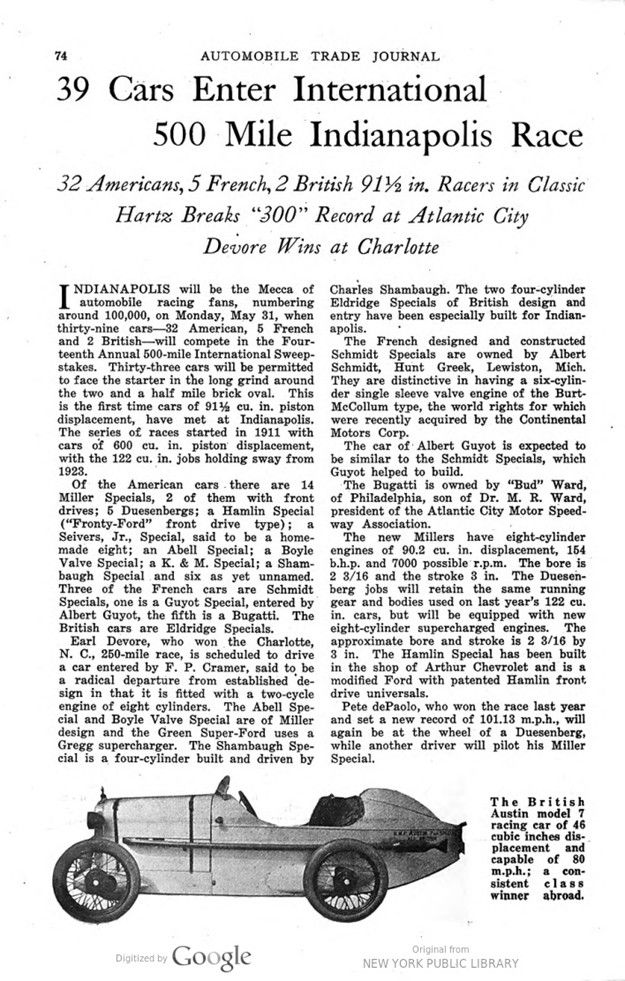
Earl Devore, who won the Charlotte, N. C., 250-mile race, is scheduled to drive a car entered by F. P. Cramer, said to be a radical departure from established design in that it is fitted with a two-cycle engine of eight cylinders. The Abell Special and Boyle Valve Special are of Miller design and the Green Super-Ford uses a Gregg supercharger. The Shambaugh Special is a four-cylinder built and driven by Charles Shambaugh. The two four-cylinder Eldridge Specials of British design and entry have been especially built for Indianapolis.
The French designed and constructed Schmidt Specials are owned by Albert Schmidt, Hunt Greek, Lewiston, Mich. They are distinctive in having a six-cylinder single sleeve valve engine of the Burt-McCollum type, the world rights for which were recently acquired by the Continental Motors Corp.
The car of Albert Guyot is expected to be similar to the Schmidt Specials, which Guyot helped to build. The Bugatti is owned by „Bud“ Ward, of Philadelphia, son of Dr. M. R. Ward, president of the Atlantic City Motor Speedway Association.
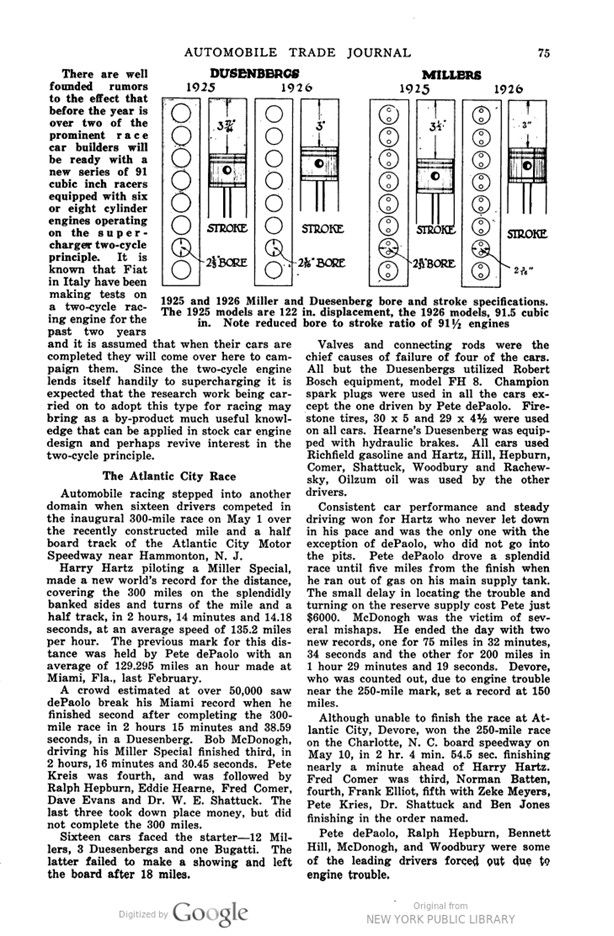
The new Millers have eight-cylinder engines of 90.2 cu. in. displacement, 154 b.h.p. and 7000 possible r.p.m. The bore is 2 3/16 and the stroke 3 in. The Duesenberg jobs will retain the same running gear and bodies used on last year’s 122 cu. in. cars, but will be equipped with new eight-cylinder supercharged engines. The approximate bore and stroke is 2 3/16 by 3 in. The Hamlin Special has been built in the shop of Arthur Chevrolet and is a modified Ford with patented Hamlin front-drive universals.
Pete dePaolo, who won the race last year and set a new record of 101.13 m.p.h., will again be at the wheel of a Duesenberg, while another driver will pilot his Miller Special.
There are well founded rumors to the effect that before the year is over two of the prominent race car builders will be ready with a new series of 91 cubic inch racers equipped with six or eight cylinder engines operating on the supercharger two-cycle principle. It is known that Fiat in Italy have been making tests on a two-cycle racing engine for the past two years and it is assumed that when their cars are completed they will come over here to campaign them. Since the two-cycle engine lends itself handily to supercharging it is expected that the research work being carried on to adopt this type for racing may bring as a by-product much useful knowledge that can be applied in stock car engine design and perhaps revive interest in the two-cycle principle.
The Atlantic City Race
Automobile racing stepped into another domain when sixteen drivers competed in the inaugural 300-mile race on May 1 over the recently constructed mile and a half board track of the Atlantic City Motor Speedway near Hammonton, N. J.
Harry Hartz piloting a Miller Special, made a new world’s record for the distance, covering the 300 miles on the splendidly banked sides and turns of the mile and a half track, in 2 hours, 14 minutes and 14.18 seconds, at an average speed of 135.2 miles per hour. The previous mark for this distance was held by Pete dePaolo with an average of 129.295 miles an hour made at Miami, Fla., last February.
A crowd estimated at over 50,000 saw dePaolo break his Miami record when he finished second after completing the 300-mile race in 2 hours 15 minutes and 38.59 seconds, in a Duesenberg. Bob McDonogh, driving his Miller Special finished third, in 2 hours, 16 minutes and 30.45 seconds. Pete Kreis was fourth, and was followed by Ralph Hepburn, Eddie Hearne, Fred Comer, Dave Evans and Dr. W. E. Shattuck. The last three took down place money, but did not complete the 300 miles.
Sixteen cars faced the starter – 12 Millers, 3 Duesenbergs and one Bugatti. The latter failed to make a showing and left the board after 18 miles.
Valves and connecting rods were the chief causes of failure of four of the cars. All but the Duesenbergs utilized Robert Bosch equipment, model FH 8. Champion spark plugs were used in all the cars except the one driven by Pete dePaolo. Firestone tires, 30 x 5 and 29 x 4½ were used on all cars. Hearne’s Duesenberg was equipped with hydraulic brakes. All cars used Richfield gasoline and Hartz, Hill, Hepburn, Comer, Shattuck, Woodbury and Rachewsky, Oilzum oil was used by the other drivers.
Consistent car performance and steady driving won for Hartz who never let down in his pace and was the only one with the exception of dePaolo, who did not go into the pits. Pete dePaolo drove a splendid race until five miles from the finish when he ran out of gas on his main supply tank. The small delay in locating the trouble and turning on the reserve supply cost Pete just $6000. McDonogh was the victim of several mishaps. He ended the day with two new records, one for 75 miles in 32 minutes, 34 seconds and the other for 200 miles in 1 hour 29 minutes and 19 seconds. Devore, who was counted out, due to engine trouble near the 250-mile mark, set a record at 150 miles.
Although unable to finish the race at Atlantic City, Devore, won the 250-mile race on the Charlotte, N. C. board speedway on May 10, in 2 hr. 4 min. 54.5 sec. finishing nearly a minute ahead of Harry Hartz. Fred Comer was third, Norman Batten, fourth, Frank Elliot, fifth with Zeke Meyers, Pete Kries, Dr. Shattuck and Ben Jones finishing in the order named.
Pete dePaolo, Ralph Hepburn, Bennett Hill, McDonogh, and Woodbury were some of the leading drivers forced out due to engine trouble.
Photos.
Page 74 -75.
The British Austin model 7 racing car of 46 cubic inches displacement and capable of 80 m.p.h.; a consistent class winner abroad.
1925 and 1926 Miller and Duesenberg bore and stroke specifications. The 1925 models are 122 in. displacement, the 1926 models, 91.5 cubic in. Note reduced bore to stroke ratio of 91½ engines