At the very end of the 1926 A.A.A. season, an extensive summary is made on the financial gains of several of that year’s drivers over the 12 races. Names of Frank Lockhart, Peter DePaolo, Fred Comer, Dave Lewis, Norman Batten, Peter Kreis, Earl DeVore, Harry Hartz, Dave Lewis, Bennett Hill, Earl Cooper and more, pass this revue. But also some typical technical issues of 1926 are briefly highlighted, such as the Miller-Duesenberg contest, as well as what superchargers are up to.
Text and jpegs by courtesy of hathitrust.org www.hathitrust.org, compiled by motorracinghistory.com
Motor Age, Vol. L, 50, No. 26, December 30, 1926
RACING RECORDS FALL and Drivers Pocket Cash in Fast 1926 Season
Speediest Race of Year Was Won at 134 M.P.H. and Slowest at 95.88 M.P.H. as New 91½ Inch Engines Got Their First Track Trials
By WILLIAM F. STURM
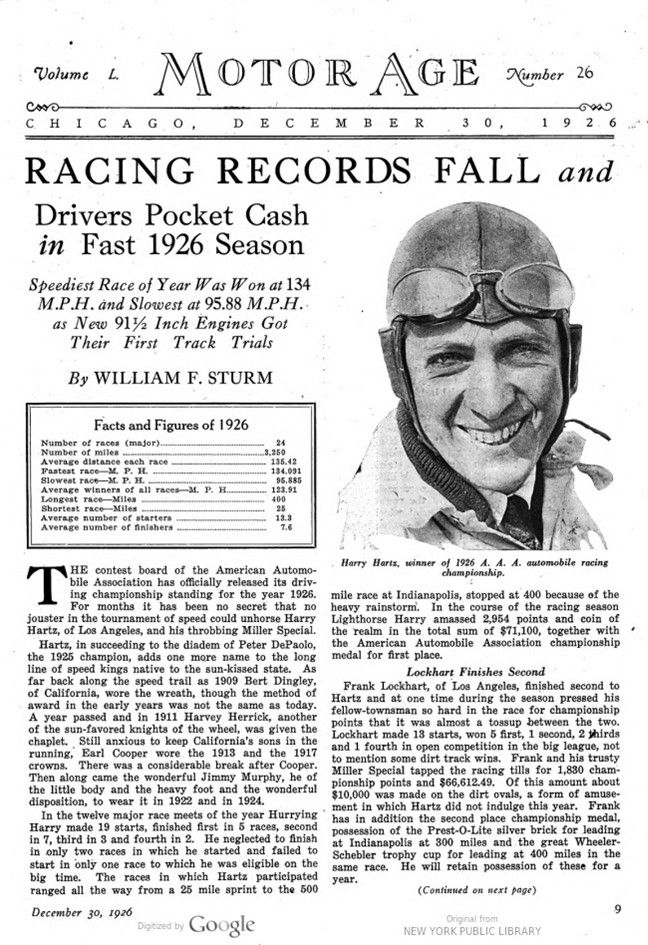
THE contest board of the American Automobile Association has officially released its driving championship standing for the year 1926. For months it has been no secret that no jouster in the tournament of speed could unhorse Harry Hartz, of Los Angeles, and his throbbing Miller Special. Hartz, in succeeding to the diadem of Peter DePaolo, the 1925 champion, adds one more name to the long line of speed kings native to the sun-kissed state. As far back along the speed trail as 1909 Bert Dingley, of California, wore the wreath, though the method of award in the early years was not the same as today. A year passed and in 1911 Harvey Herrick, another of the sun-favored knights of the wheel, was given the chaplet. Still anxious to keep California’s sons in the running, Earl Cooper wore the 1913 and the 1917 crowns. There was a considerable break after Cooper. Then along came the wonderful Jimmy Murphy, he of the little body and the heavy foot and the wonderful disposition, to wear it in 1922 and in 1924.
In the twelve major race meets of the year Hurrying Harry made 19 starts, finished first in 5 races, second in 7, third in 3 and fourth in 2. He neglected to finish in only two races in which he started and failed to start in only one race to which he was eligible on the big time. The races in which Hartz participated ranged all the way from a 25 mile sprint to the 500 mile race at Indianapolis, stopped at 400 because of the heavy rainstorm. In the course of the racing season Lighthorse Harry amassed 2,954 points and coin of the realm in the total sum of $71,100, together with the American Automobile Association championship medal for first place.
Lockhart Finishes Second
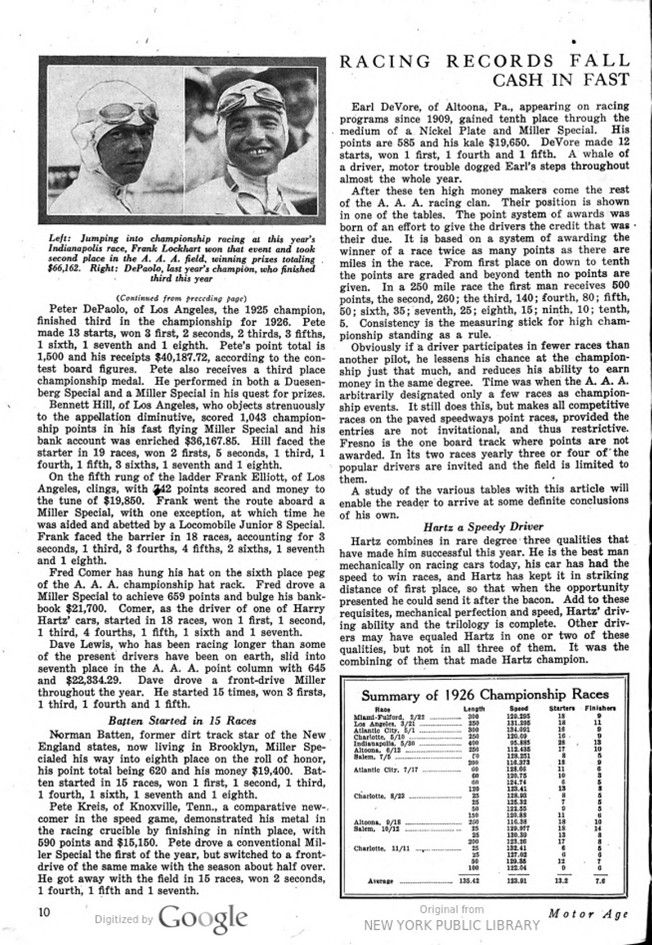
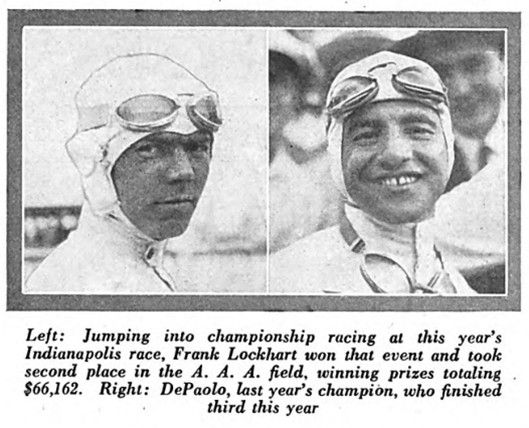
Frank Lockhart, of Los Angeles, finished second to Hartz and at one time during the season pressed his fellow-townsman so hard in the race for championship points that it was almost a tossup between the two. Lockhart made 13 starts, won 5 first, 1 second, 2 thirds and 1 fourth in open competition in the big league, not to mention some dirt track wins. Frank and his trusty Miller Special tapped the racing tills for 1,830 championship points and $66,612.49. Of this amount about $10,000 was made on the dirt ovals, a form of amusement in which Hartz did not indulge this year. Frank has in addition the second-place championship medal, possession of the Prest-O-Lite silver brick for leading at Indianapolis at 300 miles and the great Wheeler- Schebler trophy cup for leading at 400 miles in the same race. He will retain possession of these for a year.
Peter DePaolo, of Los Angeles, the 1925 champion, finished third in the championship for 1926. Pete made 13 starts, won 3 first, 2 seconds, 2 thirds, 3 fifths, 1 sixth, 1 seventh and 1 eighth. Pete’s point total is 1,500 and his receipts $40,187.72, according to the contest board figures. Pete also receives a third place championship medal. He performed in both a Duesenberg Special and a Miller Special in his quest for prizes.
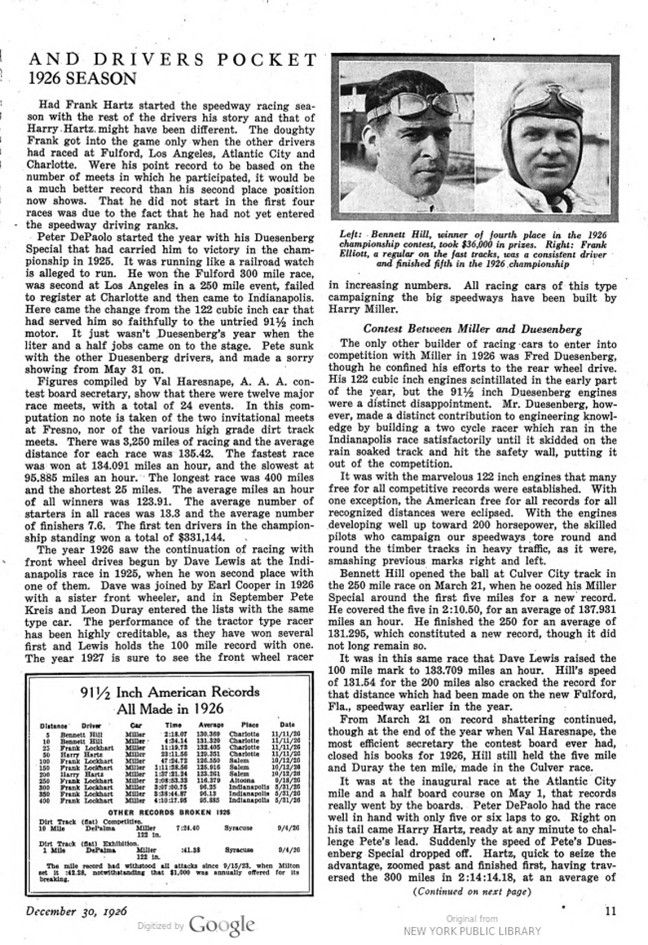
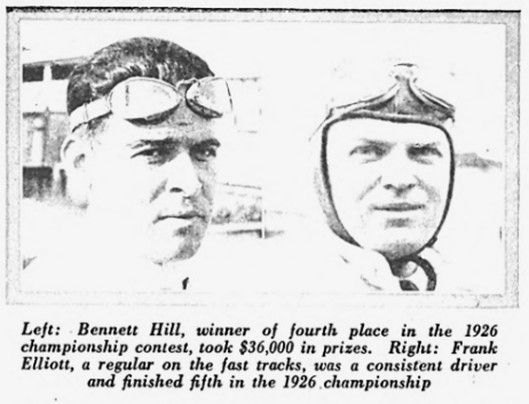
Bennett Hill, of Los Angeles, who objects strenuously to the appellation diminutive, scored 1,043 championship points in his fast flying Miller Special and his bank account was enriched $36,167.85. Hill faced the starter in 19 races, won 2 firsts, 5 seconds, 1 third, 1 fourth, 1 fifth, 3 sixths, 1 seventh and 1 eighth. On the fifth rung of the ladder Frank Elliott, of Los Angeles, clings, with 42 points scored and money to the tune of $19,850. Frank went the route aboard a Miller Special, with one exception, at which time he was aided and abetted by a Locomobile Junior 8 Special. Frank faced the barrier in 18 races, accounting for 3 seconds, 1 third, 3 fourths, 4 fifths, 2 sixths, 1 seventh and 1 eighth.
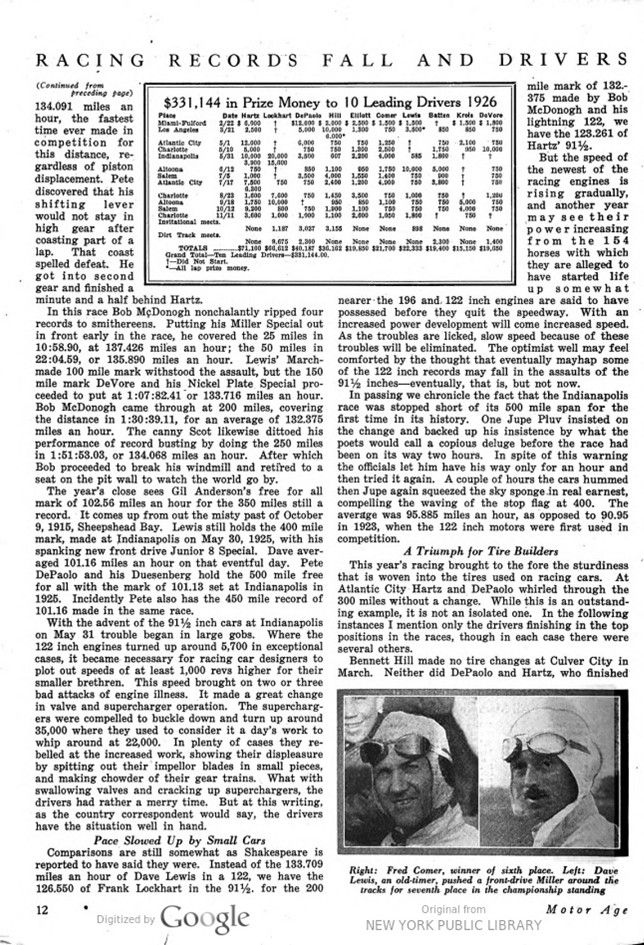
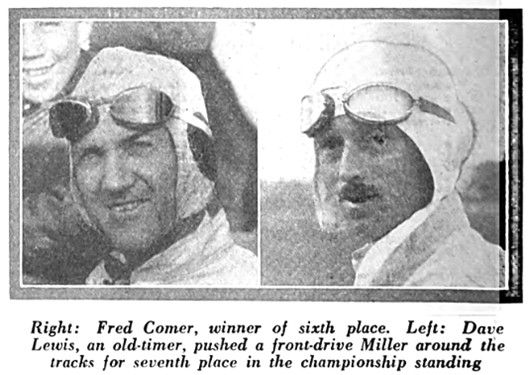
Fred Comer has hung his hat on the sixth place peg of the A. A. A. championship hat rack. Fred drove a Miller Special to achieve 659 points and bulge his bankbook $21,700. Comer, as the driver of one of Harry Hartz‘ cars, started in 18 races, won 1 first, 1 second, 1 third, 4 fourths, 1 fifth, 1 sixth and 1 seventh.
Dave Lewis, who has been racing longer than some of the present drivers have been on earth, slid into seventh place in the A. A. A. point column with 645 and $22,334.29. Dave drove a front-drive Miller throughout the year. He started 15 times, won 3 firsts, 1 third, 1 fourth and 1 fifth.
Batten Started in 15 Races
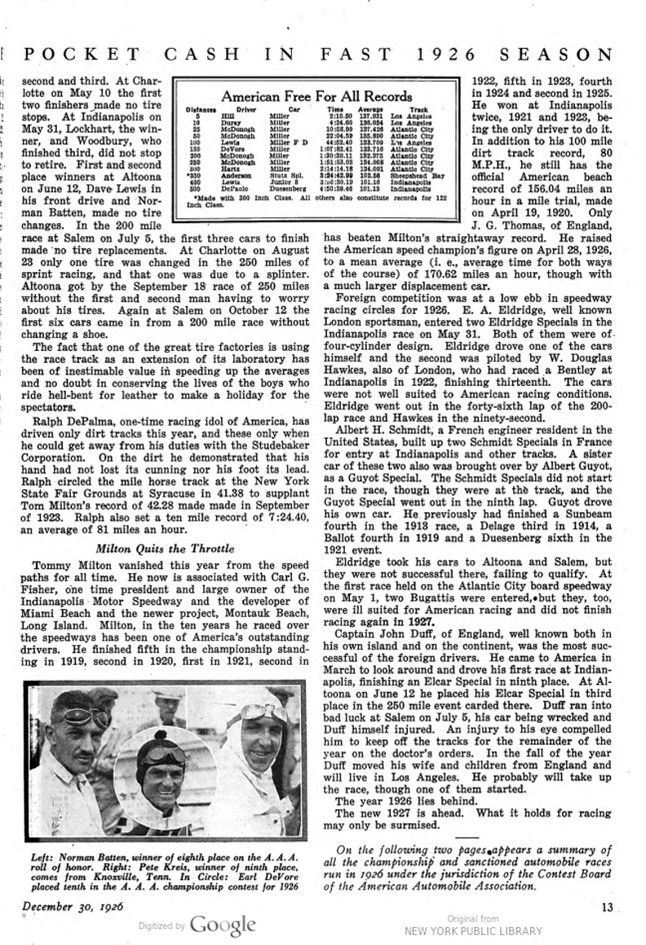
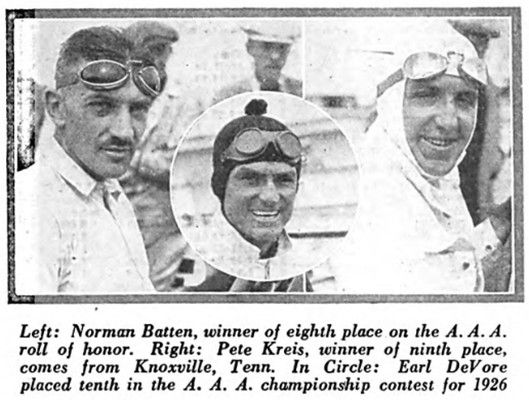
Norman Batten, former dirt track star of the New England states, now living in Brooklyn, Miller Specialed his way into eighth place on the roll of honor, his point total being 620 and his money $19,400. Batten started in 15 races, won 1 first, 1 second, 1 third, 1 fourth, 1 sixth, 1 seventh and 1 eighth.
Pete Kreis, of Knoxville, Tenn., a comparative newcomer in the speed game, demonstrated his metal in the racing crucible by finishing in ninth place, with 590 points and $15,150. Pete drove a conventional Miller Special the first of the year, but switched to a front-drive of the same make with the season about half over. He got away with the field in 15 races, won 2 seconds, 1 fourth, 1 fifth and 1 seventh.
Earl DeVore, of Altoona, Pa., appearing on racing programs since 1909, gained tenth place through the medium of a Nickel Plate and Miller Special. His points are 585 and his kale $19,650. DeVore made 12 starts, won 1 first, 1 fourth and 1 fifth. A whale of a driver, motor trouble dogged Earl’s steps throughout almost the whole year.
After these ten high money makers come the rest of the A. A. A. racing clan. Their position is shown in one of the tables. The point system of awards was born of an effort to give the drivers the credit that was their due. It is based on a system of awarding the winner of a race twice as many points as there are miles in the race. From first place on down to tenth the points are graded and beyond tenth no points are given. In a 250 mile race the first man receives 500 points, the second, 260; the third, 140; fourth, 80; fifth, 50; sixth, 35; seventh, 25; eighth, 15; ninth, 10; tenth, 5. Consistency is the measuring stick for high championship standing as a rule.
Obviously if a driver participates in fewer races than another pilot, he lessens his chance at the championship just that much, and reduces his ability to earn money in the same degree. Time was when the A. A. A. arbitrarily designated only a few races as championship events. It still does this, but makes all competitive races on the paved speedways point races, provided the entries are not invitational, and thus restrictive. Fresno is the one board track where points are not awarded. In its two races yearly three or four of the popular drivers are invited and the field is limited to them.
A study of the various tables with this article will enable the reader to arrive at some definite conclusions of his own.
Hartz a Speedy Driver
Hartz combines in rare degree three qualities that have made him successful this year. He is the best man mechanically on racing cars today, his car has had the speed to win races, and Hartz has kept it in striking distance of first place, so that when the opportunity presented he could send it after the bacon. Add to these requisites, mechanical perfection and speed, Hartz‘ driving ability and the trilogy is complete. Other drivers may have equaled Hartz in one or two of these qualities, but not in all three of them. It was the combining of them that made Hartz champion.
Had Frank Hartz started the speedway racing season with the rest of the drivers his story and that of Harry Hartz might have been different. The doughty Frank got into the game only when the other drivers had raced at Fulford, Los Angeles, Atlantic City and Charlotte. Were his point record to be based on the number of meets in which he participated, it would be a much better record than his second place position now shows. That he did not start in the first four races was due to the fact that he had not yet entered the speedway driving ranks.
Peter DePaolo started the year with his Duesenberg Special that had carried him to victory in the championship in 1925. It was running like a railroad watch is alleged to run. He won the Fulford 300-mile race, was second at Los Angeles in a 250-mile event, failed to register at Charlotte and then came to Indianapolis. Here came the change from the 122 cubic inch car that had served him so faithfully to the untried 91½ inch motor. It just wasn’t Duesenberg’s year when the liter and a half jobs came on to the stage. Pete sunk with the other Duesenberg drivers, and made a sorry showing from May 31 on.
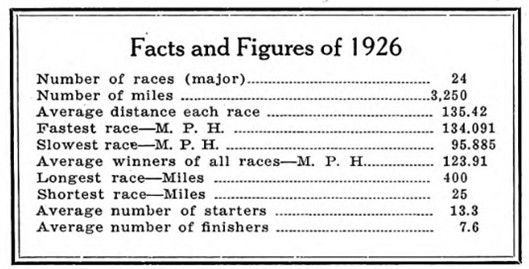
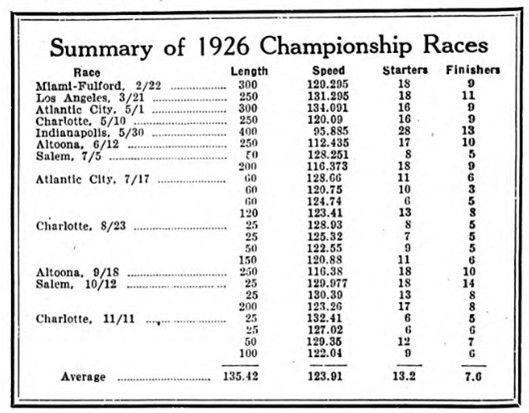
Figures compiled by Val Haresnape, A. A. A. contest board secretary, show that there were twelve major race meets, with a total of 24 events. In this computation no note is taken of the two invitational meets at Fresno, nor of the various high grade dirt track meets. There was 3,250 miles of racing and the average distance for each race was 135.42. The fastest race was won at 134.091 miles an hour, and the slowest at 95.885 miles an hour. The longest race was 400 miles and the shortest 25 miles. The average miles an hour of all winners was 123.91. The average number of starters in all races was 13.3 and the average number of finishers 7.6. The first ten drivers in the championship standing won a total of $331,144.
The year 1926 saw the continuation of racing with front wheel drives begun by Dave Lewis at the Indianapolis race in 1925, when he won second place with one of them. Dave was joined by Earl Cooper in 1926 with a sister front wheeler, and in September Pete Kreis and Leon Duray entered the lists with the same type car. The performance of the tractor type racer has been highly creditable, as they have won several first and Lewis holds the 100-mile record with one. The year 1927 is sure to see the front wheel racer in increasing numbers. All racing cars of this type campaigning the big speedways have been built by Harry Miller.
Contest Between Miller and Duesenberg
The only other builder of racing cars to enter into competition with Miller in 1926 was Fred Duesenberg, though he confined his efforts to the rear wheel drive. His 122 cubic inch engines scintillated in the early part of the year, but the 91½ inch Duesenberg engines were a distinct disappointment. Mr. Duesenberg, however, made a distinct contribution to engineering knowledge by building a two-cycle racer which ran in the Indianapolis race satisfactorily until it skidded on the rain soaked track and hit the safety wall, putting it out of the competition.
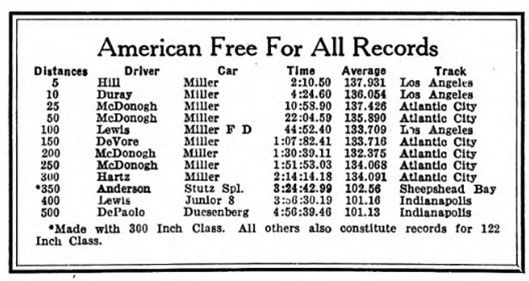
It was with the marvelous 122-inch engines that many free for all competitive records were established. With one exception, the American free for all records for all recognized distances were eclipsed. With the engines developing well up toward 200 horsepower, the skilled pilots who campaign our speedways tore round and round the timber tracks in heavy traffic, as it were, smashing previous marks right and left.
Bennett Hill opened the ball at Culver City track in the 250-mile race on March 21, when he oozed his Miller Special around the first five miles for a new record. He covered the five in 2:10.50, for an average of 137.931 miles an hour. He finished the 250 for an average of 131.295, which constituted a new record, though it did not long remain so.
It was in this same race that Dave Lewis raised the 100-mile mark to 133.709 miles an hour. Hill’s speed of 131.54 for the 200 miles also cracked the record for that distance which had been made on the new Fulford, Fla., speedway earlier in the year.
From March 21 on record shattering continued, though at the end of the year when Val Haresnape, the most efficient secretary the contest board ever had, closed his books for 1926, Hill still held the five mile and Duray the ten mile, made in the Culver race. It was at the inaugural race at the Atlantic City mile and a half board course on May 1, that records really went by the boards. Peter DePaolo had the race well in hand with only five or six laps to go. Right on his tail came Harry Hartz, ready at any minute to challenge Pete’s lead. Suddenly the speed of Pete’s Duesenberg Special dropped off. Hartz, quick to seize the advantage, zoomed past and finished first, having traversed the 300 miles in 2:14:14.18, at an average of 134.091 miles an hour, the fastest time ever made in competition for this distance, regardless of piston displacement. Pete discovered that his shifting lever would not stay in high gear after coasting part of a lap. That coast spelled defeat. He got into second gear and finished a minute and a half behind Hartz.
In this race Bob McDonogh nonchalantly ripped four records to smithereens. Putting his Miller Special out in front early in the race, he covered the 25 miles in 10:58.90, at 137.426 miles an hour; the 50 miles in 22:04.59, or 135.890 miles an hour. Lewis‘ March-made 100 mile mark withstood the assault, but the 150 mile mark DeVore and his Nickel Plate Special proceeded to put at 1:07:82.41 or 133.716 miles an hour. Bob McDonogh came through at 200 miles, covering the distance in 1:30:39.11, for an average of 132.375 miles an hour. The canny Scot likewise dittoed his performance of record busting by doing the 250 miles in 1:51:53.03, or 134.068 miles an hour. After which Bob proceeded to break his windmill and retired to a seat on the pit wall to watch the world go by.
The year’s close sees Gil Anderson’s free for all mark of 102.56 miles an hour for the 350 miles still a record. It comes up from out the misty past of October 9, 1915, Sheepshead Bay. Lewis still holds the 400 mile mark, made at Indianapolis on May 30, 1925, with his spanking new front drive Junior 8 Special. Dave averaged 101.16 miles an hour on that eventful day. Pete DePaolo and his Duesenberg hold the 500 mile free for all with the mark of 101.13 set at Indianapolis in 1925. Incidently Pete also has the 450 mile record of 101.16 made in the same race.
With the advent of the 91½ inch cars at Indianapolis on May 31, trouble began in large gobs. Where the 122-inch engines turned up around 5,700 in exceptional cases, it became necessary for racing car designers to plot out speeds of at least 1,000 revs higher for their smaller brethren. This speed brought on two or three bad attacks of engine illness. It made a great change in valve and supercharger operation. The superchargers were compelled to buckle down and turn up around 35,000 where they used to consider it a day’s work to whip around at 22,000. In plenty of cases they rebelled at the increased work, showing their displeasure by spitting out their impellor blades in small pieces, and making chowder of their gear trains. What with swallowing valves and cracking up superchargers, the drivers had rather a merry time. But at this writing, as the country correspondent would say, the drivers, have the situation well in hand.
Pace Slowed Up by Small Cars
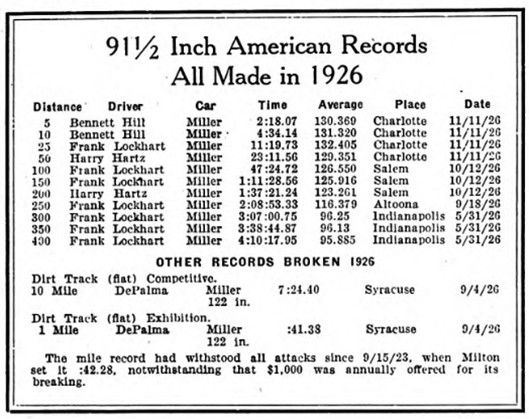
Comparisons are still somewhat as Shakespeare is reported to have said they were. Instead of the 133.709 miles an hour of Dave Lewis in a 122, we have the 126.550 of Frank Lockhart in the 91½ for the 200 mile mark of 132.-375 made by Bob McDonogh and his lightning 122, we have the 123.261 of Hartz‘ 912. But the speed of the newest of the racing engines is rising gradually, and another year may see their power increasing from the 154 horses with which they are alleged to have started life up somewhat nearer the 196 and 122-inch engines are said to have possessed before they quit the speedway. With an increased power development will come increased speed. As the troubles are licked, slow speed because of these troubles will be eliminated. The optimist well may feel comforted by the thought that eventually mayhap some of the 122 inch records may fall in the assaults of the 91½ inches – eventually, that is, but not now.
In passing we chronicle the fact that the Indianapolis race was stopped short of its 500-mile span for the first time in its history. One Jupe Pluv insisted on the change and backed up his insistence by what the poets would call a copious deluge before the race had been on its way two hours. In spite of this warning the officials let him have his way only for an hour and then tried it again. A couple of hours the cars hummed then Jupe again squeezed the sky sponge in real earnest, compelling the waving of the stop flag at 400. The average was 95.885 miles an hour, as opposed to 90.95 in 1923, when the 122- inch motors were first used in competition.
A Triumph for Tire Builders
At This year’s racing brought to the fore the sturdiness that is woven into the tires used on racing cars. Atlantic City Hartz and DePaolo whirled through the 300 miles without a change. While this is an outstanding example, it is not an isolated one. In the following instances I mention only the drivers finishing in the top positions in the races, though in each case there were several others.
Bennett Hill made no tire changes at Culver City in March. Neither did DePaolo and Hartz, who finished second and third. At Charlotte on May 10 the first two finishers made no tire stops. At Indianapolis on May 31, Lockhart, the winner, and Woodbury, who finished third, did not stop to retire. First and second place winners at Altoona on June 12, Dave Lewis in his front drive and Norman Batten, made no tire changes. In the 200 mile race at Salem on July 5, the first three cars to finish made no tire replacements. At Charlotte on August 23 only one tire was changed in the 250 miles of sprint racing, and that one was due to a splinter. Altoona got by the September 18 race of 250 miles without the first and second man having to worry about his tires. Again at Salem on October 12 the first six cars came in from a 200 mile race without changing a shoe.
The fact that one of the great tire factories is using the racetrack as an extension of its laboratory has been of inestimable value in speeding up the averages and no doubt in conserving the lives of the boys who ride hell-bent for leather to make a holiday for the spectators.
Ralph DePalma, one-time racing idol of America, has driven only dirt tracks this year, and these only when he could get away from his duties with the Studebaker Corporation. On the dirt he demonstrated that his hand had not lost its cunning nor his foot its lead. Ralph circled the mile horse track at the New York State Fair Grounds at Syracuse in 41.38 to supplant Tom Milton’s record of 42.28 made made in September of 1923. Ralph also set a ten mile record of 7:24.40, an average of 81 miles an hour.
Milton Quits the Throttle
Tommy Milton vanished this year from the speed paths for all time. He now is associated with Carl G. Fisher, one time president and large owner of the Indianapolis Motor Speedway and the developer of Miami Beach and the newer project, Montauk Beach, Long Island. Milton, in the ten years he raced over the speedways has been one of America’s outstanding drivers. He finished fifth in the championship standing in 1919, second in 1920, first in 1921, second in 1922, fifth in 1923, fourth in 1924 and second in 1925. He won at Indianapolis twice, 1921 and 1923, being the only driver to do it. In addition to his 100 mile dirt track record, 80 M.P.H., he still has the official American beach record of 156.04 miles an hour in a mile trial, made on April 19, 1920. Only J. G. Thomas, of England, has beaten Milton’s straightaway record. He raised the American speed champion’s figure on April 28, 1926, to a mean average (i. e., average time for both ways of the course) of 170.62 miles an hour, though with a much larger displacement car.
Foreign competition was at a low ebb in speedway racing circles for 1926. E. A. Eldridge, well known London sportsman, entered two Eldridge Specials in the Indianapolis race on May 31. Both of them were of. four-cylinder design. Eldridge drove one of the cars himself and the second was piloted by W. Douglas Hawkes, also of London, who had raced a Bentley at Indianapolis in 1922, finishing thirteenth. The cars were not well suited to American racing conditions. Eldridge went out in the forty-sixth lap of the 200-lap race and Hawkes in the ninety-second.
Albert H. Schmidt, a French engineer resident in the United States, built up two Schmidt Specials in France for entry at Indianapolis and other tracks. A sister car of these two also was brought over by Albert Guyot, as a Guyot Special. The Schmidt Specials did not start in the race, though they were at the track, and the Guyot Special went out in the ninth lap. Guyot drove his own car. He previously had finished a Sunbeam fourth in the 1913 race, a Delage third in 1914, a Ballot fourth in 1919 and a Duesenberg sixth in the 1921 event.
Eldridge took his cars to Altoona and Salem, but they were not successful there, failing to qualify. At the first race held on the Atlantic City board speedway on May 1, two Bugatti’s were entered, but they, too, were ill suited for American racing and did not finish racing again in 1927.
Captain John Duff, of England, well known both in his own island and on the continent, was the most successful of the foreign drivers. He came to America in March to look around and drove his first race at Indianapolis, finishing an Elcar Special in ninth place. At Al- toona on June 12 he placed his Elcar Special in third place in the 250 mile event carded there. Duff ran into bad luck at Salem on July 5, his car being wrecked and Duff himself injured. An injury to his eye compelled him to keep off the tracks for the remainder of the year on the doctor’s orders. In the fall of the year Duff moved his wife and children from England and will live in Los Angeles. He probably will take up the race, though one of them started.
The year 1926 lies behind.
The new 1927 is ahead. What it holds for racing may only be surmised.
Photos.
Page 9. Harry Hartz, winner of 1926 A. A. A. automobile racing championship.
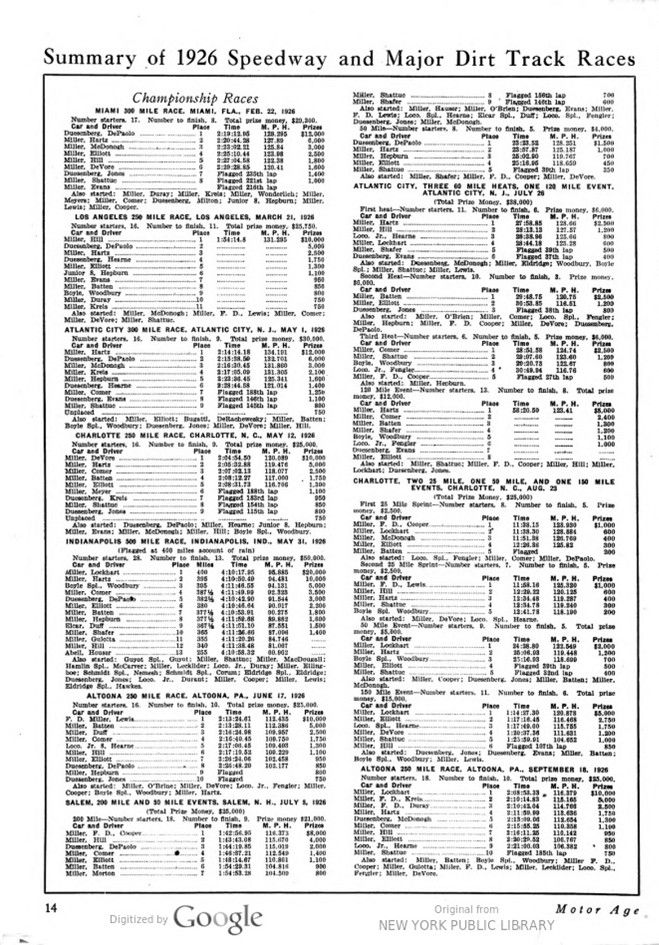
Page 10. Left: Jumping into championship racing at this year’s Indianapolis race, Frank Lockhart won that event and took second place in the A. A. A. field, winning prizes totaling $66,162. Right: DePaolo, last year’s champion, who finished third this year. Summary of 1926 Championship Races (table)
Page 11. Left: Bennett Hill, winner of fourth place in the 1926 championship contest, took $36,000 in prizes. Right: Frank Elliott, a regular on the fast tracks, was a consistent driver and finished fifth in the 1926 championship. 91½ Inch American Records All Made in 1926 (table)
Page 12. $331,144 in Prize Money to 10 Leading Drivers 1926 (table)
Right: Fred Comer, winner of sixth place. Left: Dave Lewis, an old-timer, pushed a front-drive Miller around the tracks for seventh place in the championship standing.
Page 13. American Free For All Records (table)
Left: Norman Batten, winner of eighth place on the A. A. A. roll of honor. Right: Pete Kreis, winner of ninth place, comes from Knoxville, Tenn. In Circle: Earl DeVore placed tenth in the A. A. A. championship contest for 1926
Page 14 – 15.
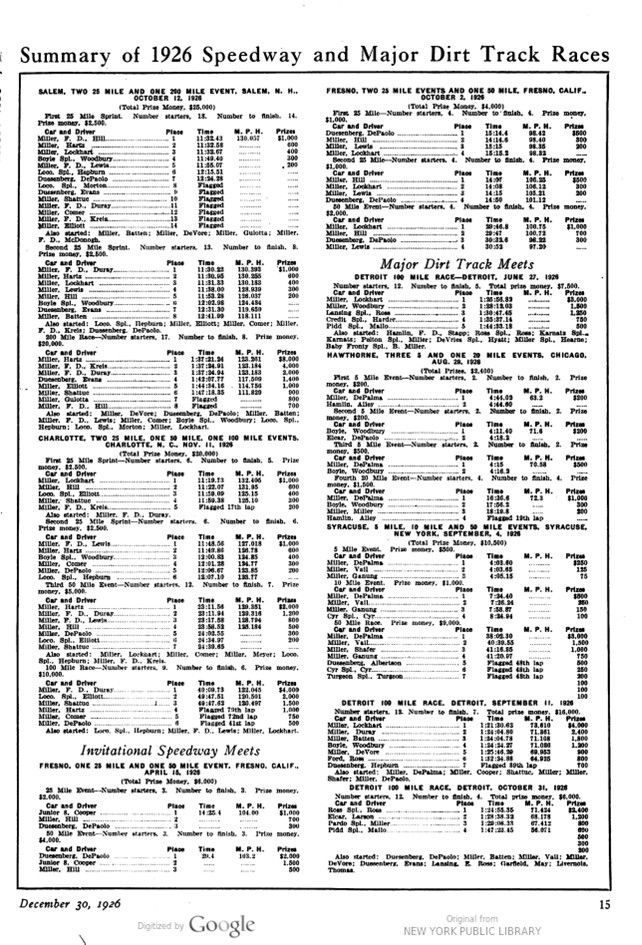
On the following two pages appears a summary of all the championship and sanctioned automobile races run in 1926 under the jurisdiction of the Contest Board of the American Automobile Association. Summary of 1926 Speedway and Major Dirt (2 tables)