
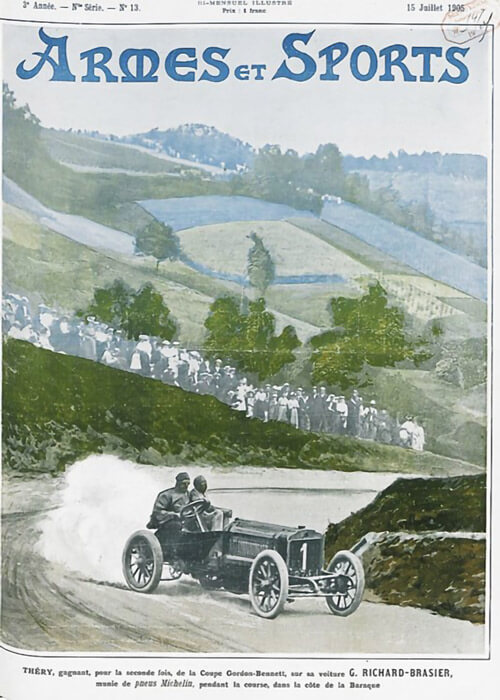
This September 1928 issue of the Journal of the SAE, deals with the up-to-then status of front wheel drive. In all, this very lenghty article comprises of no less that 25 pages, inclusive photograhs. All aspects are discussed; davantages and disadvantages are listed and compared. Almost all known front wheel drives in the US and on the continent are described. As for it’s length, the complete article is divided into four parts; here’s part II, wishing You an interesting read.

Text and jpegs by courtesy of hathitrust.org www.hathitrust.org, compiled by motorracinghistory.com
Journal of the SAE, Vol. XXIII (23), No. 3, September 1928.
Front-Wheel Drives, Are They Coming or Going? – Part II
By HERBERT CHASE – M.S.A.E.-Engineer, Erickson Co., Inc., New York City.
SEMI-ANNUAL MEETING PAPER Illustrated with PHOTOGRAPHS AND DRAWINGS
FREEDOM FROM SHIMMY TENDENCIES
In his paper on Independently Sprung Front Wheels as a Remedy for Shimmy, M. de Lavaud makes this interesting statement: (See THE JOURNAL, June 1928, p. 623.).
One usually dilates upon the remarkable steadiness and roadability of cars fitted with front drive. One should note that front-wheel drive is, in principle, associated with independent front wheels. It is precisely that independence, and not the fact that the drive is from the front, which produces those unquestionable advantages that have been verified. My opinion is that, apart from a few practical and secondary advantages, the front-wheel drive does not, in itself, produce any real technical benefit.
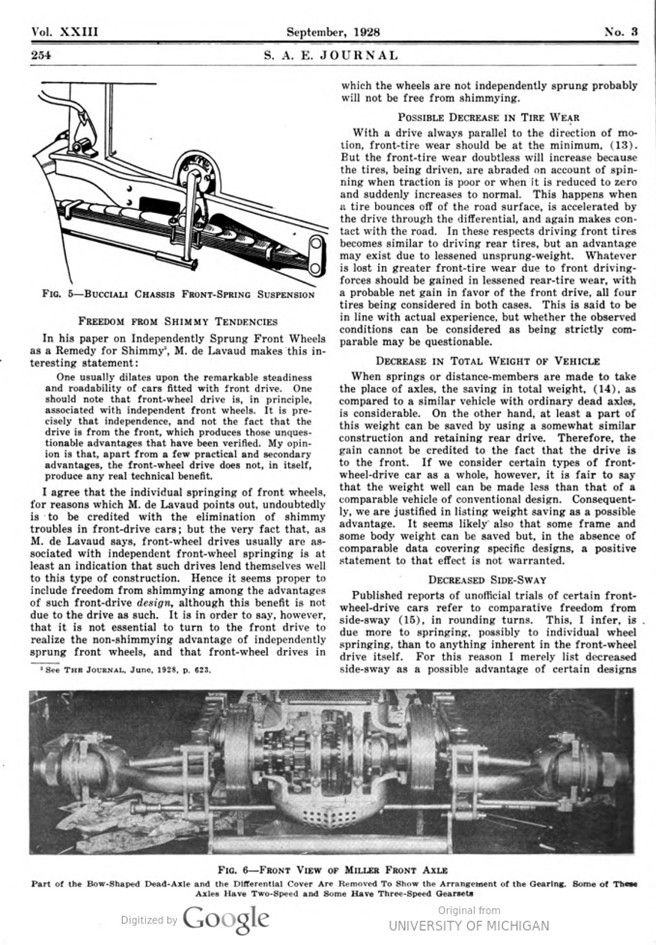
I agree that the individual springing of front wheels, for reasons which M. de Lavaud points out, undoubtedly is to be credited with the elimination of shimmy troubles in front-drive cars; but the very fact that, as M. de Lavaud says, front-wheel drives usually are associated with independent front-wheel springing is at least an indication that such drives lend themselves well to this type of construction. Hence it seems proper to include freedom from shimmying among the advantages of such front-drive design, although this benefit is not due to the drive as such. It is in order to say, however, that it is not essential to turn to the front drive to realize the non-shimmying advantage of independently sprung front wheels, and that front-wheel drives in which the wheels are not independently sprung probably will not be free from shimmying.
POSSIBLE DECREASE IN TIRE WEAR
With a drive always parallel to the direction of motion, front-tire wear should be at the minimum, (13)- But the front-tire wear doubtless will increase because the tires, being driven, are abraded on account of spinning when traction is poor or when it is reduced to zero and suddenly increases to normal. This happens when a tire bounces off of the road surface, is accelerated by the drive through the differential, and again makes contact with the road. In these respects, driving front tires becomes similar to driving rear tires, but an advantage may exist due to lessened unsprung weight. Whatever is lost in greater front-tire wear due to front driving-forces should be gained in lessened rear-tire wear, with a probable net gain in favor of the front drive, all four tires being considered in both cases. This is said to be in line with actual experience, but whether the observed conditions can be considered as being strictly comparable may be questionable.
DECREASE IN TOTAL WEIGHT OF VEHICLE
When springs or distance-members are made to take the place of axles, the saving in total weight, (14), as compared to a similar vehicle with ordinary dead axles, is considerable. On the other hand, at least a part of this weight can be saved by using a somewhat similar construction and retaining rear drive. Therefore, the gain cannot be credited to the fact that the drive is to the front. If we consider certain types of front-wheel-drive car as a whole, however, it is fair to say that the weight well can be made less than that of a comparable vehicle of conventional design. Consequently, we are justified in listing weight saving as a possible advantage. It seems likely also that some frame and some body weight can be saved but, in the absence of comparable data covering specific designs, a positive statement to that effect is not warranted.
DECREASED SIDE-SWAY
Published reports of unofficial trials of certain front-wheel-drive cars refer to comparative freedom from side-sway (15), in rounding turns. This, I infer, is due more to springing, possibly to individual wheel springing, than to anything inherent in the front-wheel drive itself. For this reason, I merely list decreased side-sway as a possible advantage of certain designs using front drive, although I am inclined to believe a similar claim might apply just as well to certain un- conventional rear-wheel-drive designs also.
DECREASED THRUST ON FRONT-WHEEL BEARINGS
W. H. Douglas, who has had, I believe, as long an experience with front-drive vehicles as any American engineer and is largely responsible for the Healey-Aero- marine design, points out that the universal-joint and the steering-system used in this motorcoach gives a maximum steering-angle of 53 deg. He adds that the allowable steering angle of rear-driven vehicles is limited by the side-thrust on the front wheels. It is evident that rear drives do impose heavy side-thrust on front-wheel bearings, that such thrusts increase materially as the steering angle is increased, and that the thrust is far less, (16), with front-wheel drive. It may well follow that a front-drive motorcoach can use a larger steering-angle than one with rear drive and not be subject to excessive thrust on front wheels and their bearings. In any case it hardly will be denied that the Healey-Aeromarine motorcoach has an exceptionally large steering-angle and a correspondingly small turning-radius for so long a vehicle.
FRONT SPRINGS AND AXLE RELIEVED OF BRAKING TORQUE
Any construction which relieves the front springs and axle from the torque reaction due to braking, (17), and still provides braking on front wheels, offers a distinct advantage; and this is the case with most front-drive designs. Brakes can be carried at the inner end of each driveshaft, or on the propeller-shaft, preferably forward of the differential where the cooling effect is good. Such a construction also makes for simple brake-controls and a reduction in unsprung weight.
SUMMARY OF ADVANTAGES
Even though numerous reservations attach to this rather formidable list of front-wheel-drive advantages, the case for such drives has strong arguments in its favor. We have yet to examine the disadvantages.
DISCUSSION OF DISADVANTAGES
Since maximum tractive-effort is a direct function of the weight on the driving wheels, (1), a decrease in that weight reduces tractive effort proportionately. This is of small moment so long as the minimum is enough to propel the vehicle without undue slippage, but below this minimum the vehicle stalls. In a passenger-car, with all the weight of the engine and driving mechanism forward and the weight of passengers relatively small in proportion to the total weight on the front axle, the chance of insufficient traction is not very great; but, in a motorcoach or motor-truck designed for heavy loads on the rear axle, the case is wholly different. This is true especially in climbing a heavy grade, a condition frequently requiring maximum traction, as the inclination of the vehicle lightens the load on the front axle and increases it on the rear axle. A greater front overhang helps to some extent, but many cases are on record in which front-drive trucks have stalled on hills, especially when the footing of the road was poor.
Basing his remarks on some 70 front-wheel-drive motorcoaches that have operated millions of miles in Chicago, G. A. Green mentions the difficulty of obtaining a satisfactory weight-distribution to provide sufficient front-wheel traction as the first disadvantage. We have heard of one case, however, in which a front- drive motorcoach is reported to have operated in snow when rear-wheel-drive vehicles stalled.
Just as weight is transferred from rear to front wheels when braking, so it is transferred from front to rear wheels when accelerating. This also militates against the front-wheel-drive vehicle under a condition in which the need for traction is great. It is therefore apparent that decreased traction does limit the usefulness of some classes of front-drive vehicle, though it probably is not a serious disadvantage in passenger- cars. In some cases, in fact, the traction actually is greater than with rear drive.
POSSIBILITY OF GREATER INJURY IN COLLISION
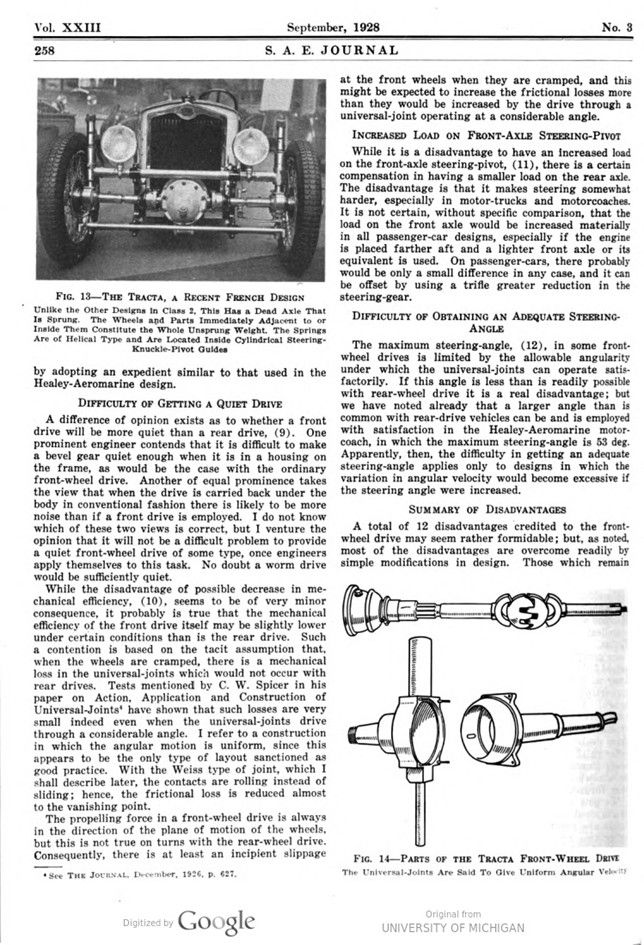
With a differential and live axle „sticking out in front“, these units are perhaps more likely to be damaged seriously in a collision, (2), than in a vehicle of conventional construction. This does not apply to all front-wheel-drive designs, but is properly urged against some and has led the makers of the Tracta car to provide a substantial bumper as an aid to selling their product. Radiators and engines of rear-drive vehicles often are injured in collision, but the damage to a front-wheel drive might easily prove more serious under similar conditions.
DIFFICULTY OF OBTAINING SATISFACTORY WEIGHT-DISTRIBUTION
This difficulty, (3), is almost insuperable in some cases, especially in motor-trucks. It has been met in some motorcoach designs and also in motor-trucks for special purposes, but inability to get satisfactory weight-distribution has resulted in serious trouble in other cases. In passenger-cars it seems to be less difficult to distribute weight so as to give as much traction as is required under all ordinary conditions.
INCREASED OVER-ALL LENGTH
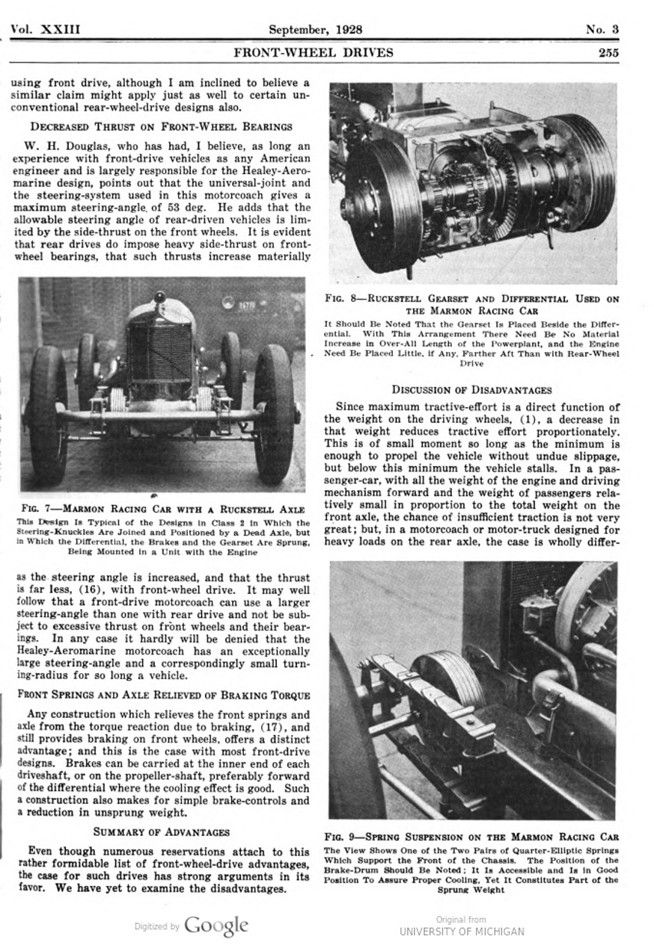
The disadvantage, (4), that front-wheel drive requires a vehicle of longer wheelbase than is needed for a similar body on a rear-drive chassis, has been cited by J. G. Vincent and other engineers. No doubt this is true if the gearset and differential are placed in front of the engine and the engine is moved back in the chassis. Strangely enough, however, a similar disadvantage in over-all length does not preclude the use of an eight-in-line engine when the sales possibilities of a car with such an engine are considered good enough! Although there are difficulties it does not seem impossible to design a front-wheel-drive car which, for a given body length, would have very little if any increase of over-all length. Suppose, for example, that we take a conventional chassis and merely turn the engine around, without moving it forward. We can then bolt up a differential housing which would come but little if any farther forward than the present radiator. The center line of the front wheels then would come about at the radiator, where it is now. The gear-set could then be placed forward of the radiator, in a space now seldom used to advantage, or be placed beside the differential as in the Marmon and the Miller designs. With such an arrangement there would be little increase in over-all length or in wheelbase.
It is impossible to make exact comparisons without using scale layouts, but I venture to predict that an engineer who set out to design a front-wheel-drive car with a given length of body and engine, and who made an effort to keep the over-all length within that for a similar car of conventional design, would find a way of doing it satisfactorily. Despite these alternatives, it appears to be fair to list greater over-all length or increased wheelbase as one of the disadvantages of a front-drive vehicle, for there are admitted difficulties in developing a design without such an increase.
INCREASED COMPLICATION OF DRIVING MECHANISM
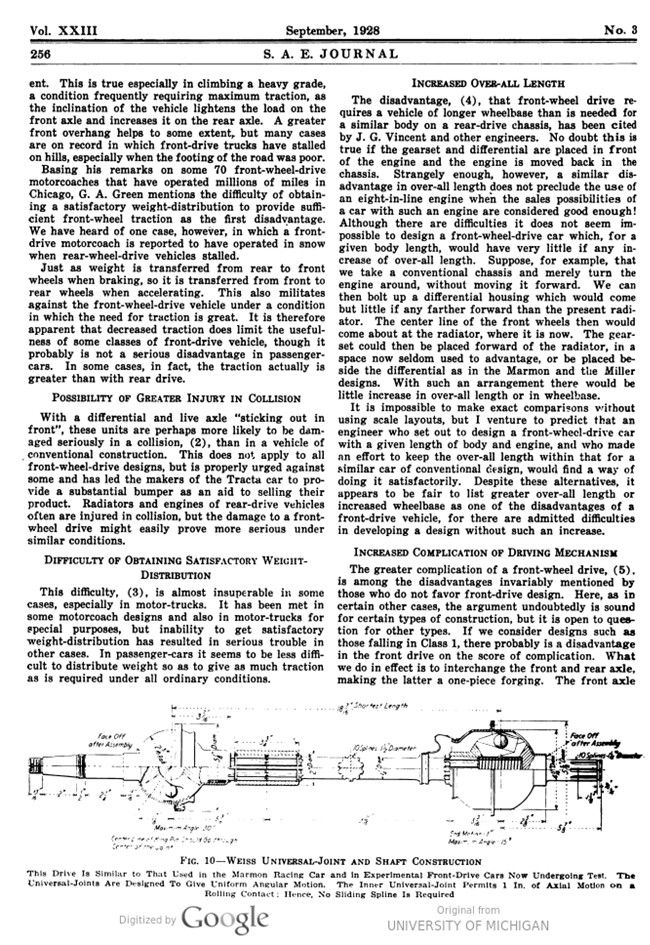
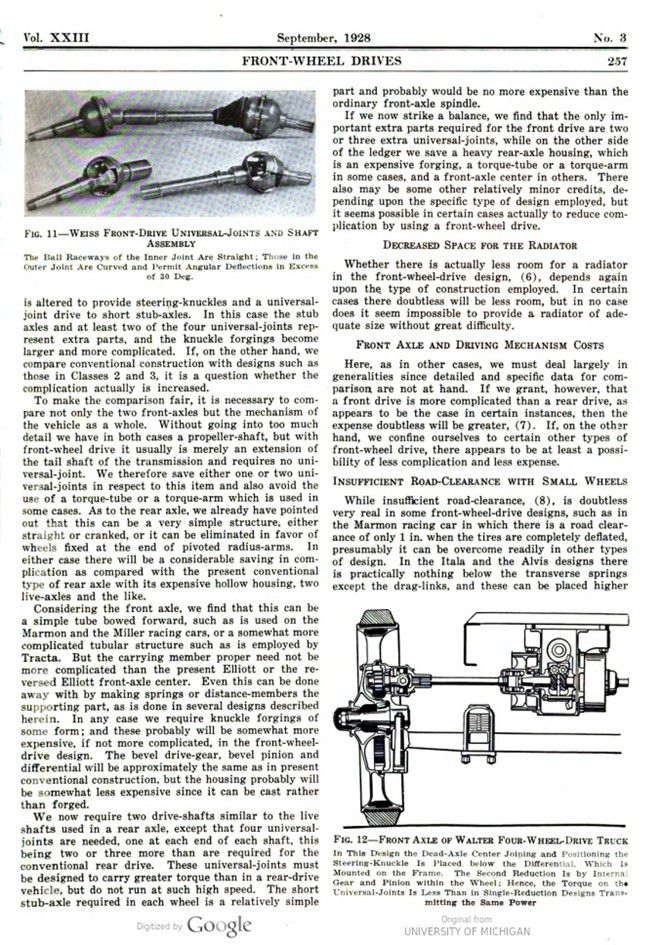
The greater complication of a front-wheel drive, (5), is among the disadvantages invariably mentioned by those who do not favor front-drive design. Here, as in certain other cases, the argument undoubtedly is sound for certain types of construction, but it is open to question for other types. If we consider designs such as those falling in Class 1, there probably is a disadvantage in the front drive on the score of complication. What we do in effect is to interchange the front and rear axle, making the latter a one-piece forging. The front axle is altered to provide steering-knuckles and a universal-joint drive to short stub-axles. In this case the stub axles and at least two of the four universal-joints represent extra parts, and the knuckle forgings become larger and more complicated. If, on the other hand, we compare conventional construction with designs such as those in Classes 2 and 3, it is a question whether the complication actually is increased.
To make the comparison fair, it is necessary to compare not only the two front-axles but the mechanism of the vehicle as a whole. Without going into too much detail, we have in both cases a propeller-shaft, but with front-wheel drive it usually is merely an extension of the tail shaft of the transmission and requires no universal-joint. We therefore save either one or two universal-joints in respect to this item and also avoid the use of a torque-tube or a torque-arm which is used in some cases. As to the rear axle, we already have pointed out that this can be a very simple structure, either straight or cranked, or it can be eliminated in favor of wheels fixed at the end of pivoted radius-arms. In either case there will be a considerable saving in complication as compared with the present conventional type of rear axle with its expensive hollow housing, two live-axles and the like.
Considering the front axle, we find that this can be a simple tube bowed forward, such as is used on the Marmon and the Miller racing cars, or a somewhat more complicated tubular structure such as is employed by Tracta. But the carrying member proper need not be more complicated than the present Elliott or the reversed Elliott front axle center. Even this can be done away with by making springs or distance-members the supporting part, as is done in several designs described herein. In any case we require knuckle forgings of some form; and these probably will be somewhat more expensive, if not more complicated, in the front-wheel-drive design. The bevel drive-gear, bevel pinion and differential will be approximately the same as in present conventional construction, but the housing probably will be somewhat less expensive since it can be cast rather than forged.
We now require two drive-shafts similar to the live shafts used in a rear axle, except that four universal-joints are needed, one at each end of each shaft, this being two or three more than are required for the conventional rear drive. These universal-joints must be designed to carry greater torque than in a rear-drive vehicle, but do not run at such high speed. The short stub-axle required in each wheel is a relatively simple part and probably would be no more expensive than the ordinary front axle spindle.
If we now strike a balance, we find that the only important extra parts required for the front drive are two or three extra universal-joints, while on the other side of the ledger we save a heavy rear-axle housing, which is an expensive forging, a torque-tube or a torque-arm in some cases, and a front-axle center in others. There also may be some other relatively minor credits, depending upon the specific type of design employed, but it seems possible in certain cases actually to reduce complication by using a front-wheel drive.
DECREASED SPACE FOR THE RADIATOR
Whether there is actually less room for a radiator in the front-wheel-drive design, (6), depends again upon the type of construction employed. In certain cases there doubtless will be less room, but in no case does it seem impossible to provide a radiator of adequate size without great difficulty.
FRONT AXLE AND DRIVING MECHANISM COSTS
Here, as in other cases, we must deal largely in generalities since detailed and specific data for comparison are not at hand. If we grant, however, that a front drive is more complicated than a rear drive, as appears to be the case in certain instances, then the expense doubtless will be greater, (7). If, on the other hand, we confine ourselves to certain other types of front-wheel drive, there appears to be at least a possibility of less complication and less expense.
INSUFFICIENT ROAD-CLEARANCE WITH SMALL WHEELS
While insufficient road-clearance, (8), is doubtless very real in some front-wheel-drive designs, such as in the Marmon racing car in which there is a road clearance of only 1 in. when the tires are completely deflated, presumably it can be overcome readily in other types of design. In the Itala and the Alvis designs there is practically nothing below the transverse springs except the drag-links, and these can be placed higher by adopting an expedient similar to that used in the Healey-Aeromarine design.
DIFFICULTY OF GETTING A QUIET DRIVE
A difference of opinion exists as to whether a front drive will be more quiet than a rear drive, (9). One prominent engineer contends that it is difficult to make a bevel gear quiet enough when it is in a housing on the frame, as would be the case with the ordinary front-wheel drive. Another of equal prominence takes the view that when the drive is carried back under the body in conventional fashion there is likely to be more noise than if a front drive is employed. I do not know which of these two views is correct, but I venture the opinion that it will not be a difficult problem to provide a quiet front-wheel drive of some type, once engineers apply themselves to this task. No doubt a worm drive would be sufficiently quiet.
While the disadvantage of possible decrease in mechanical efficiency, (10), seems to be of very minor consequence, it probably is true that the mechanical efficiency of the front drive itself may be slightly lower under certain conditions than is the rear drive. Such a contention is based on the tacit assumption that, when the wheels are cramped, there is a mechanical loss in the universal-joints which would not occur with rear drives. Tests mentioned by C. W. Spicer in his paper on Action, Application and Construction of Universal-Joints (See THE JOURNAL, December, 1926, p. 627) have shown that such losses are very small indeed even when the universal-joints drive through a considerable angle. I refer to a construction in which the angular motion is uniform, since this appears to be the only type of layout sanctioned as good practice. With the Weiss type of joint, which I shall describe later, the contacts are rolling instead of sliding; hence, the frictional loss is reduced almost to the vanishing point.
The propelling force in a front-wheel drive is always in the direction of the plane of motion of the wheels, but this is not true on turns with the rear-wheel drive. Consequently, there is at least an incipient slippage at the front wheels when they are cramped, and this might be expected to increase the frictional losses more than they would be increased by the drive through a universal-joint operating at a considerable angle.
INCREASED LOAD ON FRONT-AXLE STEERING-PIVOT
While it is a disadvantage to have an increased load on the front-axle steering-pivot, (11), there is a certain compensation in having a smaller load on the rear axle. The disadvantage is that it makes steering somewhat harder, especially in motor-trucks and motorcoaches. It is not certain, without specific comparison, that the load on the front axle would be increased materially in all passenger-car designs, especially if the engine is placed farther aft and a lighter front axle or its equivalent is used. On passenger-cars, there probably would be only a small difference in any case, and it can be offset by using a trifle greater reduction in the steering-gear.
DIFFICULTY OF OBTAINING AN ADEQUATE STEERING-ANGLE
The maximum steering-angle, (12), in some front-wheel drives is limited by the allowable angularity under which the universal-joints can operate satisfactorily. If this angle is less than is readily possible with rear-wheel drive it is a real disadvantage; but we have noted already that a larger angle than is common with rear-drive vehicles can be and is employed with satisfaction in the Healey-Aeromarine motor-coach, in which the maximum steering-angle is 53 deg. Apparently, then, the difficulty in getting an adequate steering-angle applies only to designs in which the variation in angular velocity would become excessive if the steering angle were increased.
SUMMARY OF DISADVANTAGES
A total of 12 disadvantages credited to the front- wheel drive may seem rather formidable; but, as noted, most of the disadvantages are overcome readily by simple modifications in design. Those which remain are in no way serious and probably are no greater than those which can be cited against most important mechanical features of the common automobile of today.