






Text and jpegs by courtesy of hathitrust.org www.hathitrust.org, compiled by motorracinghistory.com
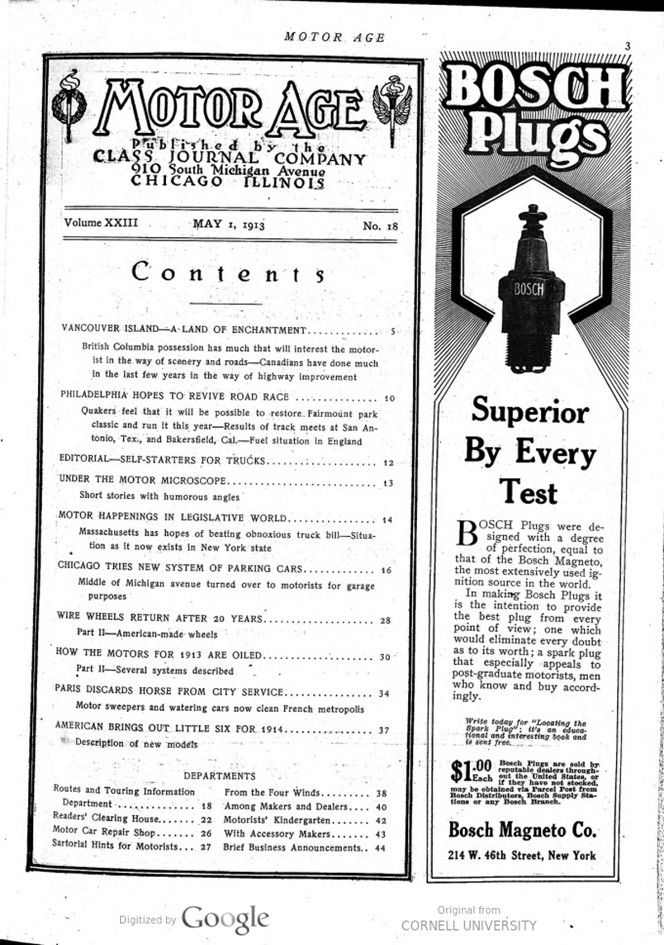
Motor Age, Vol. XXIII (23), No.18, May 1, 1925
Wire Wheels Return After 20 Years
American-Made Wheels Part II
By H. A. Tarantous
THERE are eight American makes of wire wheels on the market and if recent reports are to be upheld, within a short time this side of the Atlantic will see no less than twelve makers in the field. Already one manufacturer has come forward with a substantial hub, which is used in the conversion of wood-wheeled car to a wire-wheeled one. Within a short time it is expected that many more such makers will dot the field.
The distinguishing feature of the different makes of wire wheels is in the method of demounting and the type of hub used. The general principle in all the types is the same. There is an inner hub which contains the bearings. This is permanently mounted on the axle and the hub of the wire wheel is forced over the inner hub by means of some threaded device, usually a nut. The nut is used also in pulling the wheel from the axle. The locking arrangements are many.
McCue a Prominent Make
One of the prominent American makers is the McCue Co., Buffalo, N. Y., which is offering wire wheels in two shapes, double and triple cross-spoked. These types were illustrated in Motor Age last week in the first article of this series. Both McCue types are demountable and are made with clincher or Q. D. rims. The inner hub referred to previously is shown in the illustration of the McCue wheel, on this page. This part which contains the axle bearing, is fastened permanently to the axle. The pointed studs on the axle hub fit into holes in the wheel hub. The quick turn of a wrench is all that is necessary for the removal of a McCue wheel, and it is said that the wheel may be taken off in 8 seconds exclusive of jacking.
In the triple-spoked type there are seventy spokes, twenty-eight being on the outside and forty-two on the inside. This arrangement is necessary in order to make each spoke do its share of the work.
The spokes are made of wire manufactured by the American Steel and Wire Co. This company has been paying special attention to wire wheel materials and it is due partly to its efforts that the wire wheel has such high efficiency.
In some respects the Frayer wire wheel, manufactured by Frayer, Howard & Co., Columbus, Ohio, is similar to the McCue. The illustration on one of these pages showing the inside of the hub and the axle hub, show that the latter has pointed studs which fasten into the wheel hub. There are three in this case whereas in the McCue wheel there are six. The Frayer wheel is constructed on the cross-spoke type; those spokes on the outer end of the hub crossing through and lacing from the inside of the rim. The form of lacing used on this wheel has the advantage of leaving the base for the tire smooth, so as not to interfere with applying or removing the tire. As in most cases, the axle hub of the front wheel contains the bearing and in the rear also the mechanism to which the brake drums are attached. The exterior of the axle hubs are tapered as may be seen from the illustration, this tapered portion fitting into an opening in the wheel proper. The wheel is drawn back on the taper of the axle hub, or inner hub as it is called sometimes, by means of a nut. This nut is held in place by a latch. The application of the wrench releases the latch after which the nut may be unscrewed. With the nut off, the wheel is removed easily.
A characteristic type is the E. C. wheel, which has a demountable hub, wherein all locking mechanism is carried in the hub itself and not in the hub cap, thus eliminating injuring due to a collision. The driving mechanism of the E. C. is different than that of the other types, in that a plain hexagonal taper is used instead of the studs. An illustration in this article shows a view of the inside of the wheel at the hub. The wheel is forced into position and withdrawn by means of a lock ring. This ring is made of bronze and is turned into place by means of a special two-end wrench. E. C. wheels are made by the E. C. Sales Co., Chicago.
The T. J. Lindsay Co., Indianapolis, Ind., is offering wire wheels in both the steel rim and demountable wooden rim types. The latter type has fastened to the steel rim another rim of hickory, 1½ inches thick. The tire is locked on by means of six bolts and clamps. This wheel has sixty spokes, thirty on each side, and is adaptable to any standard demountable rim for wooden wheels.
Mott With Demountable Rim
A seventy-spoked wire wheel is being marketed by the Mott Wheel Works, Utica, N. Y., which is of the double spoke construction. Those wheels previously mentioned were mostly of the triple spoke type without demountable rims. The Utica-made product has a demountable rim which is removable by taking off five nuts, the time required being about 10 seconds. There are twenty-eight spokes on the inside and forty-two on the outside, which ratio is in use on a number of other makes. The spread of the spokes at the hub is 5 inches and at the rim 14 inches. It was said in last week’s article that great spread at the hub was necessary for the proper performance of the wire wheel, and the Mott wheel brings this out well. A feature of the wheel is that it locks itself automatically when slipped into place. The wheel itself is detachable by the use of a specially designed tool.
The New York firm headed by Robert Ashley advocates the quick detachable rim, thereby obviating the necessity of carrying a spare wheel. The parts of the rim are illustrated on one of these pages. The spokes are connected at their upper ends to the Q. D. base rim. A twist of the wrist is all that is necessary in removing the rim, only 10 seconds being required to jack up the car and take off the rim. Attaching the rim is accomplished in less time.
In Anderson, Ind., the Hill-Standard Mfg. Co. is making a wire wheel for which great simplicity is claimed. The maker states that in the event of an accident and the wheel is injured, it is cheaper to get a new wheel than to have the old one repaired. He cites the example of the block motor, which is cheaper to replace than to repair. The wheel is of the demountable type, having crossed spokes. These are seventy-two in number, thirty-six on each side. Here the spread at the hub is 3½ inches and at the rim 2 inches, claim being made that the narrow hub thus obtained is readily adaptable to spindles equipped for wooden wheels.
Whiteside Original Construction
An original spoke construction is to be seen in the wheels manufactured by the Whiteside Wheel Co., Indianapolis, Ind. The spokes run off one side at a tangent and in the same direction, while on the other side the degree of tangency is the same, but the direction opposite. The illustration of the wheel on one of these pages shows the Whiteside form of construction. There are forty spokes, twenty on each side, with a spread at the hub of 3½ inches and at the rim of 1 inch. Like the Hill-Standard, this form gives a narrow hub. The double-spoked wheel illustrated is considered by the manufacturer to have great sidewise elasticity because of the peculiar spoke arrangement. Another feature of the wheel is the absence of screw nipples for holding the spokes, nuts or any threaded parts. The elimination of the latter, it is claimed, gives a continuous even tension of the spokes. The wheel is demountable and is made for adaption to old cars as a substitute for wooden wheels, and also for new cars.
With the rapid advance of the wire wheel, many owners whose cars are equipped now with the wooden type, wish to have the more recent adoption. Lammert & Mann, Chicago, are furnishing the American substitution hub, illustrated in this article, which is made to fit over the hub of the wooden wheel by removing the wooden spokes. This method does not require additional bearings and uses much of the structure of the wooden wheel. Lammert & Mann manufacture the parts necessary for the conversion of a wooden wheeled car to a wire wheeled one and also issue a booklet containing instructions for the proper performance of the work of transformation. (To be continued)
Photo captions.
Page 28.
MOTT WIRE WHEEL WITH DEMOUNTABLE RIM
Types of Wire Wheels and Two Methods of Attachment. Reading from left to right–Lindsay double-spoke; Frayer, showing inside of hub, and wrench; McCue double-spoke, also inner hub and wrench; Whiteside tangent crossed spoke construction
Page 29.
From left to right Hill-Standard narrow hub type; American substitution hub; hub over which American substitution may be fitted. The difficulty lies in shaping the hub to fit over the portion A B; inner plate; hexagonal taper drive of E-C wheel
PARTS OF ASHLEY UNIVERSAL RIM