In 1926, the British-French manaufacturer Sunbeam-Talbot-Darracq, STD, created a Grand Prix car with 91½ inch engine displacement which was very succesfull in the European Grands Prix. A technical desciption is given here.


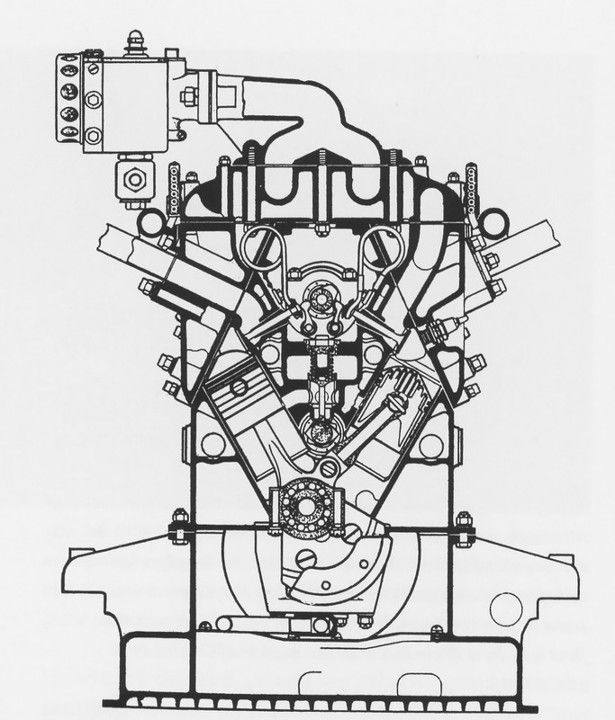
Text and jpegs by courtesy of hathitrust.org www.hathitrust.org, compiled by motorracinghistory.com
Motor Age, Vol. L (50), No. 2, July 15, 1926
12 Cylinder 67 Cubic Inch Sport Car Brought Out by Itala
New Line Is Designed to Meet Demand for Fast Roadster As Well As for Use Upon Race Track
By W. F. BRADLEY (European Staff Correspondent)
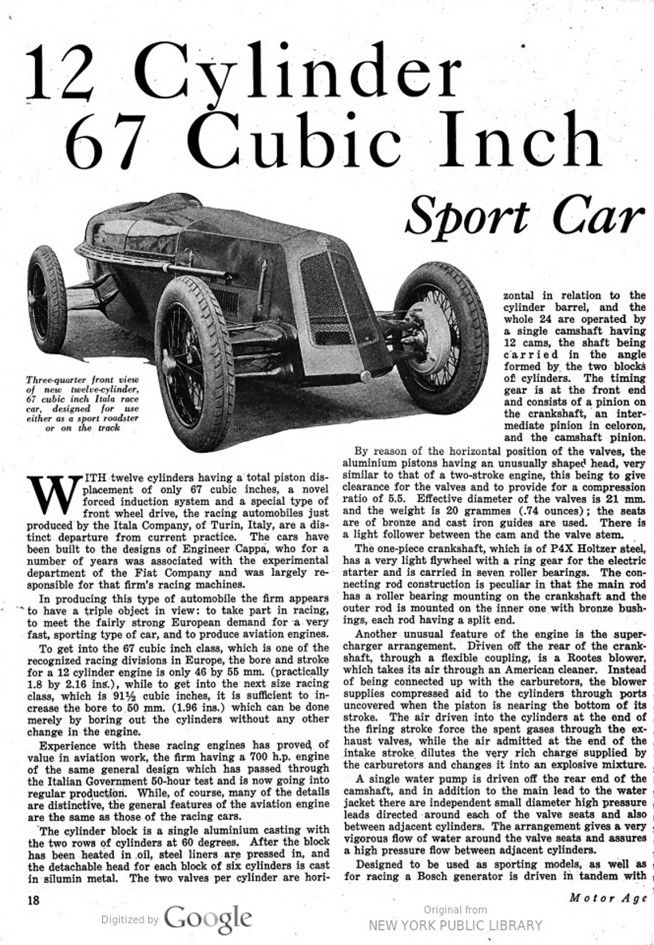
WITH twelve cylinders having a total piston displacement of only 67 cubic inches, a novel forced induction system and a special type of front wheel drive, the racing automobiles just produced by the Itala Company, of Turin, Italy, are a distinct departure from current practice. The cars have been built to the designs of Engineer Cappa, who for a number of years was associated with the experimental department of the Fiat Company and was largely responsible for that firm’s racing machines.
In producing this type of automobile, the firm appears to have a triple object in view: to take part in racing, to meet the fairly strong European demand for a very fast, sporting type of car, and to produce aviation engines. To get into the 67 cubic inch class, which is one of the recognized racing divisions in Europe, the bore and stroke for a 12 cylinder engine is only 46 by 55 mm. (practically 1.8 by 2.16 ins.), while to get into the next size racing class, which is 912 cubic inches, it is sufficient to increase the bore to 50 mm. (1.96 ins.) which can be done merely by boring out the cylinders without any other change in the engine.
Experience with these racing engines has proved of value in aviation work, the firm having a 700 h.p. engine of the same general design which has passed through the Italian Government 50-hour test and is now going into regular production. While, of course, many of the details are distinctive, the general features of the aviation engine are the same as those of the racing cars.
The cylinder block is a single aluminium casting with the two rows of cylinders at 60 degrees. After the block has been heated in oil, steel liners are pressed in, and the detachable head for each block of six cylinders is cast in silumin metal. The two valves per cylinder are horizontal in relation to the cylinder barrel, and the whole 24 are operated by a single camshaft having 12 cams, the shaft being carried in the angle formed by the two blocks of cylinders. The timing gear is at the front end and consists of a pinion on the crankshaft, an intermediate pinion in celoron, and the camshaft pinion. By reason of the horizontal position of the valves, the aluminium pistons having an unusually shaped head, very similar to that of a two-stroke engine, this being to give clearance for the valves and to provide for a compression ratio of 5.5. Effective diameter of the valves is 21 mm., and the weight is 20 grammes (.74 ounces); the seats are of bronze and cast-iron guides are used. There is a light follower between the cam and the valve stem.
The one-piece crankshaft, which is of P4X Holtzer steel, has a very light flywheel with a ring gear for the electric starter and is carried in seven roller bearings. The connecting rod construction is peculiar in that the main rod has a roller bearing mounting on the crankshaft and the outer rod is mounted on the inner one with bronze bushings, each rod having a split end.
Another unusual feature of the engine is the supercharger arrangement. Driven off the rear of the crankshaft, through a flexible coupling, is a Rootes blower, which takes its air through an American cleaner. Instead of being connected up with the carburetors, the blower supplies compressed aid to the cylinders through ports uncovered when the piston is nearing the bottom of its stroke. The air driven into the cylinders at the end of the firing stroke force the spent gases through the exhaust valves, while the air admitted at the end of the intake stroke dilutes the very rich charge supplied by the carburetors and changes it into an explosive mixture.
A single water pump is driven off the rear end of the camshaft, and in addition to the main lead to the water jacket there are independent small diameter high pressure leads directed around each of the valve seats and also between adjacent cylinders. The arrangement gives a very vigorous flow of water around the valve seats and assures a high-pressure flow between adjacent cylinders.
Designed to be used as sporting models, as well as for racing a Bosch generator is driven in tandem with the air compressor, being at the extreme rear of the engine. Ignition, however, is supplied by a couple of six-cylinder type Bosch magnetos, driven from a cross shaft at the front of the engine, each one supplying current to a group of six cylinders. It is stated that the engine speed is 8000 revolutions a minute, and that with the engine running at 6000 revolutions a road speed of 100. miles an hour is obtained.
A high-pressure lubricating system is used, with a single oil pump. The main supply of oil, practically 5 gallons, is carried in the lower portion of the base chamber, which is isolated from the upper part, so that there can be no splash, and it is of greater width than the rest of the engine. The oil is led direct to the seven main bearings and through the hollow shaft to the roller bearing connecting rods. By reason of the design of the bearing caps, oil taken to the inner roller bearing cannot escape laterally but is forced through from this to the bronze bushings of the outer rod.
Viewed externally, the Itala engine is a metal box with a couple of carburetors attached. The valve operating mechanism is enclosed in an oil tight housing, yet the camshaft, valves and valve springs are more accessible than on the normal L-head engine.
Bolted up to the front end of the engine is the clutch housing, the gearbox and the transmission casing. This consists of two castings: clutch housing, gearbox and one half of transmission housing in one unit, and forward half of transmission housing and radiator platform as the second unit, the two being bolted together.
Front-end construction comprises two transverse drive shafts from the bevel pinion, each shaft having a spherical joint at the outer end and a sliding joint on the inner end. Viewed externally the front-end construction is symmetrical, there being an oval section casing both above and below the drive shaft, the inner ends of these casings being secured to the differential housing and the outer ends attached to the steering pivot housing.
The construction above the drive shaft consists of a very broad cantilever spring, the two extremities of which are mounted between rubber blocks. The entire spring is enclosed in a sheet metal casing, which gives protection and diminishes head resistance without interfering with the free movement of the spring, for connection between the casing and the differential housing is made by means of a broad rubber band. The construction under the drive shaft is similar except that the cantilever spring is replaced by a rigid beam, with a spring mounting at each extremity.
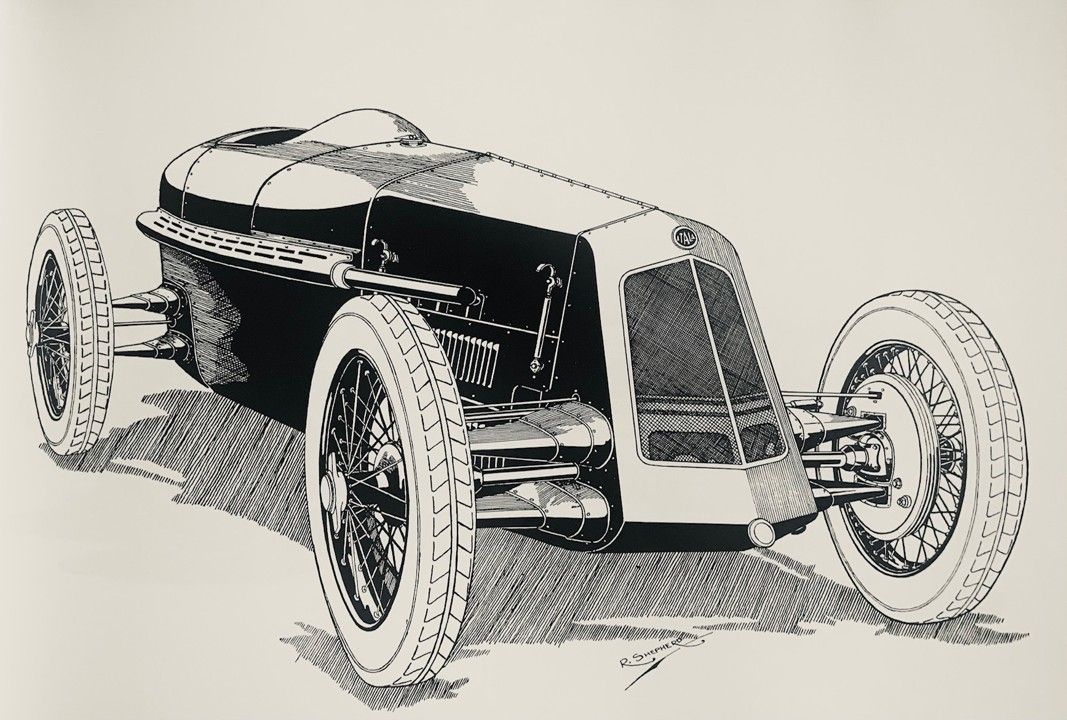
The rear end construction is an exact duplicate of that at the front, minus the driving mechanism. The same differential housing is used, without anything in it, and these front and rear housings are united by armored wood frame members. The steering gear is carried on the top of the gearbox, the steering column being horizontal and the steering wheel vertical. The first models to be produced have single seater bodies with the European width of 31 inches.
With 12 cylinders there is an exhaust pipe on each side‘ of the car, but instead of the gases being expelled through the end of the pipe, they pass into an expansion chamber forming a portion of the rear end of the body and escape through louvres in the tail.
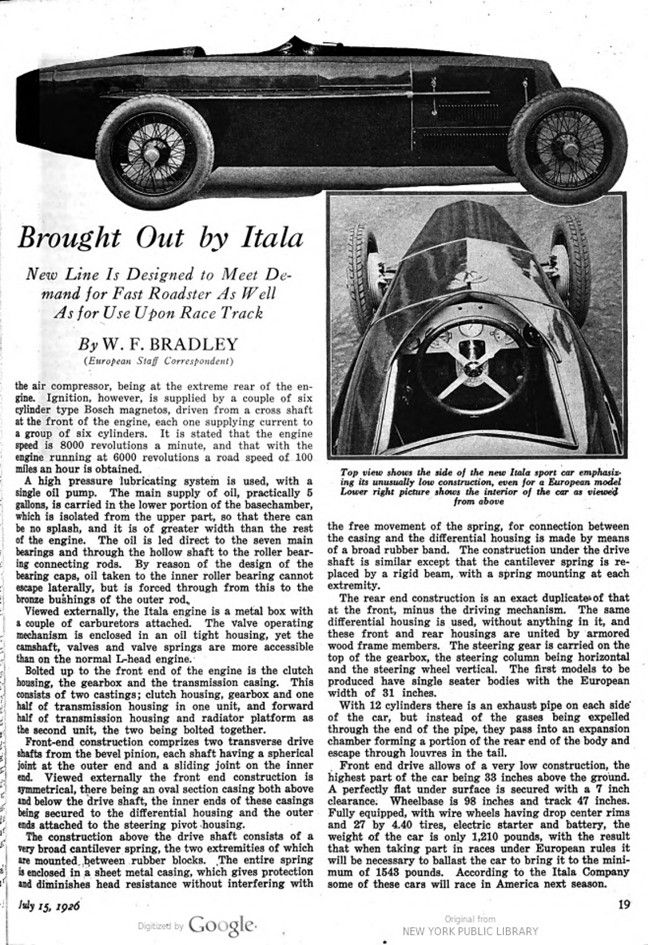
Front end drive allows of a very low construction, the highest part of the car being 33 inches above the ground. A perfectly flat under surface is secured with a 7-inch clearance: Wheelbase is 98 inches and track 47 inches. Fully equipped, with wire wheels having drop center rims and 27 by 4.40 tires, electric starter and battery, the weight of the car is only 1,210 pounds, with the result that when taking part in races under European rules it will be necessary to ballast the car to bring it to the minimum of 1543 pounds. According to the Itala Company some of these cars will race in America next season.
Photos.
Page 18. Three-quarter front view of new twelve-cylinder, 67 cubic inch Itala race car, designed for use either as a sport roadster or on the track
Page 19. Top view shows the side of the new Itala sport car emphasizing its unusually low construction, even for a European model Lower right picture shows the interior of the car as viewed from above