Text and jpegs by courtesy of hathitrust.org www.hathitrust.org, compiled by motorracinghistory.com
Motor Age, Vol. XLIX, 49, No. 21, May 27, 1926
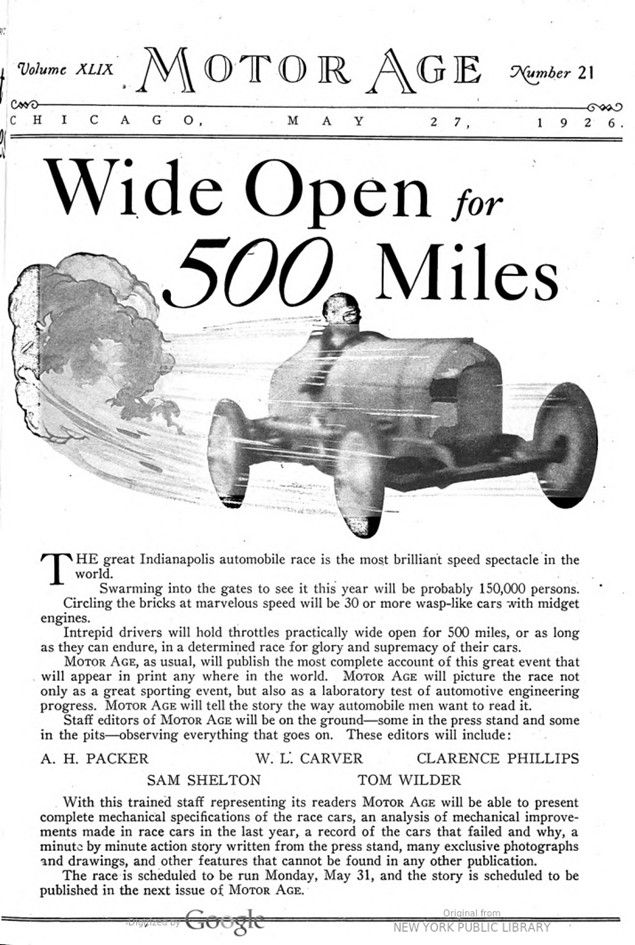
Wide Open for 500 Miles
THE great Indianapolis automobile race is the most brilliant speed spectacle in the world.
Swarming into the gates to see it this year will be probably 150,000 persons. Circling the bricks at marvelous speed will be 30 or more wasp-like cars with midget engines.
Intrepid drivers will hold throttles practically wide open for 500 miles, or as long as they can endure, in a determined race for glory and supremacy of their cars.
MOTOR AGE, as usual, will publish the most complete account of this great event that will appear in print any where in the world. MOTOR AGE will picture the race not only as a great sporting event, but also as a laboratory test of automotive engineering progress. MOTOR AGE will tell the story the way automobile men want to read it.
Staff editors of MOTOR AGE will be on the ground – some in the press stand and some in the pits – observing everything that goes on. These editors will include:
A. H. PACKER – W. L. CARVER – CLARENCE PHILLIPS – SAM SHELTON – TOM WILDER
With this trained staff representing its readers MOTOR AGE will be able to present complete mechanical specifications of the race cars, an analysis of mechanical improvements made in race cars in the last year, a record of the cars that failed and why, a minute by minute action story written from the press stand, many exclusive photographs and drawings, and other features that cannot be found in any other publication.
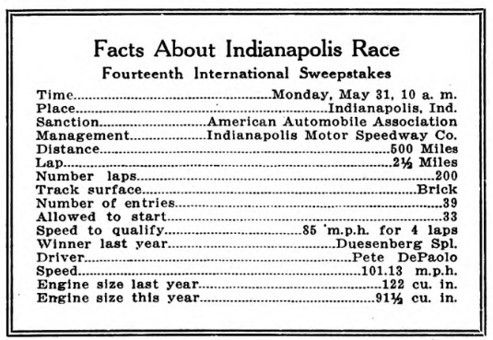
The race is scheduled to be run Monday, May 31, and the story is scheduled to be published in the next issue of MOTOR AGE.
Battle of the Midgets
Foreign Entrants, Superchargers and Small Engines of Four, Six and Eight Cylinders Intensify Interest in Indianapolis 500-Mile Race
By A. H. PACKER
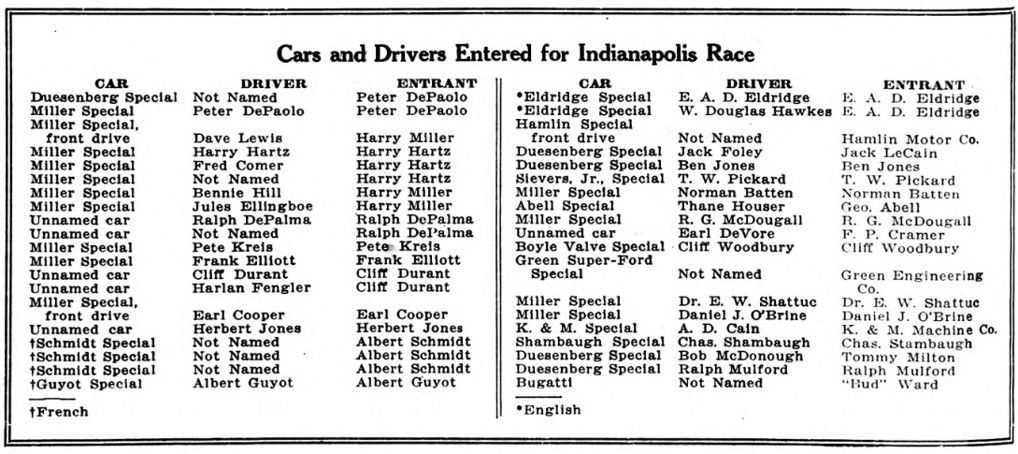
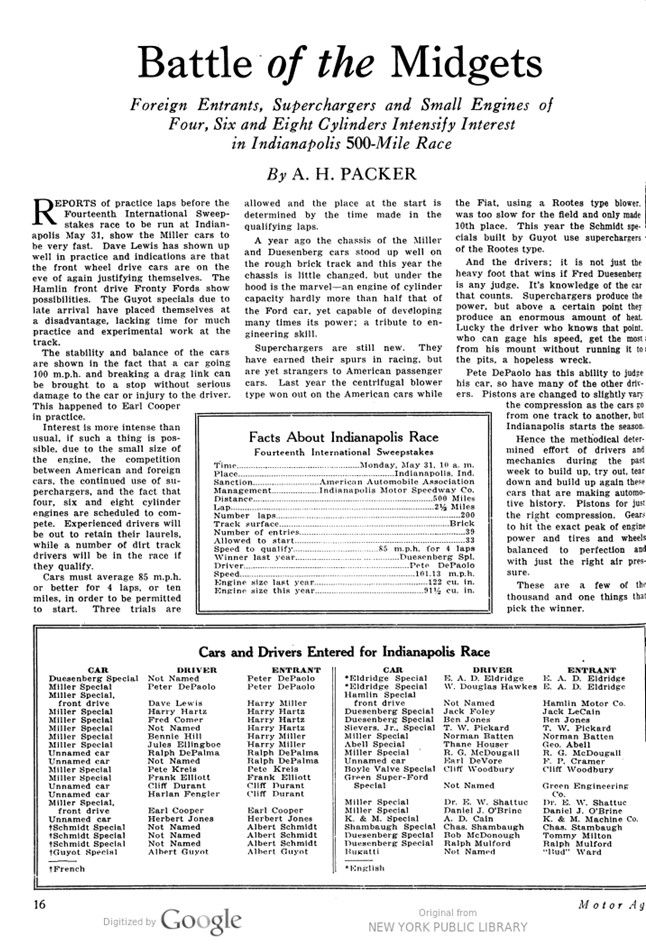
REPORTS of practice laps before the Fourteenth International Sweepstakes race to be run at Indianapolis May 31, show the Miller cars to be very fast. Dave Lewis has shown up well in practice and indications are that the front wheel drive cars are on the eve of again justifying themselves. The Hamlin front drive Fronty Fords show possibilities. The Guyot specials due to late arrival have placed themselves at a disadvantage, lacking time for much practice and experimental work at the track.
The stability and balance of the cars are shown in the fact that a car going 100 m.p.h. and breaking a drag link can be brought to a stop without serious damage to the car or injury to the driver. This happened to Earl Cooper in practice.
Interest is more intense than usual, if such a thing is possible, due to the small size of the engine, the competition between American and foreign cars, the continued use of superchargers, and the fact that four-, six- and eight-cylinder engines are scheduled to compete. Experienced drivers will be out to retain their laurels, while a number of dirt track drivers will be in the race if they qualify.
Cars must average 85 m.p.h. or better for 4 laps, or ten miles, in order to be permitted to start. Three trials are allowed and the place at the start is determined by the time made in the qualifying laps.
A year ago the chassis of the Miller and Duesenberg cars stood up well on the rough brick track and this year the chassis is little changed, but under the hood is the marvel – an engine of cylinder capacity hardly more than half that of the Ford car, yet capable of developing many times its power; a tribute to engineering skill.
Superchargers are still new. They have earned their spurs in racing, but are yet strangers to American passenger cars. Last year the centrifugal blower type won out on the American cars while the Fiat, using a Rootes type blower, was too slow for the field and only made 10th place. This year the Schmidt specials built by Guyot use superchargers of the Rootes type.
And the drivers; it is not just the heavy foot that wins if Fred Duesenberg is any judge. It’s knowledge of the car that counts. Superchargers produce the power, but above a certain point they produce an enormous amount of heat. Lucky the driver who knows that point, who can gage his speed, get the most from his mount without running it to the pits, a hopeless wreck.
Pete DePaolo has this ability to judge his car, so have many of the other drivers. Pistons are changed to slightly vary the compression as the cars go from one track to another, but Indianapolis starts the season.
Hence the methodical determined effort of drivers and mechanics during the past week to build up, try out, tear down and build up again these cars that are making automotive history. Pistons for just the right compression. Gears to hit the exact peak of engine power and tires and wheels balanced to perfection and with just the right air pressure.
These are a few of the thousand and one things that pick the winner.