

After the 1928 Indianapolis Race, many questioned the small 91.5 cubic inch (~1.5 liter) engined cars and generally the opinion grew more and more that the relatively high costst for these small cars could not be justified any more. One of the main contributors to high costs, was the expensive supercharger. After all, so was the idea, three years of racing with this engine displacement had already shown the very limited connection to all day’s automobiles. So now? How to continue?






Text and jpegs by courtesy of hathitrust.org www.hathitrust.org, compiled by motorracinghistory.com
MoToR, Vol. L, 50, No. 1, July 1928
Who Wants 91½ Inch Engines?
Should Racing Cars Be Changed?
By Harold F. Blanchard Technical Editor of MOTOR
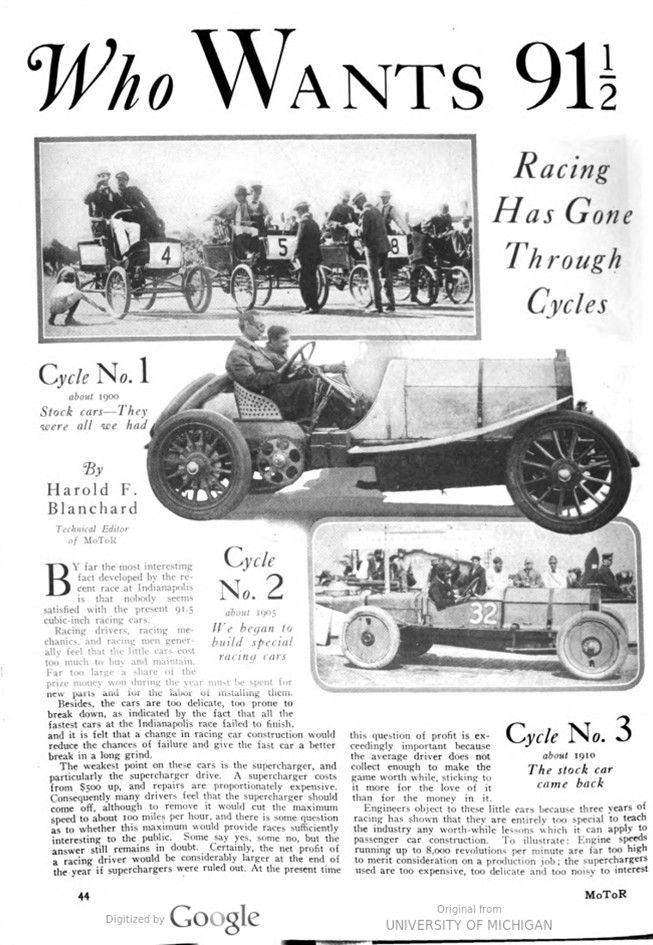
Racing Has Gone Through Cycles
Cycle No. 1 about 1900 Stock cars – They were all we had
Cycle No. 2 about 1905 We began to build special racing cars
Cycle No. 3 about 1910 The stock car came back
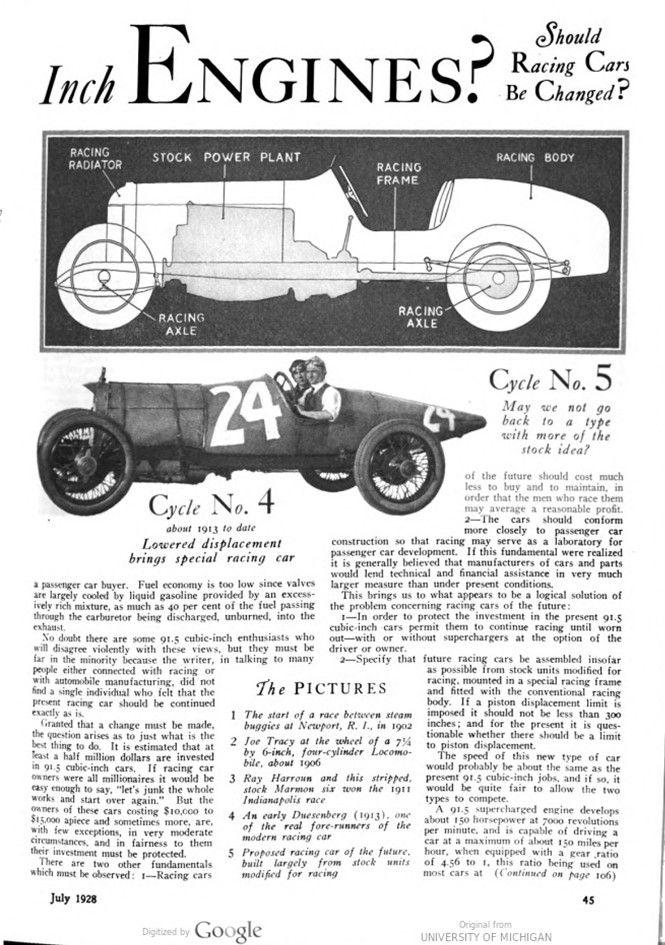
Cycle No. 4 about 1913 to date Lowered displacement brings special racing car
Cycle No. 5 May we not go back to a type with more of the stock idea?
BY far the most interesting fact developed by the recent race at Indianapolis is that nobody seems satisfied with the present 91.5 cubic-inch racing cars.
Racing drivers, racing mechanics, and racing men generally feel that the little cars cost too much to buy and maintain. Far too large a share of the prize money won during the year must be spent for new parts and for the labor of installing them.
Besides, the cars are too delicate, too prone to break down, as indicated by the fact that all the fastest cars at the Indianapolis race failed to finish, and it is felt that a change in racing car construction would reduce the chances of failure and give the fast car a better break in a long grind.
The weakest point on these cars is the supercharger, and particularly the supercharger drive. A supercharger costs from $500 up, and repairs are proportionately expensive. Consequently, many drivers feel that the supercharger should come off, although to remove it would cut the maximum speed to about 100 miles per hour, and there is some question as to whether this maximum would provide races sufficiently interesting to the public. Some say yes, some no, but the answer still remains in doubt. Certainly, the net profit of a racing driver would be considerably larger at the end of the year if superchargers were ruled out. At the present time this question of profit is exceedingly important because the average driver does not collect enough to make the game worthwhile, sticking to it more for the love of it than for the money in it.
Engineers object to these little cars because three years of racing has shown that they are entirely too special to teach the industry any worthwhile lessons which it can apply to passenger car construction. To illustrate: Engine speeds running up to 8,000 revolutions per minute are far too high to merit consideration on a production job; the superchargers used are too expensive, too delicate and too noisy to interest a passenger car buyer. Fuel economy is too low since valves are largely cooled by liquid gasoline provided by an excessively rich mixture, as much as 40 per cent of the fuel passing through the carburetor being discharged, unburned, into the exhaust.
No doubt there are some 91.5 cubic-inch enthusiasts who will disagree violently with these views, but they must be far in the minority because the writer, in talking to many people either connected with racing or with automobile manufacturing, did not find a single individual who felt that the present racing car should be continued exactly as is.
The PICTURES
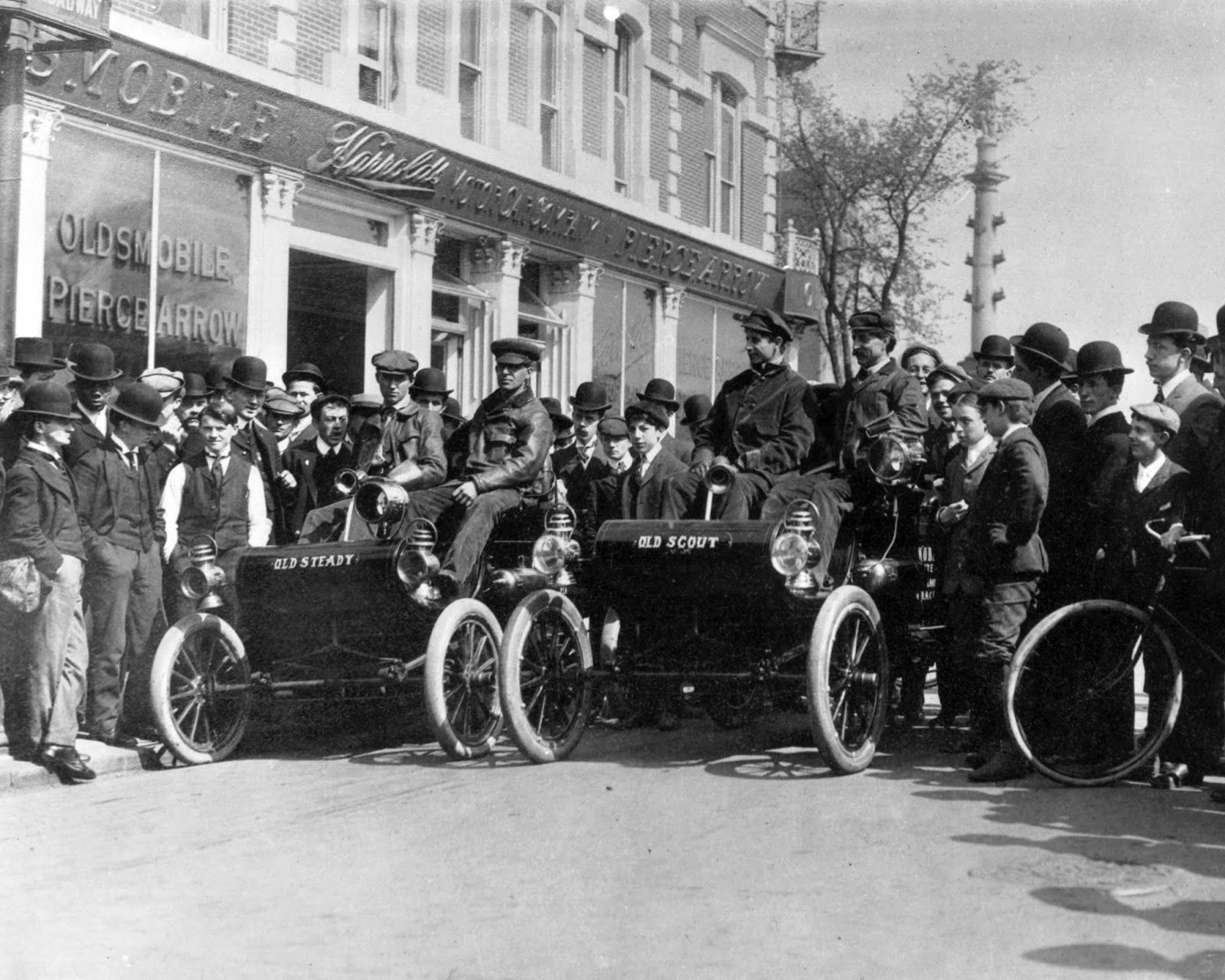
1 The start of a race between steam buggies at Newport, R. I., in 1902
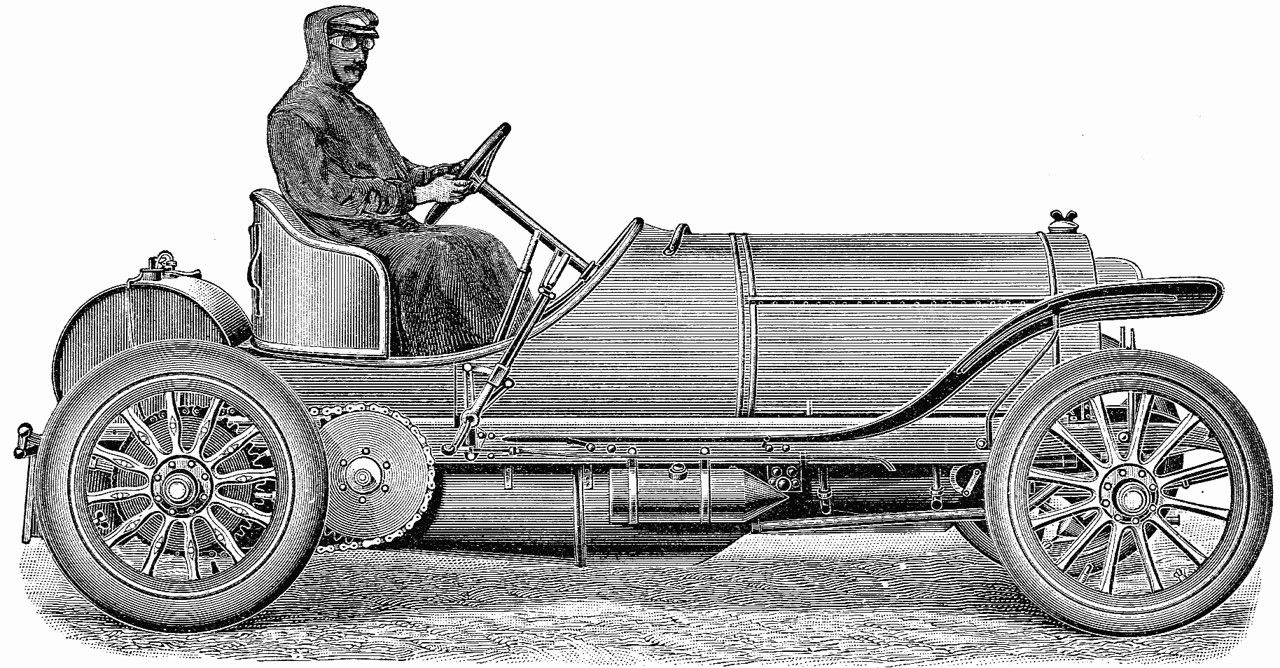
2 Joe Tracy at the wheel of a 74 by 6-inch, four-cylinder Locomobile, about 1906
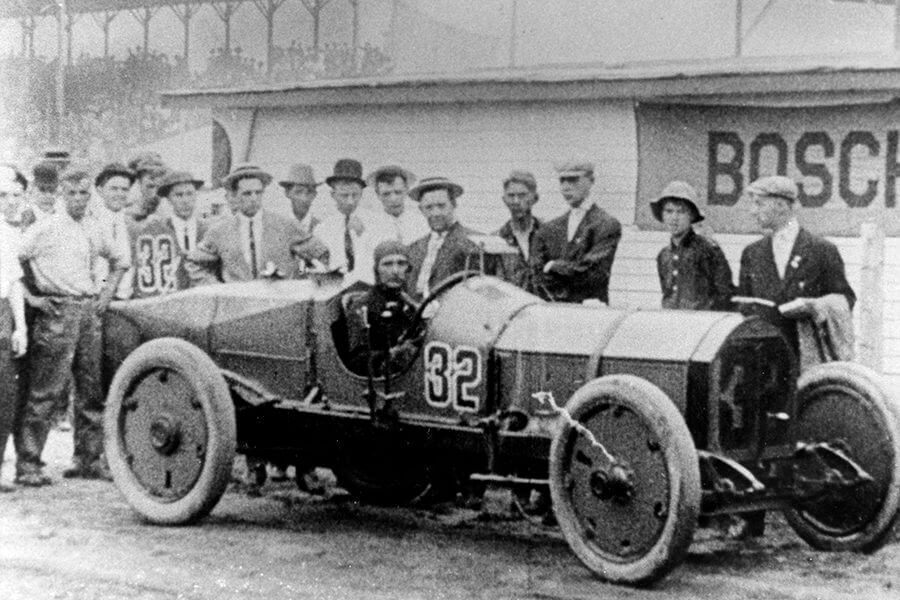
3 Ray Harroun and this stripped, stock Marmon six won the 1911 Indianapolis race
4 An early Duesenberg (1913), one of the real fore-runners of the modern racing car
5 Proposed racing car of the future, built largely from stock units modified for racing
(RACING RADIATOR – STOCK POWER PLANT – RACING BODY – RACING FRAME – RACING AXLE)
Granted that a change must be made, the question arises as to just what is the best thing to do. It is estimated that at least half a million dollars are invested in 91.5 cubic-inch cars. If racing car owners were all millionaires it would be easy enough to say, „let’s junk the whole works and start over again.“ But the owners of these cars costing $10,000 to $15,000 apiece and sometimes more, are, with few exceptions, in very moderate circumstances, and in fairness to them their investment must be protected.
There are two other fundamentals which must be observed:
1-Racing cars of the future should cost much less to buy and to maintain, in order that the men who race them may average a reasonable profit.
2-The cars should conform more closely to passenger car construction so that racing may serve as a laboratory for passenger car development.
If this fundamental were realized it is generally believed that manufacturers of cars and parts would lend technical and financial assistance in very much larger measure than under present conditions.
This brings us to what appears to be a logical solution of the problem concerning racing cars of the future:
1-In order to protect the investment in the present 91.5 cubic-inch cars permit them to continue racing until worn out-with or without superchargers at the option of the driver or owner.
2-Specify that future racing cars be assembled insofar as possible from stock units modified for racing, mounted in a special racing frame and fitted with the conventional racing body. If a piston displacement limit is imposed, it should not be less than 300 inches; and for the present it is questionable whether there should be a limit to piston displacement.
The speed of this new type of car would probably be about the same as the present 91.5 cubic-inch jobs, and if so, it would be quite fair to allow the two types to compete.
A 91.5 supercharged engine develops about 150 horsepower at 7000 revolutions per minute, and is capable of driving a car at a maximum of about 150 miles per hour, when equipped with a gear ratio of 4.56 to 1, this ratio being used on most cars at Indianapolis. It is probable that a modified production engine of 300 cubic inches would also eventually produce about 150 horsepower, and while weight and wind resistance might be a little greater on the new type car, its speed would certainly be 130 miles per hour, and no doubt some jobs would approach the 150-mile figure.
The details of this proposed car should be determined by a representative group of racing experts, but meanwhile, in order to lend definiteness to the idea, tentative specifications will be discussed, as follows:
1-It should not have a supercharger. This will not meet with the approval of those interested in superchargers, nor is it fair to the development of superchargers but there is another side to the question: Having spent several years and much money developing superchargers for racing cars, the present feeling is that they are unsatisfactory and should come off, that it is time to develop still further the un-supercharged engine. However, when better superchargers are developed they should again be permitted. But meanwhile for the sake of racing profits the supercharger should be eliminated.
2-The car should have a wheelbase of not more than 112 inches. A wheelbase of 100 inches is ideal for a racing car while large wheelbases are dangerous. The proposed car would probably require a wheelbase of more than 100 inches partly because of probable increased engine length, but more particularly because the heavier stock engine would probably have to be mounted further back in the chassis in order to secure a good weight distribution. There is also another angle to the wheelbase question. It is likely that this proposed car, with a two-seated body, would have a certain vogue as a sport roadster, and as such a wheelbase of 110 or 112 inches would be desirable for roadability.
3-The cylinder block should be stock in form – which means that it may be modified in small details, that is, modified without changing the form.
Parenthetically, it should be explained, that this proviso, as well as most others in this article, are offered as a means of fulfilling the dual fundamentals;
1-That future racing cars cost less to buy and maintain;
2-That their development more closely parallel passenger car practice. If a builder of one of these new type cars were permitted to produce a special design throughout the cost would be excessive. One of the expensive items is the cylinder block, hence the suggestion that it be stock.
4-The crankshaft must be made in production dies but the material may be special; crankpins may be bored out; counter-balance weights may be added.
5-A stock starting and lighting system must be used.
6-In all other respects the power plant may be stock or special at the option of the builder.
7-Clutch and transmission must be stock in form but may be modified in detail. That is, heavier clutch springs or a positive clutch lock may be fitted. Intermediate gears may be left out of the transmission, and different bearings, etc., may be used.
8-Axles may be specially constructed and even when stock axles are used, certain parts should meet certain safety requirements. For example, wheel spindles, tie-rod arms, and the like should be up to a certain size and strength. The same applies to steering gear linkage.
9-The frame must be special. This provision may be superfluous but the thought is that the builder should be forced to use a special frame fully meeting the requirements of racing, and that for safety and other reasons a cut-down stock car frame should not be used.
10-A racing body must be used and the radiator shell and hood must be of special design not resembling that on any production car unless the written permission of the car manufacturer is obtained. These provisions may also seem superfluous and perhaps they are but they are designed to prevent a driver shortening the wheelbase of some stock car and racing it more or less as is. This, obviously, would not be fair to the car manufacturer.
The foregoing rules may turn out to be too complete and then again, they may not be complete enough, but, their aim is mainly to cut racing cost and to assist the further development of passenger cars.
Whether the rules suggested are adequate or not, this is the way they are supposed to work: A man interested in building one of these proposed racing cars selects a powerful stock six or eight-cylinder engine. There are several stock engines, which, when properly tuned, will develop 100 to 120-horsepower, without departing from stock construction in any respect. A man who wished to get by with minimum expense could probably increase this power 10 to 20 per cent by making certain small changes such as the fitting of a larger intake manifold and racing carburetor, raising the compression, fitting valve springs more suitable for high speed, and se forth. Counterbalances on the crankshaft, if not already fitted, would probably be necessary to reduce bearing loads at excessive speeds.
It is not to be denied that certain production engines would develop troubles more or less difficult to overcome, if „hopped up“ for racing, but on the other hand it is believed that there are several engines which will stand this treatment with reasonable satisfaction.
Other minor changes might include a water pump of greater capacity, an ignition system designed especially for racing, detail changes in the lubricating system, special aluminum pistons designed to adequately conduct the excessive heat, special connecting-rods better able to withstand continuous high speed, etc.
If the builder wished to go to still further expense, he might make a special cylinder head, a special camshaft, or even a special valve gear, as for example the installation of overhead valves on an L-head block. Without question, if this type of car is accepted, racing accessories for certain stock engines such as racing camshafts, special cylinder heads, special pistons and rods, special valve gears, will be manufactured. And the same will be true of such other car units as body, frame, radiator, axles and so forth.
Hand-made frames of special design are naturally expensive but there is every indication that if this new type of racing car becomes a fact, special racing frames at reasonable cost will be available.
A stock clutch and transmission would be selected, although not necessarily of the same make as the engine. Racing axles and steering linkage would probably be used, although here again it is not likely they would have to be individually made, being secured instead from someone specializing in these units.
It is not easy to estimate the probable cost of this car. In some cases, the figure might be upwards of $5,000. On the other hand, certain racing experts believe that the cost of a conservatively built job might not exceed $1,500. It is not likely that full price would have to be paid for stock units. Secondhand units would often be available but more likely many suitable new units would be obtainable at manufacturing cost or less. In some cases, manufacturers of units would pay for having their units installed for advertising reasons and in other cases they would pay the driver a fee for experimental work, and sometimes the drivers, no doubt, would collect on both counts.
For several years past it has been the custom for various car and parts manufacturers to engage racing drivers to assist in experimental or developmental work. Consequently it is to be expected that a manufacturer with a new engine, for example, will often hire a race driver to assist in its perfection, and part of his work with the manufacturer will con- sist in installing the engine in a race car, testing it out in actual competition, in which case the driver will not only secure an engine at no cost but in addition will obtain an income for using it. The same applies to engine accessories, and in fact to all the units composing the car.
It remains to discuss how these changes will be put into practice. Contrary to popular belief, there is no rule in force limiting present racing cars to a piston displacement of 91.5 cubic inches; nor is there any rule preventing the use of the new type racing car.
In order to explain the vogue of the 91.5 cubic-inch car it is necessary to recall that all important races in this country are supervised by the Contest Board of the American Automobile Association. When the owner of a track wishes to promote a race he applies to the Contest Board for a sanction, and the granting of the sanction permits drivers and cars registered under the A. A. A. to participate.
Among other points which the sanction covers, is the question of piston displacement. The track owner can obtain a sanction for any piston displacement he desires to specify but if he specifies a piston displacement of 91.5 cubic inches, cars of greater displacement naturally cannot participate.
Since the Indianapolis race is and has been for years the most important race in the country with money prizes far in excess of those offered elsewhere, the piston displacement limit which the Speedway specifies on its sanction appears at present, at least, to be the controlling factor. Thus, cooperating with the trend in Europe, the sanction for the 1926 race specified 91.5 cubic-inch engines as compared to the three previous years when the sanction called for a piston displacement limit of 122 cubic inches. Sanctions for 1927 and 1928 Indianapolis races also called for 91.5 cubic-inch engines. Cars were built or revised to meet the 91.5 cubic-inch limit, and in most cases other track owners interested in securing the headliners during the last three seasons have also specified 91.5 cubic inches in their sanctions, since the headliners invariably possessed 91.5 cubic-inch jobs. Hence, to secure the headliners the 91.5 limit was almost imperative. It should be noted, however, that during these years some of the lesser tracks catering to second-string drivers and cars did not specify the 91.5 limit.
It is clearly apparent that the domination of the Indianapolis Speedway of this situation is accidental and not intentional, and so it appears that if it is desirable to develop a new type of racing car that the details should be decided by those most vitally interested, namely the racing car drivers, and racing car owners, although both the automotive industry and perhaps some of the more important track owners should also have a vote in the matter.