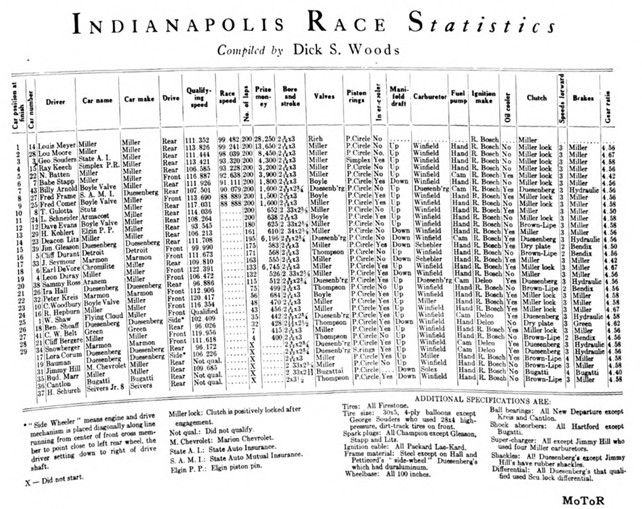
An very extensive report of the 1928 Indianapolis Race, by the magazine MoToR. Extensively in the manner, that a list of „Positions of Leading Drivers“ were tabled, as well as the „Indianapolis Race Statistcs“, compiled by Dick Woods.
Text and jpegs by courtesy of hathitrust.org www.hathitrust.org, compiled by motorracinghistory.com
MoToR, Vol. L, 50, No. 1, July 1928
The Indianapolis Race
Meyer Wins with Average of Nearly 100 M.P.H. – Terrific Pace at Start Forces Many Cars Out
By Harold F. Blanchard Technical Editor of MOTOR
Photographs by Kirkpatrick Indianapolis
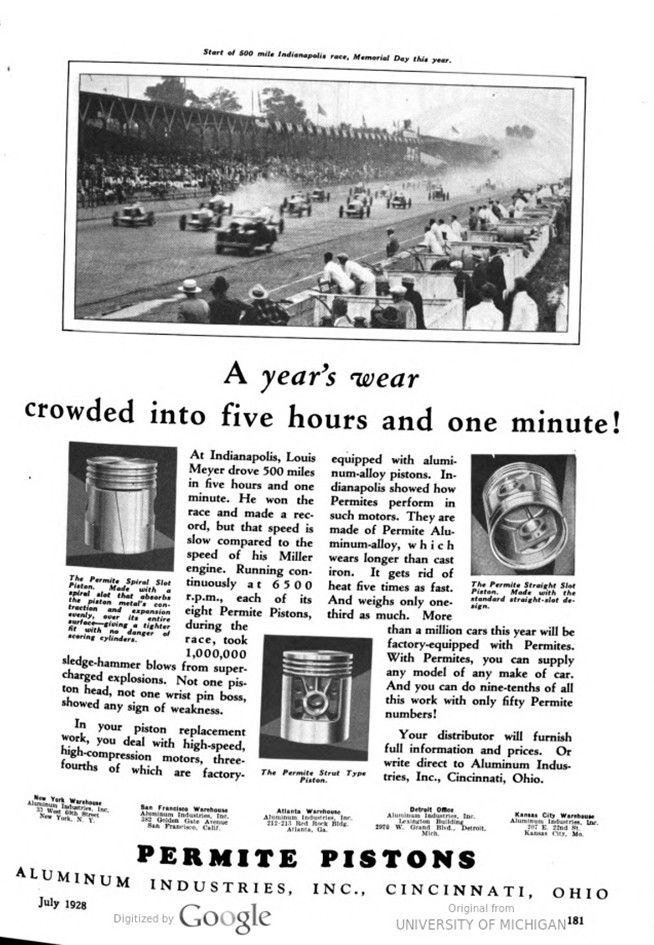
TWENTY-THREE-year-old Louis Meyer, a dirt-track driver from Los Angeles, won the recent race at Indianapolis in a rear-drive Miller at a speed of 99.482 miles per hour, beating Souder’s time of 97.45 last year, but failing to equal Pete De Paolo’s 1925 record of 101.13. Meyer drove the whole distance without relief.
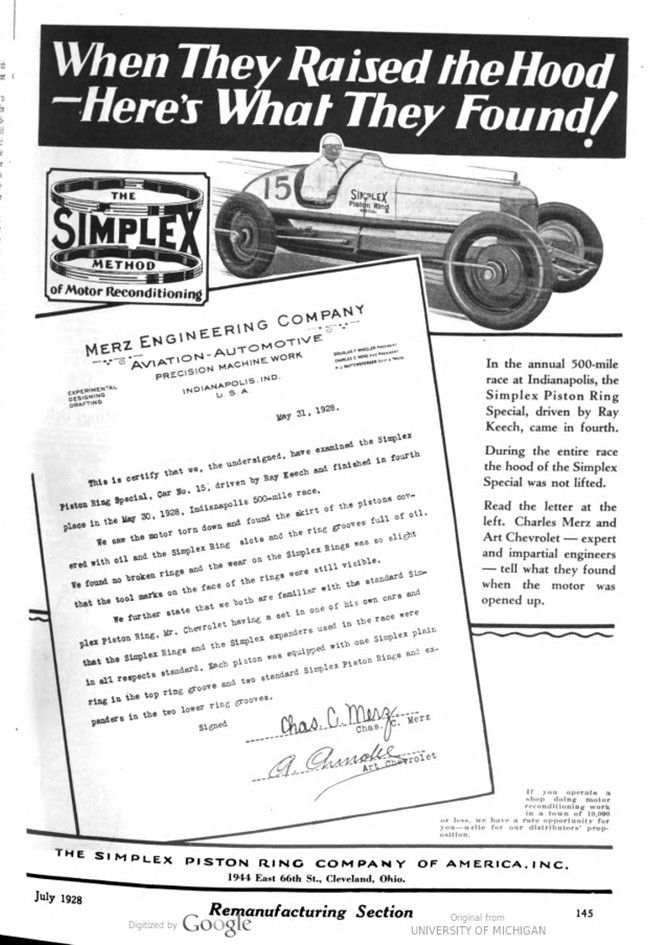
Louis Schneider, driving relief for Louis Moore was second in a Miller; Dutch Baumann, relief for Tony Gulotta was third in a Miller front-drive bearing the Stutz nameplate; Ray Keech in a Simplex Piston Ring Special was fourth; Zeke Meyer, driving for Norman Batten, took fifth position in a Miller.
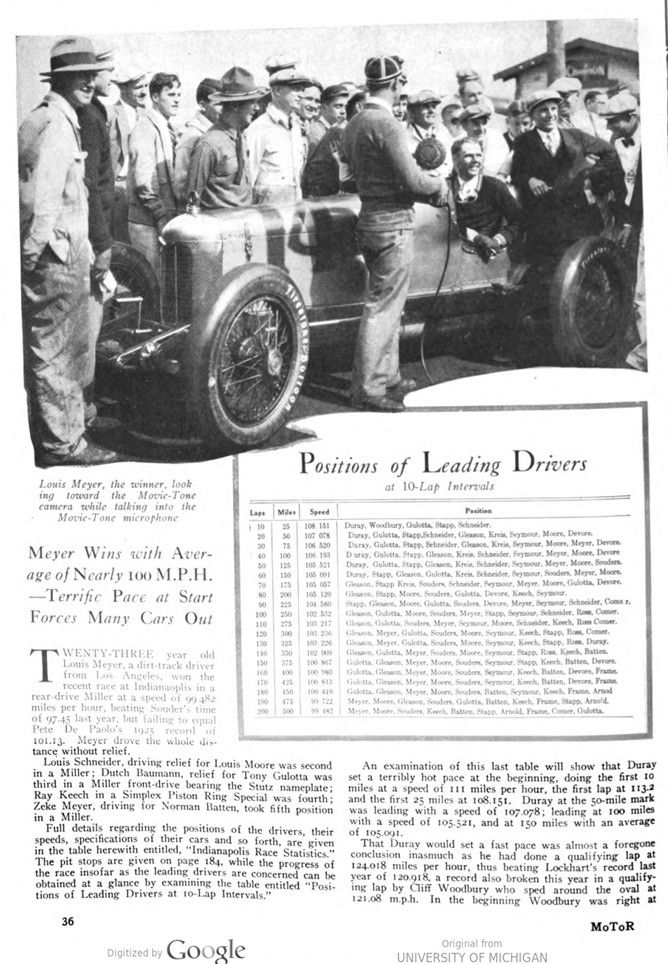
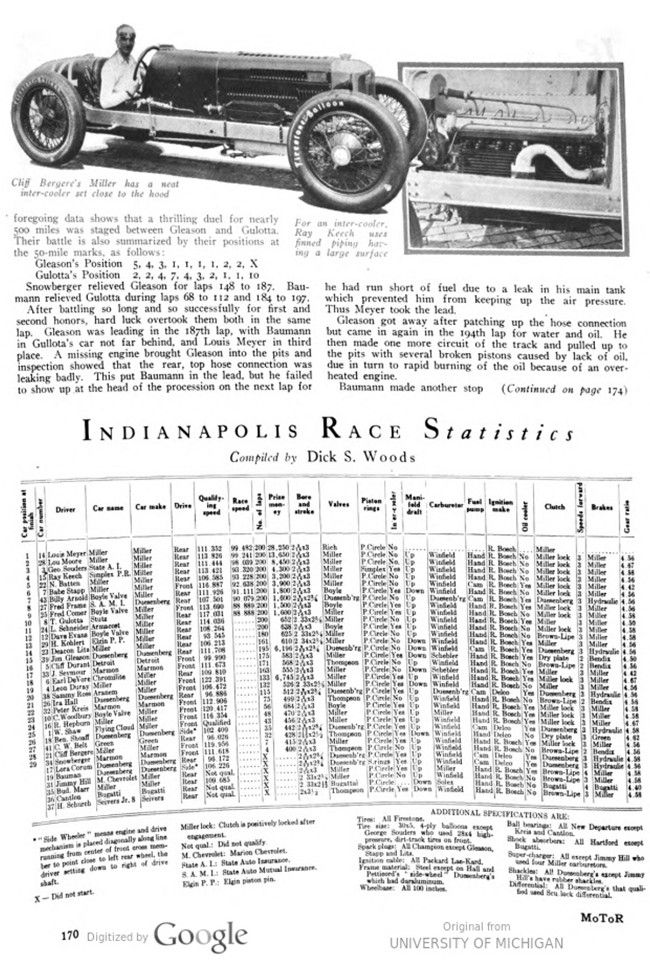
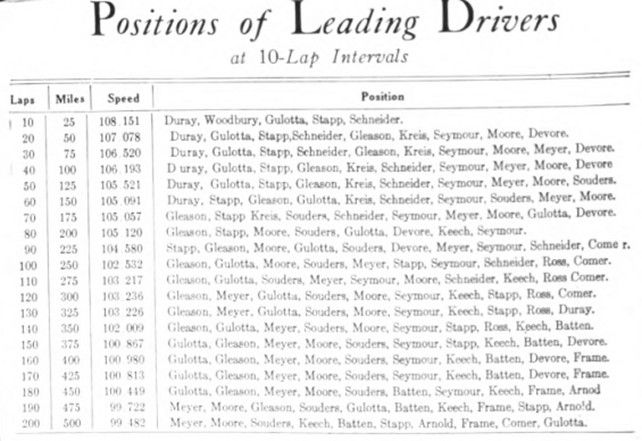
Full details regarding the positions of the drivers, their speeds, specifications of their cars and so forth, are given in the table herewith entitled, “Indianapolis Race Statistics.” The pit stops are given on page 184, while the progress of the race insofar as the leading drivers are concerned can be obtained at a glance by examining the table entitled “Positions of Leading Drivers at 10-Lap Intervals.”
An examination of this last table will show that Duray set a terribly hot pace at the beginning, doing the first 10 miles at a speed of 111 miles per hour, the first lap at 113.2 and the first 25 miles at 108.151. Duray at the 50-mile mark was leading with a speed of 107.078, leading at 100 miles with a speed of 105.521, and at‘ 150 miles with an average of 105.091.
That Duray would set a fast pace was almost a foregone conclusion inasmuch as he had done a qualifying lap, at 124.018 miles per hour, thus beating Lockhart’s record last year of 120.918, a record also broken this year in a qualifying lap by Cliff Woodbury who sped around the oval at 121.08 m.p.h. In the beginning Woodbury was right at Duray’s heels but dropped back in the 14th lap due to time lost changing spark plugs.
According to the official record the leaders during the various laps were as follows: Duray 1-54; Stapp 55-57; Duray 58-62; Souders 63-78; Gleason 79-82; Stapp 83-96; Gleason 97-148; Gulotta 149-181; Gleason 182-186; Meyer 187-200.
But this does not agree entirely with the record of the leaders at intervals of 10 laps, as follows: Lap 10 Duray; lap 20 Duray lap 30 Duray; lap 40 Duray; lap 50 Duray; lap 60 Duray; lap 70 Gleason; lap 80 Gleason; lap 90 Stapp; lap 100 Gleason; lap 110 Gleason; lap 120 Gleason; lap 130 Gleason; lap 140 Gleason; lap 150 Gulotta; lap 160 Gulotta ; lap 170 Gulotta; lap 1&o Gulotta ; lap 190 Meyer; lap 200 Meyer.
It is not possible to keep all details concerning the progress of the race so thoroughly in mind that the discrepancy in these two records can be explained, and the timing tape which carries the complete record is unavailable at this writing.
However, the foregoing data shows that a thrilling duel for nearly 500 miles was staged between Gleason and Gulotta. Their battle is also summarized by their positions at the 50-mile marks, as follows:
Gleason’s Position 5, 4, 3, I, I, I, I, 2, 2, X
Gulotta’s Position 2, 2, 4, 7, 4, 3, 2, I, I, 10
Snowberger relieved Gleason for laps 148 to 187. Baumann relieved Gulotta during laps 68 to 112 and 184 to 197.
After battling so long and so successfully for first and second honors, hard luck overtook them both in the same lap. Gleason was leading in the 187th lap, with Baumann in Gullota’s car not far behind, and Louis Meyer in third place. A missing engine brought Gleason into the pits and inspection showed that the rear, top hose connection was leaking badly. This put Baumann in the lead, but he failed to show up at the head of the procession on the next lap for he had run short of fuel due to a leak in his main tank which prevented him from keeping up the air pressure. Thus Meyer took the lead.
Gleason got away after patching up the hose connection but came in again in the 194th lap for water and oil. He then made one more circuit of the track and pulled up to the pits with several broken pistons caused by lack of oil, due in turn to rapid burning of the oil because of an overheated engine.
Baumann made another stop for gasoline on the 197th lap, but due to his fuel trouble the best he could get was 10th place.
Capt. E. V. Rickenbacker, Chairman of the Contest Board, and President of the Speedway was called upon for a grave and critical decision when it started to sprinkle about 2 o’clock. The sky had become overcast, and he ordered the caution flag displayed as soon as the first few drops were felt. The field slowed down but during the light shower that followed the track got extremely slick from the oil thrown off by the cars and the rain, and Devore took a heart-stopping spin on the north turn coming into the homestretch. It didn’t seem possible the cars immediately following could miss him, but miraculously they did, and although he hit the wall lightly, he escaped without a scratch, straightened his car out, and continued to drive. The crash, however, produced a serious leak in his fuel tank, and because of danger of catching fire, he was called into the pits, where after an examination, the technical committee refused to allow the car to continue.
The rain stopped before the track was really wet, and the race was continued.
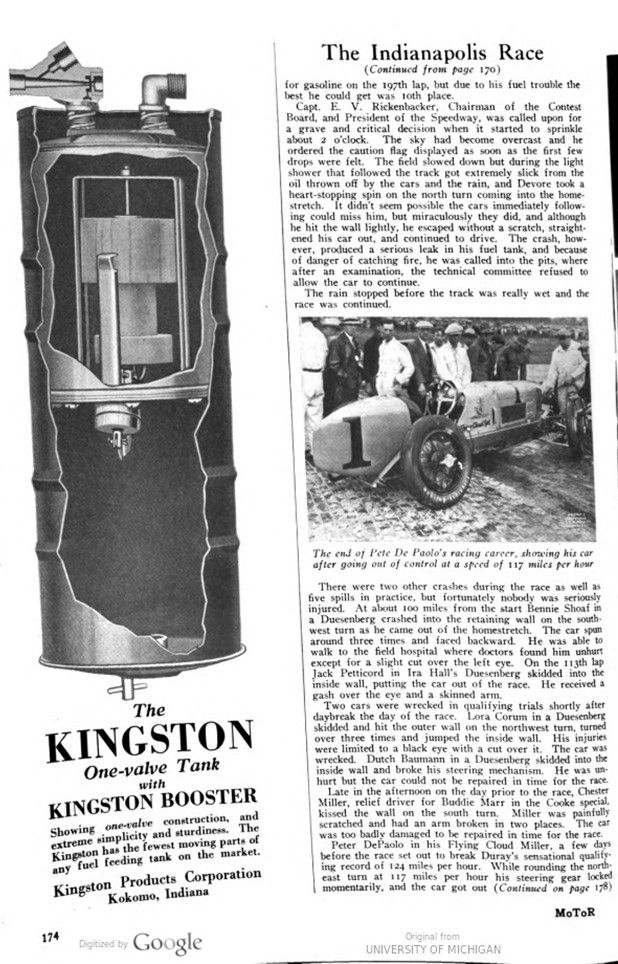
There were two other crashes during the race as well as five spills in practice, but fortunately nobody was seriously injured. At about 100 miles from the start Bennie Shoaf in a Duesenberg crashed into the retaining wall on the south-west turn as he came out of the homestretch. The car spun around three times and faced backward. He was able to walk to the field hospital where doctors found him unhurt except for a slight cut over the left eye. On the 113th lap Jack Petticord in Ira Hall’s Duesenberg skidded into the inside wall, putting the car out of the race. He received a gash over the eye and a skinned arm.
Two cars were wrecked in qualifying trials shortly after daybreak the day of the race. Lora Corum in a Duesenberg skidded and hit the outer wall on the northwest turn, turned over three times and jumped the inside wall. His injuries were limited to a black eye with a cut over it. The car was wrecked. Dutch Baumann in a Duesenberg skidded into the inside wall and broke his steering mechanism. He was unhurt but the car could not be repaired in time for the race. Late in the afternoon on the day prior to the race, Chester Miller, relief driver for Buddie Marr in the Cooké special, kissed the wall on the south turn. Miller was painfully scratched and had an arm broken in two places. The car was too badly damaged to be repaired in time for the race.
Peter DePaolo in his Flying Cloud Miller, a few days before the race set out to break Duray’s sensational qualifying record of 124 miles per hour. While rounding the north-east turn at 117 miles per hour his steering gear locked momentarily, and the car got out of control. Pete with great presence of mind lay down in the seat and grasped the steering column. The car turned several somersaults and finally threw him out. His injuries were painful but not serious, consisting of a cut on the chin and deep cuts on arms and legs. This ends his racing career for he had previously made up his mind that this would be his last race, since he had decided to enter business while still young. The car was repaired and started in the race by Wilbur Shaw.
Kelly Patillo, who was to be relief driver for Kohlert, while practicing prior to the race, skidded in the center of the south turn and after crashing rear end first into the outer retaining wall, bounced to the inner wall. He was taken to the hospital but was back on the job in two hours, as good as ever. Kohlert repaired the car and started it in the race.
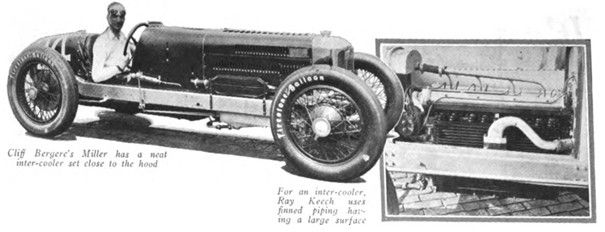
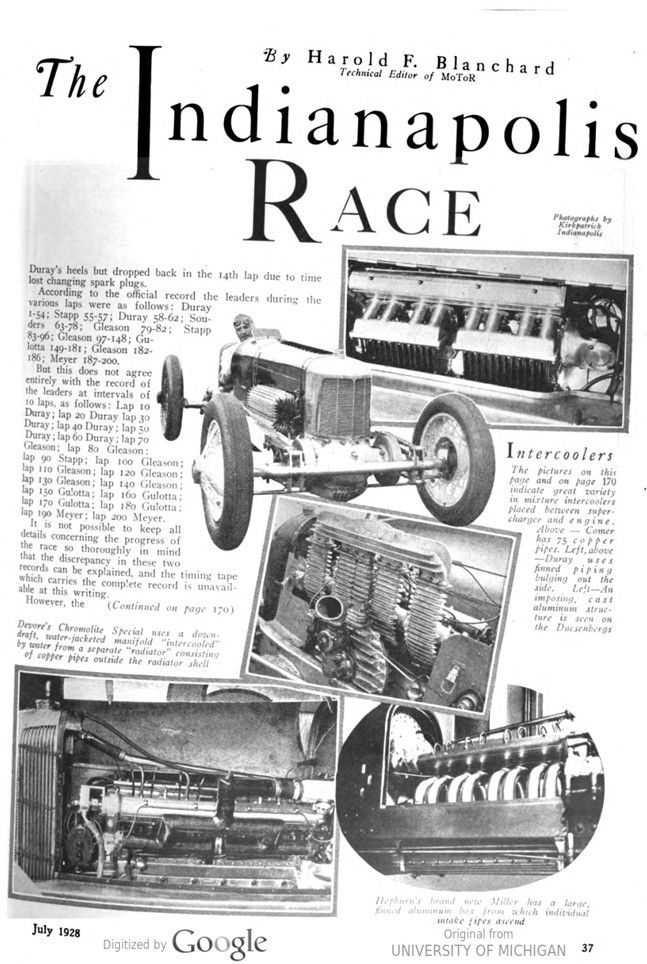
The cars in this year’s race have been changed only in minor particulars from last year. In general they have more elaborate inter-coolers of widely differing design as indicated by the accompanying photographs. Compressing the mixture in the supercharger naturally raises its temperature and the inter-cooler is a device placed between the supercharger and the cylinder block for cooling the mixture as it comes from the supercharger. The more the mixture is cooled the greater the power which the engine produces since a cool mixture weighs more than a warm mixture, and the greater the charge weight in the cylinder the greater the power produced.
More downdraft carburetors and manifolds were seen on this year’s cars. With the downdraft principle the carburetor is designed so that the flow of gas is down through it instead of up through it, and the manifolding is so laid out that the flow of mixture through it is down all the way from carburetor to engine. An excellent example of this system is Devore’s Chromolite Special illustrated herewith. The fundamental of the downdraft principle is that gravity assists the flow of mixture instead of resisting it as in the updraft system. Considering that very wet, heavy mixtures are used downdraft is of considerable advantage on this point alone since the pressure loss in the manifold must be somewhat less with gravity assisting mixture flow instead of opposing it, thus proportionately increasing the weight of charge delivered to the combustion chambers. But an even more important advantage is that with downdraft much larger manifolds section may be used, thus still further reducing the pressure loss in the manifold and correspondingly increasing the charge weight to the cylinder. Larger section manifolds, in turn, are feasible with downdraft because gravity assists in the distribution of the wet mixture and therefore lower velocities are permissible in the intake manifold. To quote figures: Let us say, that to secure proper distribution in an updraft manifold a maximum mixture velocity in the intake manifold of 13,000 feet per minute must be secured. If the maximum were much less than this figure particles of wet mixture would settle out and distribution would not be satisfactory. Therefore, the cross-section of the manifold is proportioned to give this maximum.
However, a larger section manifold would obviously result in less pressure loss and thus permit charges of greater weight and power to be delivered to the cylinders. Let us assume, therefore, that with the downdraft principle we can enlarge the manifold section to a point where the maximum mixture velocity is 8,000 feet. Due to the assistance of gravity, distribution with this relatively low velocity is satisfactory. Pressure loss in the manifold is about half what it was before, and the charge weight delivered to the cylinders is proportionately increased.
Aside from novelties in manifolding, by all odds the most interesting car in the race from a technical standpoint was Earl Devore’s Chromolite Special, a Miller. Instead of being painted, the exterior was entirely finished in chromium plate, including body, frame, axles, springs and wheels, making a very striking-looking job. Various engine parts were also chromium plated, including main bearing journals and crankpins, wristpins and valve cups against which the cams strike.
The excessively hard chromium film on the crankshaft made it possible to use special Lynite aluminum alloy connecting-rods and main bearing boxes, dispensing with babbitt in both cases, the journals resting directly on the aluminum alloy. The connecting-rods had a strength of 70,000 pounds as against the customary 50,000 for commercial aluminum alloy rods. Pistons were a magnesium alloy considerably lighter than the usual aluminum alloy. In consequence of these changes plus the elimination of the babbitt, the piston and rod assembly weighed about 12 ounces instead of about 19 ounces, thus reducing rod bearing pressures to 12/19 or to 63 per cent of what they normally would be.
Likewise the improved conductivity of all-aluminum connecting-rods as compared to steel rods, plus the improved conductivity of an all-aluminum rod as compared to the same rod lined with babbitt, plus the improved conductivity of babbitt-less aluminum main bearings as against babbitted steel bearings, resulted in the engine running 20 degrees cooler, and since heat is wasted power, Devore stated after the race that acceleration and power were noticeably improved by the changes described.
Aluminum alloy rods without babbitt have been tried experimentally by some passenger car manufacturers against a hard steel crankshaft, but the steel surface was not sufficiently hard to be suitable against the aluminum alloy. On the other hand, chromium is sufficiently hard to stand up against the aluminum alloy. The writer examined the bearings and crankshaft on Devore’s car after the race and found that the bearings were in better condition than the conventional babbitt bearings. The chromium was also in good condition although scratched through slightly in a few places, which is hardly to be wondered at considering the chromium film was only a quarter thousandth of an inch.
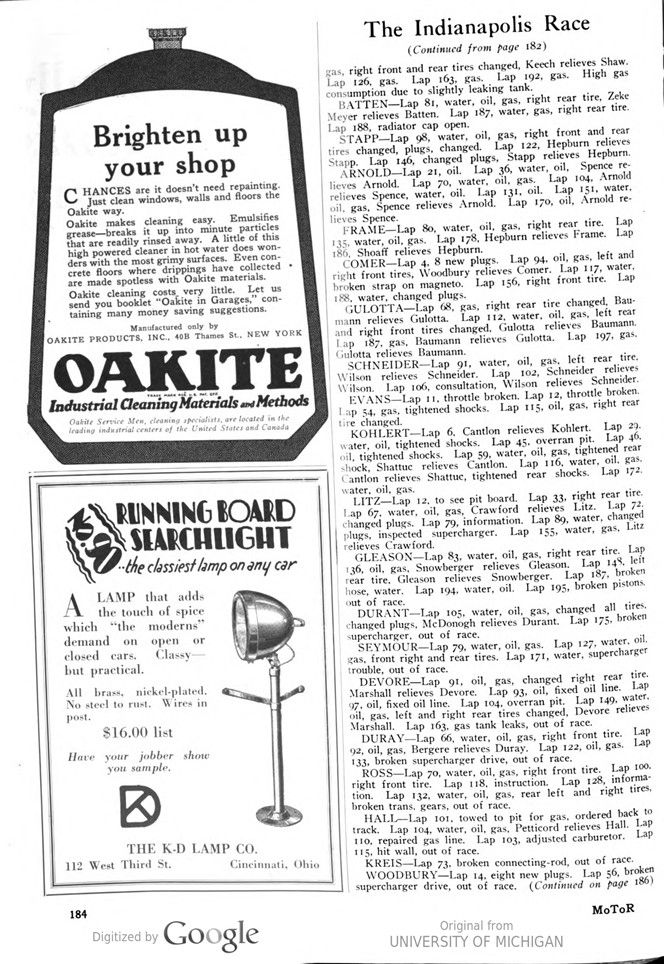
Thirty-three cars entered, twenty-nine started, of which fifteen dropped out before the race was over. There were eighty-nine pit stops. During these stops, drivers were changed thirty-two times, forty-seven tires were changed, gasoline was added forty-six times, water thirty-seven times, oil forty-four times, spark plugs were changed eleven times, while there were thirty cases of miscellaneous trouble. Eight cars dropped out with supercharger trouble.
MEYER—Lap 83, water, oil, gas, right front and rear tires changed.
MOORE—Lap 102, water, oil, gas, left front and rear tires, right front tire. Lap 133, right rear tire, Schneider relieves Moore.
SOUDERS-Lap 79, water, oil, gas, changed left and right rear tires. Lap 117, oil, gas, changed all tires. Lap 137, water, gas, changed left rear and right front tires.
KEECH–Lap 87, water, oil, gas, right rear tire changed, Shaw relieves Keech. Lap 117, oil, gas, right front and rear tires changed, Keech relieves Shaw. Lap 126, gas. Lap 163, gas. Lap 192, gas. High gas consumption due to slightly leaking tank.
BATTEN—Lap 81, water, oil, gas, right rear tire, Zeke Meyer relieves Batten. Lap 187, water, gas, right rear tire. Lap 188, radiator cap open.
STAPP—Lap 98, water, oil, gas, right front and rear tires changed, plugs, changed. Lap 122, Hepburn relieves Stapp. Lap 146, changed plugs, Stapp relieves Hepburn.
ARNOLD—Lap 21, oil. Lap 36, water, oil, Spence relieves Arnold. Lap 70, water, oil, gas. Lap 104, Arnold relieves Spence, water, oil. Lap 131, oil. Lap 151, water, oil, gas, Spence relieves Arnold. Lap 170, oil, Arnold relieves Spence.
FRAME—Lap 80, water, oil, gas, right rear tire. Lap 135, water, oil, gas. Lap 178, Hepburn relieves Frame. Lap 186, Shoaff relieves Hepburn.
COMER—Lap 4, 8 new plugs. Lap 94, oil, gas, left and right front tires, Woodbury relieves Comer. Lap 117, water, broken strap on magneto. Lap 156, right front tire. Lap 188, water, changed plugs.
GULOTTA-Lap 68, gas, right rear tire changed, Baumann relieves Gulotta. Lap 112, water, oil, gas, left rear and right front tires changed, Gulotta relieves Baumann. Lap 187, gas, Baumann relieves Gulotta. Lap 197, gas, Gulotta relieves Baumann.
SCHNEIDER—Lap 91, water, oil, gas, left rear tire, Wilson relieves Schneider. Lap 102, Schneider relieves Wilson. Lap 106, consultation, Wilson relieves Schneider.
EVANS—Lap 11, throttle broken. Lap 12, throttle broken. Lap 54, gas, tightened shocks. Lap 115, oil, gas, right rear tire changed.
KOHLERT-Lap 6, Cantlon relieves Kohlert. Lap 29, water, oil, tightened shocks. Lap 45 overran pit. Lap 46, oil, tightened shocks. Lap 59, water, oil, gas, tightened rear shock, Shattuc relieves Cantlon. Lap 116, water, oil, gas, Cantlon relieves Shattuc, tightened rear shocks. Lap 172, water, oil, gas.
LITZ—Lap 12, to see pit board. Lap 33, right rear tire. Lap 67, water, oil, gas, Crawford relieves Litz. Lap 72, changed plugs. Lap 79, information. Lap 89, water, changed plugs, inspected supercharger. Lap 155, water, gas, Litz relieves Crawford.
GLEASON—Lap 83, water, oil, gas, right rear tire. Lap 136, oil, gas, Snowberger relieves Gleason. Lap 143, left rear tire, Gleason relieves Snowberger. Lap 187, broken hose, water. Lap 194, water, oil. Lap 195, broken pistons, out of race.
DURANT—Lap 105, water, oil, gas, changed all tires. changed plugs, McDonogh relieves Durant. Lap 175, broken supercharger, out of race.
SEYMOUR—Lap 79, water, oil, gas. Lap 127, water, oil, gas, front right and rear tires. Lap 171, water, supercharger trouble, out of race.
DEVORE—Lap 91, oil, gas, changed right rear tire. Marshall relieves Devore. Lap 93, oil, fixed oil line. Lap 97, oil, fixed oil line. Lap 104, overran pit. Lap 149, water, oil , gas, left and right rear tires changed, Devore relieves Marshall. Lap 163, gas tank leaks, out of race.
DURAY—Lap 66, water, oil, gas, right front tire. Lap 92, oil, gas, Bergere relieves Duray. Lap 122, oil, gas. Lap 133, broken supercharger drive, out of race.
ROSS—Lap 70, water, oil, gas, right front tire. Lap 100, right front tire. Lap 118, instruction. Lap 128, information. Lap 132, water, oil, gas, rear left and right tires, broken trans. gears, out of race.
HALL–Lap 101, towed to pit for gas, ordered back to track. Lap 104, water, oil, gas, Petticord relieves Hall. Lap 110, repaired gas line. Lap 103 adjusted carburetor. Lap 115, hit wall, out of race. KREIS-Lap 73, broken connecting-rod, out of race.
WOODBURY-Lap 14, eight new plugs. Lap 56, broken supercharger drive, out of race.
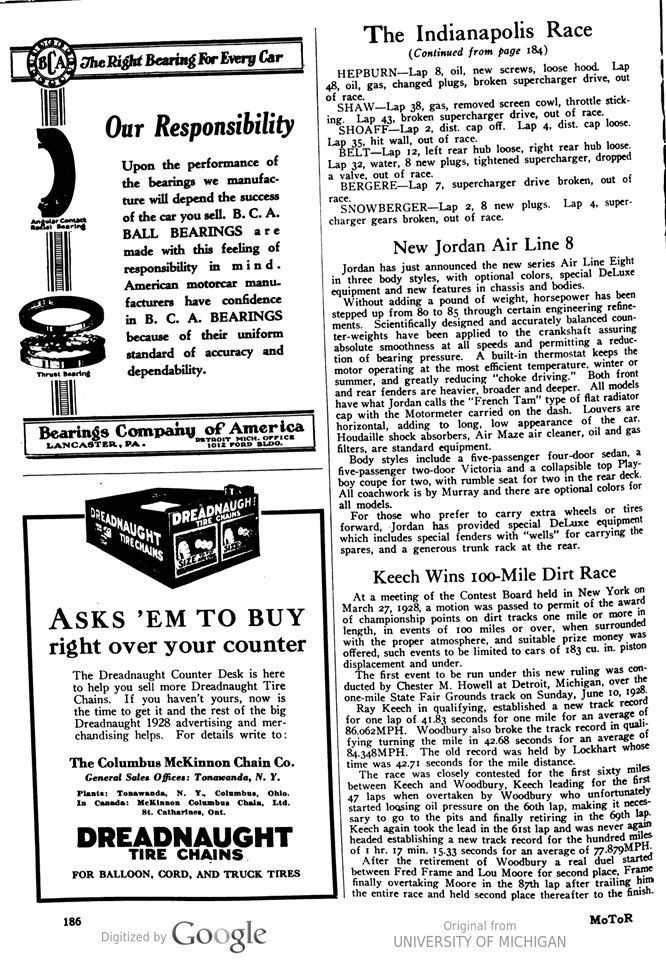
HEPBURN-Lap 8, oil, new screws, loose hood. Lap 48, oil, gas, changed plugs, broken supercharger drive, out of race. Our Responsibility
SHAW–Lap 38, gas, removed screen cowl, throttle sticking. Lap 43, broken supercharger drive, out of race.
SHOAFF-Lap 2, dist. cap off. Lap 4, dist. cap loose. Lap 35, hit wall, out of race.
BELT–Lap 12, left rear hub loose, right rear hub loose. Lap 32, water, 8 new plugs, tightened supercharger, dropped a valve, out of race.
BERGERE-Lap 7, supercharger drive broken, out of race.
SNOWBERGER-Lap 2, 8 new plugs. Lap 4, supercharger gears broken, out of race.
Photos.
Page 36.
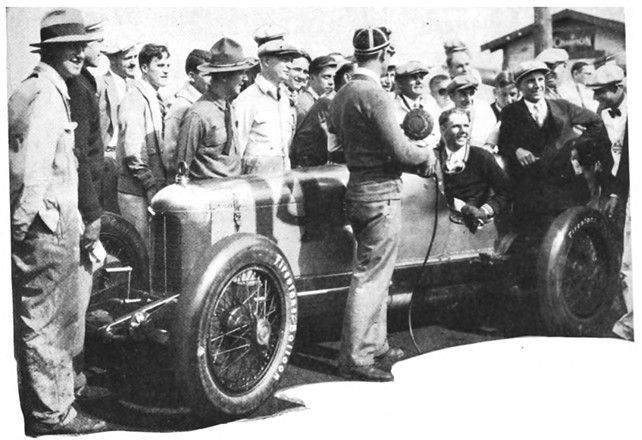
Louis Meyer, the winner, looking toward the Movie-Tone camera while talking into the Movie-Tone microphone.
Page 37.
Intercoolers: The pictures on this page and on page 170 indicate great variety in mixture intercoolers placed between supercharger and engine.
Above – Comer has 75 Copper pipes. Left, above – Duray uses finned piping bulging out the side. Left – An imposing, cast aluminum structure is seen the Duesenbergs.
Devore’s Chromolite Special uses a down-draft, water-jacketed manifold “intercooled” by water from a separate „radiator” consisting of copper pipes outside the radiator shell. Hepburn’s brand-new Miller has a large, finned aluminum box from which individual intake pipes ascend