Text and jpegs by courtesy of hathitrust.org www.hathitrust.org, compiled by motorracinghistory.com
Automobile Trade Journal, Vol. XXX, 30, No. 11, May 1, 1926
New Cars and Models
Single-Sleeve Valve Engines Will I Try Their Stuff at Indianapolis
91 inch engines this year will be 100 per cent supercharger equipped
IF all entries listed materialize into actual starters the Indianapolis 500-mile race to be held May 31st this year will be more international in aspect than any time since 1915. For the first time in several years there is a real diversification in constructional and design features of the entries. Heretofore the real competition has been largely confined to the cars built by Fred Duesenberg and Harry Miller. This year the Guyot-Schmidt Specials from France, and the Eldridge Specials from Great Britain are scheduled to come over and provide a thorn in the side of the Duesenberg-Miller jobs which have shared Indianapolis honors between them during the past four years. There will be fours, sixes, and eights with the latter type predominating.
There will be single-sleeve valve engines, and poppet valve engines. There will be superchargers on all of them as becomes good racing cars nowadays and more than one front drive job will be present to demonstrate its turn holding ability at high speed.
With the retirement of Tommy Milton, twice winner of the classic, interest centers on the young champion Peter de Paolo; on Bennie Hill, of the heavy foot; Bob McDonogh, famous graduate of a famous teacher; Dave Lewis, of front wheel drive renown; Earl Cooper, masterful but unlucky, Leon Duray, who drives them till they break up; Frank Elliott, who is always good for a big surprise, and the always in the money, Harry Hartz.
The summary specifications of the two foreign entries are shown in the following paragraphs.
Owned by Mr. H. Albert Schmidt, of Hunt Creek, Lewiston, Mich., and built in the shops of Albert Guyot, at Paris, the three Guyot specials for the Indianapolis race are distinctive in having a six-cylinder single-sleeve valve engine of the Burt-McCollum type world rights for which recently were obtained by Continental Motors Corp.
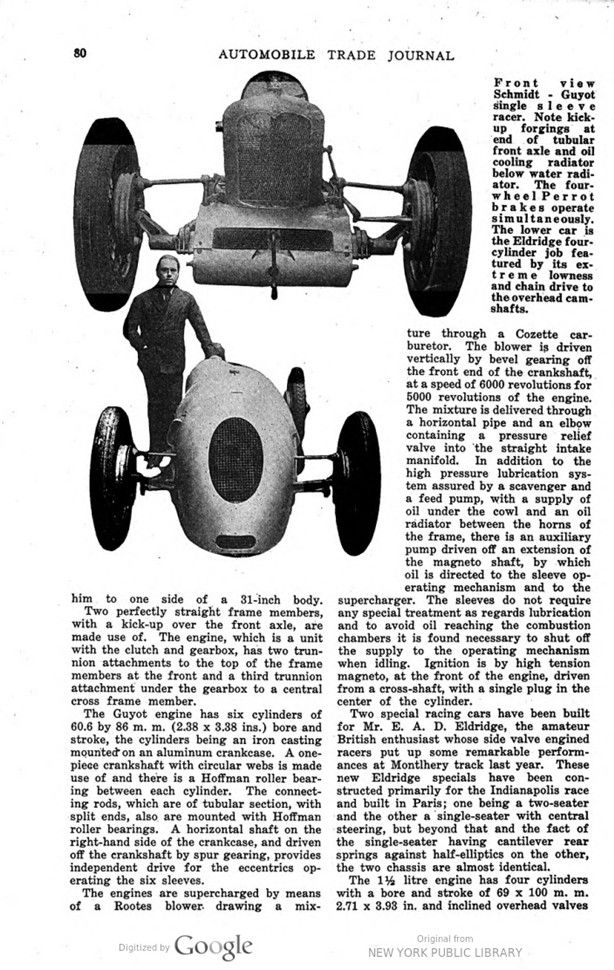
Track conditions have been kept prominently in view in laying out the design of these cars, and Guyot has preferred to meet American rather than European requirements. Thus, the frame is narrow, the steering is centrally placed, and the driver is in the middle, in contrast to the European practice of placing him to one side of a 31-inch body.
Two perfectly straight frame members, with a kick-up over the front axle, are made use of. The engine, which is a unit with the clutch and gearbox, has two trunnion attachments to the top of the frame members at the front and a third trunnion attachment under the gearbox to a central cross frame member.
The Guyot engine has six cylinders of 60.6 by 86 m. m. (2.38 x 3.38 ins.) bore and stroke, the cylinders being an iron casting mounted on an aluminum crankcase. A one-piece crankshaft with circular webs is made use of and there is a Hoffman roller bearing between each cylinder. The connecting rods, which are of tubular section, with split ends, also are mounted with Hoffman roller bearings. A horizontal shaft on the right-hand side of the crankcase, and driven off the crankshaft by spur gearing, provides independent drive for the eccentrics operating the six sleeves.
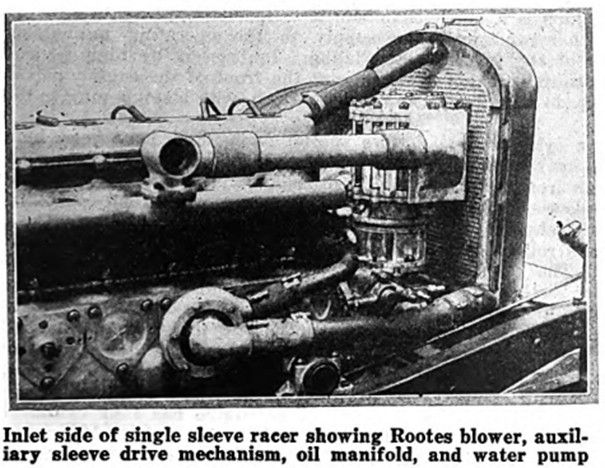
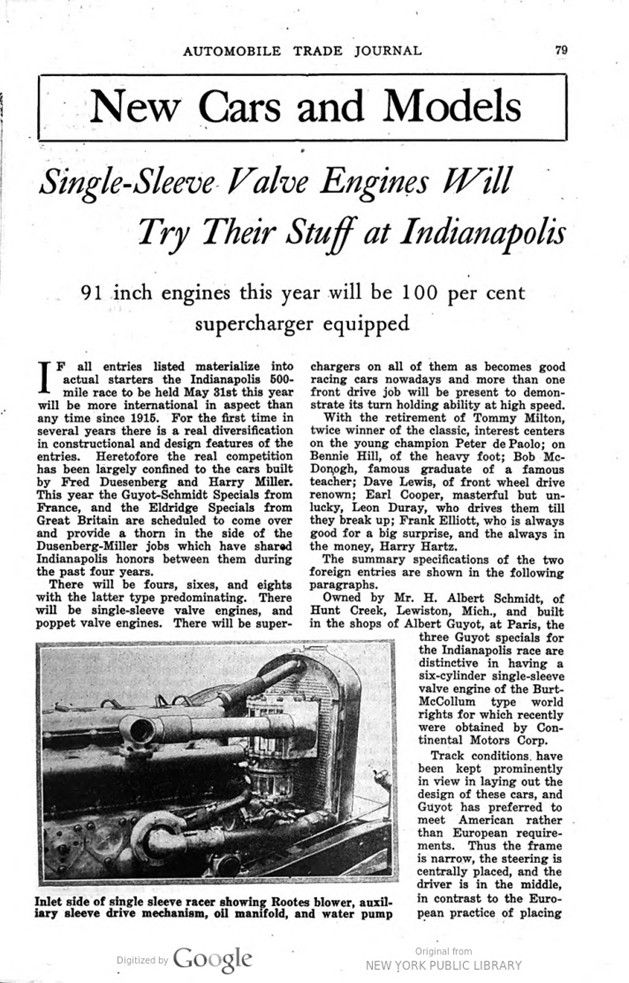
The engines are supercharged by means of a Rootes blower, drawing a mixture through a Cozette carburetor. The blower is driven vertically by bevel gearing off the front end of the crankshaft, at a speed of 6000 revolutions for 5000 revolutions of the engine. The mixture is delivered through a horizontal pipe and an elbow containing pressure relief valve into the straight intake manifold. In addition to the high pressure lubrication system assured by a scavenger and a feed pump, with a supply of oil under the cowl and an oil radiator between the horns of the frame, there is an auxiliary pump driven off an extension of the magneto shaft, by which oil is directed to the sleeve operating mechanism and to the supercharger. The sleeves do not require any special treatment as regards lubrication and to avoid oil reaching the combustion chambers it is found necessary to shut off the supply to the operating mechanism when idling. Ignition is by high tension magneto, at the front of the engine, driven from a cross-shaft, with a single plug in the center of the cylinder.
Two special racing cars have been built for Mr. E. A. D. Eldridge, the amateur British enthusiast whose side valve engined racers put up some remarkable performances at Montlhéry track last year. These new Eldridge specials have been constructed primarily for the Indianapolis race and built in Paris; one being a two-seater and the other a single-seater with central steering, but beyond that and the fact of the single-seater having cantilever rear springs against half-elliptics on the other, the two chassis are almost identical.
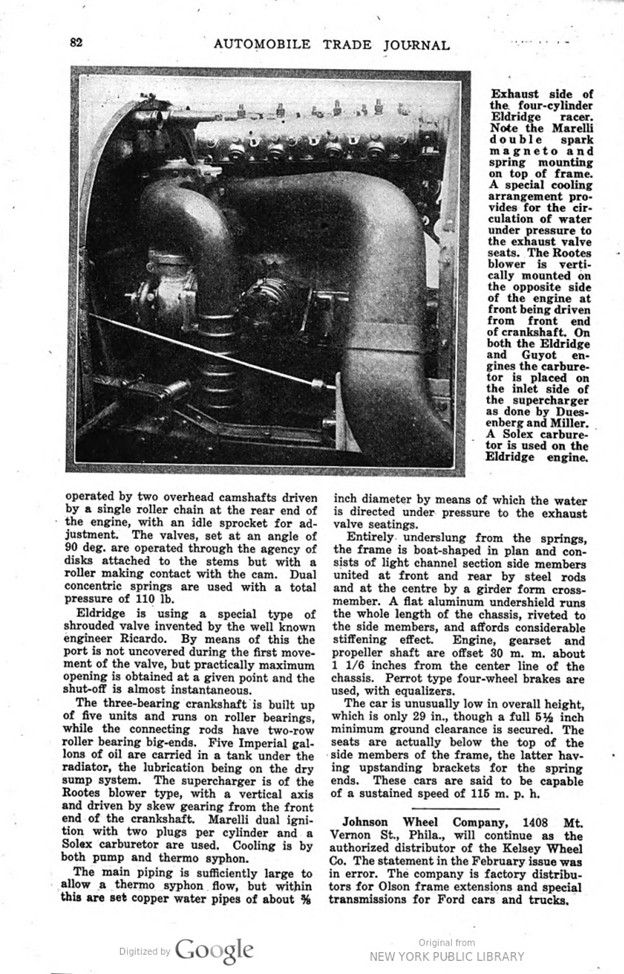
The 1½ litre engine has four cylinders with a bore and stroke of 69 x 100 m. m. 2.71 x 3.93 in. and inclined overhead valves operated by two overhead camshafts driven by a single roller chain at the rear end of the engine, with an idle sprocket for adjustment. The valves, set at an angle of 90 deg. are operated through the agency of disks attached to the stems but with a roller making contact with the cam. Dual concentric springs are used with a total pressure of 110 lb.
Eldridge is using a special type of shrouded valve invented by the well-known engineer Ricardo. By means of this the port is not uncovered during the first movement of the valve, but practically maximum opening is obtained at a given point and the shut-off is almost instantaneous.
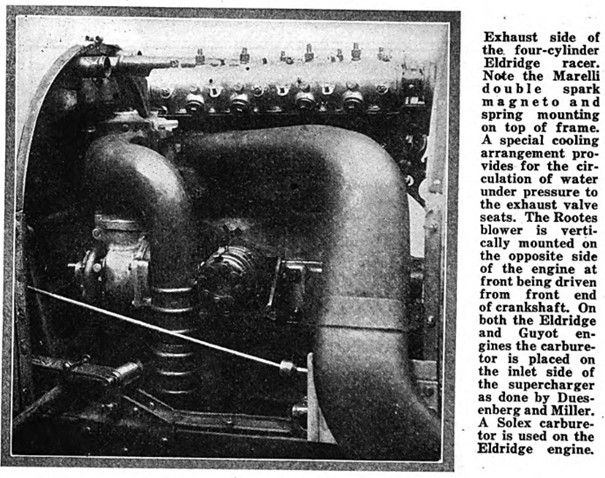
The three-bearing crankshaft is built up of five units and runs on roller bearings, while the connecting rods have two-row roller bearing big-ends. Five Imperial gallons of oil are carried in a tank under the radiator, the lubrication being on the dry sump system. The supercharger is of the Rootes blower type, with a vertical axis and driven by skew gearing from the front end of the crankshaft. Marelli dual ignition with two plugs per cylinder and a Solex carburetor are used. Cooling is by both pump and thermos-syphon.
The main piping is sufficiently large to allow a thermos-syphon flow, but within this are set copper water pipes of about 3/8 inch diameter by means of which the water is directed under pressure to the exhaust valve seatings.
Entirely underslung from the springs, the frame is boat-shaped in plan and consists of light channel section side members united at front and rear by steel rods and at the centre by a girder form cross-member. A flat aluminum under-shield runs the whole length of the chassis, riveted to the side members, and affords considerable stiffening effect. Engine, gearset and propeller shaft are offset 30 m. m. about 1 1/6 inches from the center line of the chassis. Perrot type four-wheel brakes are used, with equalizers.
The car is unusually low in overall height, which is only 29 in., though a full 5½ inch minimum ground clearance is secured. The seats are actually below the top of the side members of the frame, the latter having upstanding brackets for the spring ends. These cars are said to be capable of a sustained speed of 115 m. p. h.
Photos.
Page 79.
Inlet side of single sleeve racer showing Rootes blower, auxiliary sleeve drive mechanism, oil manifold, and water pump
Page 80.
Front view Schmidt Guyot single sleeve racer. Note kick-up forgings at end of tubular front axle and oil cooling radiator below water radiator. The four-wheel Perrot brakes operate simultaneously. The lower car is the Eldridge four-cylinder job featured by its extreme lowness and chain drive to the overhead camshafts.
Exhaust side of the four-cylinder Eldridge racer. Note the Marelli double spark magneto and spring mounting on top of frame. A special cooling arrangement pro- vides for the circulation of water under pressure to the exhaust valve seats. The Rootes blower is vertically mounted on the opposite side of the engine at front being driven from front end of crankshaft. On both the Eldridge and Guyot engines the carburetor is placed on the inlet side of the supercharger as done by Duesenberg and Miller. A Solex carburetor is used on the Eldridge engine.