In this aritcle, some the most interesting cars and engines of the 1930 Indianapolis 500 are briefly highlighted. As a result of the new rules, many different cars and their variants were possible; particularly the stock cars. The two 16-cylinder cars; the V16 Maserati with 241 cu. in; as well as the Sampson Special with a 201 cu. in. engine of 2 parallel 8-cylinder banks. The Model A Duesenberg, the Miller-Scofield Special and more Specials.
Text and jpegs by courtesy of hathitrust.org www.hathitrust.org, compiled by motorracinghistory.com
Automotive Industries, Vol. 62, No. 20, May 17, 1930
Speed Kings Prepare for Annual 500-Mile Classic
Modified passenger car engines as well as special plants ranging from 100 to 336 cu. in. displacement entered in Decoration Day race at Indianapolis.
By W. K. Toboldt – Technical Editor Automobile Trade Journal and Motor Age
WITH four, six, eight and sixteen-cylinder cars having displacements ranging from 100 to 336 cu. in. entered in the Indianapolis race, it would seem that the new race rules are living up to the expectations of their originators. The entries are varied not only as to type but make as well, for there are approximately ten different makes represented. One foreign maker, Maserati of Italy, is sending two cars, a V sixteen and a straight eight, and two distinctly stock jobs are entered, a du Pont and a Stutz. The former a factory entry and the latter by a private individual. In addition, there are several race cars powered with modified passenger-car engines.
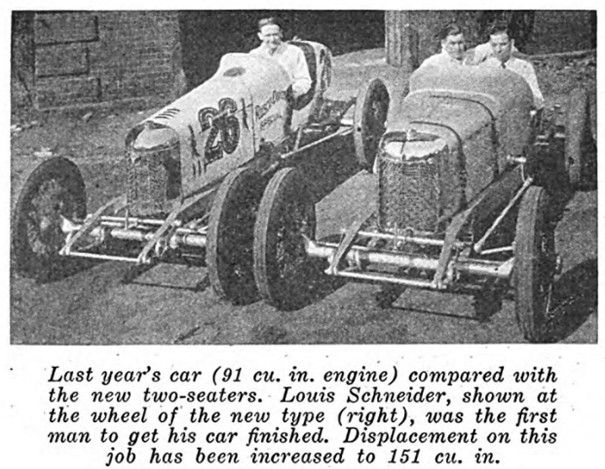
Estimates of the average speed for the race range from 85 m.p.h. up. In this connection it is interesting to note that Louis Meyer in 91 cu. in. single-seater fitted with a single carburetor did a lap at a fraction better than 100 m.p.h. Louis Schneider, who was the first man to have a completed car at the track, has made several laps at approximately 103 m.p.h.
While the small-bore multi-cylinder engines have the advantage of high engine speed, the four-cylinder cars should be easier to carburate, and many believe that the race will be won and lost by the carburetors and manifolding. With the superchargers removed, the race cars are, for the most part, using higher compression ratios, and considerable experimenting is being done on carburetors and manifolds. According to the drivers and mechanics of the cars fitted with modified passenger car engines, improved carburetion, higher compression ratios, magnetos and increased bearing clearances will enable them to compete with the cars equipped with engines designed for racing.
Interest will undoubtedly center in the two 16-cylinder entries, the Sampson Special and the Maserati. However, it is scarcely fair to call these cars „freaks,“ since there is a 16-cylinder passenger car in regular passenger car production.
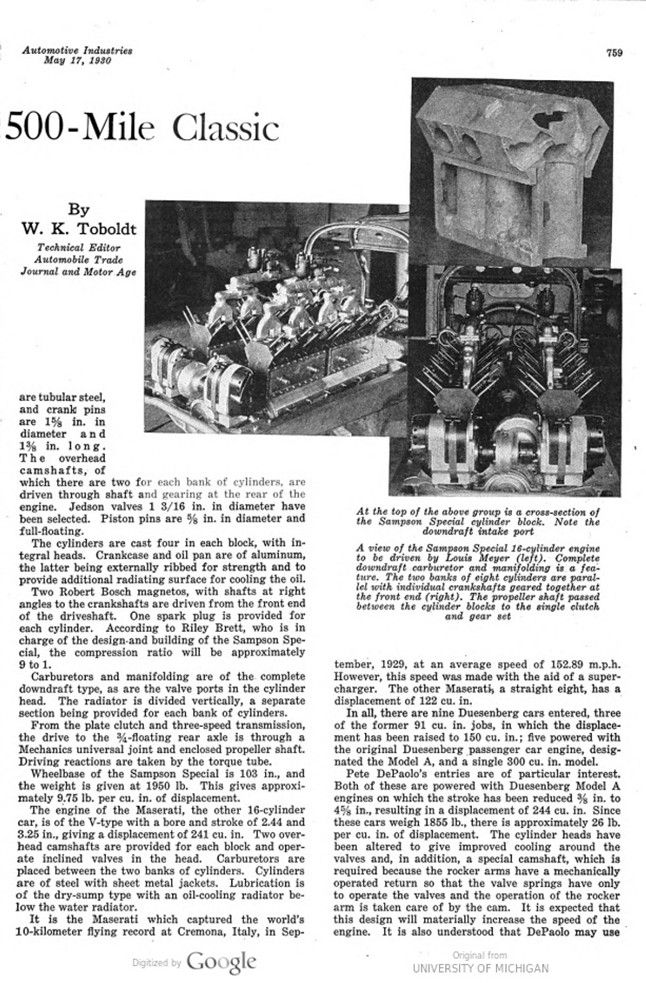
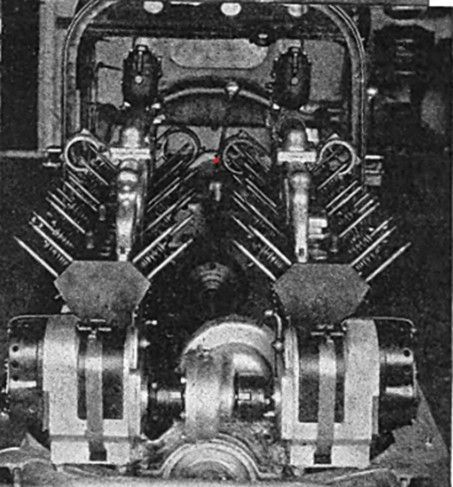
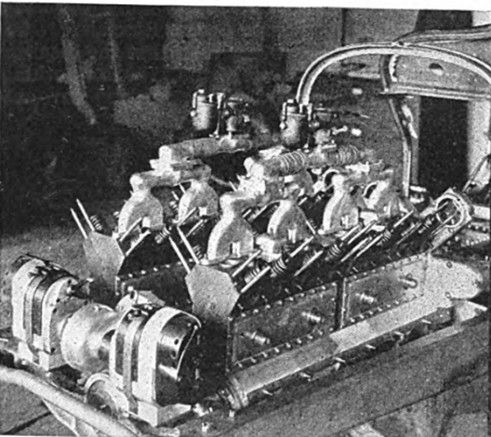
The Sampson Special has a bore and stroke of 2 5/16 by 3, resulting in a displacement of 201 cu. in. Two parallel banks of eight cylinders each, with individual crankshafts, placed 12 in. apart, rotate in a common crankcase. Five main bearings are provided for each shaft. A spur gear, mounted on the front end of each crankshaft, meshes with a gear on the end of a hollow ground shaft 26 in. long, which passes between the cylinder blocks to the driving member of the clutch. As the engines rotate in a counter-clockwise direction, the driveshaft rotates clockwise.
In accordance with usual race car practice the pistons are of light alloy construction, and it is understood that they are of Ray Day manufacture, fitted with three Perfect Circle rings. Connecting rods are tubular steel, and crank pins are 1 5/8 in. in diameter and 1 3/8 in. long. The overhead camshafts, of which there are two for each bank of cylinders, are driven through shaft and gearing at the rear of the engine. Jedson valves 1 3/16 in. in diameter have been selected. Piston pins are 5/8 in. in diameter and full-floating.
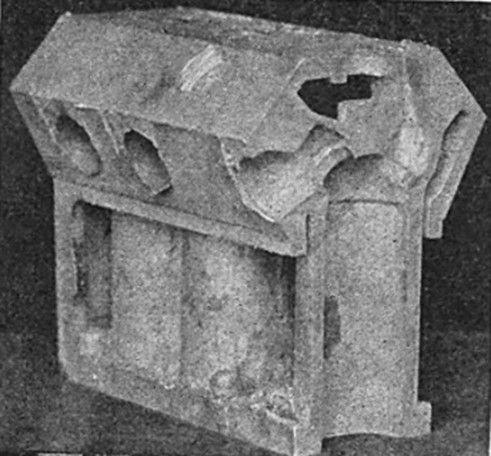
The cylinders are cast four in each block, with integral heads. Crankcase and oil pan are of aluminum, the latter being externally ribbed for strength and to provide additional radiating surface for cooling the oil.
Two Robert Bosch magnetos, with shafts at right angles to the crankshafts are driven from the front end of the driveshaft. One spark plug is provided for each cylinder. According to Riley Brett, who is in charge of the design and building of the Sampson Special, the compression ratio will be approximately 9 to 1.
Carburetors and manifolding are of the complete downdraft type, as are the valve ports in the cylinder head. The radiator is divided vertically, a separate section being provided for each bank of cylinders.
From the plate clutch and three-speed transmission, the drive to the 3/4-floating rear axle is through a Mechanics universal joint and enclosed propeller shaft. Driving reactions are taken by the torque tube. Wheelbase of the Sampson Special is 103 in., and the weight is given at 1950 lb. This gives approximately 9.75 lb. per cu. in. of displacement.
The engine of the Maserati, the other 16-cylinder car, is of the V-type with a bore and stroke of 2.44 and 3.25 in., giving a displacement of 241 cu. in. Two overhead camshafts are provided for each block and operate inclined valves in the head. Carburetors are placed between the two banks of cylinders. Cylinders are of steel with sheet metal jackets. Lubrication is of the dry-sump type with an oil-cooling radiator below the water radiator.
It is the Maserati which captured the world’s 10-kilometer flying record at Cremona, Italy, in September, 1929, at an average speed of 152.89 m.p.h. However, this speed was made with the aid of a supercharger. The other Maserati, a straight eight, has a displacement of 122 cu. in.
In all, there are nine Duesenberg cars entered, three of the former 91 cu. in. jobs, in which the displacement has been raised to 150 cu. in.; five powered with the original Duesenberg passenger car engine, designated the Model A, and a single 300 cu. in. model.
Pete DePaolo’s entries are of particular interest. Both of these are powered with Duesenberg Model A engines on which the stroke has been reduced 3/8 in. to 4 5/8 in., resulting in a displacement of 244 cu. in. Since these cars weigh 1855 lb., there is approximately 26 lb. per cu. in. of displacement. The cylinder heads have been altered to give improved cooling around the valves and, in addition, a special camshaft, which is required because the rocker arms have a mechanically operated return so that the valve springs have only to operate the valves and the operation of the rocker arm is taken care of by the cam. It is expected that this design will materially increase the speed of the engine. It is also understood that DePaolo may use the L.G.S. clutch as a free-wheel device. With the exception of the stock cars DePaolo’s cars have the largest wheelbase, which is 114 in. Clutch, transmission and axles are the same as used in the Model A Duesenberg passenger car.
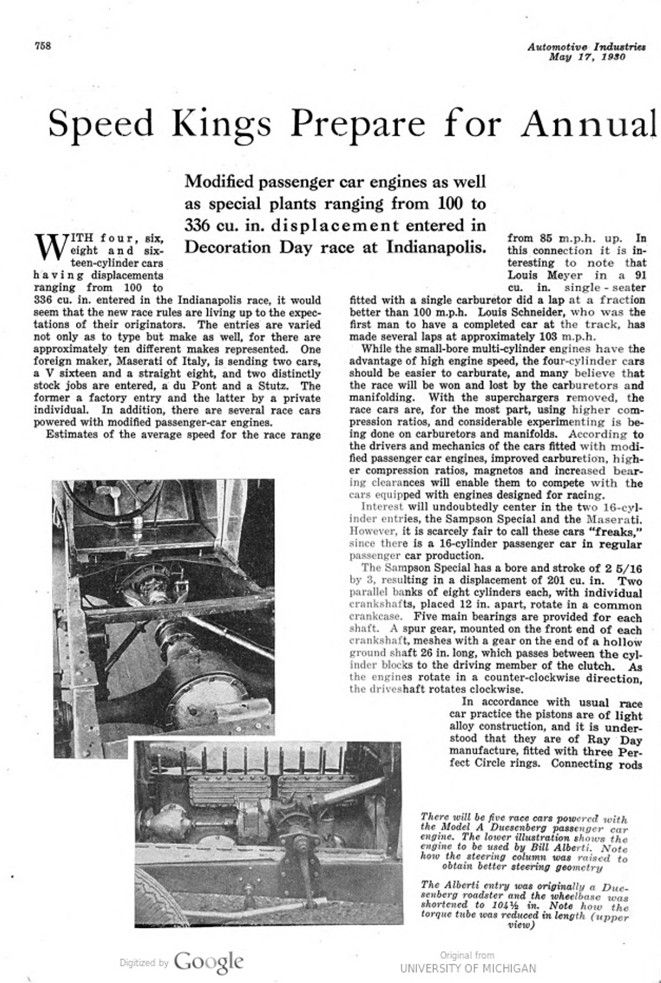
The Model A Duesenberg entered by Bill Alberti, and which has been altered under the direction of Jim Calvert, has a wheelbase of 1041/2 in. It is quite possible that this engine will be fitted with the original type of cylinder head which has been in use several years. Naturally, the shorter wheelbase necessitated a reduction in length of the torque tube. The manner in which this was executed is shown in one of the illustrations.
The three Duesenberg race cars are similar in design to the former 91 cu. in. model, but the displacement has been increased to 150 cu. in. Naturally the frames have been widened to permit the use of the two-man body. Carburetors are manifolding, while not complete at the time of writing, are understood to be of the downdraft type.
The Nardi Special, consisting of a Mercedes chassis and Model A Duesenberg engine, is featured by an unusual rear spring suspension. The rear spring mounting consists of two 1/4-elliptic springs on each side. The springs are mounted end to end, with the thin end of the spring at the rear axle and the heavy end of each spring bolted rigidly to the frame. The forward one of the springs on each side is attached to the axle housing by an ordinary shackle, while the rearward spring floats in a roller arrangement on top of the axle housing.
Considerable interest is being shown in the Miller-Schofield Special to be driven by Shorty Cantlon. This is equipped with a four-cylinder engine of 151 cu. in. displacement with two overhead camshafts. Empire State Special, with Wilbur Shaw at the wheel, is also of interest. This is another Miller-engined four-cylinder job and is the same engine which established some new records at the Syracuse track.
The eight-cylinder Millers for the most part have been increased to 150 cu. in. displacement. In some cases, such as the cars to be driven by Seymour and Huff, the displacement has been raised to only 100 cu. in. Incidentally, the last two mentioned are the former Cooper Specials.
Other than that the displacement is 151 cu. in. and the weight is 1750 lb.; nothing is known of the front-drive Miller-engined car entered by Harry Hartz. While the official entry list states that Hartz will drive, many of the drivers believe that Bob McDonough will be at the wheel.
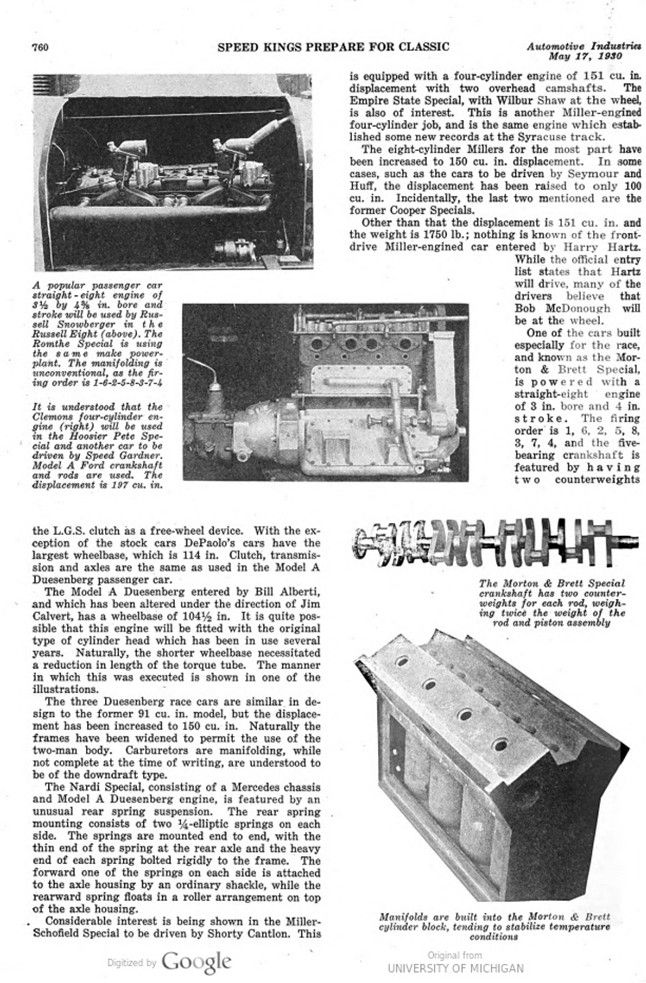
One of the cars built especially for the race and known as the Morton & Brett Special, is powered with a straight-eight engine of 3 in. bore and 4 in. stroke. The firing order is 1, 6, 2, 5, 8, 3, 7, 4, and the five-bearing crankshaft is featured by having two counterweights for each connecting rod. According to Morton and Brett, the combined weight of the counterbalances is equal to twice the weight of the rod and piston assembly and results in an exceptionally smooth-running engine. Carburetors are of the updraft type, with the manifold cast in the block. Camshafts above the cylinder block operate inclined valves in accordance with usual race car practice. Two plugs are provided for each cylinder, and approximately 235 hp. are claimed for this 226 cu. in. powerplant.
An Emmons four-cylinder engine will be used in the Hoosier Pete, and the car to be driven by Speed Gardner. This engine, which is built around a Model A Ford crankshaft, has seen several seasons, dirt-track racing. Crankcase, cylinder and block and heat are of special design, however. The overhead camshaft, driven by a silent chain, operates on cups or pistons which cover the ends of the vertical valves. Two spark plugs are provided for each cylinder, and ample cooling is provided around the plugs and valves.
The Romthe Special and the Russell Eight are both powered with the same make of straight-eight engine which is used in a current model passenger car of popular make and which has a bore and stroke of 3½ by 4 3/8 in. The displacement of 337 cu. in. is one of the largest entered in the race. The engine is of the L-head type, and the camshaft is driven by a gear. The Russell Eight will weigh ap- proximately 8 lb. per cu. in. of displacement and is fitted with two downdraft Marvel carburetors.
Another passenger car engine which has found its way into a racing chassis is the V eight, entered by Ira Vail and which will be driven by Claude Burton. This engine has horizontal valves.
A Stutz, entered by Milton Jones of Cleveland, and a du Pont, a factory entry, will be of particular interest to the stock car fans. Both are stock speedster models with fenders and windshield removed. In each case the displacement is 322 cu. in., but the Stutz, with a weight of 4350, is approximately 1000 lb. heavier than the du Pont. Another car which may be in this stock car class is the six-cylinder Chrysler of 3½ by 5 in. bore and stroke, entered by Juan Gaudino. However, details of this car are not available, but it is probable that the powerplant will be placed in a racing chassis. The Slade Special, Fansin Jr. Special, Butcher Brother Special, Ambler Special, Trexler Special are also powered with modified passenger car engines in racing chassis. The Ambler Special engine has overhead valves operated from a camshaft in the crankcase mounted in a Mercedes chassis.
Photos.
Page 758.
There will be five race cars powered with the Model A Duesenberg passenger car engine. The lower illustration shows the engine to be used by Bill Alberti. Note how the steering column was raised to obtain better steering geometry
The Alberti entry was originally a Duesenberg roadster and the wheelbase was shortened to 1042 in. Note how the torque tube was reduced in length (upper view)
Page 759.
At the top of the above group is a cross-section of the Sampson Special cylinder block. Note the downdraft intake port
A view of the Sampson Special 16-cylinder engine to be driven by Louis Meyer (left). Complete downdraft carburetor and manifolding is a feature. The two banks of eight cylinders are parallel with individual crankshafts geared together at the front end (right). The propeller shaft passed between the cylinder blocks to the single clutch and gear set
Page 760.
A popular passenger car straight-eight engine of 3½ by 4 3/8 in. bore and stroke will be used by Russell Snowberger in the Russell Eight (above). The Romthe Special is using the same make powerplant. The manifolding is unconventional, as the firing order is 1-6-2-5-8-3-7-4
It is understood that the Clemons four-cylinder engine (right) will be used in the Hoosier Pete Special and another car to be driven by Speed Gardner. Model A Ford crankshaft and rods are used. The displacement is 197 cu. in.
The Morton & Brett Special crankshaft has two counterweights for each rod, weighing twice the weight of the rod and piston assembly
Manifolds are built into the Morton & Brett cylinder block, tending to stabilize temperature conditions
Page 761.
Last year’s car (91 cu. in. engine) compared with the new two-seaters. Louis Schneider, shown at the wheel of the new type (right), was the first man to get his car finished. Displacement on this job has been increased to 151 cu. in.
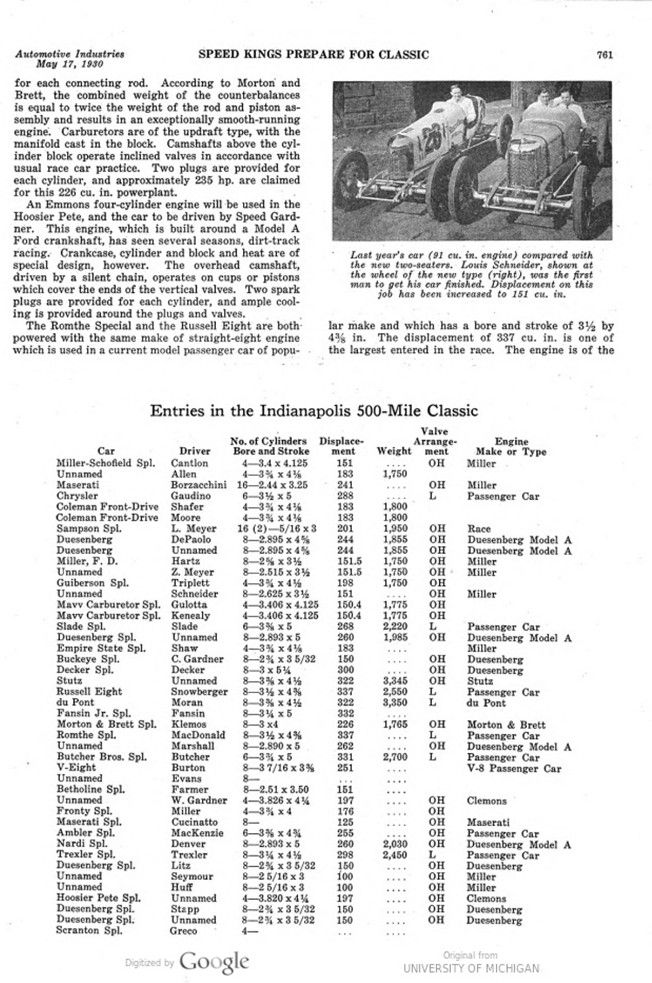
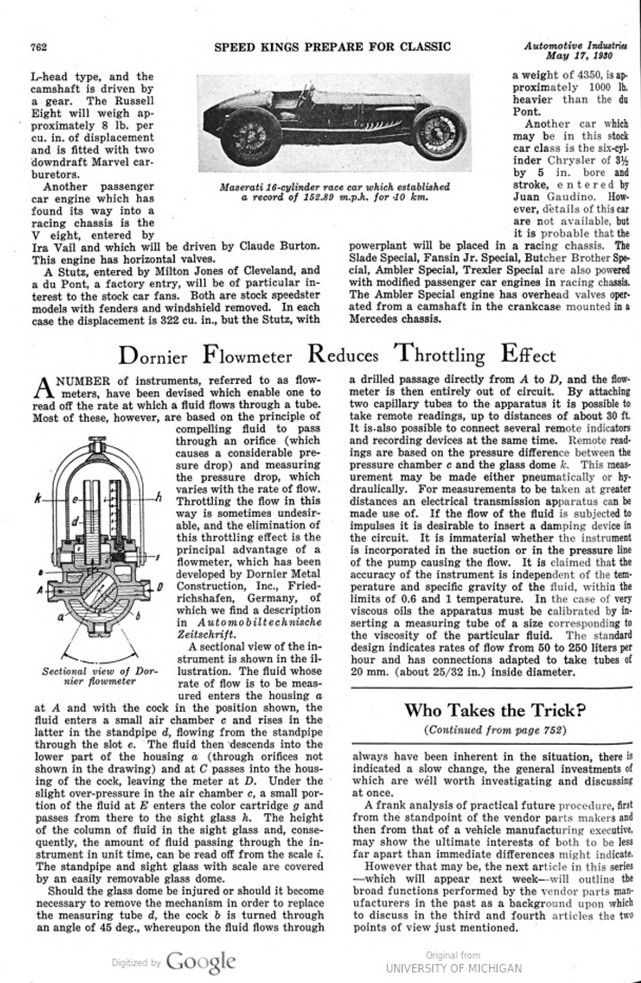
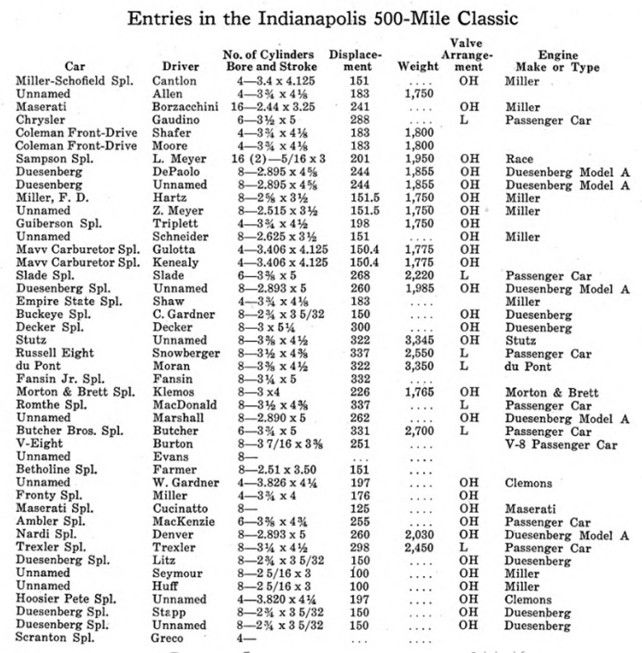
Entries in the Indianapolis 500-Mile Classic (table)Page 762. Maserati 16-cylinder race car which established a record of 152.89 m.p.h. for 10 km.