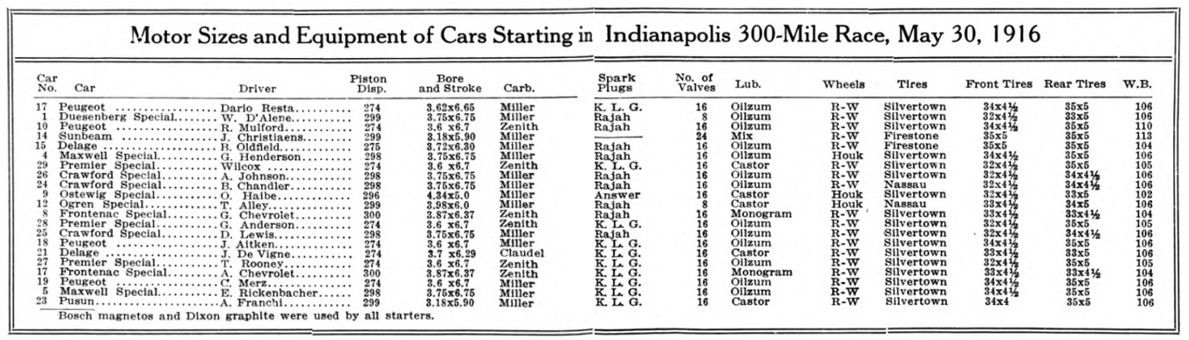
Here, some of the cars technical specifics during the race are discussed.
The Premier- and Crawford teams, as well as the Chevrolet team are shortly highlighted. The Ostewig car, a new appearance of this race, is technically assessed.


Text and jpegs by courtesy of hathitrust.org www.hathitrust.org, compiled by motorracinghistory.com
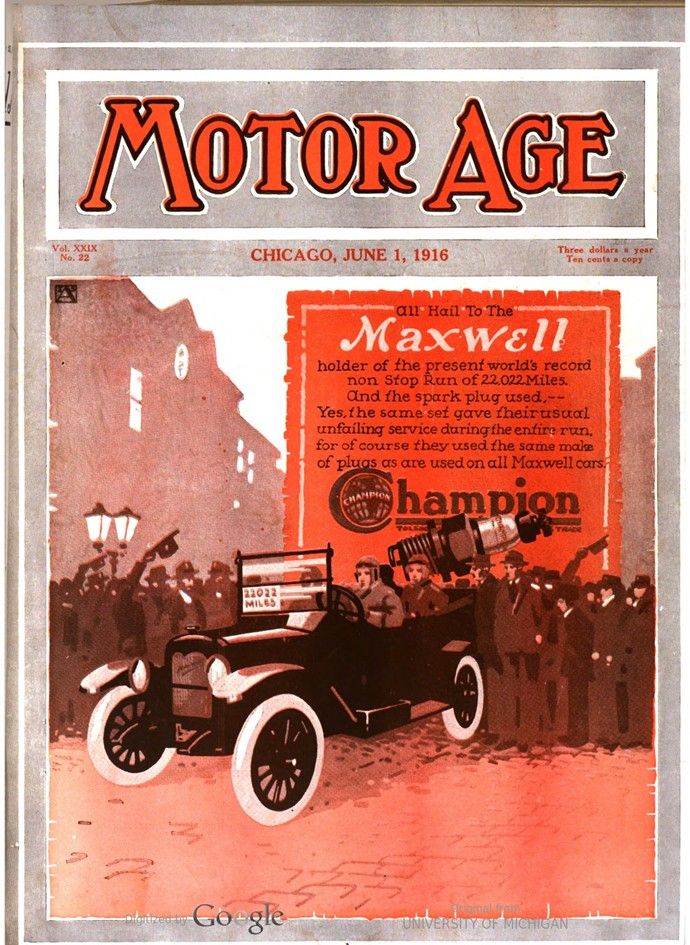
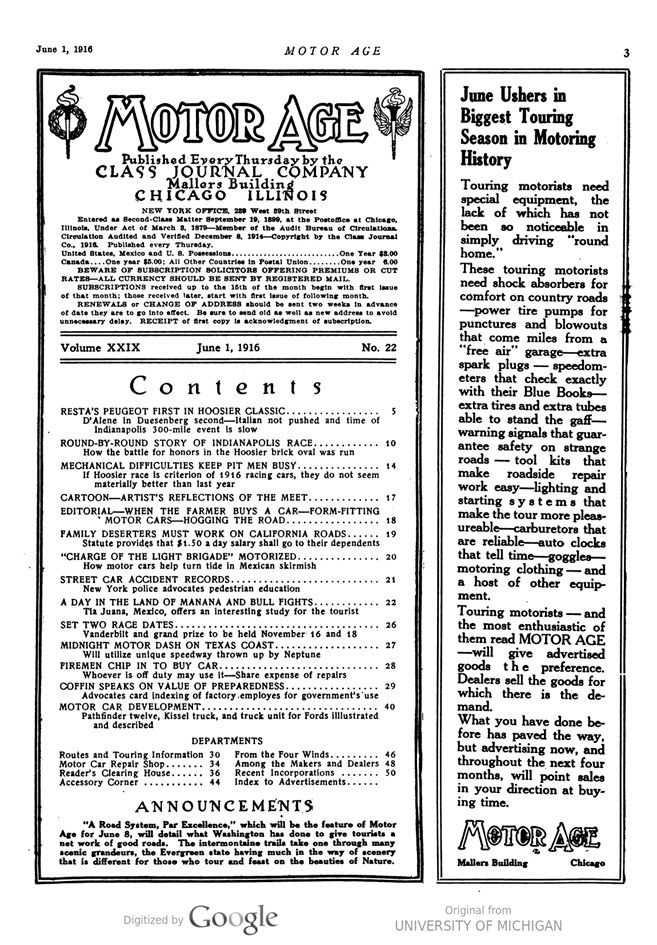
MOTOR AGE Vol. XXIX, No. 22 Chicago, June 1, 1916, page 14 – 17
New and Green Cars Make Much Pit Work
No Non-Stop Runs in Indianapolis Memorial Day Event-Speed Reaps Harvest of Spark Plugs
By Darwin S. Hatch
INDIANAPOLIS MOTOR SPEEDWAY, May 30 – If one were to judge by the showing that the cars made at Indianapolis today as compared with a year ago, one would be forced to believe that the special speed creations which are to be campaigned this year are no better than those of last year. Not only was the average speed slower for the shorter distance this year, but mechanical difficulties were as numerous, if not more numerous and serious, than they were in the last 500-mile race on the Hoosier oval.
It is true that there were fewer stops at the pits in today’s race than there were a year ago, and that there were fewer stops per car, but the race only 60 per cent of the distance of the last 500-mile sweepstakes, whereas the stops per car were 75 per cent as great as those of a year ago. It is safe to assume that if there were another 200 miles added to today’s distance, the ratio of calls at the pits would have been somewhat greater than that of the 1915 race.
Also, it is a certainty that there would not have been eleven cars finished as there were 1 year ago, had today’s field been compelled to complete 500 miles before receiving the checkered flag. As it was, there were only eleven cars to finish today and it is beyond the pale of probability that Tom Alley could have kept his one cylinder going for an additional double century.
Resta, D’Alene, Mulford, Christiaens and Oldfield in all probability could have completed 500 miles without losing a great amount of time at the pits, but the rest of the field today experienced mechanical difficulties before the finish of the 300 miles.
Of the twenty-one cars which followed out the pacemaker of the preliminary lap to the flying start, five went through the race without lifting the hood, just as a year ago five of the twenty-four starters completed the 500 miles without mechanical difficulties. It is worthy of note that the first five were the only cars which completed the 300 miles this year without having unbuckled the hood straps or tinkered with the running gears. In this roll of honor were Resta’s Peugeot, D’Alene’s Duesenberg, Mulford’s Peugeot, Christiaen’s Sunbeam, and Oldfield’s Delage.
The track was cool, the race was short, the pace was slow, yet not a driver equaled Tom Alley’s record of last year by going through without a change of tire. In the 300 miles of today’s event the twenty-one starters made a total of seventy-three stops at the pits, exclusive of those which ended in the complete withdrawal of the car. This makes an average of three and one-half stops this year as against four stops per car for the 60 per cent greater distance in the last 500-mile race. By the eleven finishers there were thirty-one stops at the pits, slightly less than three stops per car. This does not compare very favorably with the four stops per car averaged for the Indianapolis race a year ago with its greater distance.
If, however, we look into the entry list more closely, we will find that this pessimistic view which might be gained from the comparison of the two races at Indianapolis is likely to be proven an erroneous one. In fact, in spite of the rather disappointingly large number of mechanical difficulties today, many of the cars probably will make a very much better showing in later events. There was an unusually large number of green cars among the starters in this race. Of the twenty-one starters, there were nine which had never faced a starter’s flag before. None of them had been completed more than a few weeks and some had hardly had time to get thoroughly warmed up before the starting bomb sounded.
The Premiers were just as green as they were painted and the one which Wilcox tooled into seventh place had been run only a few miles before it lined up at the start. The fact that it finished at all may be considered a very good record and one not to be expected as a general thing. It showed very good design and workmanship that it could be put together in what must have been considerable of a rush and taken through the 300 miles successfully.
Equally enthusiastic may we be over the future of the Crawford team. Chandler’s team of three cars managed to place two in the money and both of them were so new that the paint had hardly dried on their bodies.
The Chevrolet Brothers‘ outfit of Frontenacs, while they did not get in the money and had a disheartening number of spark plug changes and some other difficulties, probably need only working out to bring them into good shape to finish in the money in later events.
The Ostewig is quite a new car and had not had sufficient working out to bring its speed up to what it possibly will have later. Nevertheless, it showed great consistency, and only made four stops and only one of these was for mechanical troubles, this a minor one due to a loose exhaust pipe.
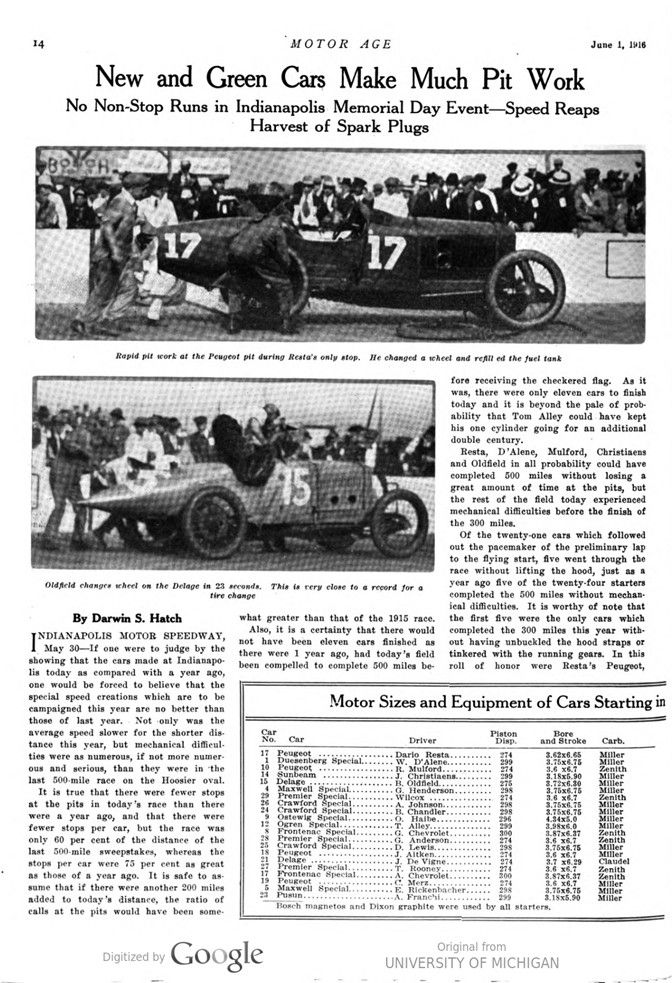
Resta made only one stop before he finished a winner. This was after he had gone 175 miles, when he changed a right rear tire and took on gasoline. This seemed more a matter of precaution than of necessity, so that he would be in shape to go through the remainder of the race without a halt.
D’Alene likewise made but one stop and this after he had gone 130 miles. He also took on supplies and changed a right rear tire, getting away in 1 minute 35 seconds.
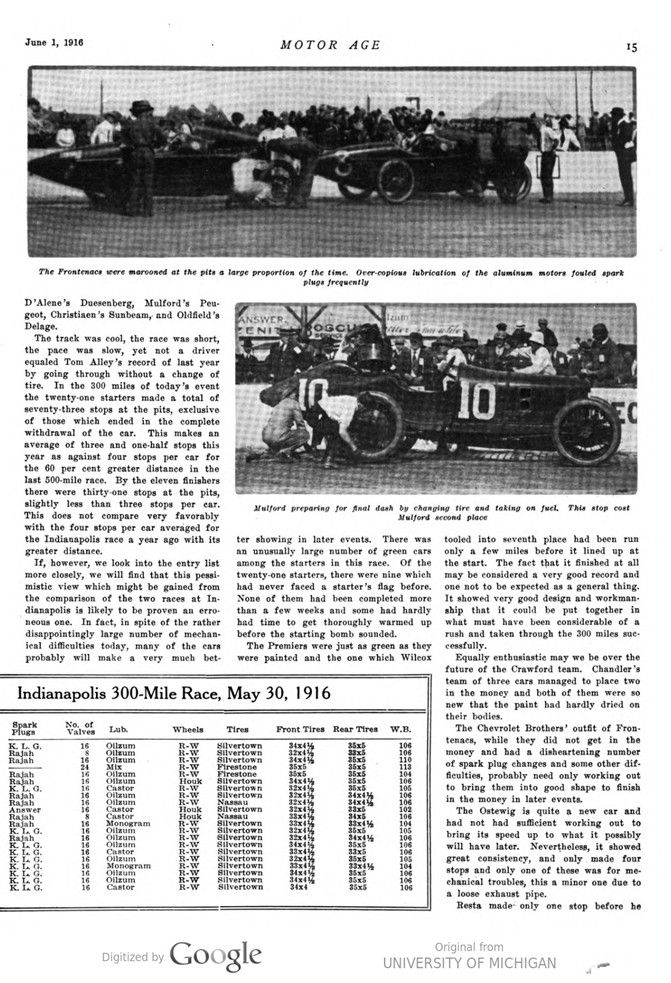
Mulford got into third place more by consistent running than speed. He prepared for his final dash by changing a right rear tire and taking on gasoline after he had gone 147 miles. His stop was one of the short ones, as he was away in 33 seconds. Christiaens stopped twice, once to change a left rear tire and again to change the right rear tire. In each case he was held only 2 minute. Oldfield made four stops, practically all of them necessitated by tire changes, although he took on sup- plies in two of his halts. His last stop was nearly a record tire change, as he was held only 23 seconds in replacing a right front tire.
Details of Ostewig
The Ostewig car, which finished ninth, was not described with the other entries last week. It is fitted with a Wisconsin powerplant that has been developed very much along the line of the Delage.
The engine is a four-cylinder sixteen-valve design having a bore of 4.34 and a stroke of 5 inches. The cylinder casting is vertical and the valves are carried on each side, operating horizontally. The motor, as far as the camshaft layout is concerned, is the same as a T-head job, as there are two shafts, one located on each side of the crankshaft. The camshafts are driven off the timing set at the front end of the motor.
The cams actuate long vertical push rods, four of which are located on each side of the motor. Each push rod operates two valves simultaneously. The push rods on the right take care of the intake and those of the left the exhaust. The rods bear against Y-shaped rocker arms which are so curved as to transform the motion given to them in a vertical direction by the push rods to a horizontal motion. The vertical rods bear against the stems of the Y and at the end of each of the branches there is a bearing against the end of the valve stem. Thus each rocker arm takes care of the two intake or two exhaust valves for one cylinder.
As a whole, the pit work was only fair, although there were two or three shining examples of good pit management and well-drilled teams. There was no hint of accident at the pits and the J-M fire extinguishers, which were on hand to put out blazes under the hoods, had no opportunity to show their ability as they had at Sheepshead Bay.
There was an excessive amount of spark plug changes. Most of these were due to heating through green motors, improper oiling, etc., but one is forced to wonder whether the dearth of spark plug materials on account of the European war might not have something to do with the short life of the plugs in some instances.
Delages May Be Docked
Harry Harkness, owner of the three Grand Prix Delages, stated tonight that he was ordering the cars shipped back to New York and that they probably would be withdrawn from racing for the remainder of the season.
The serious injury of Lecain was the climax of the misfortune attending the fatal cars, Lecain’s former teammates, Harry Grant and Carl Limberg, both having met death at the wheels of the Harkness importations. The Delages are entered at Chicago for June 10, but probably will not appear, it is reported on good authority. Oldfield’s Delage is the only future contender of that make.
Rickenbacherisms
Boost the driver as much as the car he drives and attendance at speedway meets will be greater.
Extend every courtesy to the fans for the public foots the bills.
Patriotic spirit born of American supremacy in racing is something we must nurse.
Look after the physical comforts of those attending races and make it equally as easy to reach the track as it is the city where the race is held.
Less than 50 per cent of the speedways have proper facilities for taking the fans from the city to the track.
Hotel rates should not be raised on race days for the influx of people is an advertisement for the city that will bear commercial fruit unless the welcome is too costly.
Three veteran drivers should be ap- pointed at each meet to look over the course not less than 5 days before the race and pass on its safety.
Checking of cars should be done by a trained force of checkers, under the direction of the Speedway Association or the A. A. A.
Arrangements should be made to allow the carrying of the same number on racing cars through the season.
Photo captions. – June 1, 1916 – MOTOR AGE
Page 14.
Rapid pit work at the Peugeot pit during Resta’s only stop. He changed a wheel and refilled the fuel tank
Oldfield changes wheel on the Delage in 23 seconds. This is very close to a record for a tire change
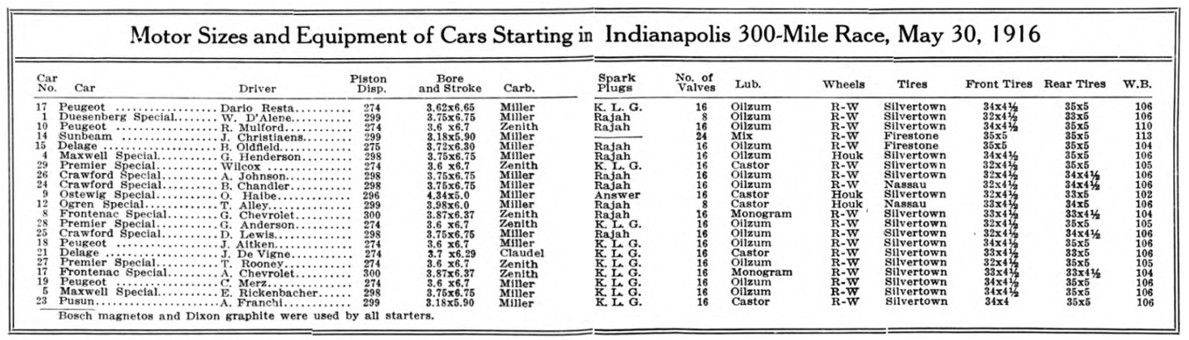
Motor Sizes and Equipment of Cars Starting in Indianapolis 300-Mile Race, May 30, 1916
Page 15.
The Frontenacs were marooned at the pits a large proportion of the time. Over-copious lubrication of the aluminum motors fouled spark
Mulford preparing for final dash by changing tire and taking on fuel. This stop cost Mulford second place
Page 16.
Ralph Mulford handles his car with gloves. His hands are protected even when putting the final touches on his motor just before the start of the race
Aitken made fast tire changes. It was well that his pitmen were quick for he stopped four times for tires.
Page 17, June 1, 1916 17 MOTOR AGE
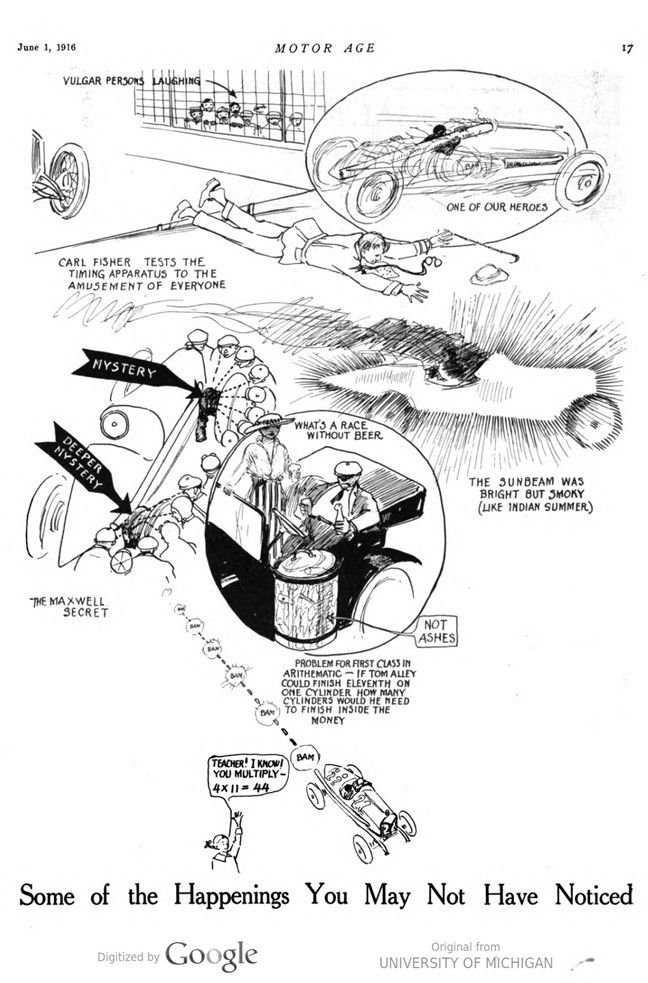
Some of the Happenings You May Not Have Noticed
CARL FISHER TESTS THE TIMING APPARATUS TO THE AMUSEMENT OF EVERYONE – ONE OF OUR HEROES – VULGAR PERSONS LAUGHING
MYSTERY – DEEPER MYSTERY – THE MAXWELL SECRET
THE SUNBEAM WAS BRIGHT BUT SMOKY (LIKE INDIAN SUMMER)
WHAT’S A RACE WITHOUT BEER – NOT ASHES
PROBLEM FOR FIRST CLASS IN ARITHEMATIC – IF TOM ALLEY COULD FINISH ELEVENTH ON ONE CYLINDER HOW MANY CYLINDERS WOULD HE NEED BAM TO FINISH INSIDE THE MONEY
TEACHER! I KNOW! YOU MULTIPLY- 4×11=44