In 1926, the Miller Cars already were that successfull, that two types could bw bought at the Miller Company; a front-wheel drive and a rear-wheel driven version. Both cars had the same engine; whereas the front-wheel drive car had the engine assembled in reverse.
Text and jpegs by courtesy of hathitrust.org www.hathitrust.org, compiled by motorracinghistory.com
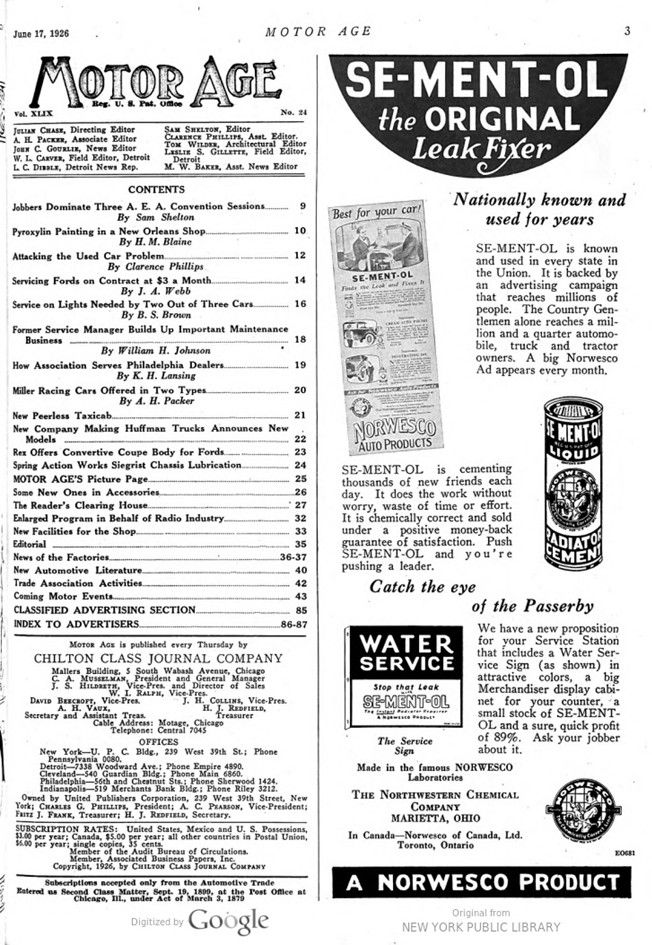
Motor Age, Vol. XLIX (49), No. 24, June 17, 1926
Miller Racing Cars Offered in Two Types
Front Wheel Drive of 91½ Inch Model Lists at $15,000 and Rear Wheel Drive at $10,000 – Engine Develops 154 h. p.
By A. H. PACKER
TWO type of Miller race cars of the 90.2 cu. in. displacement type are available, one being the conventional rear wheel drive car, the other the front wheel drive type in which the engine is reversed in the frame. The prices of these cars are $10,000 and $15,000 respectively, exclusive of revenue tax.
The engine sells separately for $6,000 and is of the eight-in-line type, four cylinders being cast in each block. Combustion chambers are semi-spherical. Valves are overhead, driven by two camshafts, operated by ball bearing mounted gear train at the front of the engine. There are two valves per cylinder. A supercharger is supplied as regular equipment, it also being included on the 120.8 cu. in. engine which sells at the same price.
The crankshaft is counterbalanced, turns on five main bearings and weighs 46 pounds. The piston weight, less rings, is 4½ oz., the weight of a complete piston and rod assembly being 19 oz. The weight of the engine is 330 pounds, or 2.14 pounds per horsepower, the maximum power developed being 154 h.p. at 7,000 r.p.m., or 1.7 H. P. per cu. in.
The material in the crankshaft is Agathon alloy steel made by the Central Steel Co., while Chrome Vanadium steel made by the United Alloy Steel Co. is used in such parts as front axle ends, steering knuckles, steering pins, timing gears, connecting rods, valve tappets, drive shafts, axle shafts, transmission shafts and transmission gears. Parts of this character are machined from solid billets or blocks of steel in most cases.
Ball bearings used are New Departure; ignition, Robert Bosch magneto; plugs, Champion and A. C.; shock absorbers, Hartford; wire wheels, Rudge Whitworth, Wire Wheel Corp. of America; piston rings, Perfect Circle.
In holding the chassis weight down to 1,400 pounds it is interesting to note the way the weight of the various parts is distributed. The complete transmission, for example, weighs but 50 pounds. The complete rear axle weighs 170 pounds, including torque tube and brakes; the front axle weighs 100 pounds; the steering gear 15 pounds, and the body 76 pounds.
—–
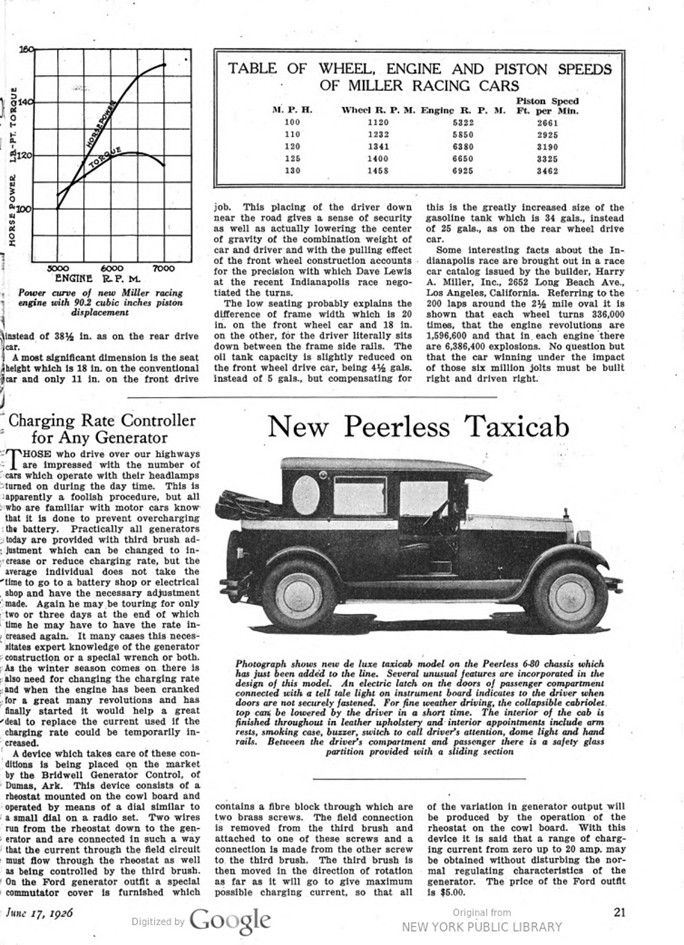
Horse Power Speed Data for Model 91 Miller Engine
100 H. P. at 5,000 r.p.m.
118 H. P. at 5,500 r.p.m.
136 H. P. at 6,000 r.p.m.
150 H. P. at 6,500 r.p.m.
154 H. P. at 7,000 r.p.m.
——
The front and rear drive cars have identical engines, while the chassis have a number of points in common. In each car the weight per horse power is 9 pounds, weight per cubic inch displacement of engine is 15 pounds; wheelbase, 100 inches;. tread, 52 inches; height at frame 18 inches; depth of frame 5 inches; water capacity 42 gals., tire size 30×5 in.
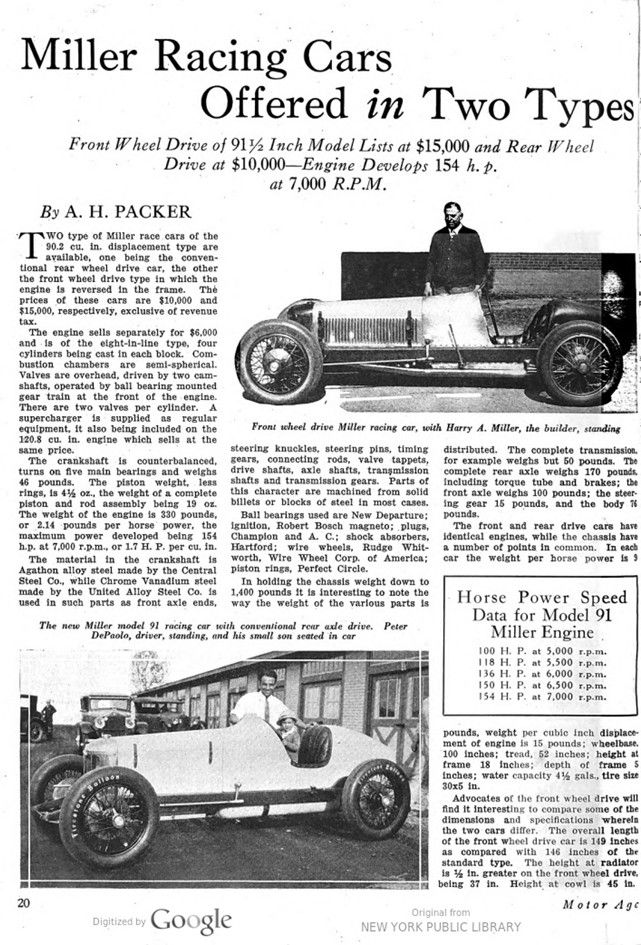
Advocates of the front wheel drive will find it interesting to compare some of the dimensions and specifications wherein the two cars differ. The overall length of the front wheel drive car is 149 inches as compared with 146 inches of the standard type. The height at radiator is ½ in. greater on the front wheel drive, being 37 in. Height at cowl is 45 in. instead of 38½ in. as on the rear drive car.
A most significant dimension is the seat height which is 18 in. on the conventional car and only 11 in. on the front drive job. This placing of the driver down near the road gives a sense of security as well as actually lowering the center of gravity of the combination weight of car and driver and with the pulling effect of the front wheel construction accounts for the precision with which Dave Lewis at the recent Indianapolis race negotiated the turns.
The low seating probably explains the difference of frame width which is 20 in. on the front wheel car and 18 in. on the other, for the driver literally sits down between the frame side rails. The oil tank capacity is slightly reduced on the front wheel drive car, being 4½ gals. instead of 5 gals., but compensating for this is the greatly increased size of the gasoline tank which is 34 gals., instead of 25 gals., as on the rear wheel drive car.
Some interesting facts about the Indianapolis race are brought out in a race car catalog issued by the builder, Harry A. Miller, Inc., 2652 Long Beach Ave., Los Angeles, California. Referring to the 200 laps around the 2½ mile oval it is shown that each wheel turns 336,000 times, that the engine revolutions are 1,596,600 and that in each engine there are 6,386,400 explosions. No question but that the car winning under the impact of those six million jolts must be built right and driven right.
Photos.
Page 20.
Front wheel drive Miller racing car, with Harry A. Miller, the builder, standing.
The new Miller model 91 racing car with conventional rear axle drive. Peter DePaolo, driver, standing, and his small son seated in car.