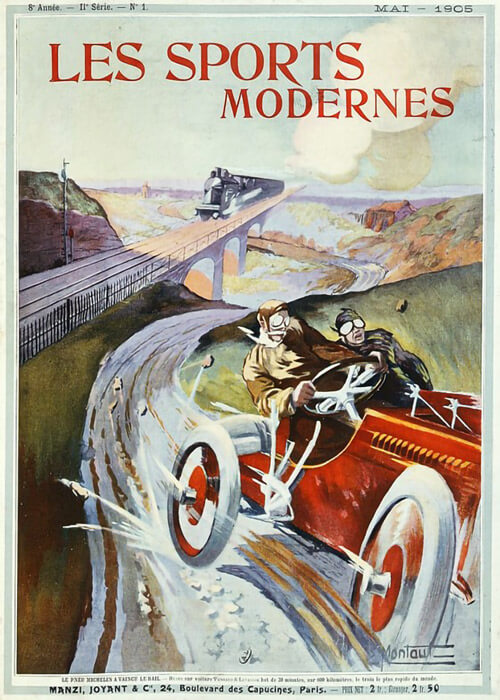
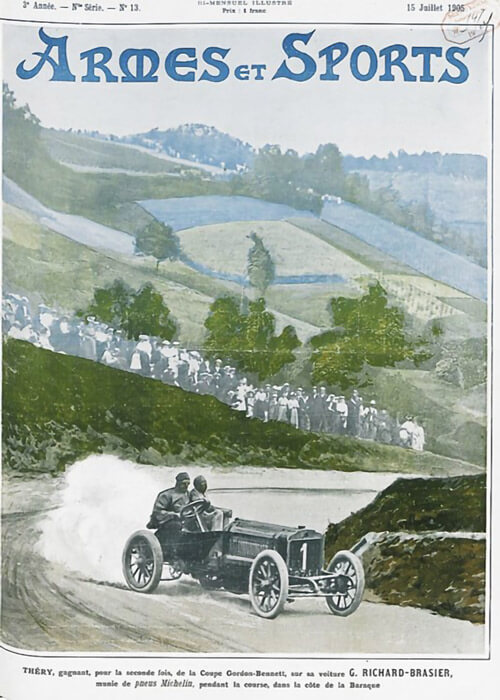
This second article in the series of four in the French La Vie automobile describes the French elimination trials in the Belgian Ardennes, as the selection for the 1904 Gordon Bennett Cup in the German Taunus. The winner of this elimination, Théry in a Richard-Brasier would be the later winner of the race itself. What happened? The winner car was the least powerful one, hence a relatively light vehicle. The other cars mostly had much more powerful engines; but to limit their max weight, all other components were as light as possible. Hence, very likely not to withstand the severe loading conditions on the road. So these cars almost all failed during the course. Now, the least powerfull car was the most endurable, leading to victory. What a recognition!


With kind permission of Le Conservatoire numérique des Arts et Métiers (Cnum) – https://cnum.cnam.fr Text and photos compiled by motorracingistory.com, translation by DeepL.com.
La Vie Automobile Vol. 4. — N° 139. – Saturday May 28, 1904.
THE QUALIFYING RUNS
The Gordon Bennett Cup qualifying round took place on Friday, May 20, on the course we mentioned in our penultimate issue, in superb weather and amid a considerable crowd of onlookers.
The three drivers who qualified to represent France in the Gordon Bennett Cup, which will be held on June 16 in Germany, are:
1 Théry, on Richard-Brasier.
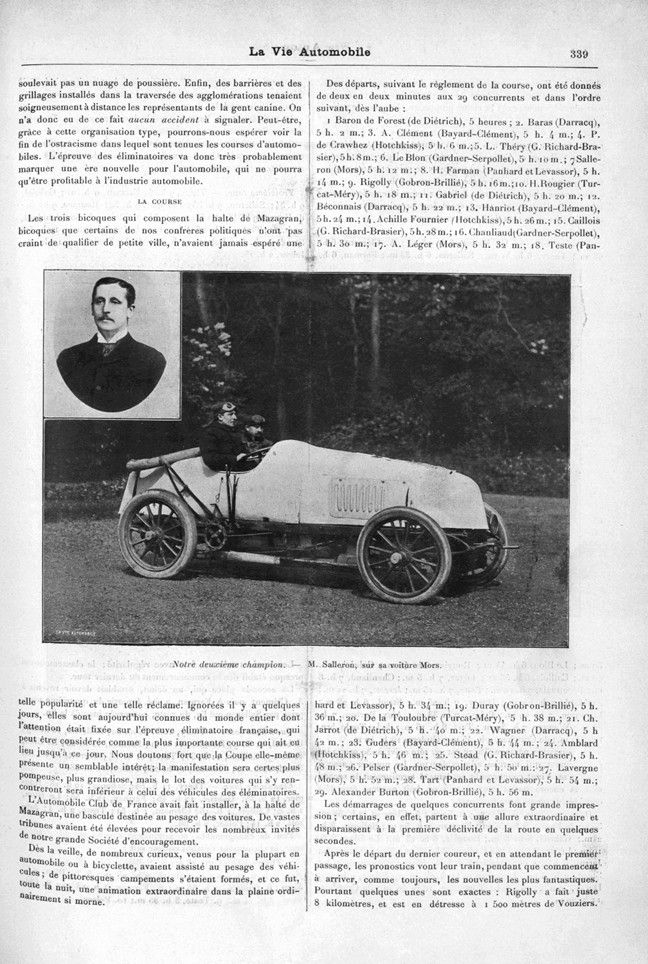
2 Salleron, on Mors.
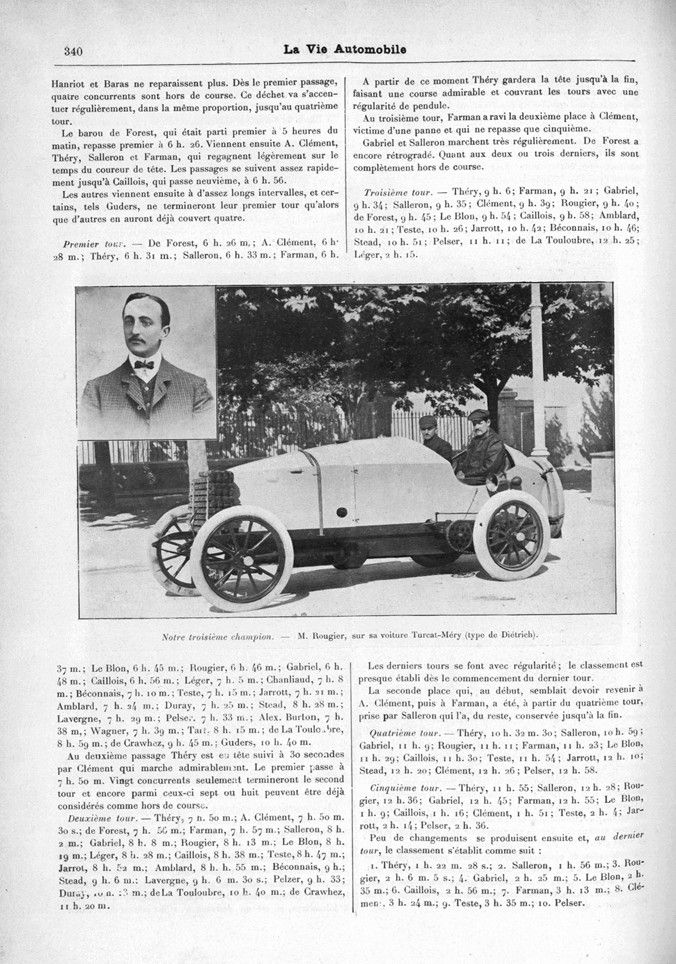
3 Rougier, on Turcat-Méry.
Théry’s victory definitively establishes the Georges Richard-Brasier brand in first place, confirming its long efforts and impressive performance in Nice. The company that is capable of building machines such as the Four-Leaf Clover and the vehicles of Théry and Caillois is one of those on which we can and must place our hopes for the return of the Cup to the Place de la Concorde.
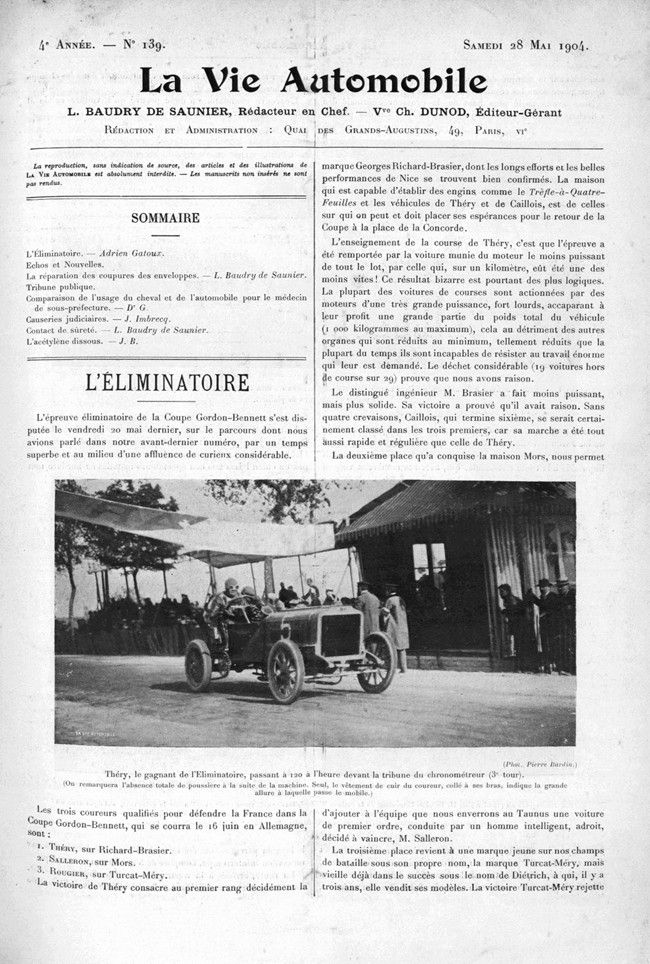
The lesson to be learned from Théry’s race is that the event was won by the car with the least powerful engine of the lot, by the one that, over a kilometer, would have been one of the slowest! This bizarre result is, however, most logical. Most racing cars are powered by very powerful, very heavy engines, which account for a large part of the total weight of the vehicle (1,000 kilograms maximum), to the detriment of the other components, which are reduced to a minimum, so much so that most of the time they are unable to withstand the enormous workload required of them. The considerable number of dropouts (19 cars out of 29) proves that we are right.
The distinguished engineer Mr. Brasier made a less powerful but more solid car. His victory proved that he was right. Without four flat tires, Caillois, who finished sixth, would certainly have ranked in the top three, as his pace was just as fast and consistent as Théry’s.
The second place won by Mors allows us to add to the team we will be sending to Taunus a first-class car, driven by an intelligent, skilled man determined to win, Mr. Salleron.
Third place went to a brand that is new to our battlegrounds under its own name, Turcat-Méry, but already old in terms of success under the name Diétrich, to whom it sold its models three years ago. Turcat-Méry’s victory reflects well on the Diétrich brand, which also took fourth place in the race results.
We mentioned earlier the unusually high number of “dropouts” in the race (19 cars stopped by various breakdowns, out of 29), which can be attributed in part to the desire of almost all manufacturers to make their cars too powerful.
Another cause of this enormous dropout rate is undoubtedly attributable to the road itself, which, with its numerous bends and uneven surface, put the cars to the test and the drivers through a severe trial.
Some of the drivers, who were nevertheless considered virtuosos behind the wheel, were either unfamiliar with their machines or overconfident in their skills, and were unable to stay on the road, ending up in the fields alongside it.
The qualifying round thus proved that a sturdy car needed a careful driver.
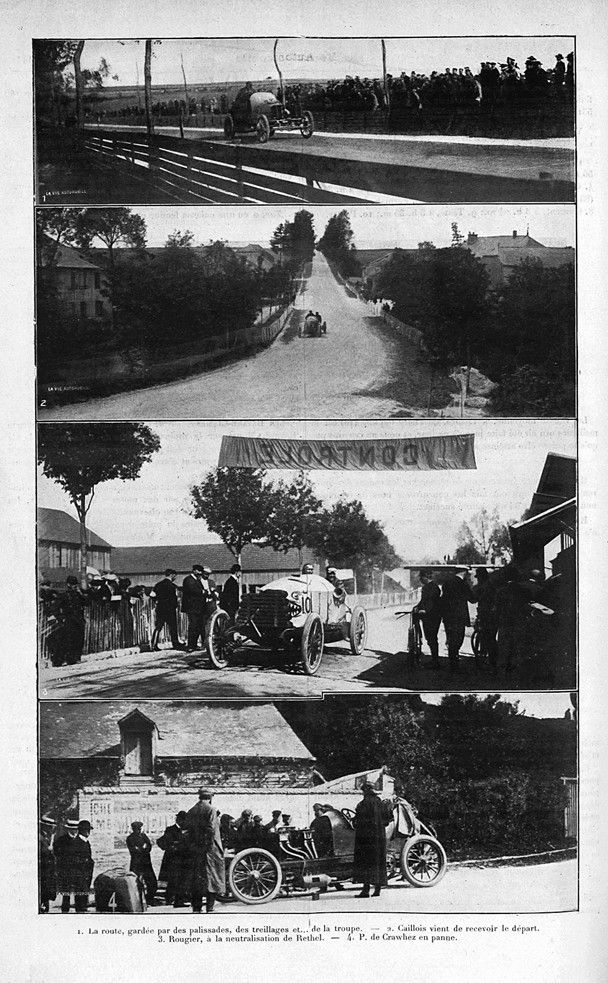
Security was masterfully organized. Never before had a race been held under such safe conditions. Not a single person on the road, not even a dog! The 200,000 spectators lining the route were kept at a safe distance by an unbroken cordon of 5,000 troops. The road, sprayed with Westrumite, was perfectly dry. The cars, traveling at 140 kilometers per hour, did not raise a cloud of dust. Finally, barriers and fences installed in built-up areas kept dogs at a safe distance. As a result, there were no accidents to report. Perhaps, thanks to this model organization, we can hope to see an end to the ostracism of motor racing. The qualifying rounds will therefore most likely mark a new era for the automobile, which can only be beneficial to the automotive industry.
THE RACE
The three shacks that make up the Mazagran stop, shacks that some of our political colleagues have not hesitated to describe as a small town, never expected such popularity and publicity. Ignored just a few days ago, they are now known throughout the world, whose attention was focused on the French qualifying event, which can be considered the most important race to date. We very much doubt that the Cup itself will be of similar interest; the event will certainly be more pompous and grandiose, but the field of cars that will compete there will be inferior to that of the qualifying rounds.
The Automobile Club de France had installed a weighbridge at the Mazagran stop for weighing the cars. Large grandstands had been erected to accommodate the many guests of our great Society of Encouragement.
The day before, many curious onlookers, most of whom had come by car or bicycle, had watched the vehicles being weighed. Colorful camps had sprung up, and throughout the night there was extraordinary activity in the usually dreary plain.
In accordance with the race rules, the 29 competitors set off at two-minute intervals in the following order at dawn:
1 Baron de Forest (de Diétrich), 5 a.m.; 2. Baras (Darracq), 5:02 a.m.; 3. A. Clément (Bayard-Clément), 5:04 a.m.; 4. P. de Crawhez (Hotchkiss), 5:06 a.m.; 5. L. Théry (G. Richard-Brasier), 5:08 a.m.; 6. Le Blon (Gardner-Serpollet), 5 hours 10 minutes; Salleron (Mors), 5 hours 12 minutes; 8. H. Farman (Panhard et Levassor), 5 hours 14 minutes; 9. Rigolly (Gobron-Brillié), 5 hours 16 minutes; 10. H. Rougier (Turcat-Méry), 5 hrs 18 mins; 11. Gabriel (de Diélrich), 5 hrs 20 mins; 12. Béconnais (Darracq), 5 hrs 22 mins; 13. Hanriot (Bayard-Clément), 5 hrs 24 mins; 14. Achille Fournier (Hotchkiss), 5 hours 26 minutes; 15. Caillois (G. Richard-Brasier), 5 hours 28 minutes; 16. Chanliaud (Gardner-Serpollet), 5 hours 30 min.; 17. A. Léger (Mors), 5 hrs. 32 min.; 18. Teste (Panhard et Levassor), 5 hrs. 34 min.; 19. Duray (Gobron-Brillié), 5 hrs. 36 min.;
20. de La Touloubre (Turcat-Méry), 5 hrs 38 mins; 21. Ch. Jarrot (de Diétrich), 5 hrs 40 mins; 22. Wagner (Darracq), 5 hrs 42 mins; 23: Guders (Bayard-Clément), 5 hrs 44 mins; 24. Amblard (Hotchkiss), 5 hrs 46 mins; 25. Stead (G. Richard-Brasier), 5 hrs 48 mins; 26. Pelser (Gardner-Serpollet), 5 hrs 50 mins; 27. Lavergne (Mors), 5 hrs 62 min.; 28. Tart (Panhard et Levassor), 5 hrs. 54 min.; 29. Alexander Burton (Gobron-Brillié), 5 hrs. 56 min.
The starts made by some of the competitors are very impressive; some of them set off at an extraordinary pace and disappear around the first bend in the road in a matter of seconds.
After the last rider had set off, and while waiting for the first to pass through, predictions were rife, while the most fantastic news began to arrive, as always. However, some of it was accurate: Rigolly had covered just 8 kilometers and was in distress 1,500 meters from Vouziers, while Hanriot and Baras did not reappear. By the time the first competitor passes, four are already out of the race. This dropout rate will continue to increase steadily, at the same rate, until the fourth lap.
Baron de Forest, who started first at 5 a.m., passes first again at 6:26 a.m. Next come A. Clément, Théry, Salleron, and Farman, who are slightly closing in on the leader’s time. The runners followed each other fairly quickly until Caillois, who came in ninth at 6:56 a.m. The others followed at fairly long intervals, and some, such as Guders, did not finish their first lap until others had already completed four
First round. — De Forest, 6 hours 26 minutes; A. Clément, 6 hours 28 minutes; Théry, 6 hours 31 minutes; Salleron, 6 hours 33 minutes; Farman, 6 hours 37 minutes; Le Blon, 6 hours 45 minutes ; Rougier, 6:46 a.m.; Gabriel, 6:48 a.m.; Caillois, 6:56 a.m.; Léger, 7:05 a.m.; Chanliaud, 7:08 a.m.; Béconnais, 7:10 a.m.; Teste, 7:10 a.m.; Jarrott, 7:21 a.m.; Amblard, 7:24 a.m.; Duray, 7:25 a.m.; Stead, 8:28 a.m.; Lavergne, 7:29 a.m.; Pelser, 7:33 a.m.; Alex. Burlon, 7:38 a.m.; Wagner, 7:39 a.m.; Tart, 8:15 a.m.; de La Touloubre, 8:59 a.m.; de Crawhez, 9:45 a.m.; Guders, 10:40 a.m.
On the second lap, Théry is in the lead, followed 30 seconds behind by Clément, who is performing admirably. The first passes at 7:50 a.m. Only twenty competitors will finish the second lap, and even among these, seven or eight can already be considered out of the race.
Second lap. — Théry, 7:50 a.m.; A. Clément, 7: 50 min. 30 sec.; de Forest, 7:56 min.; Farman, 7:57 min.; Salleron, 8:02 min.; Gabriel, 8:08 min.; Rougier, 8:13 min.; Le Blon, 8:19 min.; Léger, 8:28 min.; Caillois, 8:38 a.m.; Teste, 8:47 a.m.; Jarrot, 8:52 a.m.; Amblard, 8:55 a.m.; Béconnais, 9:00 a.m.; Stead, 9:06 a.m.; Lavergne, 9:06:30 a.m.; Pelzer, 9:33 a.m.; Duray, 10:13 a.m.; de La Touloubre, 10:40 a.m.; de Crawhez, 11:20 a.m.
From that moment on, Théry remained in the lead until the end, driving an admirable race and covering the laps with clockwork regularity.
On the third lap, Farman took second place from Clément, who suffered a breakdown and only came back in fifth.
Gabriel and Salleron were running very steadily. De Forest had fallen back again. As for the last two or three, they were completely out of the race.
Third lap. — Théry, 9:06; Farman, 9:21; Gabriel, 9:34; Salleron, 9:35; Clément, 9:39; Rougier, 9:40; de Forest, 9:45; Le Blon, 9:54; Caillois, 9:58 a.m.; Amblard, 10:21 a.m.; Teste, 10:26 a.m.; Jarrott, 10:42 a.m.; Béconnais, 10:46 a.m.; Stead, 10:51 a.m.; Pelser, 11:11 a.m.; de La Touloubre, 12:25 p.m.; Léger, 2:15 p.m. 25; Léger, 2:15.
The last laps were completed regularly; the ranking was almost established at the start of the last lap.
Second place, which at the start seemed likely to go to A. Clément, then to Farman, was taken by Salleron from the fourth lap onwards, who kept it until the end.
Fourth lap. — Théry, 10:32:30; Salleron, 10:59; Gabriel, 11:09; Rougier, 11:11; Farman, 11:23; Le Blon, 11:29 a.m.; Caillois, 11:30 a.m.; Teste, 11:54 a.m.; Jarrott, 12:10 p.m.; Stead, 12:20 p.m.; Clément, 12:26 p.m.; Pelser, 12:58 p.m.
Fifth lap. —Théry, 11:55 a.m.; Salleron, 12:28 p.m.; Rougier, 12:36 p.m.; Gabriel, 12:45 p.m.; Farman, 12:55 p.m.; Le Blon, 11:09 a.m.; Caillois, 11:16 a.m.; Clément, 11:51 a.m.; Teste, 2:04; Jarrott, 2:14; Pelser, 2:36.
Few changes occurred after that, and at the last lap, the rankings were as follows:
1. Théry, 1:22:28; 2. Salleron, 1:56; 3. Rougier, 2 hours 6 minutes 5 seconds; 4. Gabriel, 2 hours 25 minutes; 5. Le Blon, 2 hours 35 minutes; 6. Caillois, 2 hours 56 minutes; 7. Farman, 3 hours 13 minutes; 8. Clément, 3 hours 24 minutes; 9. Teste, 3 hrs 35 min; 10. Pelser.


As can be seen, out of twenty-nine cars that started, ten finished. The racecourse was 86.5 km per lap, or 531 kilometers in total.
Here are the arrival times with the average speeds per hour:
1. Théry, at 1 hr 22 min 28 sec (99.416 km); 2. Salleron, at 1 hr 56 min (93.889 km); 3. Rougier, at 2 hr 6 min 5 sec (92.513 km); 4. Gabriel, at 2 hours 25 minutes (91.007 km); 5. Le Blon, at 2 hours 35 minutes (85.065 km); 6. Caillois, at 2 hours 56 minutes; 7. Farman, at 3 hours 13 minutes; 8. Clément, at 3 hours 24 min.; 9. Teste, at 3 hr. 35 min.; 10. Pelser.
The average speed per hour achieved by Théry (99 km. 4i6) is the best to date, and we do not believe it can be matched at Taunus on June 16.
* * *
We thought it would be interesting to investigate the causes of the various breakdowns that put competitors out of the race, and here is a brief summary.
Richard-Brasier: Théry. —- Rubs everyone up the wrong way, has no history, could have gone significantly faster, but feeling confident, he preferred to play it safe rather than jeopardize his chances.
Caillois — Finished sixth after a series of tire failures (three punctures and two blowouts) and a 25-minute delay at the Vouziers checkpoint. Having passed the checkpoint by five meters, he tried to reverse, but his gearshift jammed and he had to struggle with it for 25 minutes. Without this string of bad luck, Caillois, who was driving at exactly the same pace as Théry, could have hoped to finish in the top ten.
Stead. Had his water tank completely destroyed as a result of the vibrations on the road.
Mors – Salleron finished second; he suffered several breakdowns. Salleron’s car is much more powerful and faster than the winner’s; without the breakdowns, Salleron could perhaps have claimed the top spot.
Léger saw his water circulation fail him on numerous laps, forcing him to abandon the race after the third lap.
Panhard and Levassor. — Farman finished seventh after being one of the favorites for a while. His engine, which had always run smoothly, overheated and Farman had to stop often to add water and avoid seizing up.
Teste suffered from the same problem, but as his case was more serious, he had to abandon the race.
Tart had a cracked cylinder head for the same reason.
The Bayard-Cléments. — A. Clément finished alone for the Bayard brand. Driving the least powerful of the three Bayards, the son of the famous manufacturer probably owes it to this circumstance that he finished the race and threatened his competitors for a long time.
The Bayard-Clément company had produced two series of cars, one powered by 80 horsepower engines, the other by 120 horsepower engines.
When the route for the first race was announced, it was decided that the former would be used. Less powerful but more maneuverable on a rough course, they were expected to perform very well, as was rightly thought at the Michelet Quay factories.
When the change imposed by the ministry came, the course being significantly better, it was decided to run the second series of vehicles. Only Clément’s son was skeptical and wanted to keep his little 80-horsepower car. He was right, and without the problems caused by his fuel tank, which leaked like a sieve, he could have hoped for one of the top places in the rankings. It should be added that, in the opinion of all the spectators, it was his car that seemed to handle the road best.
Hanriot had trouble with his clutch release-bearing from the start of the race and was soon forced to become a mere spectator. Guders had a fuel tank failure.
***
The Hotchkiss cars. — The Hotchkiss company, which was competing for the first time, was the victim of relentless bad luck; its defeat can hardly be blamed on it, since it was the victim of two accidents that were not caused by parts it had manufactured. As for its third vehicle, it fell victim to its driver’s excessive desire to drive it too fast to victory; his driver only managed to drive it into the fields.
Achille Fournier was driving at high speed and was very well placed in the race when, at Novy-Chevrière, he made the mistake of not slowing down on a bend.
The centrifugal force caused the vehicle to skid, first losing a wheel, then spinning around and rolling into a field.
Amblard was making an excellent impression and was running very smoothly when, at full speed, his rear axle broke; his car swerved several times and finally rolled over. Amblard and his mechanic suffered only a few bruises.
P. de Crawliez, the famous Belgian driver, was the victim of the same accident as Amblard.
The Darracqs. — Never before had the Darracq company been the victim of such a series of accidents and such bad luck in a race.
Baras suddenly saw one of his tires fail; the valiant driver continued on the rim, hoping to gain a stock, replace the missing tire, but he soon saw his rim imitate his tire and was forced to abandon the race.
Béconnais was the victim of his fuel tank and also had serious problems with his magneto.
Wagner, like Béconnais, saw his fuel tank turn into a sieve.
The Diétrichs. — Had multiple breakdowns involving tires, fuel tank, and ignition.
Gabriel finished fourth; the winner of Paris-Madrid would undoubtedly have taken third place from Rougier had he not been the victim of numerous flat tires.
Baron de Forest and Jarrot were forced to abandon the race for the same reasons.
The Turcat-Mérys—newcomers to the race, at least under their own name—took third place and were part of the famous trio.
Rougier, an excellent driver, had some problems with his tires but was nevertheless able to finish fast enough to take third place in the standings.
De La Touloubre saw his water tank crack along its entire length and was therefore forced to stop.
The Serpollets performed very brilliantly, with two of their three cars finishing the race with Le Blon and Pelser; as for Chanliaud, a puncture in one of his generator’s tubes caused him to abandon the race.
The Gorron Brilliés, on whom much hope had been pinned, did not feature at all. Rigolly and Duray had problems with their gearboxes, and Burlon had a broken piston.
As we can see, flat tires and cracked fuel tanks were the two main causes of breakdowns. This was mainly due to the vehicles being shaken about on fairly rough ground.
Adrien Gatoux.
Photos.
Page 337.
Théry, winner of the qualifying round, passing at 120 km/h in front of the timekeeper’s stand (3rd lap). (Note the total absence of dust behind the machine. Only the rider’s leather clothing, clinging to his arms, indicates the high speed at which the vehicle is traveling.) (Photo: Pierre Bardin.)
Page 338.
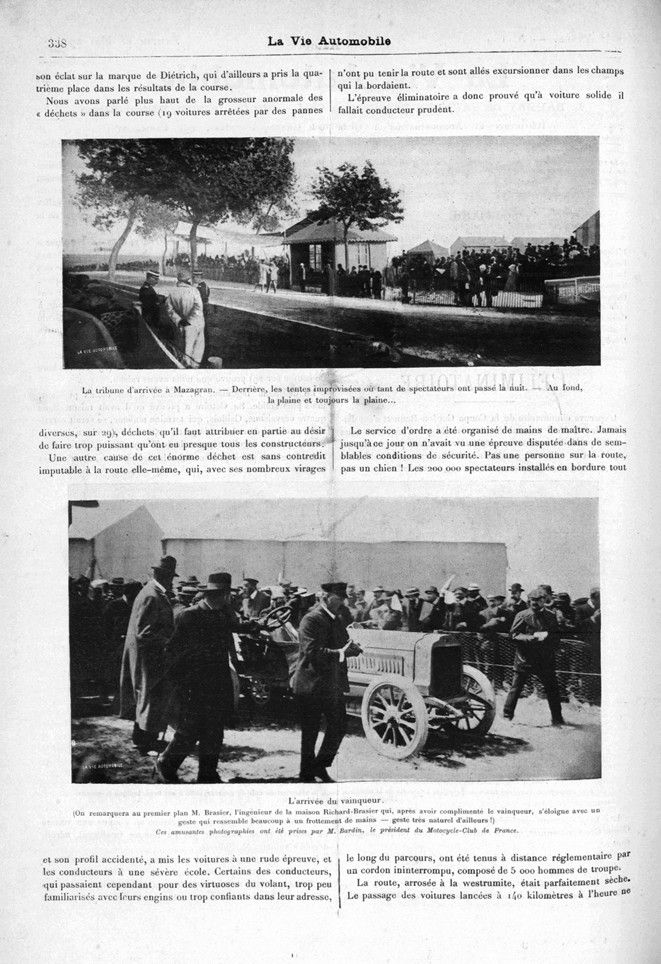
The finish line stand at Mazagran. — Behind it, the makeshift tents where so many spectators spent the night. — In the background, the plain and more plain…
The arrival of the winner. (In the foreground, we see Mr. Brasier, the engineer from Richard-Brasier, who, after congratulating the winner, walks away with a gesture that looks very much like rubbing his hands together—a very natural gesture, by the way!) These amusing photographs were taken by Mr. Bardin, president of the Motocycle-Club de France.
Pages 339-340.
Our second champion. — Mr. Salleron, in his Mors car.
Our third champion. — Mr. Rougier, in his Turcat-Méry car (Diétrich model).
Page 341.
Achille Fournier cheerfully accepts his breakdown. — An inflexible gatekeeper. — Fanatics who slept on board!
Farman at 100 kilometers per hour. — Gabriel at speed. — Teste in his Panhard & Levassor.
Page 342.
1. The road, guarded by fences, trellises and… troops. — 2. Caillois has just received the start. 3. Rougier, at the neutralization in Rethel. — 4. P. de Crawhez broken down.