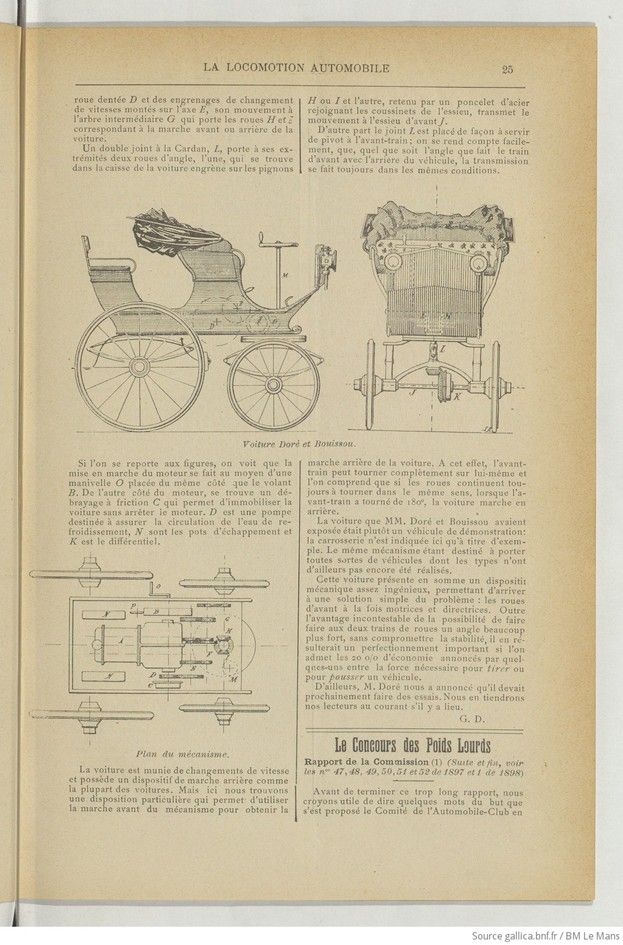
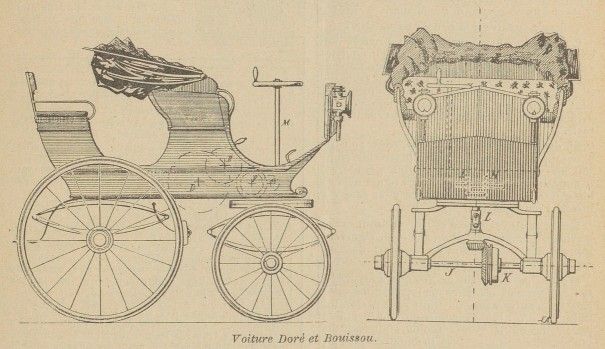
This front-wheel drive vehicle of 1898 has a front-end unit (French: avant-train) with the driving pinion in its middle, driven by a cardan joint. Rotating or swivelling the bogey changes driving direction and by swinging it a 180°, the vehicle drives backward, without the need for a reverse gear. The front-end unit rotates around the driving pinion shaft, thereby assuring gear meshing between pinion and bevel gear, independent of the driving direction. An inventive, simple as effective solution. Unfortunately, I don’t have information whether this solution was succesfull . (Translation included)
Avec l’authorisation du Bibliothèque national francais, gallica.bnf.fr.
Text et photos compilé par motorracingistory.com. (Translation by DeepL.com)
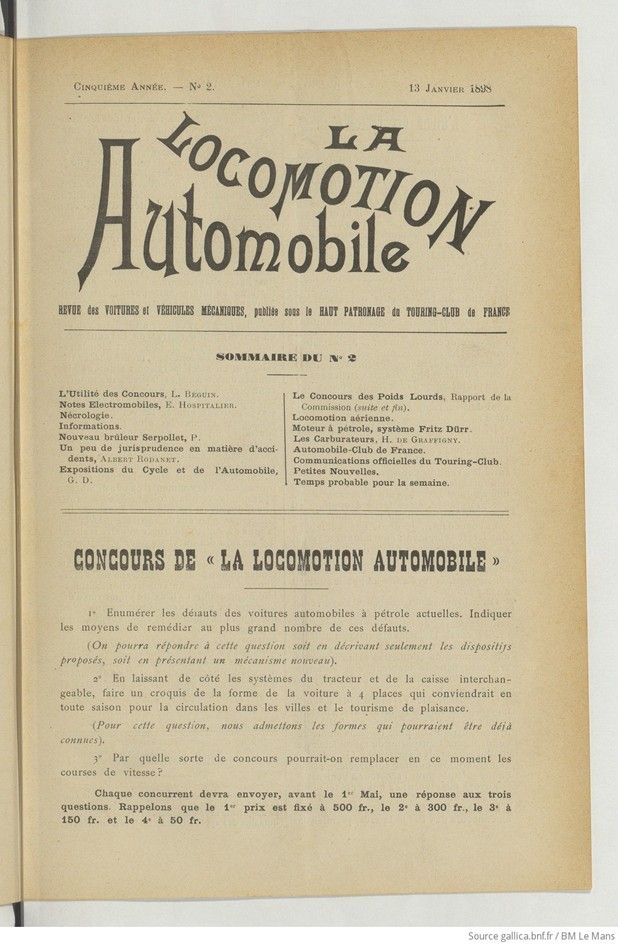
La Locomotion Automobile, 5e Année, No. 2, 13 Janvier 1898
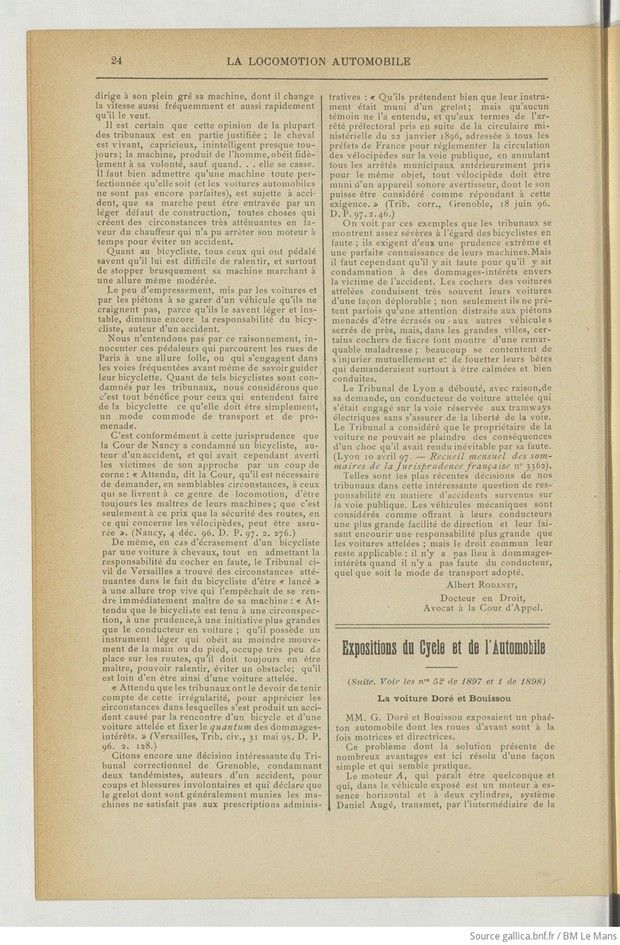
La voiture Doré et Bouissou
Expositions du Cycle et de l’Automobile {Suite. Voir les n° 52 de 1897 et 1 de 1898)
MM. G. Doré et Bouissou exposaient un phaéton automobile dont les roues d’avant sont à la fois motrices et directrices.
Ce problème dont la solution présente de nombreux avantages est ici résolu d’une façon simple et qui semble pratique.
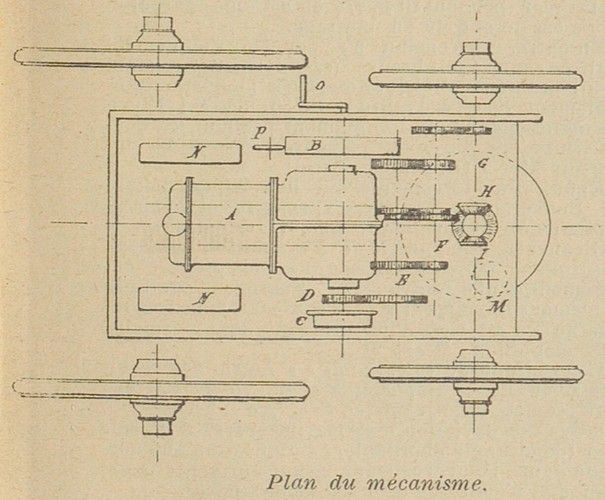
Le moteur A, qui paraît être quelconque et qui, dans le véhicule exposé est un moteur à essence horizontal et à deux cylindres, système Daniel Augé, transmet, par l’intermédiaire de la roue dentée D et des engrenages de changement de vitesses montés sur l’axe E, son mouvement à l’arbre intermédiaire G qui porte les roues H et I correspondant à la marche avant ou arrière de la voiture.
Un double joint à la Cardan, L, porte à ses extrémités deux roues d’angle, l’une, qui se trouve dans la caisse de la voiture engrène sur les pignons H ou I et l’autre, retenu par un poncelet d’acier rejoignant les coussinets de l’essieu, transmet le mouvement à l’essieu d’avant J.
D’autre part le joint L est placé de façon à servir de pivot à l’avant-train ; on se rend compte facilement, que, quel que soit l’angle que fait le train d’avant avec l’arrière du véhicule, la transmission se tait toujours dans les mêmes conditions.
Si l’on se reporte aux figures, on voit que la mise en marche du moteur se fait au moyen d’une manivelle O placée du même côté que le volant B. De l’autre côté du moteur, se trouve un débrayage à friction C qui permet d’immobiliser la voiture sans arrêter ie moteur. D est une pompe destinée à assurer la circulation de l’eau de refroidissement, N sont les pots d’échappement et K est le différentiel.
La voiture est munie de changements de vitesse et possédé un dispositif de marche arrière comme la plupart des voitures. Mais ici nous trouvons une disposition particulière qui permet d’utiliser la marche avant du mécanisme pour obtenir la marche arrière de la voiture. A cet effet, l’avant-train peut tourner complètement sur lui-même et l’on comprend que si les roues continuent toujours à tourner dans le même sens, lorsque l’avant-train a tourné de 180°, la voiture marche en arrière.
La voiture que MM. Doré et Bouissou avaient exposée était plutôt un véhicule de démonstration : la carrosserie n’est indiquée ici qu’à titre d’exemple. Le même mécanisme étant destiné à porter * toutes sortes de véhicules dont les types n’ont d’ailleurs pas encore été réalisés.
Cette voiture présente en somme un dispositif mécanique assez ingénieux, permettant d’arriver à une solution simple du problème : les roues d’avant à la fois motrices et directrices. Outre l’avantage incontestable de la possibilité de faire faire aux deux trains de roues un angle beaucoup plus fort, sans compromettre la stabilité, il en résulterait un perfectionnement important si l’on admet les 20 0/0 d’économie annoncés par quelques-uns entre la force nécessaire pour tirer ou pour pousser un véhicule.
D’ailleurs, M. Doré nous a annoncé qu’il devait prochainement faire des essais. Nous en tiendrons nos lecteurs au courant s’il y a lieu.
G. D.
Photos. Plan du mécanisme.
Translation by DeepL.com
The Doré and Bouissou car
Messrs. G. Doré and Bouissou exhibited an automobile phaeton whose front wheels are both driven and steered.
This problem, the solution to which offers many advantages, is solved here in a simple and seemingly practical way.
The engine A, which appears to be ordinary and which, in the vehicle on display, is a horizontal two-cylinder gasoline engine, Daniel Augé system, transmits its movement via the gear wheel D and the gear shift gears mounted on the axle E to the intermediate shaft G, which carries the wheels H and I corresponding to the forward or reverse movement of the car.
A double Cardan joint, L, carries two angle wheels at its ends, one of which, located in the car body, meshes with the pinions H or I, and the other, held by a steel pin connecting the axle bearings, transmits the movement to the front axle J.
Furthermore, the joint L is positioned so as to act as a pivot for the front axle; it is easy to see that, regardless of the angle between the front axle and the rear of the vehicle, the transmission always operates under the same conditions.
Referring to the figures, we can see that the engine is started by means of a crank O located on the same side as the steering wheel B. On the other side of the engine is a friction clutch C, which allows the car to be immobilized without stopping the engine. D is a pump designed to circulate the cooling water, N are the exhaust pipes, and K is the differential.
The car is equipped with a gearbox and has a reverse gear like most cars. But here we find a special arrangement that allows the forward gear of the mechanism to be used to reverse the car. To this end, the front axle can turn completely on itself, and it is clear that if the wheels continue to turn in the same direction, when the front-end unit has turned 180°, the car will move backwards.
The car that Messrs. Doré and Bouissou had exhibited was more of a demonstration vehicle: the bodywork is shown here only as an example. The same mechanism is intended to carry all kinds of vehicles, the types of which have not yet been produced.
In short, this car features a rather ingenious mechanical device that provides a simple solution to the problem: front wheels that are both driven and steered. In addition to the undeniable advantage of being able to turn both sets of wheels at a much greater angle without compromising stability, this would result in a significant improvement if we accept the 20% reduction in the force required to pull or push a vehicle, as claimed by some. Moreover, Mr. Doré has announced that he will soon be conducting tests. We will keep our readers informed if necessary.
G. D.