This article of the French La Vie automobile basically describes the complete route of the 1904 Gordon Bennett Race. After a short introduction on the past races, the 18 contestants and their cars are presented, with several pictures of them. Then, the entire route through the German Taunus mountains is described very accurately, inclusive a route map with ascents and descents.




With kind permission of Le Conservatoire numérique des Arts et Métiers (Cnum) – https://cnum.cnam.fr
Text and photos compiled by motorracingistory.com., translation by DeepL.com
La Vie Automobile, Vol. 4. — N° 141. – Saturday, June 11 1904.
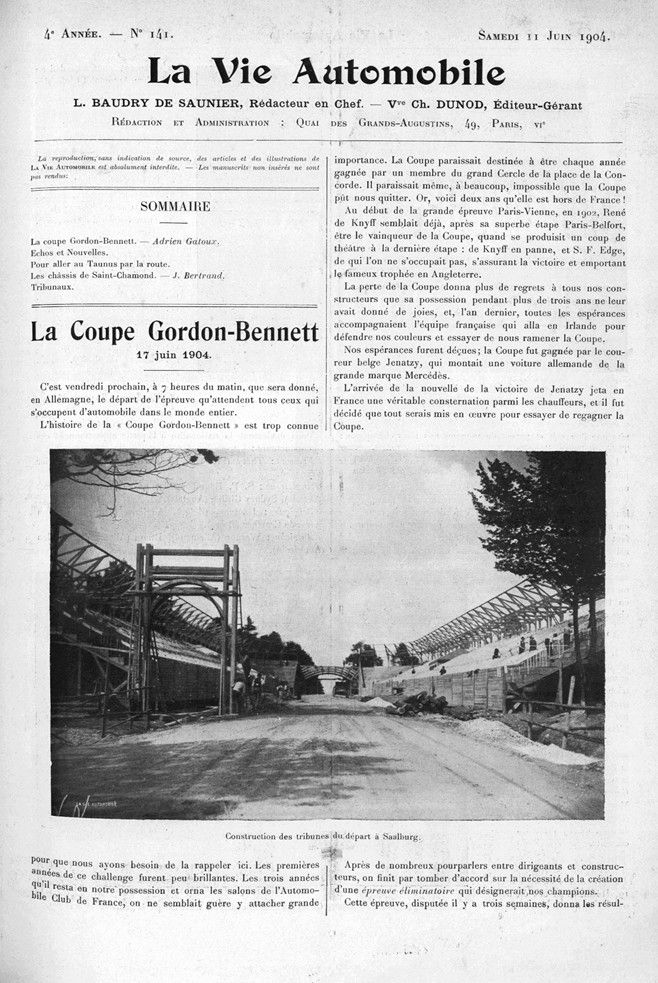
The Gordon-Bennett Cup – (JUNE 17, 1904)
Next Friday, at 7 a.m., the race that everyone involved in the automotive world has been waiting for will begin in Germany.
The history of the Gordon Bennett Cup is too well known for us to need to recount it here. The early years of this challenge were not particularly impressive. During the three years that it remained in our possession and adorned the salons of the Automobile Club de France, it did not seem to be held in high regard. The Cup seemed destined to be won each year by a member of the grand Cercle de la Place de la Concorde. To many, it even seemed impossible that the Cup could ever leave us. Yet it has now been out of France for two years!
At the start of the great Paris-Vienna race in 1902, René de Knyff already seemed, after his superb Paris-Belfort stage, to be the winner of the Cup, when a dramatic turn of events occurred in the last stage: de Knyff broke down, and S. F. Edge, who had been ignored, secured victory and took the famous trophy to England.
The loss of the Cup caused our manufacturers more regret than its possession for more than three years had given them joy, and last year, all hopes were pinned on the French team that went to Ireland to defend our colors and try to bring the Cup back to us.
Our hopes were dashed; the Cup was won by the Belgian driver Jenatzy, who was driving a German car from the prestigious Mercedes brand. The news of Jenatzy’s victory caused consternation among drivers in France, and it was decided that everything would be done to try to win back the Cup.
After numerous discussions between leaders and manufacturers, agreement was finally reached on the need to create a qualifying round to select our champions.
This round, which took place three weeks ago, produced the results we all know and allowed us to name our three champions: Théry, Salleron, and Rougier.
Recent events in France have been mirrored in England; like us, our neighbors held a qualifying event.
Other countries simply designated the brands they felt were best suited to defend their interests without resorting to the judgment of God in the form of a qualifying round. It should also be noted that in these other countries, the number of factories capable of producing vehicles that can compete on equal terms with ours is very limited. Fortunately for us, in France we are spoiled for choice.
***
Germany will be represented by two Mercedes cars and one Opel-Darracq. — Austria by three Austrian Mercedes cars. — Belgium by three Pipe cars. — Italy by three Fiat cars. — England by one Napier and two Wolseley’s. — Finally, Switzerland by a single vehicle, the Dufaux car. With our Georges Richard-Brazier, our Mors, and our Turcat-Méry (Diétrich), there are a total of 19 competing vehicles.
***
The numbers assigned to these 19 vehicles were given to them in the order in which the clubs issued their challenge to the Deutscher Automobil Club, holder of the Cup.
Here are the names of the drivers with their starting order, the name of the brand they are driving and the nation they are representing:
1. Jenatzy (Mercedes, German).
2. Edge (Napier, English).
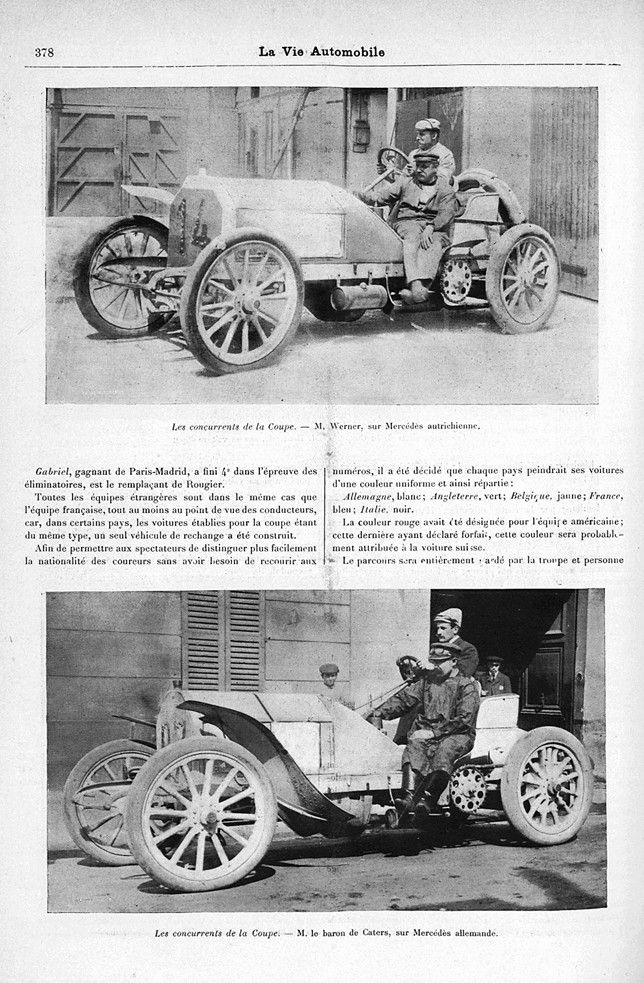
3. Werner (Mercedes, Austrian).
4. Lancia (Fiat, Italian).
5. Théry (Richard-Brasier, French).
6. Hautvast (Pipe, Belgian).
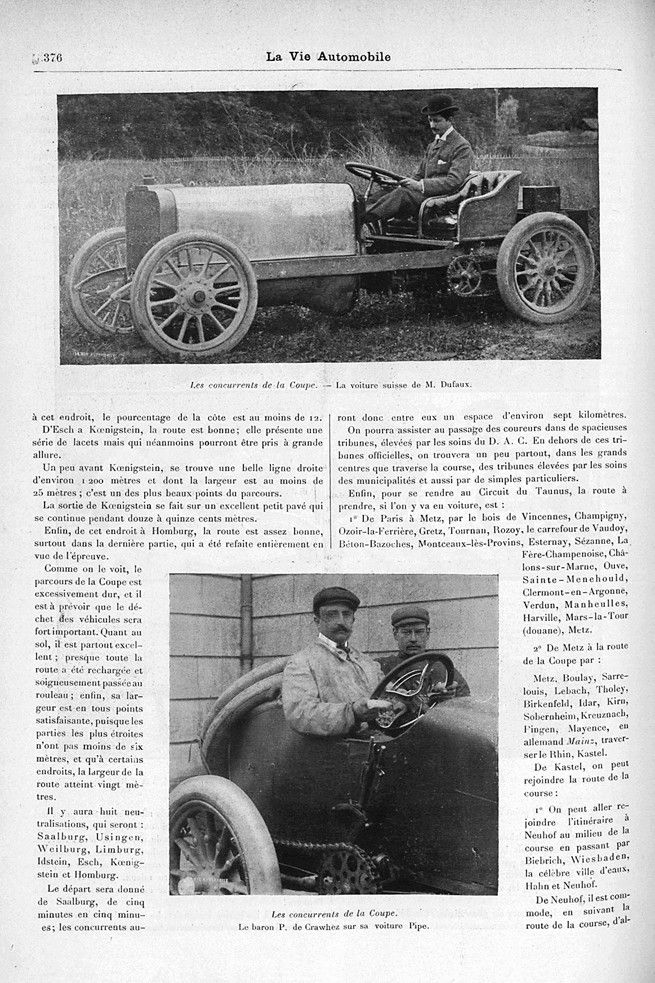
7. Dufaüx (Dufaux, Swiss).
8. De Caters (Mercedes, Belgian).
9. Sydney Girling (Wolseley, English).
10. Braun (Mercedes, Austrian).
11. Storero (Fiat, Italian).
12. Salleron (Mors, French).
13. Augières (Pipe, Belgian).
14. Fritz Opel (Darracq, Belgian).
15. Jarrott (Wolseley, English).
16. Warden (Mercedes, Austrian).
17. Cagno (Fiat, Italian).
18. Rougier (Turcat-Méry, French). 19. P. de Crawhez (Pipe, Belgian).
Here are the nationalities of these 19 drivers:
France: Théry (French), Salleron (French), Rougier (French).
England: S. F. Edge (English, born in Australia), Jarrott (English), Sydney Girling (English).
Belgium: Hautvast (Belgian), Augières (French), Baron Pierre de Crawhez (Belgian).
Austria: Werner (German), Braun (German), Warden (American).
Switzerland: Ch. Dufaux (Swiss).
Italy: Storero (Italian), Lancia (Italian), Cagno (Italian).
That is 4 French, 4 Belgians, 3 Germans, 3 Italians, 3 English, 1 American, 1 Swiss.
In terms of tires, three brands are currently competing for the vehicles. It seems likely that we will have what has been decided to date:
Michelin will be used on the 3 French cars, the 3 Italian cars, and the Swiss car, for a total of 7 cars.
Continental will be used on the three German cars, the three Austrian cars, and the three Belgian cars, for a total of nine cars.
Dunlop will be used on the three English cars.
It is understood that the Michelin and Continental tires for Italy, Switzerland, Austria, and Belgium are manufactured in those countries under license, in accordance with the regulations. It is known that every part of a car entered in the Cup must be manufactured by the nation entering that car. However, the regulations make an exception for the nationality of the raw materials used in magneto soft iron (generally of Swedish origin) and tire fabric (generally of Belgian origin).
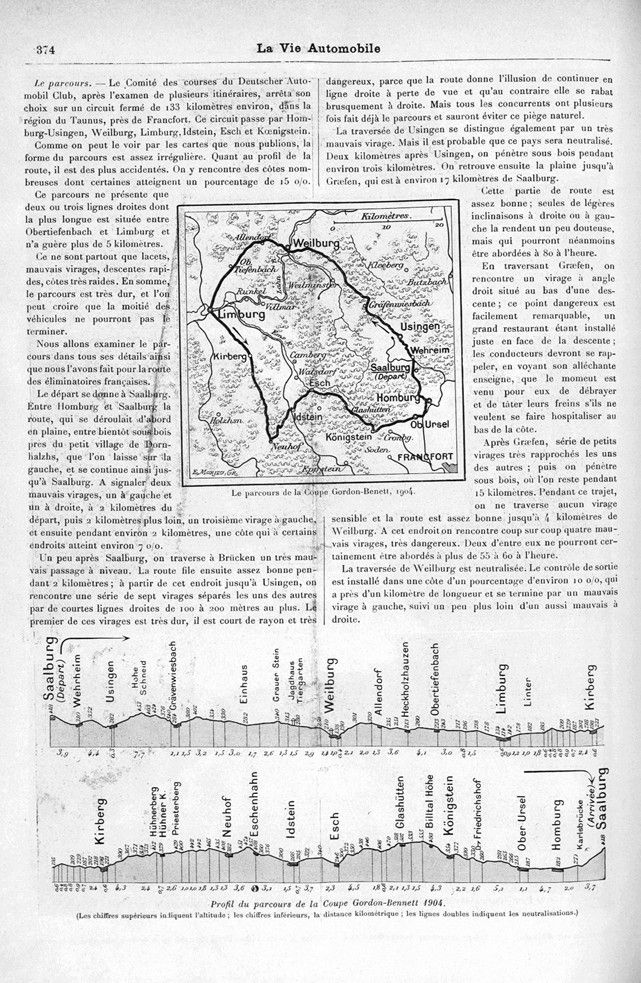
The route. — After examining several itineraries, the Deutscher Automobil Club’s racing committee settled on a closed circuit of approximately 133 kilometers in the Taunus region, near Frankfurt. This circuit passes through Homberg-Usingen, Weilburg, Limburg, Idstein, Esch, and Königstein.
As can be seen from the maps we are publishing, the shape of the route is quite irregular. As for the profile of the road, it is extremely uneven. There are numerous hills, some of which reach a gradient of 15%.
This route has only two or three straight sections, the longest of which is between Obertiefenbach and Limburg and is barely more than 5 kilometers long.
There are hairpin bends, sharp turns, fast descents, and very steep climbs everywhere. In all, the course is very difficult, and it is likely that half of the vehicles will not be able to finish.
We will examine the course in detail, as we did for the French qualifying route.
The start is in Saalburg. Between Homburg and Saalburg, the road, which runs along the plain, soon enters a forest near the small village of Dornhalzhs, which is left on the left, and continues like this until Saalburg. There are two dangerous bends, one to the left and one to the right, 2 kilometers from the start, then 2 kilometers further on, a third bend to the left, and then for about 2 kilometers, a hill that in some places reaches a gradient of about 7%.
Shortly after Saalburg, you cross a very bad level crossing at Brücken. The road then runs fairly smoothly for 2 kilometers; from this point to Usingen, there is a series of seven bends separated by short straights of 100 to 200 meters at most. The first of these bends is very difficult, with a short radius and very dangerous, because the road gives the illusion of continuing straight ahead as far as the eye can see, but instead it suddenly turns sharply to the right. However, all the competitors have already done the course several times and will know how to avoid this natural trap
The crossing of Usingen is also notable for a very dangerous bend. However, it is likely that this section will be neutralized. Two kilometers after Usingen, the route enters woodland for about three kilometers. It then returns to flat terrain until Græfen, which is about 17 kilometers from Saalburg.
This part of the road is fairly good; only slight inclines to the right or left make it a little tricky, but it can still be tackled at 80 km/h.
When crossing Græfen, there is a right-angle bend at the bottom of a descent; this dangerous spot is easily noticeable, as there is a large restaurant just opposite the descent; Drivers should remember, when they see its tempting sign, that it is time to shift down and test their brakes if they do not want to end up in the hospital at the bottom of the hill.
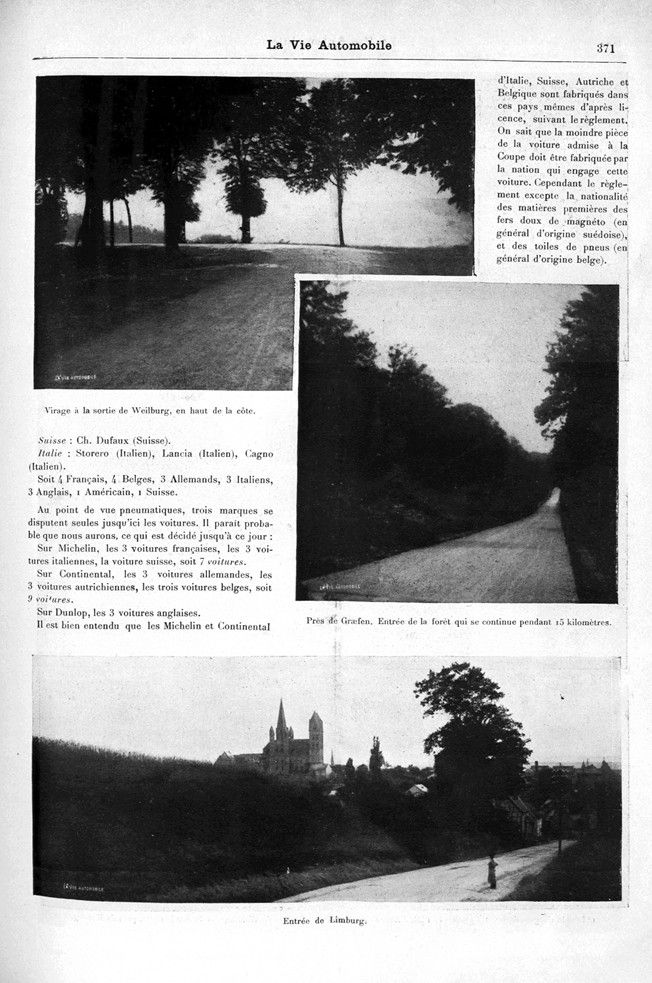
After Græfen, there is a series of small bends very close together; then you enter the woods, where you remain for 15 kilometers. During this stretch, there are no significant bends, and the road is fairly good until 4 kilometers from Weilburg. At this point, there are four dangerous bends in quick succession. Two of them certainly cannot be taken at more than 55 to 60 km/h.
The crossing of Weilburg is neutralized; the exit control is installed on a hill with a gradient of about 10%, which is nearly a kilometer long and ends with a dangerous left turn, followed a little further on by an equally dangerous right turn.
We then reach the small village of Allendorf. Before entering the village, the road has been completely modified; there used to be a bend there that was so bad that it could not be taken at more than 15 mph. Wanting to improve the road as much as possible and avoid the risk of accidents, the Deutscher Automobil Club bought a field and rebuilt a section of road at its own expense, which is now S-shaped and quite acceptable.
Shortly after Allendorf, we come to the worst part of the route. There is a narrow, short-radius bend, raised on the right, followed abruptly by a left-hand bend on a bridge! This point is exactly 45 kilometers from Saalburg.
The village of Heckholzhauzen is also notable for its poor crossing; after that, the road is fairly good until Obertiefenbach. The section between Obertiefenbach and Limburg is the most beautiful of the entire route. This is certainly where vehicles will reach their maximum speed.
The crossing of Limburg is neutralized, and the start is uphill!
From Limburg to Kirberg, the road crosses open country; it is fairly good until one kilometer from Kirberg.
At this point, it turns sharply to the right, then, before entering the village, has two or three more difficult bends.
Once this section is over, the route becomes beautiful again until Neuhof. This area will hopefully be neutralized, as the road has a sharp bend at this point where it will be impossible to take at more than 20 km/h.
Immediately after leaving Neuhof, there is a horseshoe-shaped bend, followed by three other very bad S-bends, ending with a fast descent leading to Eschenhahn.
The road then passes over the railroad tracks and through the village of Idstein, which is neutralized. The entrance to Idstein is dangerous, as there is a bad curve on a bridge. The exit is not much better, as it is also on a hill ending in a bad curve that is raised at the top!
From Idstein to Esch, there is nothing to report. The exit from Esch is on a 10% incline ending at the top with a right-hand bend; at this point, the gradient is at least 12%.
From Esch to Königstein, the road is good; it has a series of hairpin bends, but these can nevertheless be taken at high speed.
Shortly before Königstein, there is a beautiful straight stretch of about 1,200 meters, at least 25 meters wide; this is one of the most beautiful parts of the course.
The exit from Königstein is on excellent small cobblestones that continue for twelve to fifteen hundred meters.
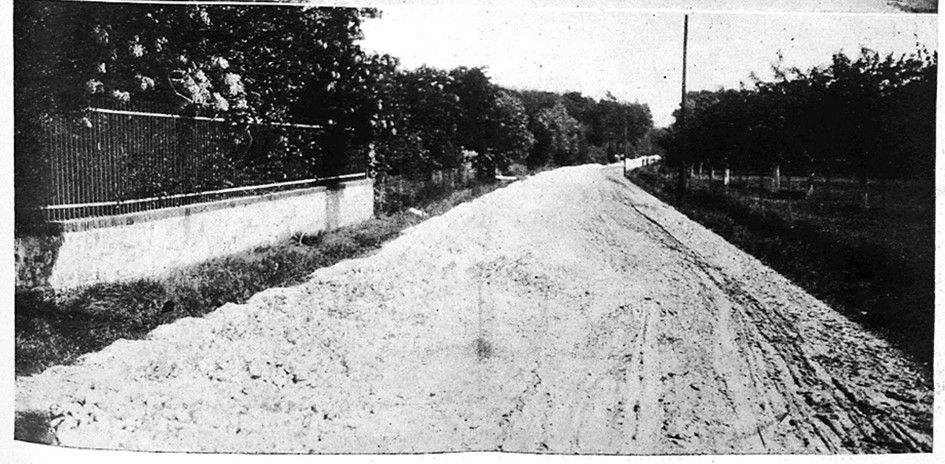
Finally, from this point to Homburg, the road is fairly good, especially in the last section, which has been completely resurfaced for the event.
As can be seen, the Cup route is extremely difficult, and it is to be expected that there will be a high rate of vehicle failure. As for the ground, it is excellent throughout; almost the entire road has been resurfaced and carefully rolled; finally, its width is satisfactory in all respects, since the narrowest parts are no less than six meters wide, and in some places the road is twenty meters wide.
There will be eight neutralizations, which will be: Saalburg, Usingen, Weilburg, Limburg, Idstein, Esch, Kœnigstein, and Homburg.
The start will be given from Saalburg, every five minutes; the competitors will therefore have a gap of about seven kilometers between them.
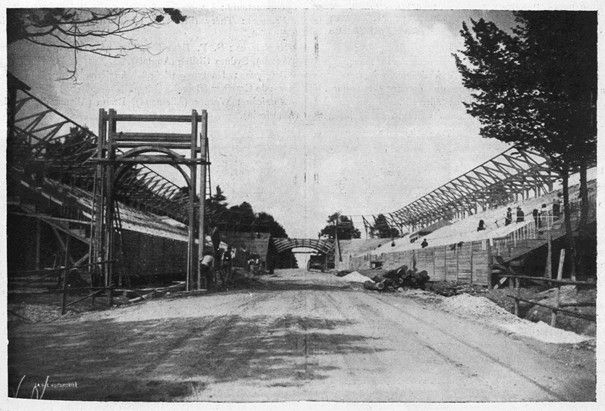
Spectators will be able to watch the drivers pass by from spacious grandstands erected by the D.A.C. In addition to these official grandstands, there will be grandstands erected by local authorities and private individuals throughout the major towns and cities along the route.
Finally, to get to the Taunus Circuit by car, take the following route:
1e From Paris to Metz, via the Bois de Vincennes, Champigny, Ozoir-la-Ferrière, Gretz, Tournau, Rozoy, the Vaudoy crossroads, Béton-Bazoches, Montceaux-lès-Provins, Esternay, Sézanne, La Fère-Champenoise, Châlons-sur-Marne, Ouve, Sainte-Menehould, Clermont-en-Argonne, Verdun, Manheulles, Harville, Mars-la-Tour (customs), Metz.
2nd From Metz to the Coupe route via:
Metz, Boulay, Sarre-louis, Lebach, Tholey, Birkenfeld, Idar, Kirn, Sobernheim, Kreuznach, Pingen, Mainz, cross the Rhine, Kastel.
From Kastel, you can join the race route:
1. You can join the route at Neuhof in the middle of the race via Biebrich, Wiesbaden, the famous spa town, Hahn, and Neuhof.
From Neuhof, it is convenient to follow the race route to Limburg or Weilburg in the north; ldstein, Ecks, and Kœnigstein in the south.
2nd You can go to Frankfurt, in German Francfurt-am-Main, and Homburg via the following route: Hattersheim, Hoechst, Francfurt-am-Main, Oberursel, where you rejoin the Cup route and Homburg.
The French drivers who are going to Taunus to defend our colors have three assistants who are also traveling in a race car; if, at the last minute, a rider is indisposed or his car suffers an irreparable breakdown, one of the assistants will take his place.
Here is the exact composition of the second team accompanying Messrs. Théry, Salleron, and Rougier:
Caillois, who finished 61st in the qualifying rounds, Georges-Richard Brazier, Théry’s co-driver.
Léger, who finished second in the Mors team in the qualifying rounds, Salleron’s co-driver.
Gabriel, winner of Paris-Madrid, finished 43rd in the qualifying rounds and is Rougier’s replacement.
All the foreign teams are in the same situation as the French team, at least as far as the drivers are concerned, because in some countries, as the cars entered for the cup are of the same type, only one replacement vehicle has been built.
In order to make it easier for spectators to distinguish the nationality of the drivers without having to resort to numbers, it was decided that each country would paint its cars in a uniform color, distributed as follows:
Germany, white; England, green; Belgium, yellow; France, blue; Italy, black.
The color red had been designated for the American team; however, as the latter has withdrawn, this color will probably be assigned to the Swiss car.
The course will be entirely prepared by the troops, and no one will be allowed, under any pretext whatsoever, to cross the roadblocks; however, there is no need to worry about this, as our neighbors are record-breakers when it comes to corporatism!
A veritable small army of workers has been mobilized for the occasion, and all the manufacturers have set up camps in the villages along the route. As for tires, there will be numerous refueling stations. Michelin, for its part, will have no fewer than sixteen, one at each neutralization and one between neutralizations.
Finally, a whole program of festivities has been organized for the Cup. The program is as follows:
June 16, gala evening at the Kursaal theater in Homburg.
June 17, Gordon Bennett Cup.
On the 18th, a day of rest; excursion on the roads of the circuit, and in the evening a grand banquet hosted by the D. A. C.
On the 19th, races at the Frankfurt autodrome. During this meeting, the Emperor’s Cup for alcohol-powered vehicles will be contested.
On the 20th, an elegance contest in Homburg.
It is confirmed that the Emperor will arrive in Homburg on June 16 to attend the race; it is also said that Mr. Gordon Bennett will be among his guests.
It is very likely that the first start will be given at seven o’clock in the morning; neutralizations will take at least 1 hour and 15 minutes per lap. As the drivers will complete four laps, five hours must be allowed for neutralizations alone. As the course is very poor, the drivers’ average speed will vary between 90 and 95 kilometers per hour, which represents approximately six hours for 550 kilometers. The race will therefore not end before 6 p.m. for the first drivers.
The event has generated real enthusiasm in the region where it is being held, which is easy to understand because, apart from the curiosity aroused by the event, the hope of attracting tens of thousands of visitors has filled all the hoteliers with joy. This joy has had an immediate impact on accommodation prices, which have instantly risen to fantastic levels. To give you an idea, in Hombourg, they are not afraid to charge a whopping $60 per night per bed. We would therefore advise visitors to find accommodation 50 or 60 kilometers from the course and, as the start is quite late, to travel there on the morning of the race.
There is another practical way to attend the event without running the risk of being fleeced: travel on the special train organized for the occasion by our colleagues of L’Auto.
The schedule for this special train is as follows:
Outbound. — Departure from Paris-Est at 4 p.m. on Thursday, June 16. Arrival at Saalburg Station around 3:30 a.m. on Friday, June 17. Saalburg Station is 10 minutes from the starting line.
Return, Friday, June 17. — Departure from Saalburg Station between 7 and 8 p.m. Arrival in Paris between 7 and 8 a.m. on Saturday, June 18.
The trip can thus be made in a maximum of 40 hours, 16 of which will be spent at the Cup venue.
In Saalburg, a giant board will display the arrival times and also the dispatches from all points along the route, reporting on the incidents that are sure to occur during the race.
***
Finally, let us add that we wish the French drivers every success in their attempt to bring home the Cup, and hope that the rain does not spoil the day, as the course is almost entirely in woodland, which would make the road terribly slippery and dangerous.
Adrien Gatoux.
Photos.
369 – 380: Construction of the starting stands at Saalburg.
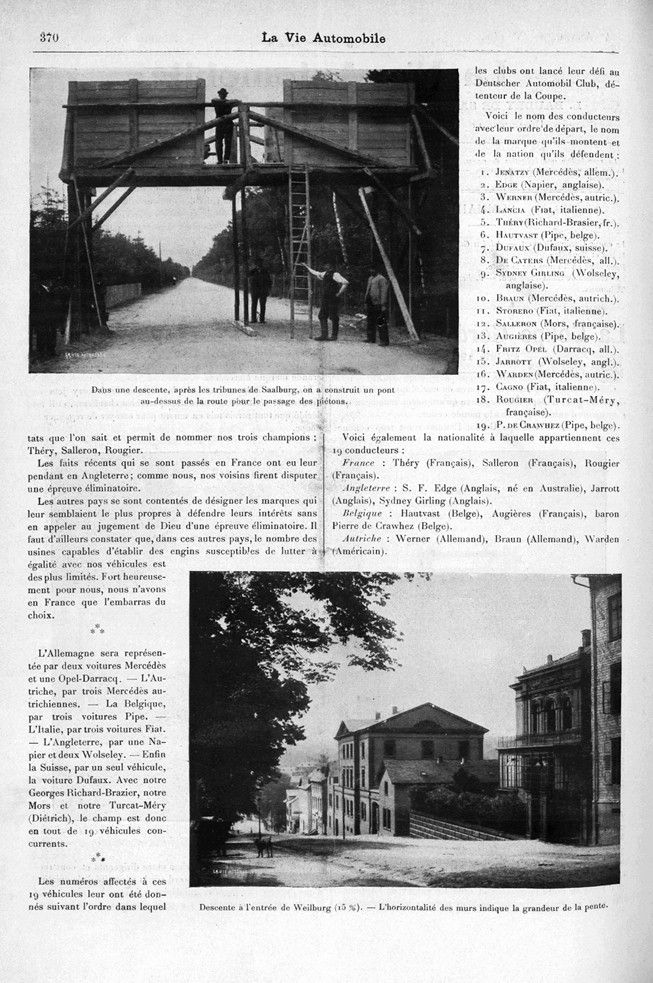
370: On a downhill stretch after the Saalburg stands, a bridge has been built over the road for pedestrians to cross. — Downhill stretch at the entrance to Weilburg (10%). — The horizontality of the walls indicates the steepness of the slope.
371: Bend at the exit of Weilburg, at the top of the hill. — Near Græfen. Entrance to the forest, which continues for 15 kilometers. — Entrance to Limburg.
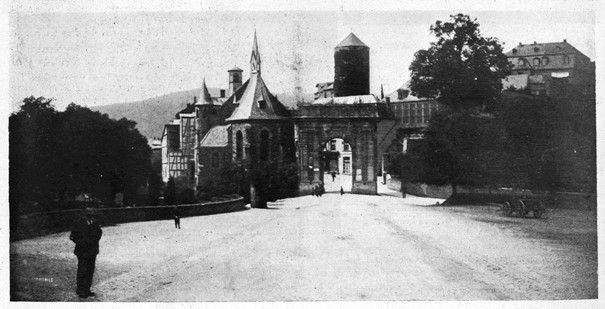
372: 1. Double bend to the right and left (1 km from Allendorf). — 2. Entrance gate to Weilburg. — 3. On the road, near Kirberg.
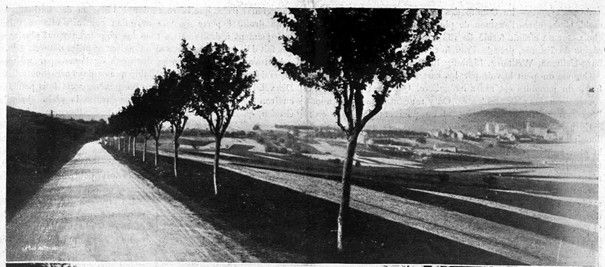
373: 1. Road and view of Idstein. — 2. Dangerous bend before Ober-Ursel. — 3. On the road to Ober-Ursel (This section of the road is currently being rebuilt).
374: The Gordon Bennett Cup route, 1904. — Profile of the 1904 Gordon Bennett Cup route. (The upper numbers indicate altitude; the lower numbers indicate distance in kilometers; the double lines indicate neutralizations.)
375: The Cup competitors. — The English team. — 1. Edge. — 2. Sidney Girling. — 3. Jarrott. — 4, 5, and 6. Substitutes.
376: The Cup competitors. — Mr. Dufaux’s Swiss car. — Baron P. de Crawhez in his Pipe car.
377: The Cup competitors. — Mr. Hautvast in his Pipe car. — Mr. Jenatzy, winner of the Cup in 1903, in a German Mercedes.
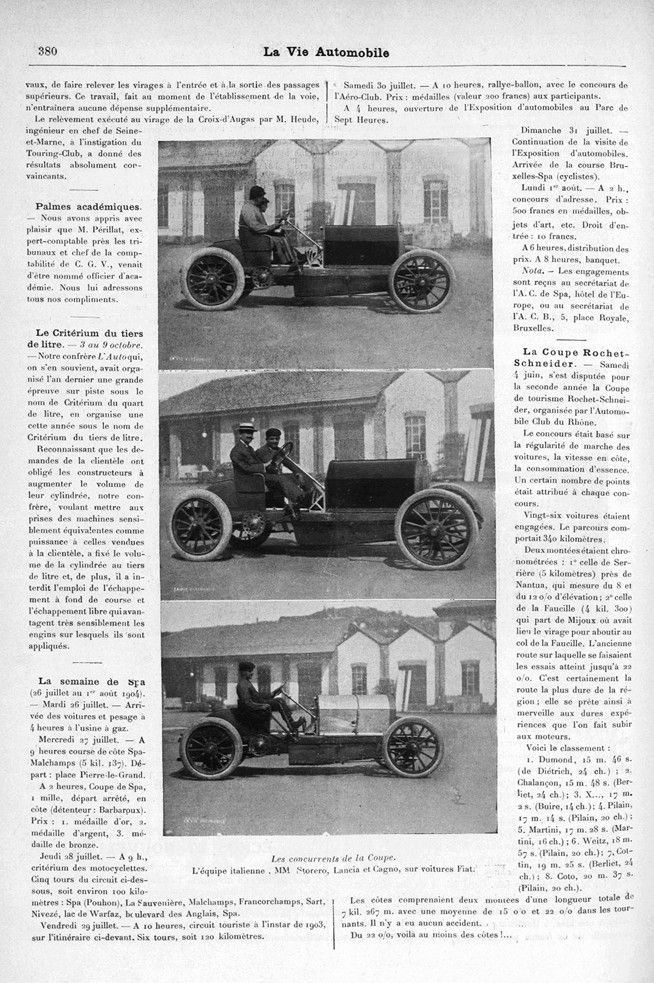
378: The Cup competitors. — Mr. Werner in an Austrian Mercedes. — Baron de Caters, in a German Mercedes. 379 – 380: The Cup competitors. — Mr. Hiéronymus, in an Austrian Mercedes. — The Italian team. Messrs. Storero, Lancia, and Cagno, in Fiat cars.