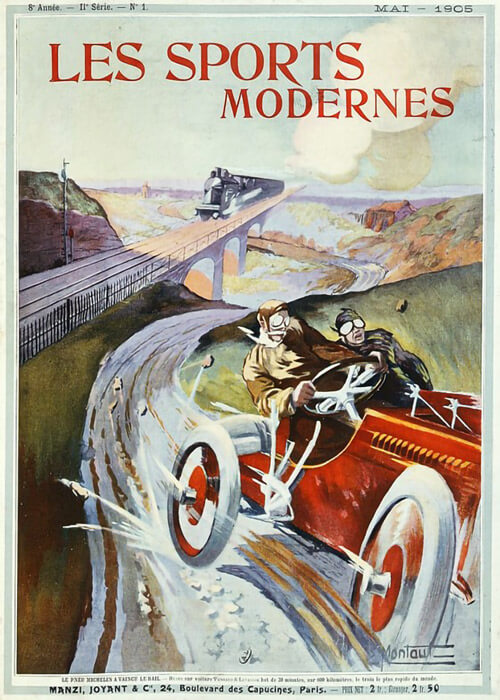
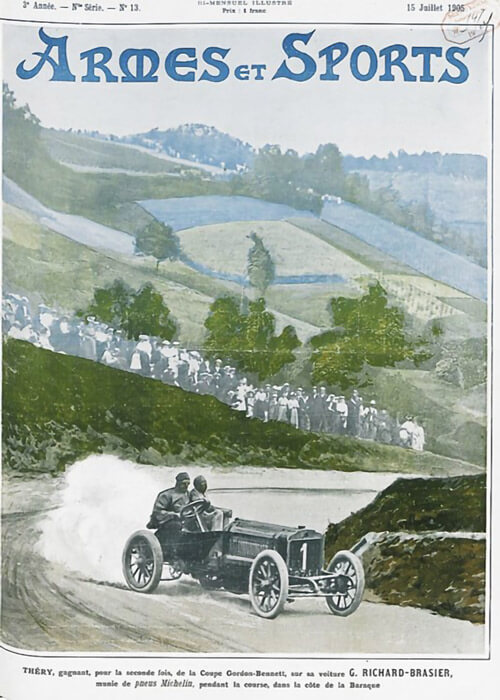
By the end of January 1903, it was evident that no Gorden Bennett Race was going to be held on British soil. In this January 24 issue, the real reason for not racing in the England (a certain law forbade racing “Along England’s greenest hills”) is not clearly discribed. But some ironics can’t be missed here. Any way, no racing on England’s soil in 1903, hence Ireland came into play. On the same page, however, some typical statements by Baron De Rothschild were made to the French automotive industry, which at that time was overwhelming. Some estimates on human health at then unknown high speeds of 100 kmh, were also highlighted. Althugh it has nothing to do with the wheres of the coming Gordon Bennett race, but interesting enough to share this. Tthoughts in the first years of automotive history, more than a century ago
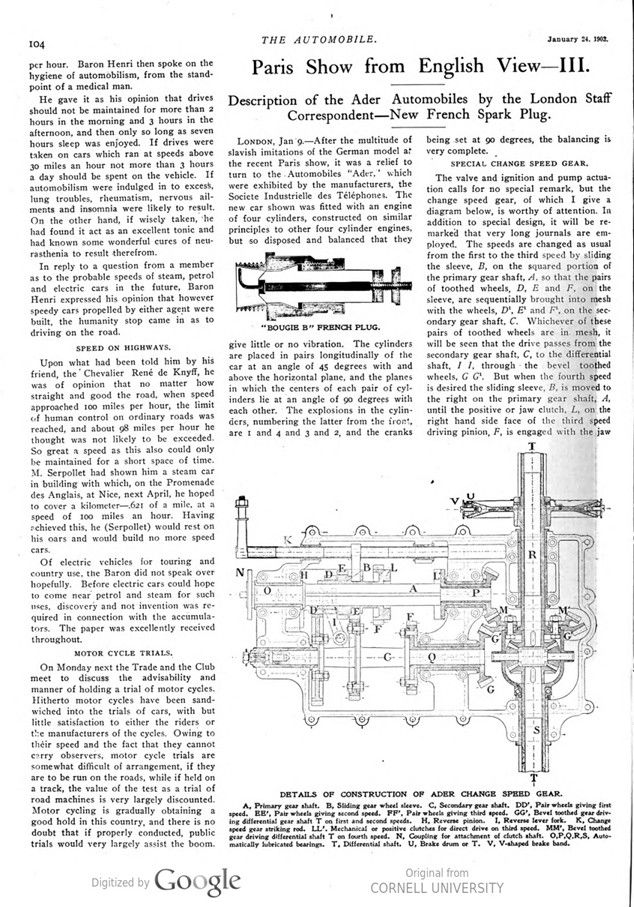
Text and photos with courtesy of hathitrust hathitrust.org, compiled by motorracingistory.com.
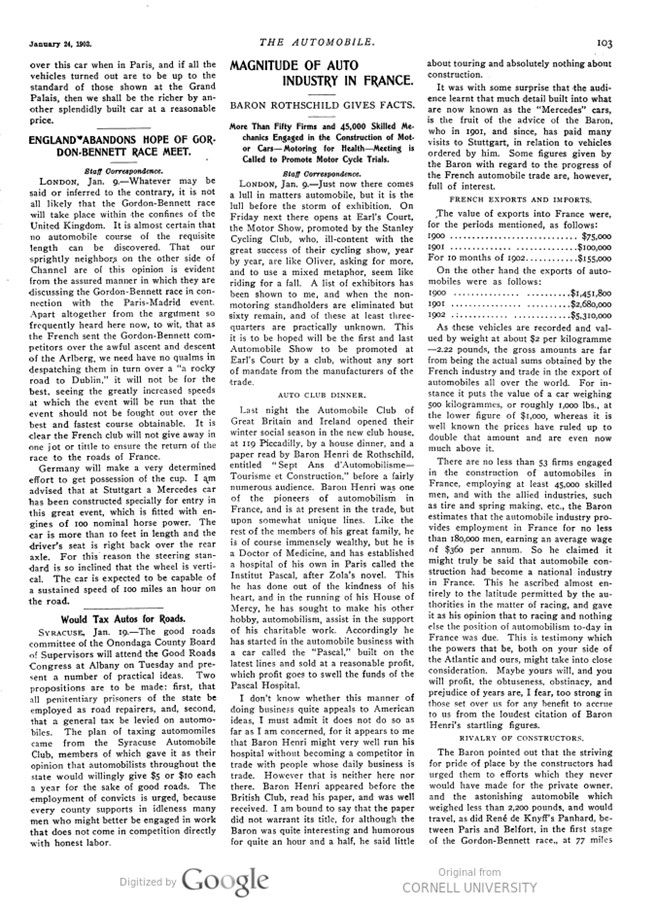
THE AUTOMOBILE – Vol. 8, No. 4, January 24, 1903
ENGLAND ABANDONS HOPE OF GORDON-BENNETT RACE MEЕТ
Staff Correspondence.
LONDON, Jan. 9. – Whatever may be said or inferred to the contrary, it is not all likely that the Gordon-Bennett race will take place within the confines of the United Kingdom. It is almost certain that no automobile course of the requisite length can be discovered. That our sprightly neighbors on the other side of Channel are of this opinion is evident from the assured manner in which they are discussing the Gordon-Bennett race in connection with the Paris-Madrid event. Apart altogether from the argument so frequently heard here now, to wit, that as the French sent the Gordon-Bennett competitors over the awful ascent and descent of the Arlberg, we need have no qualms in despatching them in turn over a “a rocky road to Dubiin,” it will not be for the best, seeing the greatly increased speeds at which the event will be run that the event should not be fought out over the best and fastest course obtainable. It is clear the French club will not give away in one jot or tittle to ensure the return of the race to the roads of France.
Germany will make a very determined effort to get possession of the cup. I am advised that at Stuttgart, a Mercedes car has been constructed specially for entry in this great event, which is fitted with engines of 100 nominal horsepower. The car is more than 10 feet in length and the driver’s seat is right back over the rear axle. For this reason the steering standard is so inclined that the wheel is vertical. The car is expected to be capable of a sustained speed of 100 miles an hour on the road.
MAGNITUDE OF AUTO INDUSTRY IN FRANCE.
BARON ROTHSCHILD GIVES FACTS.
More Than Fifty Firms and 45,000 Skilled Mechanics Engaged in the Construction of Motor Cars – Motoring for Health – Meeting is Called to Promote Motor Cycle Trials.
Staff Correspondence.
LONDON, Jan. 9. Just now there comes a lull in matters automobile, but it is the lull before the storm of exhibition. On Friday next there opens at Earl’s Court, the Motor Show, promoted by the Stanley Cycling Club, who, ill-content with the great success of their cycling show, year by year, are like Oliver, asking for more, and to use a mixed metaphor, seem like riding for a fall. A list of exhibitors has been shown to me, and when the non-motoring standholders are eliminated but sixty remain, and of these at least three-quarters are practically unknown. This it is to be hoped will be the first and last Automobile Show to be promoted at Earl’s Court by a club, without any sort of mandate from the manufacturers of the trade.
AUTO CLUB DINNER.
Last night the Automobile Club of Great Britain and Ireland opened their winter social season in the new club house, at 119 Piccadilly, by a house dinner, and a paper read by Baron Henri de Rothschild, entitled “Sept Ans d’Automobilisme — Tourisme et Construction,” before a fairly numerous audience. Baron Henri was one of the pioneers of automobilism in France, and is at present in the trade, but upon somewhat unique lines. Like the rest of the members of his great family, he is of course immensely wealthy, but he is a Doctor of Medicine, and has established a hospital of his own in Paris called the Institut Pascal, after Zola’s novel. This he has done out of the kindness of his heart, and in the running of his House of Mercy, he has sought to make his other hobby, automobilism, assist in the support of his charitable work. Accordingly he has started in the automobile business with a car called the “Pascal,” built on the latest lines and sold at a reasonable profit, which profit goes to swell the funds of the Pascal Hospital.
I don’t know whether this manner of doing business, quite appeals to American ideas, I must admit it does not do so as far as I am concerned, for it appears to me that Baron Henri might very well run his hospital without becoming a competitor in trade with people whose daily business is trade. However that is neither here nor there. Baron Henri appeared before the British Club, read his paper, and was well received. I am bound to say that the paper did not warrant its title, for although the Baron was quite interesting and humorous for quite an hour and a half, he said little about touring and absolutely nothing about construction.
It was with some surprise that the audience learnt that much detail built into what are now known as the “Mercedes” cars, is the fruit of the advice of the Baron, who in 1901, and since, has paid many visits to Stuttgart, in relation to vehicles ordered by him. Some figures given by the Baron with regard to the progress of the French automobile trade are, however, full of interest.
FRENCH EXPORTS AND IMPORTS.
The value of exports into France were, for the periods mentioned, as follows:
1900 – $75,000
1901 – $100,000
For 10 months of 1902 – $155,000
On the other hand the exports of auto-obiles were as follows:
1900 – $1,451,800
1901 – $2,680,000
1902 – $5,310,000
As these vehicles are recorded and valued by weight at about $2 per kilogramme -2.22 pounds, the gross amounts are far from being the actual sums obtained by the French industry and trade in the export of automobiles all over the world. For instance, it puts the value of a car weighing 500 kilogrammes, or roughly 1,000 lbs., at the lower figure of $1,000, whereas it is well known the prices have ruled up to double that amount and are even now much above it.
There are no less than 53 firms engaged in the construction of automobiles in France, employing at least 45,000 skilled men, and with the allied industries, such as tire and spring making, etc., the Baron estimates that the automobile industry provides employment in France for no less than 180,000 men, earning an average wage of $360 per annum. So he claimed it might truly be said that automobile construction had become a national industry in France. This he ascribed almost entirely to the latitude permitted by the authorities in the matter of racing, and gave it as his opinion that to racing and nothing else the position of automobilism to-day in France was due. This is testimony which the powers that be, both on your side of the Atlantic and ours, might take into close consideration. Maybe yours will, and you will profit, the obtuseness, obstinacy, and prejudice of years are, I fear, too strong in those set over us for any benefit to accrue to us from the loudest citation of Baron Henri’s startling figures.
RIVALRY OF CONSTRUCTORS.
The Baron pointed out that the striving for pride of place by the constructors had urged them to efforts which they never would have made for the private owner, and the astonishing automobile which weighed less than 2,200 pounds, and would travel, as did René de Knyff’s Panhard, between Paris and Belfort, in the first stage of the Gordon-Bennett race, at 77 miles per hour. Baron Henri then spoke on the hygiene of automobilism, from the standpoint of a medical man.
He gave it as his opinion that drives should not be maintained for more than 2 hours in the morning and 3 hours in the afternoon, and then only so long as seven hours sleep was enjoyed. If drives were taken on cars which ran at speeds above 30 miles an hour not more than 3 hours a day should be spent on the vehicle. If automobilism were indulged into excess, lung troubles, rheumatism, nervous ailments and insomnia were likely to result. On the other hand, if wisely taken, he had found, it act as an excellent tonic and had known some wonderful cures of neurasthenia to result therefrom.
In reply to a question from a member as to the probable speeds of steam, petrol and electric cars in the future, Baron Henri expressed his opinion that however speedy cars propelled by either agent were built, the humanity stop came in as to driving on the road.
SPEED ON HIGHWAYS.
Upon what had been told him by his friend, the Chevalier René de Knyff, he was of opinion that no matter how straight and good the road, when speed approached 100 miles per hour, the limit of human control on ordinary roads was reached, and about 98 miles per hour he thought was not likely to be exceeded. So great a speed as this also could only be maintained for a short space of time. M. Serpollet had shown him a steam car in building with which, on the Promenade des Anglais, at Nice, next April, he hoped to cover a kilometer – .621 of a mile, at a speed of 100 miles an hour. Having achieved this, he (Serpollet) would rest on his oars and would build no more speed cars.
Of electric vehicles for touring and country use, the Baron did not speak over hopefully. Before electric cars could hope to come near petrol and steam for such uses, discovery and not invention was required in connection with the accumulators. The paper was excellently received throughout.