
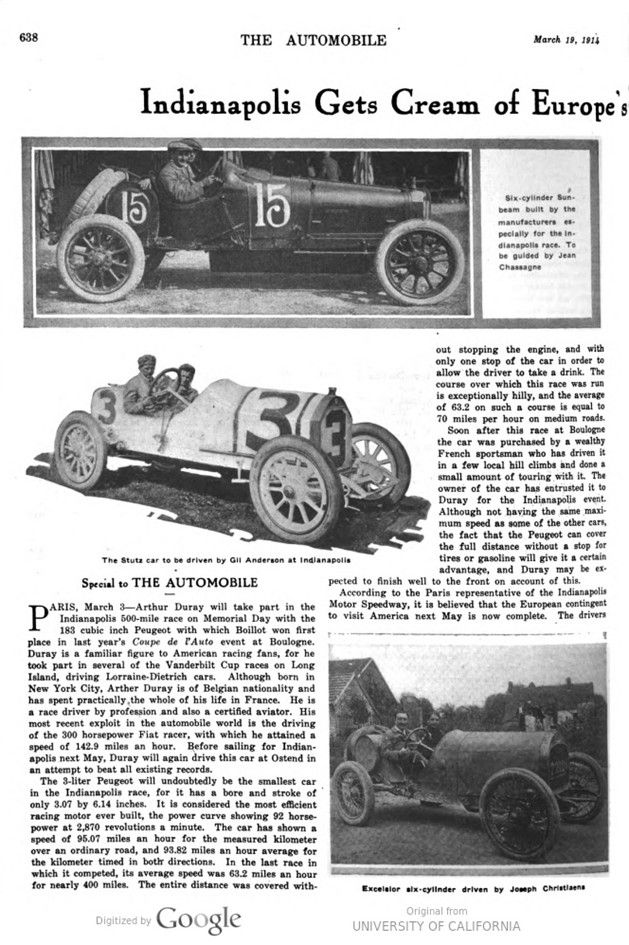


Text and jpegs by courtesy of hathitrust.org www.hathitrust.org, compiled by motorracinghistory.com
The Automobile, Vol. XXX (30), No. 12, March 19, 1914
Indianapolis Gets Cream of Europe’s Grand Prix Racing Cars and Drivers
Special to THE AUTOMOBILE
PARIS, March 3 – Arthur Duray will take part in the Indianapolis 500-mile race on Memorial Day with the 183 cubic inch Peugeot with which Boillot won first place in last year’s Coupe de l’Auto event at Boulogne. Duray is a familiar figure to American racing fans, for he took part in several of the Vanderbilt Cup races on Long Island, driving Lorraine-Dietrich cars. Although born in New York City, Arther Duray is of Belgian nationality and has spent practically the whole of his life in France. He is a race driver by profession and also a certified aviator. His most recent exploit in the automobile world is the driving of the 300 horsepower Fiat racer, with which he attained a speed of 142.9 miles an hour. Before sailing for Indianapolis next May, Duray will again drive this car at Ostend in an attempt to beat all existing records.
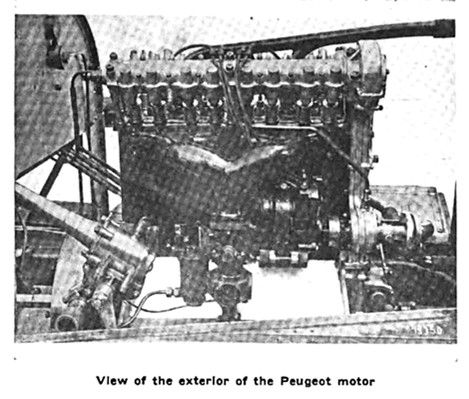
The 3-liter Peugeot will undoubtedly be the smallest car in the Indianapolis race, for it has a bore and stroke of only 3.07 by 6.14 inches. It is considered the most efficient racing motor ever built, the power curve showing 92 horsepower at 2,870 revolutions a minute. The car has shown a speed of 95.07 miles an hour for the measured kilometer over an ordinary road, and 93.82 miles an hour average for the kilometer timed in both directions. In the last race in which it competed; its average speed was 63.2 miles an hour for nearly 400 miles. The entire distance was covered without stopping the engine, and with only one stop of the car in order to allow the driver to take a drink. The course over which this race was run is exceptionally hilly, and the average of 63.2 on such a course is equal to 70 miles per hour on medium roads.
Soon after this race at Boulogne the car was purchased by a wealthy French sportsman who has driven it in a few local hill climbs and done a small amount of touring with it. The owner of the car has entrusted it to Duray for the Indianapolis event. Although not having the same maximum speed as some of the other cars, the fact that the Peugeot can cover the full distance without a stop for tires or gasoline will give it a certain advantage, and Duray may be expected to finish well to the front on account of this.
According to the Paris representative of the Indianapolis Motor Speedway, it is believed that the European contingent to visit America next May is now complete. The drivers having put in an official entry are:
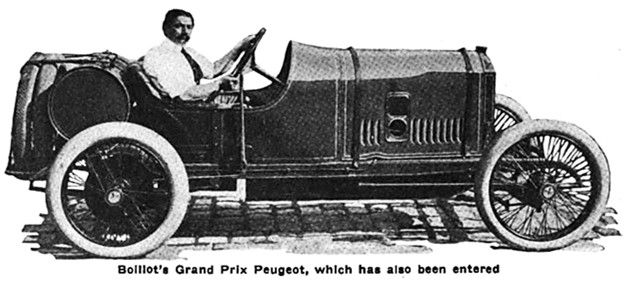
1. Boillot-Grand Prix Peugeot
2. Goux-Grand Prix Peugeot
3. Albert Guyot-Grand Prix Delage
4. Christiaens-Grand Prix 6-cylinder Excelsior
5. Jean Chassagne Grand Prix and World’s 12-hour record Sunbeam 6 cylinder
6. Arthur Duray-3-liter Peugeot
This team is undoubtedly the strongest ever sent across the Atlantic and promises the finest race ever seen in America. Boillot, Goux, Chassagne and Guyot finished respectively first, second, third and fourth in last year’s French Grand Prix. The Peugeot cars have won the Grand Prix 2 years in succession; the Delage holds the world’s long distance road record, and the Sunbeam is the identical motor which covered 1,078 miles 460 yards in 12 hours, on Brooklands, a world’s record.
Joseph Christiaens, chief of the Excelsior racing team, has just handed in his engagement to the European representative of the Indianapolis Motor Speedway for the Memorial Day race on the Indianapolis track. Christiaens will drive the six-cylinder Excelsior car built for the French Grand Prix at Amiens last year, in which race the car finished eighth. The Excelsior racer is built near Brussels, Belgium, and has cylinders in two sets of three measuring 90 by 160 millimeters bore and stroke. Valves are on one side, two Claudel carbureters are used and a Bosch magneto is fitted. The crankshaft is carried in seven plain bearings, to which oil is delivered under high pressure. Transmission comprises cone clutch, four speed gearbox and shaft drive. Palmer tires have generally been used on the Excelsior racers and the wheels are always Adex detachable. Weight of the car is 1,980 pounds.
In the 850 cubic inch class Christiaens holds all the records. He has covered the half mile flying start at the rate of 108.30 miles an hour, the mile flying at 106.86, and ten laps standing start at 101.66 miles an hour.
The Sunbeam entry will be a six-cylinder car having a bore and stroke of 3.14 by 5.9 inches. While the chassis will be specially prepared to meet the Indianapolis Speedway conditions, the motor will be the one used to secure the world’s 12-hour record. In this record a distance of 1,078 miles 460 yards was covered in 12 hours, standing start, being at the rate of 89.85 miles an hour. The average speed for 10 hours was 91.06 miles, and for 9 hours it was 93.43 miles.
Jean Chassagne, who was one of the three drivers when this record was established, is a Frenchman occupying the position of chief race driver and tester with the Sunbeam company. Before becoming a race driver Chassagne was in the French navy. He has visited America several times in connection with important road races, but always in the capacity of mechanician.
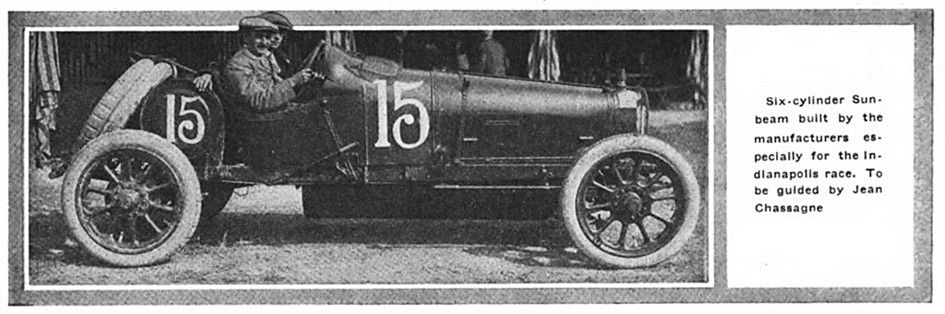

Photo captions.
Page 638.
Six-cylinder Sunbeam built by the manufacturers especially for the Indianapolis race. To be guided by Jean Chassagne
The Stutz car to be driven by Gil Anderson at Indianapolis
Excelsior six-cylinder driven by Joseph Christiaens
Page 639.
Goux’s Peugeot, a fine example of the streamline body, which will be brought over for the Decoration Day races
Boillot’s Grand Prix Peugeot, which has also been entered
View of the exterior of the Peugeot motor