Text and pictures with courtesy of hathitrust hathtrust.org, compiled by motorracinghistory
THE AUTOMOBILE WEEKLY – NEW YORK – SATURDAY, OCTOBER 15, 1904 – CHICAGO 10 CENTS
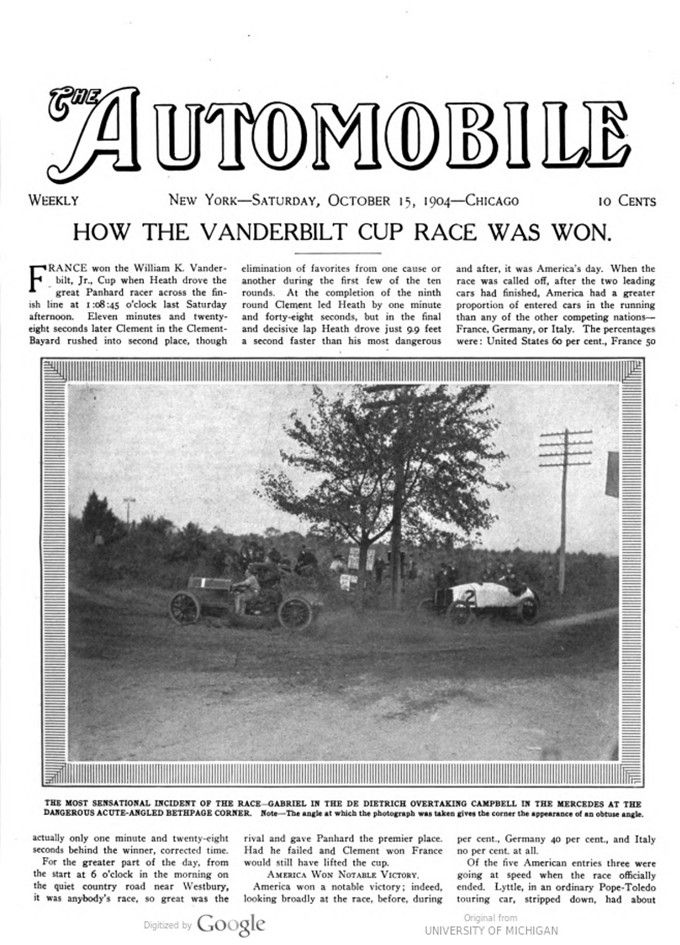
HOW THE VANDERBILT CUP RACE WAS WON.
FRANCE won the William K. Vanderbilt, Jr., Cup when Heath drove the great Panhard racer across the finish line at 1:08:45 o’clock last Saturday afternoon. Eleven minutes and twenty- eight seconds later Clement in the Clement-Bayard rushed into second place, though actually only one minute and twenty-eight seconds behind the winner, corrected time.
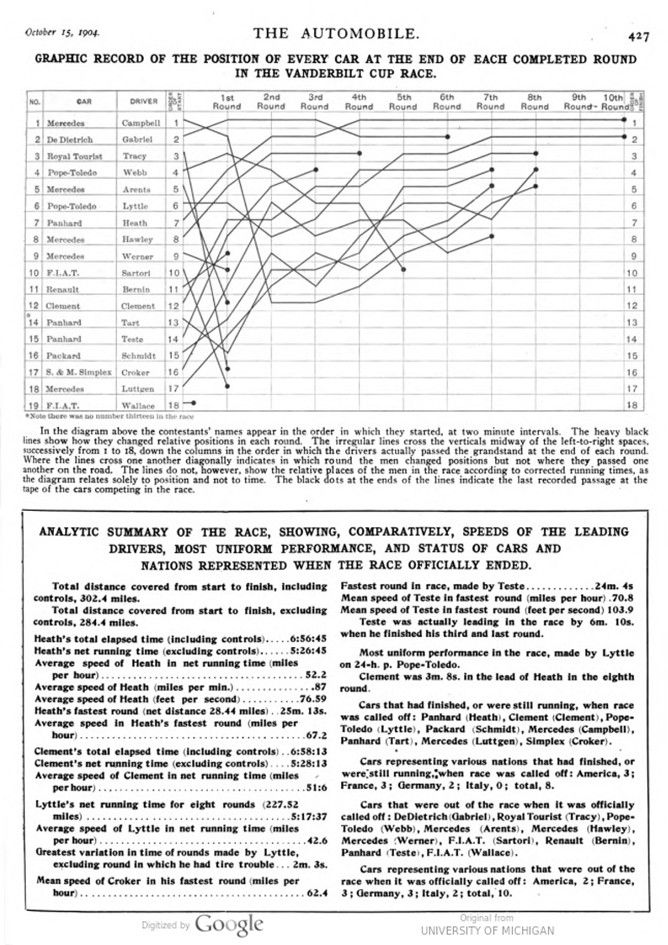
For the greater part of the day, from the start at 6 o’clock in the morning on the quiet country road near Westbury, it was anybody’s race, so great was the elimination of favorites from one cause or another during the first few of the ten rounds. At the completion of the ninth round Clement led Heath by one minute and forty-eight seconds, but in the final and decisive lap Heath drove just 9.9 feet a second faster than his most dangerous rival and gave Panhard the premier place. Had he failed and Clement won France would still have lifted the cup.
AMERICA WON NOTABLE VICTORY.
America won a notable victory; indeed, looking broadly at the race, before, during and after, it was America’s day. When the race was called off, after the two leading cars had finished, America had a greater proportion of entered cars in the running than any of the other competing nations – France, Germany, or Italy. The percentages were: United States 60 per cent., France 50 per cent., Germany 40 per cent., and Italy no per cent. at all.
Of the five American entries three were going at speed when the race officially ended. Lyttle, in an ordinary Pope-Tole touring car, stripped down, had about completed his ninth round; Schmidt, in the light-racing Packard, was running in his ninth round, and Croker, in the Simplex, was east of Queens on his seventh round. He finished this round unofficially.
Of the three French cars that were in the running, Heath and Clement had finished. Tart was compelled to stop near the grandstand for tire repairs before he had completed his eighth round.
The two remaining German cars, driven by Campbell and Luttgen, were running in their ninth and eighth rounds respectively when the race was officially ended.
All other cars had abandoned the race.
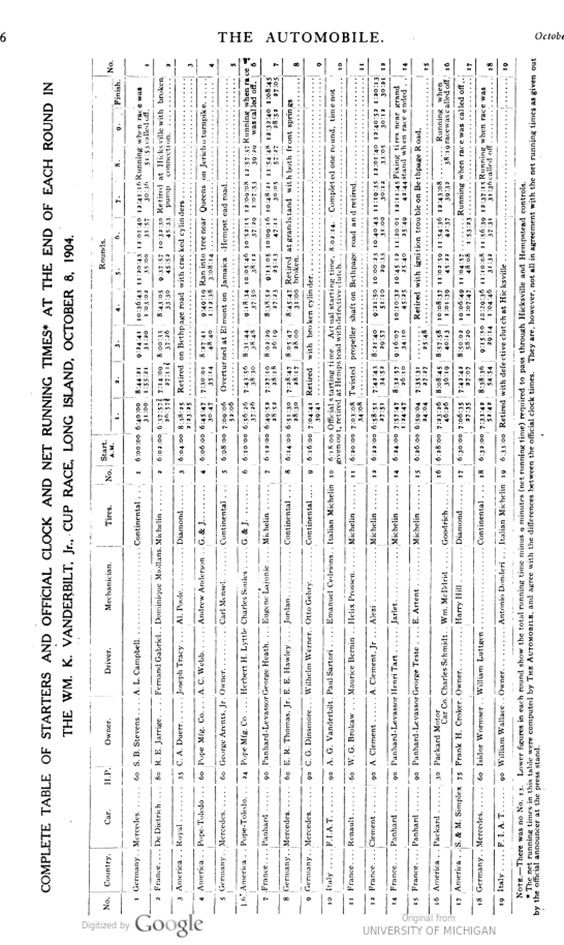
Heath’s average speed for the entire ten rounds of the race was 52.2 miles an hour, actual running time. This was eight-tenths of a mile an hour less than the German Gordon Bennett last summer, and 2.7 miles an hour greater than the winner of the Irish Gordon Bennett in 1903.
FASTEST CAR IN RACE.
Teste in the Panhard was known to have the fastest car in the race, and he made the fastest round, at a mean speed of 70.8 miles an hour. His average for the three rounds through which he lasted was 66 miles an hour.
Lyttle furnished the surprise of the day by driving the little Pope-Toledo with a greater regularity in the time of his rounds than any other driver. The maximum variation in his speed for seven rounds was only two minutes and three seconds.
It was not a Mercedes day. Of the seven Mercedes type cars that were entered five were eliminated by other than tire troubles and the two that were in to the end, though of 60 horsepower, were defeated by an ordinary American touring car of 24 horsepower.
LUCK WAS A FACTOR.
Luck was a more important factor, however, in the winning and losing of the Vanderbilt cup race than in probably any other international race ever held. Cut glass and nails were strewn thickly along portions of the road, and especially at the bad corners. Whether or not this was done maliciously will probably never be known. As hundreds of cars passed over the course on the days preceding the race and did not meet with more than ordinary tire troubles, the inference is that the course was planted. Veiled threats made by the organized opposition to the race are still fresh in the memory.
Barring this disagreeable, if intentional dastardly, feature, the race was a remarkable success. When one considers the slight experience that most of those in charge at the start or along the course had had in such events, the results are very agreeable.
ONE FATAL ACCIDENT.
But one unfortunate accident occurred, and in justice to all it can be set down at this was due entirely to the foolhardiness of the driver in entering his car. While driving on the Jamaica-Hempstead Road in the second round Arents’s car lost a tire and he lost control of the machine, so that it overturned on the road. Arents was thrown out and stunned and Carl Mensel, his mechanician, received fatal injuries. Arents was speedily removed to the hospital and has since lain for several days unconscious from a blod clot in his brain, from which the physicians hope he will recover. Previous to that he had made a wild entry into the Hempstead control, showing inability to handle a car at high speed, and on that occasion missing by a foot a probably fatal collision with a tree.
FORTUNE FAVORED SPECTATORS.
Good fortune seems to have favored the spectators who at many points crowded on the course throughout the day and risked their lives on every occasion that a breakdown happened by surrounding the stopped car, regardless of the railroad speeds of those in the running. Curiously enough, it was not usually the rural population that acted so foolishly, but city folk and automobilists. It was solely due to the want of consideration shown by automobilists in the vicinity of the grandstand that the race was called off long before the legal hour for opening the road to general traffic had come around and before the remaining cars had a chance to fight out the battle to a finish.
No sooner had Clement arrived in second place than scores of drivers, whose cars were parked on the turf along the road, swung out into the oiled stretch directly in the path of the racers, those afoot following the example. A fearful congestion in the vicinity of the grandstand caused Mr. Vanderbilt to quickly decide to stop the race.
Throughout the race at the points where crowds congregated, outside the limits of New York City, the county peace officers and special deputies were of little service in keeping the course clear. Their authority was limited or at least they did not seem to be sure of its extent, and suggestion rather than command was not effective in handling the sightseers. The contrast at Queens within the city limits was remarkable. There the metropolitan police ruled the road and kept a clear course, and that without unnecessary friction or excitement.
OILING THE ROAD EFFECTIVE.
Oiling of the course was well worth the price paid for it. On the straight stretches and bends there was no sign of dust. At the bad corners which had not been rolled down hard the loose dirt was thrown up in showers on the passage of cars, but it was mingled with oil and heavy and it soon settled again.
Transportation facilities for the crowds were good and few of those who had not left the matter of over-night accommodations to the last moment had to remain up or sleep in chairs. Prices along the route were high in some instances, but, on the whole, not unreasonable.
It was remarkable that while there were hundreds of automobiles at many stretches along the course, and not less than 100,000 persons viewing it, no accidents to those going or coming were recorded. A better demonstration of the safety of the automobile to other road users could not have been made.
SPORTSMAN’S POINT OF VIEW.
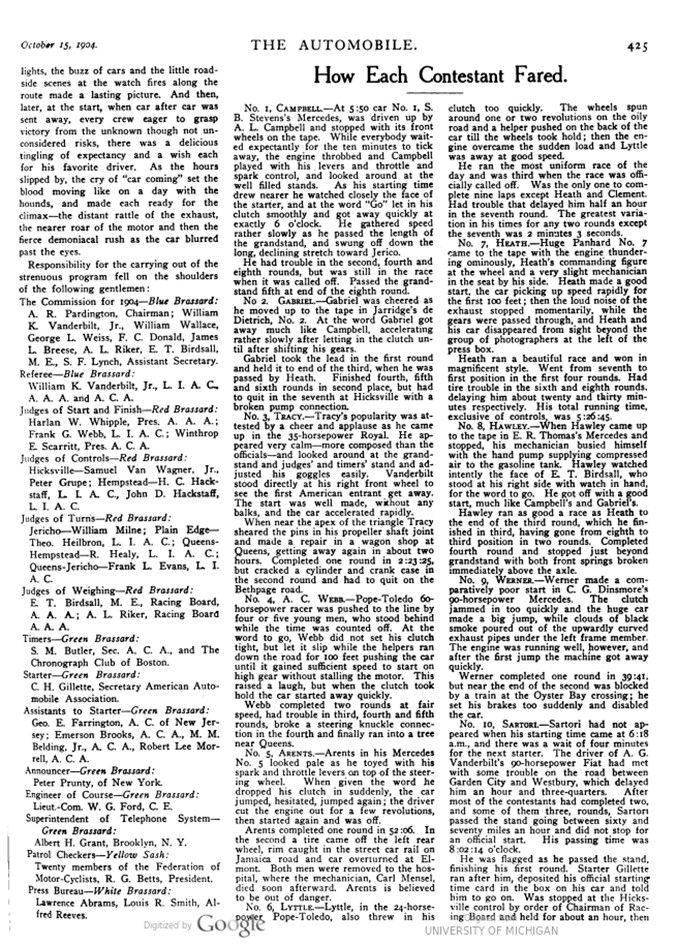
From the sportsman’s point of view the race was an inspiration. None will soon forget the kaleidoscopic scenes of early morning when darkness was changing into dawn. The fresh, clear air, the flashing lights, the buzz of cars and the little road- side scenes at the watch fires along the route made a lasting picture. And then, later, at the start, when car after car was sent away, every crew eager to grasp victory from the unknown though not un- considered risks, there was a delicious tingling of expectancy and a wish each for his favorite driver. As the hours slipped by, the cry of „car coming“ set the blood moving like on a day with the hounds, and made each ready for the climax-the distant rattle of the exhaust, the nearer roar of the motor and then the fierce demoniacal rush as the car blurred past the eyes.
Responsibility for the carrying out of the strenuous program fell on the shoulders of the following gentlemen:
The Commission for 1904 – Blue Brassard: A. R. Pardington, Chairman; William K. Vanderbilt, Jr., William Wallace, George L. Weiss, F. C. Donald, James L. Breese, A. L. Riker, E. T. Birdsall, M. E., S. F. Lynch, Assistant Secretary. Referee-Blue Brassard: William K. Vanderbilt, Jr., L. I. A. C., A. A. A. and A. C. A.
Judges of Start and Finish – Red Brassard: Harlan W. Whipple, Pres. A. A. A.; Frank G. Webb, L. I. A. C.; Winthrop E. Scarritt, Pres. A. C. A.
Judges of Controls – Red Brassard: Hicksville-Samuel Van Wagner, Jr., Peter Grupe; Hempstead-H. C. Hack- staff, L I. A. C., John D. Hackstaff, L. I. A. C.
Judges of Turns – Red Brassard: Jericho William Milne; Plain Edge- Theo. Heilbron, L. I. A. C.; Queens- Hempstead-R. Healy, L. I. A. C.; Queens-Jericho-Frank L. Evans, L. I. A. C.
Judges of Weighing – Red Brassard: E. T. Birdsall, M. E., Racing Board, A. A. A.; A. L. Riker, Racing Board A. A. A.
Timers-Green Brassard: S. M. Butler, Sec. A. C. A., and The Chronograph Club of Boston.
Starter – Green Brassard: C. H. Gillette, Secretary American Automobile Association.
Assistants to Starter – Green Brassard: Geo. E. Farrington, A. C. of New Jersey; Emerson Brooks, A. C. A., M. M. Belding, Jr., A. C. A., Robert Lee Morrell, A. C. A.
Announcer-Green Brassard: Peter Prunty, of New York.
Engineer of Course – Green Brassard: Lieut.-Com. W. G. Ford, C. E.
Superintendent of Telephone System- Green Brassard: Albert H. Grant, Brooklyn, N. Y.
Patrol Checkers – Yellow Sash: Twenty members of the Federation of Motor-Cyclists, R. G. Betts, President.
Press Bureau – White Brassard: Lawrence Abrams, Louis R. Smith, Alfred Reeves.
It is understood that the receipts from the sale of grand stand boxes and seats, the official program and entrance fees with a liberal contribution from Mr. Vanderbilt will cover the cost of the race without having recourse to the guarantee fund.
Under the conditions of the deed of gift the next race for the cup will take place in this country.
In view of the freedom from accidents to spectators and the great revenue that came to Nassau County thereby, it is not believed that there will be any opposition to the race next year.
It seems certain that the great showing made by American cars in the first race will assure a more serious and adequate representation of American makers at the next contest.
“I spent all my time at the controls and foreign stations to learn how they ran the game, “ said Barney Oldfield. “I have learned a lot and have an opinion of just what a car should be for such a race. I am going to have a try for the Gordon Bennett cup next year and you can say that my car will weigh less than 1,800 pounds.“
Photo captions.
Page 423.
THE MOST SENSATIONAL INCIDENT OF THE RACE-GABRIEL IN THE DE DIETRICH OVERTAKING CAMPBELL IN THE MERCEDES AT THE DANGEROUS ACUTE-ANGLED BETHPAGE CORNER. Note – The angle at which the photograph was taken gives the corner the appearance of an obtuse angle.
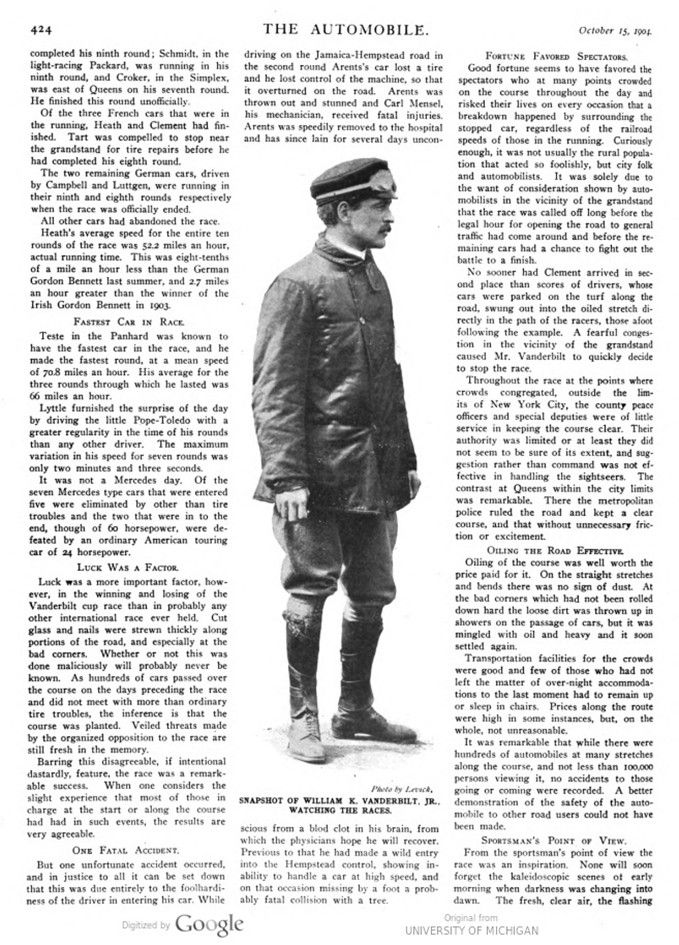
Photo by Levick, SNAPSHOT OF WILLIAM K. VANDERBILT, JR., WATCHING THE RACES.
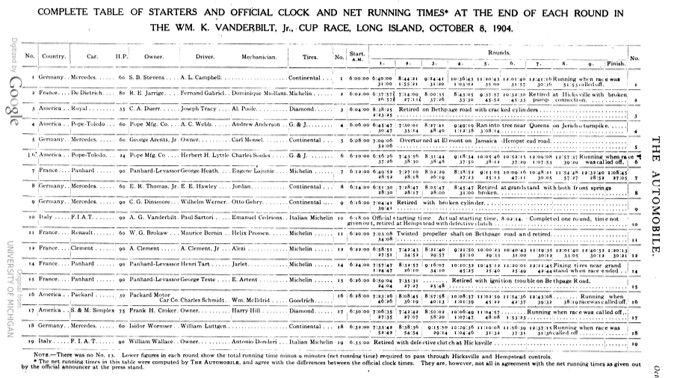
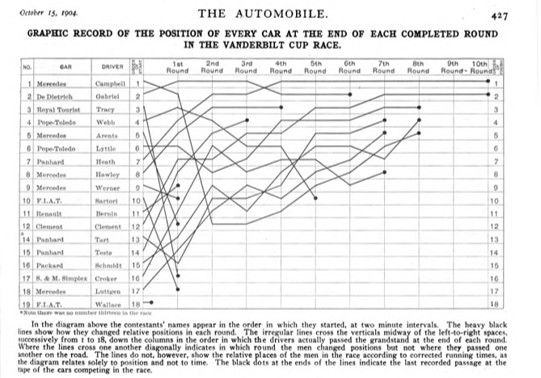
How Each Contestant Fared.
No. 1, CAMPBELL. – At 5:50 car No. 1, S. B. Stevens’s Mercedes, was driven up by A. L. Campbell and stopped with its front wheels on the tape. While everybody waited expectantly for the ten minutes to tick away, the engine throbbed and Campbell played with his levers and throttle and spark control and looked around at the well filled stands. As his starting time drew nearer, he watched closely the face of the starter, and at the word „Go“ let in his clutch smoothly and got away quickly at exactly 6 o’clock. He gathered speed rather slowly as he passed the length of the grandstand, and swung off down the long, declining stretch toward Jerico.
He had trouble in the second, fourth and eighth rounds, but was still in the race when it was called off. Passed the grand-stand fifth at end of the eighth round. No 2. GABRIEL. – Gabriel was cheered as he moved up to the tape in Jarridge’s de Dietrich, No. 2. At the word Gabriel got away much like Campbell, accelerating rather slowly after letting in the clutch until after shifting his gears.
Gabriel took the lead in the first round and held it to end of the third, when he was passed by Heath. Finished fourth, fifth and sixth rounds in second place, but had to quit in the seventh at Hicksville with a broken pump connection.
No. 3, TRACY. – Tracy’s popularity was attested by a cheer and applause as he came up in the 35-horsepower Royal. He appeared very calm – more composed than the officials – and looked around at the grand-stand and judges‘ and timers‘ stand and adjusted his goggles easily. Vanderbilt stood directly at his right front wheel to see the first American entrant get away. The start was well made, without any balks, and the car accelerated rapidly.
When near the apex of the triangle Tracy sheared the pins in his propeller shaft joint and made a repair in a wagon shop at Queens, getting away again in about two hours. Completed one round in 2:23:25 but cracked a cylinder and crank case in the second round and had to quit on the Bethpage Road.
No. 4, A. C. WEBB. – Pope-Toledo 60-horsepower racer was pushed to the line by four or five young men, who stood behind while the time was counted off. At the word to go, Webb did not set his clutch tight, but let it slip while the helpers ran down the road for 100 feet pushing the car until it gained sufficient speed to start on high gear without stalling the motor. This raised a laugh, but when the clutch took hold the car started away quickly.
Webb completed two rounds at fair speed, had trouble in third, fourth and fifth rounds, broke a steering knuckle connection in the fourth and finally ran into a tree near Queens.
No. 5, ARENTS. – Arents in his Mercedes No. 5 looked pale as he toyed with his spark and throttle levers on top of the steering wheel. When given the word he dropped his clutch in suddenly, the car jumped, hesitated, jumped again; the driver cut the engine out for a few revolutions, then started again and was off.
Arents completed one round in 52:06. In the second a tire came off the left rear wheel, rim caught in the streetcar rail on Jamaica road and car overturned at Elmont. Both men were removed to the hospital, where the mechanician, Carl Mensel, died soon afterward. Arents is believed to be out of danger.
No. 6, Lyttle. – Lyttle, in the 24-horse- power Pope-Toledo, also threw in his clutch too quickly. The wheels spun around one or two revolutions on the oily road and a helper pushed on the back of the car till the wheels took hold; then the engine overcame the sudden load and Lyttle was away at good speed.
He ran the most uniform race of the day and was third when the race was officially called off. Was the only one to complete nine laps except Heath and Clement. Had trouble that delayed him half an hour in the seventh round. The greatest variation in his times for any two rounds except the seventh was 2 minutes 3 seconds.
No. 7, HEATH. – Huge Panhard No. 7 came to the tape with the engine thundering ominously, Heath’s commanding figure at the wheel and a very slight mechanician in the seat by his side. Heath made a good start, the car picking up speed rapidly for the first 100 feet; then the loud noise of the exhaust stopped momentarily, while the gears were passed through, and Heath and his car disappeared from sight beyond the group of photographers at the left of the press box.
Heath ran a beautiful race and won in magnificent style. Went from seventh to first position in the first four rounds. Had tire trouble in the sixth and eighth rounds, delaying him about twenty and thirty minutes respectively. His total running time, exclusive of controls, was 5:26:45.
No. 8, HAWLEY. – When Hawley came up to the tape in E. R. Thomas’s Mercedes and stopped, his mechanician busied himself with the hand pump supplying compressed air to the gasoline tank. Hawley watched intently the face of E. T. Birdsall, who stood at his right side with watch in hand, for the word to go. He got off with a good start, much like Campbell’s and Gabriel’s.
Hawley ran as good a race as Heath to the end of the third round, which he finished in third, having gone from eighth to third position in two rounds. Completed fourth round and stopped just beyond grandstand with both front springs broken immediately above the axle.
No. 9, WERNER. – Werner made a comparatively poor start in C. G. Dinsmore’s 90-horsepower Mercedes. The clutch jammed in too quickly and the huge car made a big jump, while clouds of black smoke poured out of the upwardly curved exhaust pipes under the left frame member. The engine was running well, however, and after the first jump the machine got away quickly.
Werner completed one round in 39:41, but near the end of the second was blocked by a train at the Oyster Bay crossing; he set his brakes too suddenly and disabled the car.
No. 10, SARTORI. – Sartori had not appeared when his starting time came at 6:18 a.m., and there was a wait of four minutes for the next starter. The driver of A. G. Vanderbilt’s 90-horsepower Fiat had met with some trouble on the road between Garden City and Westbury, which delayed him an hour and three-quarters. After most of the contestants had completed two, and some of them three, rounds, Sartori passed the stand going between sixty and seventy miles an hour and did not stop for an official start. His passing time was 8:02:14 o’clock.
He was flagged as he passed the stand, finishing his first round. Starter Gillette ran after him, deposited his official starting timecard in the box on his car and told him to go on. Was stopped at the Hicksville control by order of Chairman of Racing Board and held for about an hour, then told he could go on; but he was only able to reach Hempstead, owing to a defective clutch.
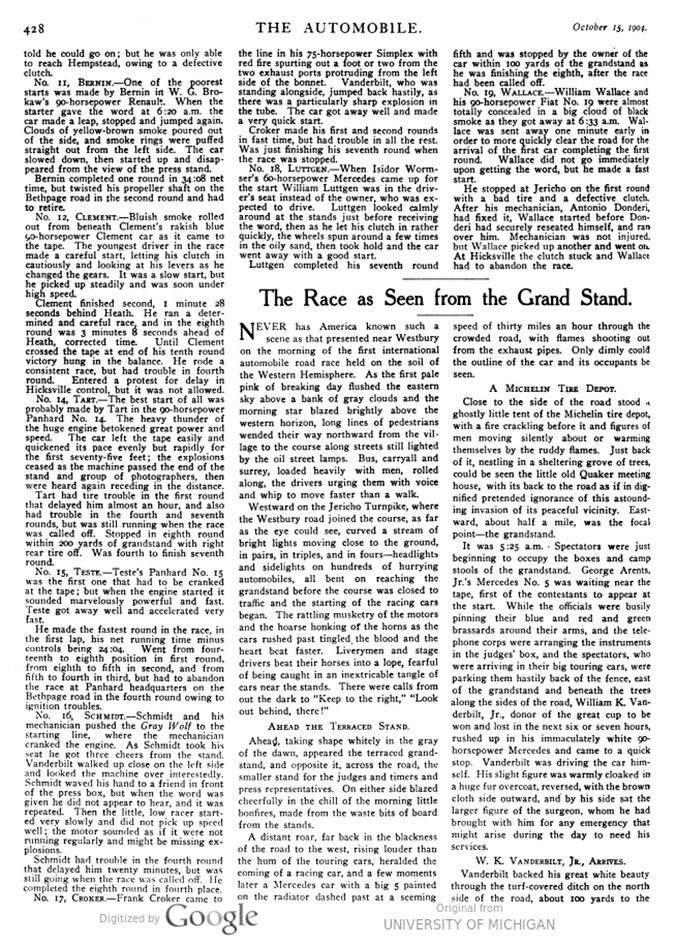
No. 11, BERNIN. – One of the poorest starts was made by Bernin in W. G. Brokaw’s 90-horsepower Renault. When the starter gave the word at 6:20 a.m. the car made a leap, stopped and jumped again. Clouds of yellow-brown smoke poured out of the side, and smoke rings were puffed straight out from the left side. The car slowed down, then started up and disappeared from the view of the press stand.
Bernin completed one round in 34:08 net time, but twisted his propeller shaft on the Bethpage road in the second round and had to retire.
No. 12, CLEMENT. – Bluish smoke rolled out from beneath Clement’s rakish blue 90-horsepower Clement car as it came to the tape. The youngest driver in the race made a careful start, letting his clutch in cautiously and looking at his levers as he changed the gears. It was a slow start, but he picked up steadily and was soon under high speed.
Clement finished second, 1 minute 28 seconds behind Heath. He ran a determined and careful race, and in the eighth round was 3 minutes 8 seconds ahead of Heath, corrected time. Until Clement crossed the tape at end of his tenth round victory hung in the balance. He rode a consistent race, but had trouble in fourth round. Entered a protest for delay in Hicksville control, but it was not allowed.
No. 14, TART. – The best start of all was probably made by Tart in the 90-horsepower Panhard No. 14. The heavy thunder of the huge engine betokened great power and speed. The car left the tape easily and quickened its pace evenly but rapidly for the first seventy-five feet; the explosions ceased as the machine passed the end of the stand and group of photographers, then were heard again receding in the distance.
Tart had tire trouble, in the first round that delayed him almost an hour, and also had trouble in the fourth and seventh rounds, but was still running when the race was called off. Stopped in eighth round within 200 yards of grandstand with right rear tire off. Was fourth to finish seventh round.
No. 15, TESTE. – Teste’s Panhard No. 15 was the first one that had to be cranked at the tape; but when the engine started it sounded marvelously powerful and fast. Teste got away well and accelerated very fast.
He made the fastest round in the race, in the first lap, his net running time minus controls being 24:04. Went from fourteenth to eighth position in first round, from eighth to fifth in second, and from fifth to fourth in third, but had to abandon the race at Panhard headquarters on the Bethpage road in the fourth round owing to ignition troubles.
No. 16, SCHMIDT. – Schmidt and his mechanician pushed the Gray Wolf to the starting line, where the mechanician cranked the engine. As Schmidt took his seat he got three cheers from the stand. Vanderbilt walked up close on the left side and looked the machine over interestedly. Schmidt waved his hand to a friend in front of the press box, but when the word was given he did not appear to hear, and it was repeated. Then the little, low racer started very slowly and did not pick up speed well; the motor sounded as if it were not running regularly and might be missing explosions.
Schmidt had trouble in the fourth round that delayed him twenty minutes, but was still going when the race was called off. He completed the eighth round in fourth place.
No. 17, CROKER. – Frank Croker came to the line in his 75-horsepower Simplex with red fire spurting out a foot or two from the two exhaust ports protruding from the left side of the bonnet. Vanderbilt, who was standing alongside, jumped back hastily, as there was a particularly sharp explosion in the tube. The car got away well and made a very quick start.
Croker made his first and second rounds in fast time, but had trouble in all the rest. Was just finishing his seventh round when the race was stopped.
No. 18, LUTTGEN. – When Isidor Wormser’s 60-horsepower Mercedes came up for the start William Luttgen was in the driver’s seat instead of the owner, who was expected to drive. Luttgen looked calmly around at the stands just before receiving the word, then as he let his clutch in rather quickly, the wheels spun around a few times in the oily sand, then took hold and the car went away with a good start.
Luttgen completed his seventh round fifth and was stopped by the owner of the car within 100 yards of the grandstand as he was finishing the eighth, after the race had been called off.
No. 19, WALLACE. – William Wallace and his 90-horsepower Fiat No. 19 were almost totally concealed in a big cloud of black smoke as they got away at 6:33 a.m. Wal- lace was sent away one minute early in order to more quickly clear the road for the arrival of the first car completing the first round. Wallace did not go immediately upon getting the word, but he made a fast start.
He stopped at Jericho on the first round with a bad tire and a defective clutch. After his mechanician, Antonio Donderi, had fixed it, Wallace started before Donderi had securely reseated himself, and ran over him. Mechanician was not injured, but Wallace picked up another and went on. At Hicksville the clutch stuck and Wallace had to abandon the race.