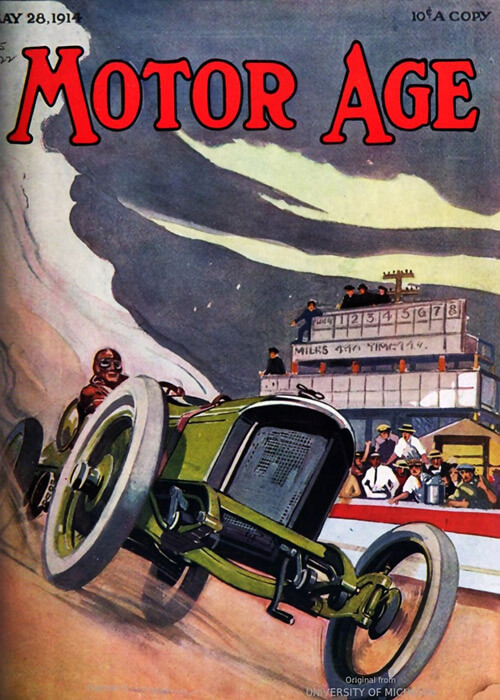
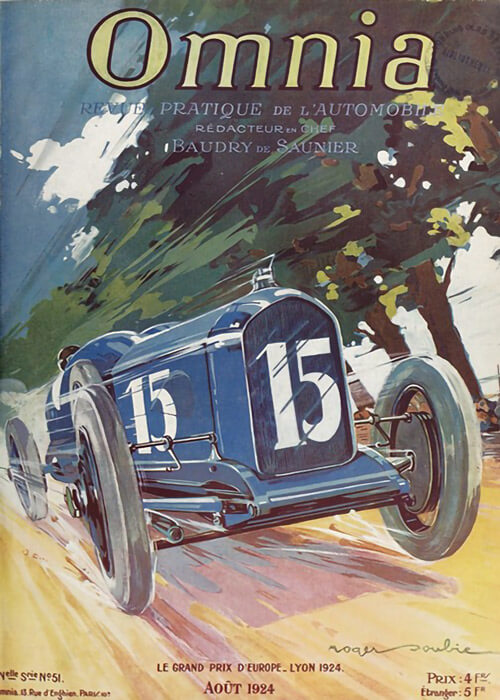
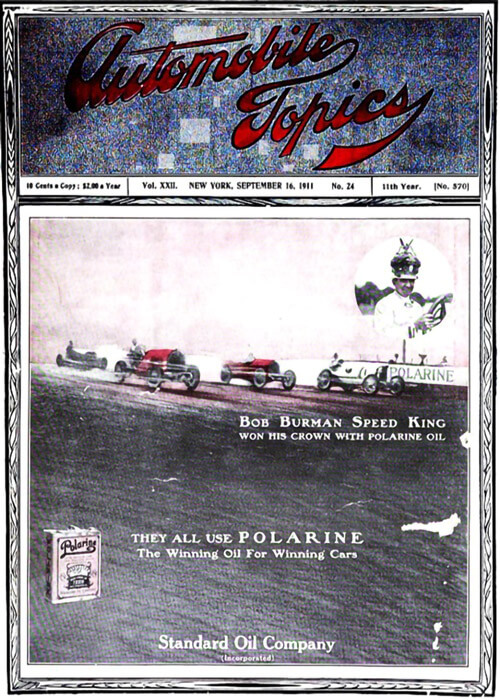
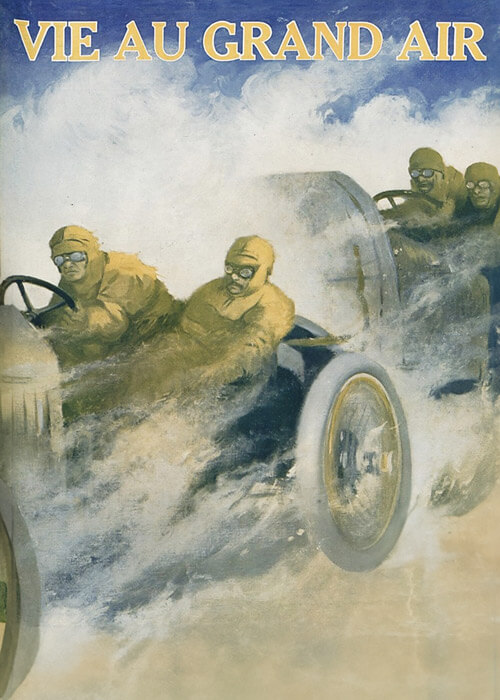
In the 1927 indianapolis 500, polesetter Frank Lockhart, in a Miller, took the lead and dominated the first half. He had to give up in the 120th lap, as a connectig-rod broke. Then, Pete DePaolo in a Miller took the lead till he got out because of a supercharger issue. After that, it was the rookie George Souders who took the lead till the finishline. Generally, the race was characterized by many failures.
Text and jpegs by courtesy of hathitrust.org www.hathitrust.org, compiled by motorracinghistory.com
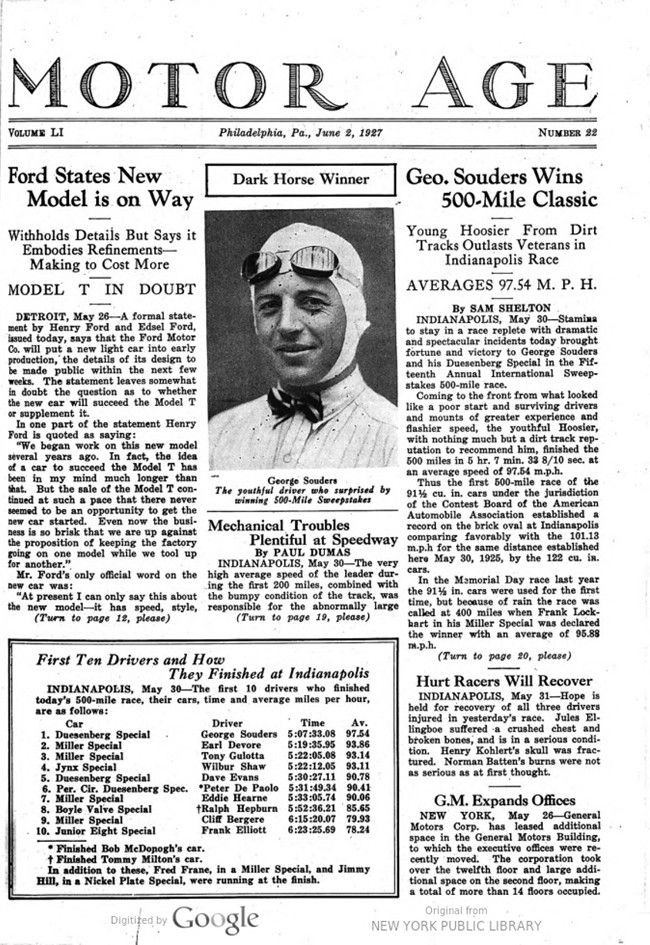
Motor Age, Vol. LI, 51, No. 22, June 2, 1927
Geo. Souders Wins 500-Mile Classic
Young Hoosier From Dirt Tracks Outlasts Veterans in Indianapolis Race
AVERAGES 97.54 M. P. H.
By SAM SHELTON
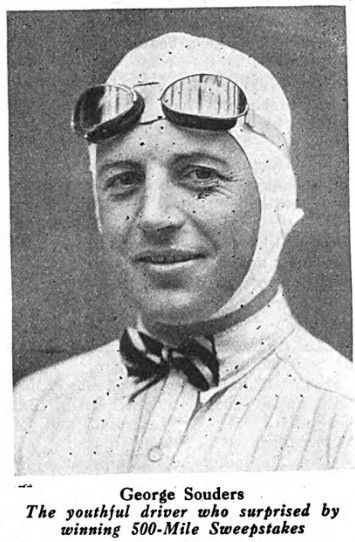
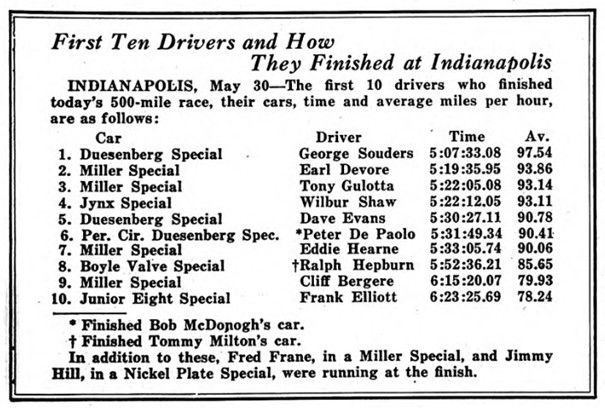
INDIANAPOLIS, May 30 – Stamina to stay in a race replete with dramatic and spectacular incidents today brought fortune and victory to George Souders and his Duesenberg Special in the Fifteenth Annual International Sweepstakes 500-mile race.
Coming to the front from what looked like a poor start and surviving drivers and mounts of greater experience and flashier speed, the youthful Hoosier, with nothing much but a dirt track reputation to recommend him, finished the 500 miles in 5 hr. 7 min. 33 8/10 sec. at an average speed of 97.54 m.p.h.
Thus, the first 500-mile race of the 912 cu. in. cars under the jurisdiction of the Contest Board of the American Automobile Association established a record on the brick oval at Indianapolis Plentiful at Speedway comparing favorably with the 101.13 m.p.h for the same distance established here May 30, 1925, by the 122 cu. in. cars.
In the Memorial Day race last year, the 91½ in. cars were used for the first time, but because of rain the race was called at 400 miles when Frank Lockhart in his Miller Special was declared the winner with an average of 95.88 m.p.h.
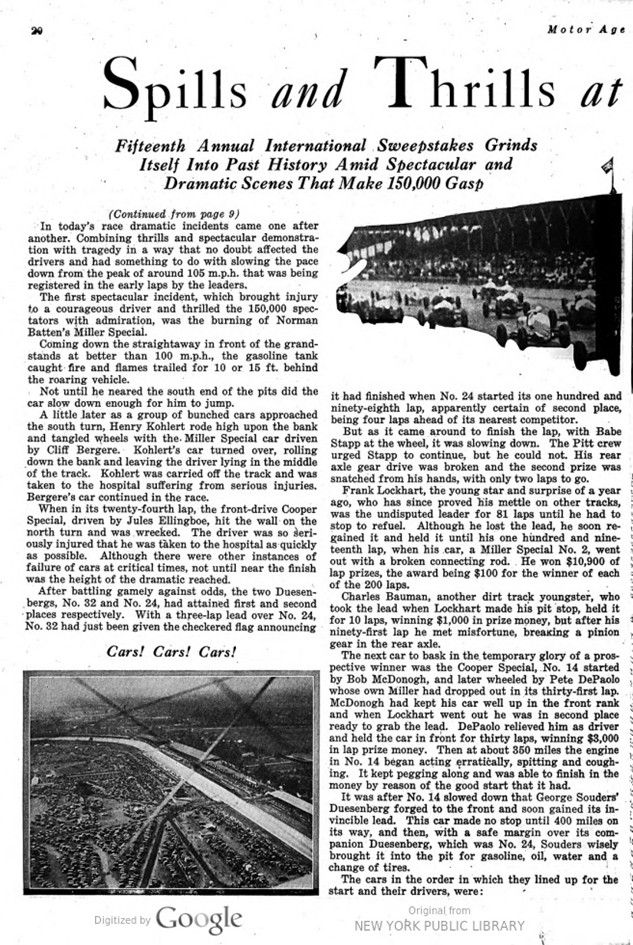
Spills and Thrills at Indianapolis!
Fifteenth Annual International Sweepstakes Grinds Itself Into Past History Amid Spectacular and Dramatic Scenes That Make 150,000 Gasp
(continued from page 9)
In today’s race dramatic incidents came one after another. Combining thrills and spectacular demonstration with tragedy in a way that no doubt affected the drivers and had something to do with slowing the pace down from the peak of around 105 m.p.h. that was being registered in the early laps by the leaders.
The first spectacular incident, which brought injury. to a courageous driver and thrilled the 150,000 spectators with admiration, was the burning of Norman Batten’s Miller Special.
Coming down the straightaway in front of the grandstands at better than 100 m.p.h., the gasoline tank caught fire and flames trailed for 10 or 15 ft. behind the roaring vehicle.
Not until he neared the south end of the pits did the car slow down enough for him to jump.
A little later as a group of bunched cars approached the south turn, Henry Kohlert rode high upon the bank and tangled wheels with the Miller Special car driven by Cliff Bergere. Kohlert’s car turned over, rolling down the bank and leaving the driver lying in the middle of the track. Kohlert was carried off the track and was taken to the hospital suffering from serious injuries. Bergere’s car continued in the race.
When in its twenty-fourth lap, the front-drive Cooper Special, driven by Jules Ellingboe, hit the wall on the north turn and was wrecked. The driver was so seriously injured that he was taken to the hospital as quickly as possible. Although there were other instances of failure of cars at critical times, not until near the finish was the height of the dramatic reached.
After battling gamely against odds, the two Duesenberg’s, No. 32 and No. 24, had attained first and second places respectively. With a three-lap lead over No. 24, No. 32 had just been given the checkered flag announcing it had finished when No. 24 started its one hundred and ninety-eighth lap, apparently certain of second place, being four laps ahead of its nearest competitor.
But as it came around to finish the lap, with Babe Stapp at the wheel, it was slowing down. The Pitt crew urged Stapp to continue, but he could not. His rear axle gear drive was broken and the second prize was snatched from his hands, with only two laps to go.
Frank Lockhart, the young star and surprise of a year ago, who has since proved his mettle on other tracks, was the undisputed leader for 81 laps until he had to stop to refuel. Although he lost the lead, he soon regained it and held it until his one hundred and nineteenth lap, when his car, a Miller Special No. 2, went out with a broken connecting rod. He won $10,900 of lap prizes, the award being $100 for the winner of each of the 200 laps.
Charles Bauman, another dirt track youngster, who took the lead when Lockhart made his pit stop, held it ninety-first lap he met misfortune, breaking a pinion for 10 laps, winning $1,000 in prize money, but after his gear in the rear axle.
The next car to bask in the temporary glory of a prospective winner was the Cooper Special, No. 14 started by Bob McDonogh, and later wheeled by Pete DePaolo whose own Miller had dropped out in its thirty-first lap. McDonogh had kept his car well up in the front rank and when Lockhart went out he was in second place ready to grab the lead. DePaolo relieved him as driver and held the car in front for thirty laps, winning $3,000 in lap prize money. Then at about 350 miles the engine in No. 14 began acting erratically, spitting and coughing. It kept pegging along and was able to finish in the money by reason of the good start that it had.
It was after No. 14 slowed down that George Souders‘ Duesenberg forged to the front and soon gained its invincible lead. This car made no stop until 400 miles on its way, and then, with a safe margin over its companion Duesenberg, which was No. 24, Souders wisely brought it into the pit for gasoline, oil, water and a change of tires.
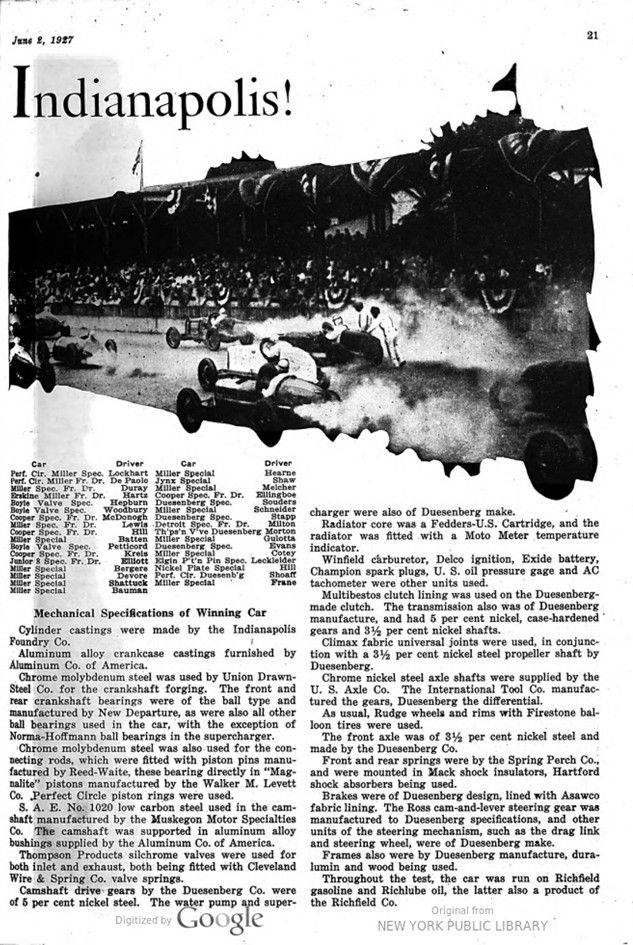
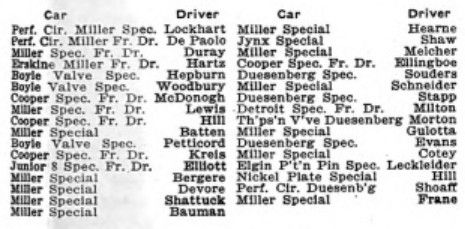
The cars in the order in which they lined up for the start and their drivers, were:
Mechanical Specifications of Winning Car
Cylinder castings were made by the Indianapolis Foundry Co.
Aluminum alloy crankcase castings furnished by Aluminum Co. of America.
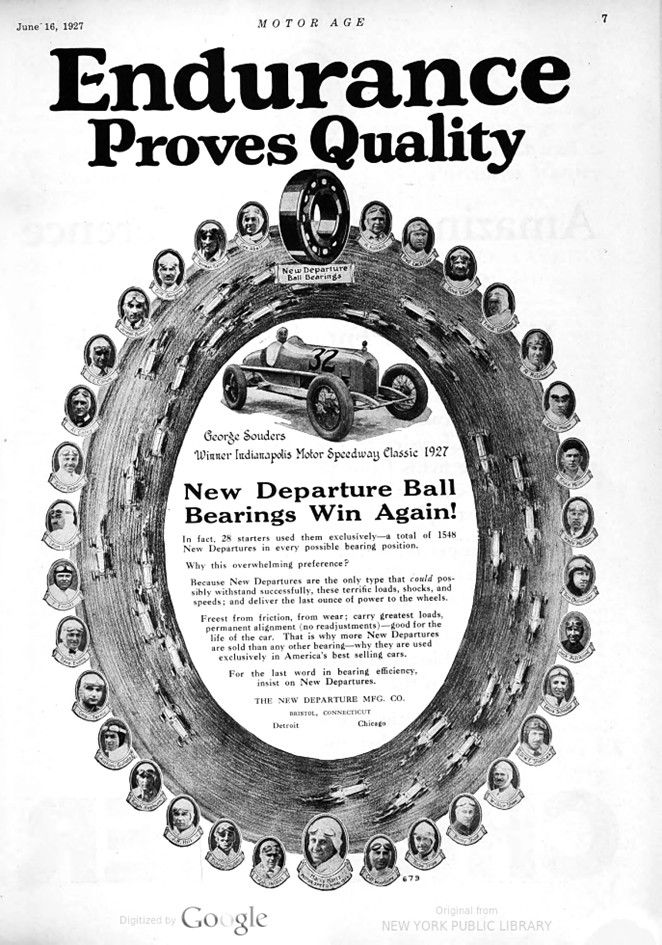
Chrome molybdenum steel was used by Union Drawn-Steel Co. for the crankshaft forging. The front and rear crankshaft bearings were of the ball type and manufactured by New Departure, as were also all other ball bearings used in the car, with the exception of Norma-Hoffmann ball bearings in the supercharger.
Chrome molybdenum steel was also used for the connecting rods, which were fitted with piston pins manufactured by Reed-Waite, these bearing directly in „Magnalite“ pistons manufactured by the Walker M. Levett Co. Perfect Circle piston rings were used.
S. A. E. No. 1020 low carbon steel used in the camshaft manufactured by the Muskegon Motor Specialties Co. The camshaft was supported in aluminum alloy bushings supplied by the Aluminum Co. of America.
Thompson Products silichrome valves were used for both inlet and exhaust, both being fitted with Cleveland Wire & Spring Co. valve springs.
Camshaft drive gears by the Duesenberg Co. were of 5 per cent nickel steel. The water pump and supercharger were also of Duesenberg make.
Radiator core was a Fedders-U.S. Cartridge, and the radiator was fitted with a Moto Meter temperature indicator.
Winfield carburetor, Delco ignition, Exide battery, Champion spark plugs, U. S. oil pressure gage and AC tachometer were other units used.
Multibestos clutch lining was used on the Duesenberg-made clutch.
The transmission also was of Duesenberg manufacture, and had 5 per cent nickel, case-hardened gears and 32 per cent nickel shafts.
Climax fabric universal joints were used, in conjunction with a 32 per cent nickel steel propeller shaft by Duesenberg.
Chrome nickel steel axle shafts were supplied by the U. S. Axle Co.
The International Tool Co. manufactured the gears, Duesenberg the differential.
As usual, Rudge wheels and rims with Firestone balloon tires were used.
The front axle was of 32 per cent nickel steel and made by the Duesenberg Co.
Front and rear springs were by the Spring Perch Co., and were mounted in Mack shock insulators, Hartford shock absorbers being used.
Brakes were of Duesenberg design, lined with Asawco fabric lining.
The Ross cam-and-lever steering gear was manufactured to Duesenberg specifications, and other units of the steering mechanism, such as the drag link and steering wheel, were of Duesenberg make.
Frames also were by Duesenberg manufacture, duralumin and wood being used. Throughout the test, the car was run on Richfield gasoline and Richlube oil, the latter also a product of the Richfield Co.