An interesting technical desciption and at the same time a short survey on some of the 1926 European and American cars, that were to compete in the 1926 Indianapolis 500 race. The American Miller cars, the Duesenberg’s, even a first two-cycle engined car as well as the front-wheel driven Hamlin Special. From the European side, the Eldridge- and Schmidt Specials, as well as the Guyot and Bugatti cars are shortly discussed.

Text and jpegs by courtesy of hathitrust.org www.hathitrust.org, compiled by motorracinghistory.com
Automotive Industries, Vol. 54, No. 19, May 13, 1926
Cars of Three Nations to Race at Indianapolis This Year
Three Schmidt Specials, a Guyot and a Bugatti from France. Two Eldridge Specials from England. 32 American cars entered, one with a two-cycle engine and four of front drive type.
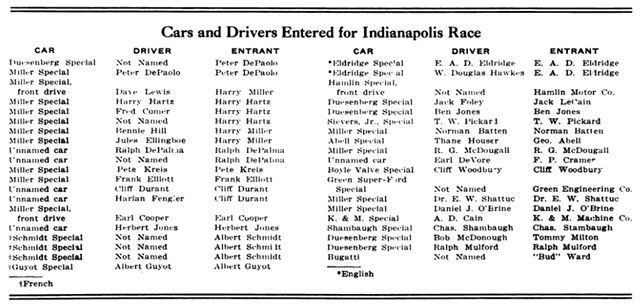
THIRTY-NINE 91½ cu. in. cars — 32 American, 5 French and 2 British — have been entered for the Fourteenth Annual International Sweepstakes to be run at the Indianapolis Motor Speedway, Monday, May 31. Of this number, 33 will be permitted under the rules to start the 500-mile run over the two-and-a-half- mile brick and concrete track, the cars to start being decided the week before the race by means of speed trials.
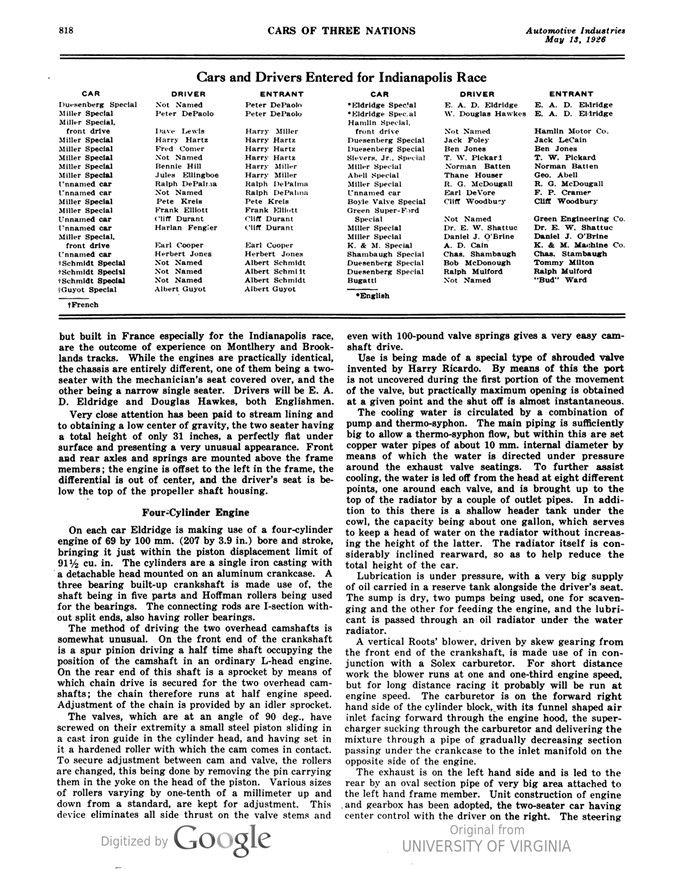
Of the American cars, there are 14 Miller Specials, 2 of them with front drives; 5 Duesenberg’s; a Hamlin Special („Fronty-Ford“ front drive type); a Seivers, Jr., Special, said to be a home-made eight; an Abell Special; a Boyle Valve Special; a Green Super- Ford Special; a K. & M. Special; a Shambaugh Special, and six as yet unnamed.
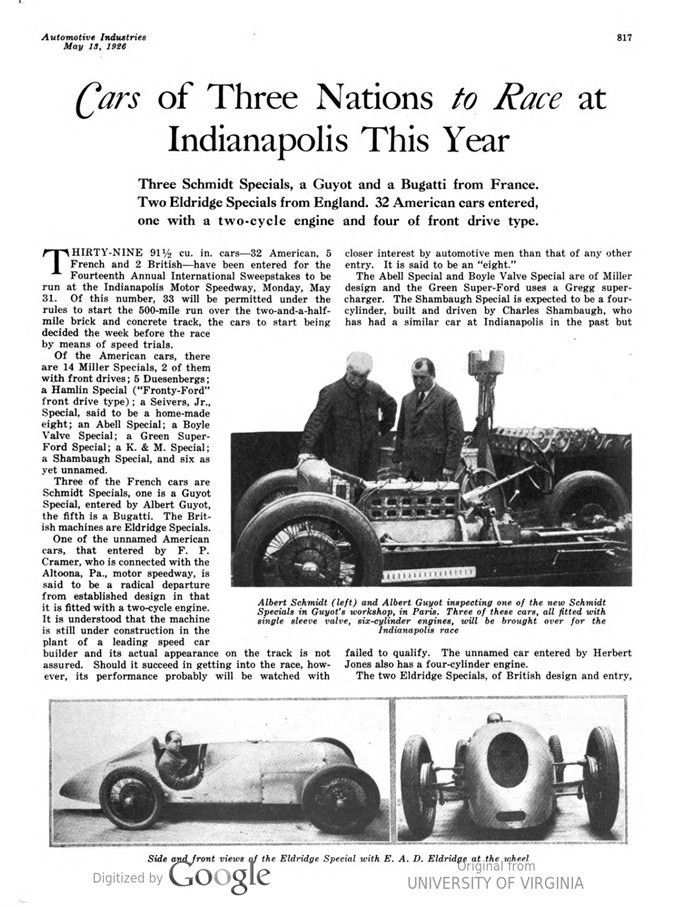
Three of the French cars are Schmidt Specials, one is a Guyot Special, entered by Albert Guyot, the fifth is a Bugatti. The British machines are Eldridge Specials.
One of the unnamed American cars, that entered by F. P. Cramer, who is connected with the Altoona, Pa., motor speedway, is said to be a radical departure from established design in that it is fitted with a two-cycle engine. It is understood that the machine is still under construction in the plant of a leading speed car builder and its actual appearance on the track is not assured. Should it succeed in getting into the race, however, its performance probably will be watched with closer interest by automotive men than that of any other entry. It is said to be an „eight.“
The Abell Special and Boyle Valve Special are of Miller design and the Green Super-Ford uses a Gregg supercharger. The Shambaugh Special is expected to be a four-cylinder, built and driven by Charles Shambaugh, who has had a similar car at Indianapolis in the past but failed to qualify. The unnamed car entered by Herbert Jones also has a four-cylinder engine.
The two Eldridge Specials, of British design and entry, but built in France especially for the Indianapolis race, are the outcome of experience on Montlhéry and Brooklands tracks. While the engines are practically identical, the chassis are entirely different, one of them being a two-seater with the mechanician’s seat covered over, and the other being a narrow single seater. Drivers will be E. A. D. Eldridge and Douglas Hawkes, both Englishmen.
Very close attention has been paid to streamlining and to obtaining a low center of gravity, the two seater having a total height of only 31 inches, a perfectly flat under surface and presenting a very unusual appearance. Front and rear axles and springs are mounted above the frame members; the engine is offset to the left in the frame, the differential is out of center, and the driver’s seat is below the top of the propeller shaft housing.
Four-Cylinder Engine
On each car Eldridge is making use of a four-cylinder engine of 69 by 100 mm. (207 by 3.9 in.) bore and stroke, bringing it just within the piston displacement limit of 91V2 cu. in. The cylinders are a single iron casting with a detachable head mounted on an aluminum crankcase. A three-bearing built-up crankshaft is made use of, the shaft being in five parts and Hoffman rollers being used for the bearings. The connecting rods are I-section without split ends, also having roller bearings.
The method of driving the two overhead camshafts is somewhat unusual. On the front end of the crankshaft is a spur pinion driving a half time shaft occupying the position of the camshaft in an ordinary L-head engine. On the rear end of this shaft is a sprocket by means of which chain drive is secured for the two overhead camshafts; the chain therefore runs at half engine speed. Adjustment of the chain is provided by an idler sprocket.
The valves, which are at an angle of 90 deg., have screwed on their extremity a small steel piston sliding in a cast iron guide in the cylinder head, and having set in it a hardened roller with which the cam comes in contact. To secure adjustment between cam and valve, the rollers are changed, this being done by removing the pin carrying them in the yoke on the head of the piston. Various sizes of rollers varying by one-tenth of a millimeter up and down from a standard, are kept for adjustment. This device eliminates all side thrust on the valve stems and even with 100-pound valve springs gives a very easy camshaft drive.
Use is being made of a special type of shrouded valve invented by Harry Ricardo. By means of this the port is not uncovered during the first portion of the movement of the valve, but practically maximum opening is obtained at a given point and the shut off is almost instantaneous.
The cooling water is circulated by a combination of pump and thermo-syphon. The main piping is sufficiently big to allow a thermo-syphon flow, but within this are set copper water pipes of about 10 mm. internal diameter by means of which the water is directed under pressure around the exhaust valve seatings. To further assist cooling, the water is led off from the head at eight different points, one around each valve, and is brought up to the top of the radiator by a couple of outlet pipes. In addition to this there is a shallow header tank under the cowl, the capacity being about one gallon, which serves to keep a head of water on the radiator without increasing the height of the latter. The radiator itself is considerably inclined rearward, so as to help reduce the total height of the car.
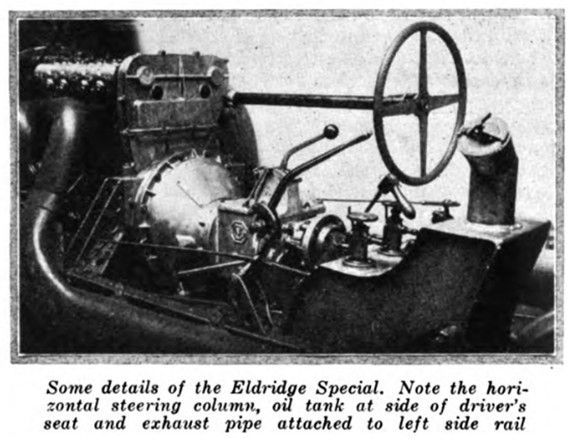
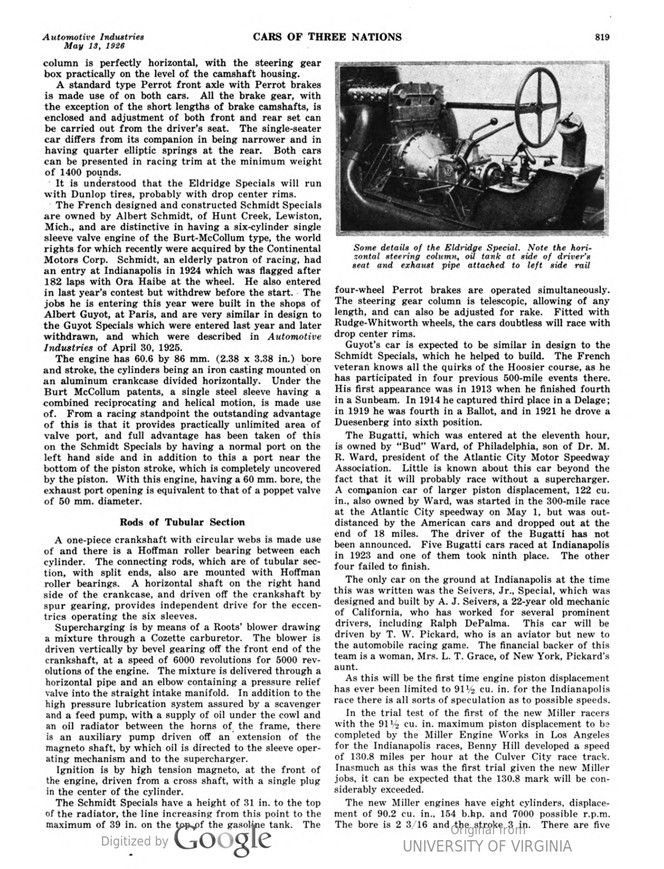
Lubrication is under pressure, with a very big supply of oil carried in a reserve tank alongside the driver’s seat. The sump is dry, two pumps being used, one for scavenging and the other for feeding the engine, and the lubricant is passed through an oil radiator under the water radiator.
A vertical Roots‘ blower, driven by skew gearing from the front end of the crankshaft, is made use of in conjunction with a Solex carburetor. For short distance work the blower runs at one and one-third engine speed, but for long distance racing it probably will be run at engine speed. The carburetor is on the forward right-hand side of the cylinder block, with its funnel shaped air inlet facing forward through the engine hood, the supercharger sucking through the carburetor and delivering the mixture through a pipe of gradually decreasing section passing under the crankcase to the inlet manifold on the opposite side of the engine.
The exhaust is on the left hand side and is led to the rear by an oval section pipe of very big area attached to the left hand frame member. Unit construction of engine and gearbox has been adopted, the two-seater car having center control with the driver on the right. The steering column is perfectly horizontal, with the steering gear box practically on the level of the camshaft housing.
A standard type Perrot front axle with Perrot brakes is made use of on both cars. All the brake gear, with the exception of the short lengths of brake camshafts, is enclosed and adjustment of both front and rear set can be carried out from the driver’s seat. The single-seater car differs from its companion in being narrower and in having quarter elliptic springs at the rear. Both cars can be presented in racing trim at the minimum weight of 1400 pounds.
It is understood that the Eldridge Specials will run with Dunlop tires, probably with drop center rims.
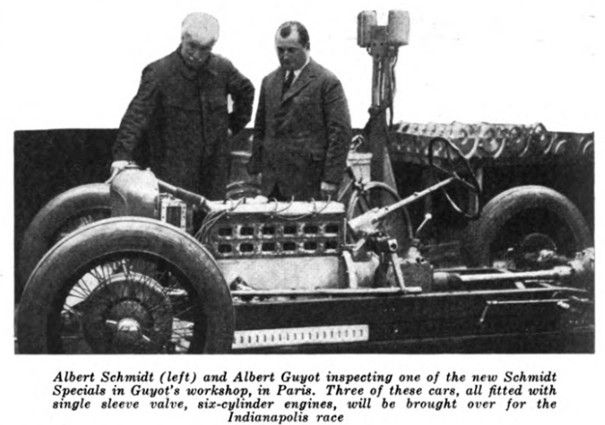
The French designed and constructed Schmidt Specials are owned by Albert Schmidt, of Hunt Creek, Lewiston, Mich., and are distinctive in having a six-cylinder single sleeve valve engine of the Burt-McCollum type, the world rights for which recently were acquired by the Continental Motors Corp. Schmidt, an elderly patron of racing, had an entry at Indianapolis in 1924 which was nagged after 182 laps with Ora Haibe at the wheel. He also entered in last year’s contest but withdrew before the start. The jobs he is entering this year were built in the shops of Albert Guyot, at Paris, and are very similar in design to the Guyot Specials which were entered last year and later withdrawn, and which were described in Automotive Industries of April 30, 1925.
The engine has 60.6 by 86 mm. (2.38 x 3.38 in.) bore and stroke, the cylinders being an iron casting mounted on an aluminum crankcase divided horizontally. Under the Burt McCollum patents, a single steel sleeve having a combined reciprocating and helical motion, is made use of. From a racing standpoint the outstanding advantage of this is that it provides practically unlimited area of valve port, and full advantage has been taken of this on the Schmidt Specials by having a normal port on the left hand side and in addition to this a port near the bottom of the piston stroke, which is completely uncovered by the piston. With this engine, having a 60 mm. bore, the exhaust port opening is equivalent to that of a poppet valve of 50 mm. diameter.
Rods of Tubular Section
A one-piece crankshaft with circular webs is made use of and there is a Hoffman roller bearing between each cylinder. The connecting rods, which are of tubular section, with split ends, also are mounted with Hoffman roller bearings. A horizontal shaft on the right-hand side of the crankcase, and driven off the crankshaft by spur gearing, provides independent drive for the eccentrics operating the six sleeves.
Supercharging is by means of a Roots‘ blower drawing a mixture through a Cozette carburetor. The blower is driven vertically by bevel gearing off the front end of the crankshaft, at a speed of 6000 revolutions for 5000 revolutions of the engine. The mixture is delivered through a horizontal pipe and an elbow containing a pressure relief valve into the straight intake manifold. In addition to the high pressure lubrication system assured by a scavenger and a feed pump, with a supply of oil under the cowl and an oil radiator between the horns of the frame, there is an auxiliary pump driven off an extension of the magneto shaft, by which oil is directed to the sleeve operating mechanism and to the supercharger.
Ignition is by high tension magneto, at the front of the engine, driven from a cross shaft, with a single plug in the center of the cylinder.
The Schmidt Specials have a height of 31 in. to the top of the radiator, the line increasing from this point to the maximum of 39 in. on the top of the gasoline tank. The four-wheel Perrot brakes are operated simultaneously. The steering gear column is telescopic, allowing of any length, and can also be adjusted for rake. Fitted with Rudge-Whitworth wheels, the cars doubtless will race with drop center rims.
Guyot’s car is expected to be similar in design to the Schmidt Specials, which he helped to build. The French veteran knows all the quirks of the Hoosier course, as he has participated in four previous 500-mile events there. His first appearance was in 1913 when he finished fourth in a Sunbeam. In 1914 he captured third place in a Delage; in 1919 he was fourth in a Ballot, and in 1921 he drove a Duesenberg into sixth position.
The Bugatti, which was entered at the eleventh hour, is owned by „Bud“ Ward, of Philadelphia, son of Dr. M. R. Ward, president of the Atlantic City Motor Speedway Association. Little is known about this car beyond the fact that it will probably race without a supercharger. A companion car of larger piston displacement, 122 cu. in., also owned by Ward, was started in the 300-mile race at the Atlantic City speedway on May 1, but was outdistanced by the American cars and dropped out at the end of 18 miles. The driver of the Bugatti has not been announced. Five Bugatti cars raced at Indianapolis in 1923 and one of them took ninth place. The other four failed to finish.
The only car on the ground at Indianapolis at the time this was written was the Seivers, Jr., Special, which was designed and built by A. J. Seivers, a 22-year old mechanic of California, who has worked for several prominent drivers, including Ralph DePalma. This car will be driven by T. W. Pickard, who is an aviator but new to the automobile racing game. The financial backer of this team is a woman, Mrs. L. T. Grace, of New York, Pickard’s aunt.
As this will be the first time engine piston displacement has ever been limited to 91% cu. in. for the Indianapolis race there is all sorts of speculation as to possible speeds.
In the trial test of the first of the new Miller racers with the 91V2 cu. in. maximum piston displacement to bs completed by the Miller Engine Works in Los Angeles for the Indianapolis races, Benny Hill developed a speed of 130.8 miles per hour at the Culver City racetrack. Inasmuch as this was the first trial given the new Miller jobs, it can be expected that the 130.8 mark will be considerably exceeded.
The new Miller engines have eight cylinders, displacement of 90.2 cu. in., 154 b.h.p. and 7000 possible r.p.m. The bore is 2 3/16 and the stroke 3 in. There are five main bearings, two overhead spur gear driven camshafts, and an integrally counterbalanced crankshaft as on the older models. The engine weighs 290 lb., or about 100 lb. less than the last year 122 in. engine of the same make. There are two valves per cylinder, with one spark plug in center of each cylinder. The turbine supercharger in the new cars is built to drive off the crankshaft, as against the former drive off the camshaft.
A feature of the new cars is easier steering, which has been effected with an all-ball bearing steering gear. An- other feature is a positive lock for the clutch. Dogs drop- ping in slots in the flywheel prevent any possibility of clutch slipping when car is racing at high speed.
Duesenbergs Still Under Cover
Little information has been released as yet regarding the Duesenbergs. It is known, however, that the same running gear and bodies as used on last year’s 122 cu. in jobs will be retained and that the engines will have eight supercharged cylinders as heretofore. The approximate bore and stroke is 2 3/16 by 3 in. The new engines will turn up much faster than any of previous Duesenberg design and the builder is of the opinion that this year’s speeds will not suffer in comparison with the 1925 record.
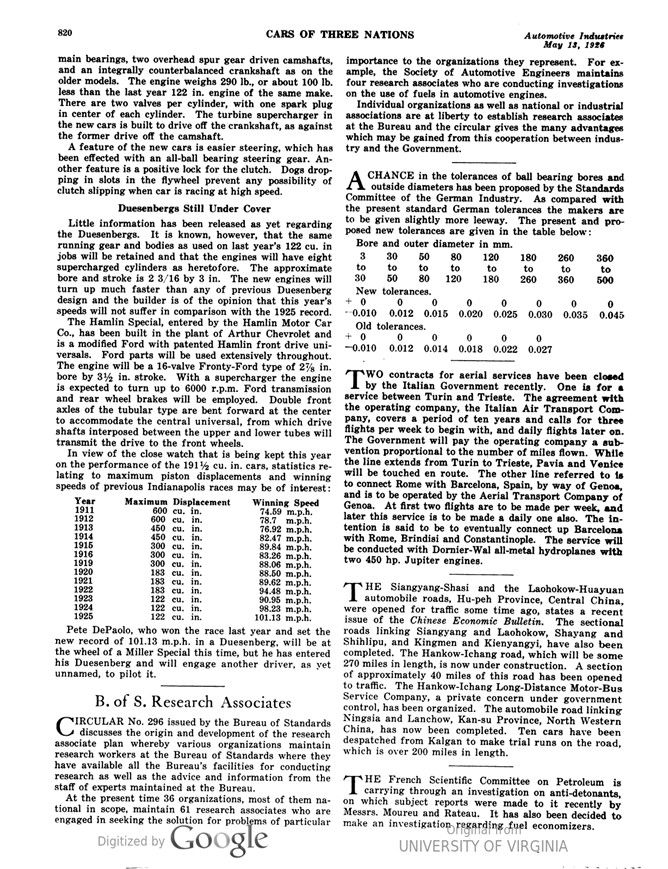
The Hamlin Special, entered by the Hamlin Motor Car Co., has been built in the plant of Arthur Chevrolet and is a modified Ford with patented Hamlin front drive universals. Ford parts will be used extensively throughout. The engine will be a 16-valve Fronty-Ford type of 2 7/8 in- bore by 3½ in. stroke. With a supercharger the engine is expected to turn up to 6000 r.p.m. Ford transmission and rear wheel brakes will be employed. Double front axles of the tubular type are bent forward at the center to accommodate the central universal, from which drive shafts interposed between the upper and lower tubes will transmit the drive to the front wheels. In view of the close watch that is being kept this year on the performance of the 191V2 cu. in. cars, statistics relating to maximum piston displacements and winning speeds of previous Indianapolis races may be of interest: (see table of page 34.)
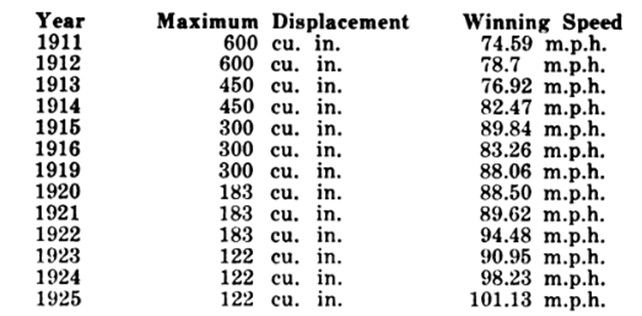
Pete DePaolo, who won the race last year and set the new record of 101.13 m.p.h. in a Duesenberg, will be at the wheel of a Miller Special this time, but he has entered his Duesenberg and will engage another driver, as yet unnamed, to pilot it.
Photos.
Page 31.
Albert Schmidt (left) and Albert Guyot inspecting one of the new Schmidt Specials in Guyot’s workshop, in Paris. Three of these cars, all fitted with single sleeve valve, six-cylinder engines, will be brought over for the Indianapolis race
Side and front views of the Eldridge Special with E. A. D. Eldridge at the wheel
Page 33.
Some details of the Eldridge Special. Note the horizontal steering column, oil tank at side of driver’s seat and exhaust pipe attached to left side rail