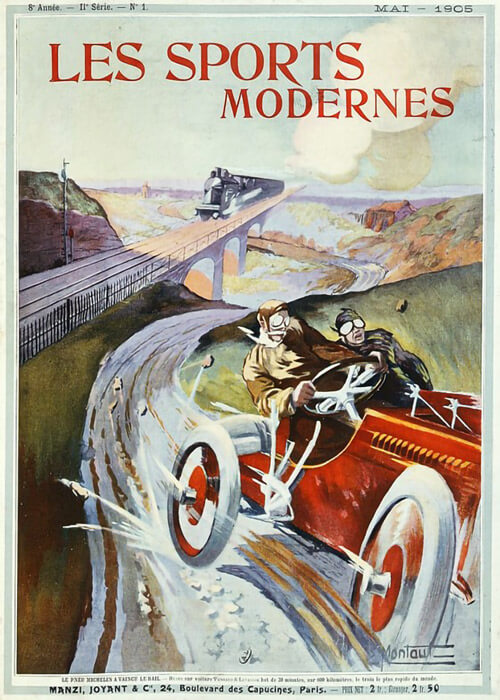
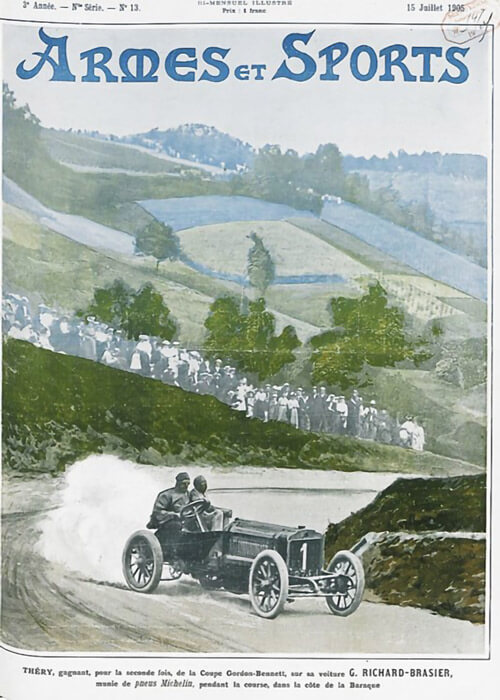
In those days, technical journalistst on both sides of the ocean, excchanged their knowledge. This article is the English translation of the original one, published earlier in the september 1895 issue of the French magazine La Nature. The first application of the Michelin pneumatic tyre in a French contest and the application of ball bearings in a wheel. I’m not quite sure, whether the bearing and the tyre were both applied in the Michelin vehicle L’Èclair during the 1895 Paris-Bordeauy contest, but I doubt that.
Text and jpegs by courtesy of hathitrust.org www.hathitrust.org, compiled by motorracinghistory.com
Scientific American, Supplement, Vol. XL (40), No. 1040, December 7, 18951
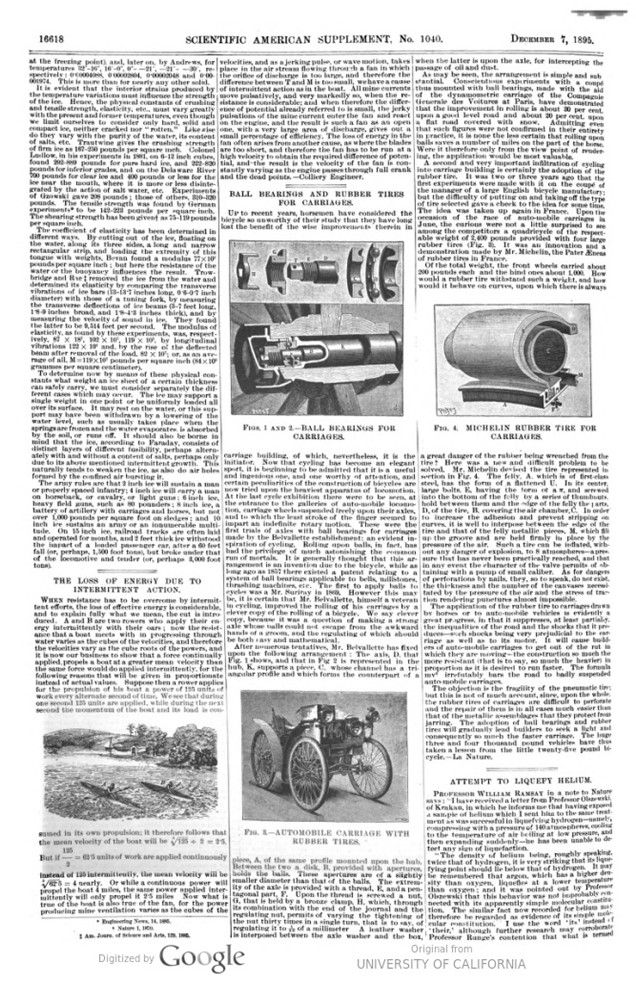
BALL BEARINGS AND RUBBER TIRES FOR CARRIAGES.
UP to recent years, horsemen have considered the bicycle so unworthy of their study that they have long lost the benefit of the wise improvements therein in carriage building, of which, nevertheless, it is the initiator. Now that cycling has become an elegant sport, it is beginning to be admitted that it is a useful and ingenious one, and one worthy of attention, and certain peculiarities of the construction of bicycles are now tried upon the heaviest apparatus of locomotion.
At the last cycle exhibition, there were to be seen, at the entrance to the galleries of auto-mobile locomotion, carriage wheels suspended freely upon their axles, and to which the least stroke of the finger seemed to impart an indefinite rotary motion. These were the first trials of axles with ball bearings for carriages made by the Belvallette establishment: an evident inspiration of cycling. Rolling upon balls, in fact, has had the privilege of much astonishing the common run of mortals. It is generally thought that this arrangement is an invention due to the bicycle, while as long ago as 1857 there existed a patent relating to a system of ball bearings applicable to bells, millstones, thrashing machines, etc. The first to apply balls to cycles was a Mr. Suriray in 1869. However, this may be, it is certain that Mr. Belvallette, himself a veteran in cycling, improved the rolling of his carriages by a clever copy of the rolling of a bicycle. We say clever copy, because it was a question of making a strong axle whose balls could not escape from the awkward hands of a groom, and the regulating of which should be both easy and mathematical.
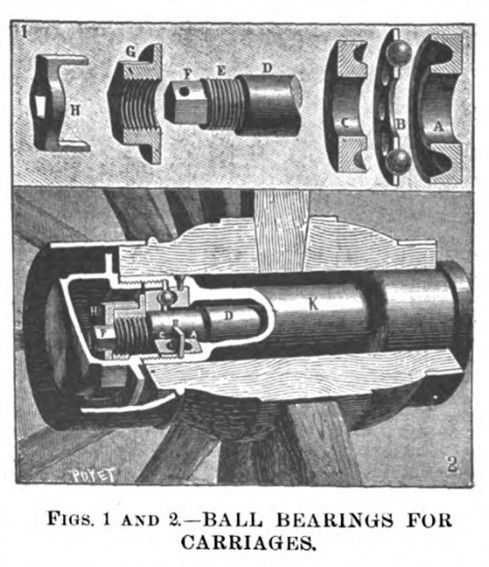
After numerous tentatives, Mr. Belvallette has fixed upon the following arrangement: The axis, D. that Fig. 1 shows, and that in Fig 2 is represented in the hub, K, supports a piece, C. whose channel has a triangular profile and which forms the counterpart of a piece, A, of the same profile mounted upon the hub. Between the two a disk, B, provided with apertures, holds the balls. These apertures are of a slightly smaller diameter than that of the balls. The extremity of the axle is provided with a thread, E, and a pentagonal part, F. Upon the thread is screwed a nut, G, that is held by a bronze clamp, H, which, through its combination with the end of the journal and the regulating nut, permits of varying the tightening of the nut thirty times in a single turn, that is to say, of regulating it to 1/30 of a millimeter. A leather washer is interposed between the axle washer and the box, when the latter is upon the axle, for intercepting the passage of oil and dust.
As may be seen, the arrangement is simple and substantial. Conscientious experiments with a coupé thus mounted with ball bearings, made with the aid of the dynamometric carriage of the Compagnie Generale des Voitures at Paris, have demonstrated that the improvement in rolling is about 30 per cent, upon a good level road and about 20 per cent, upon a flat road covered with snow. Admitting even that such figures were not confirmed in their entirety in practice, it is none the less certain that rolling upon balls saves a number of miles on the part of the horse. Were it therefore only from the viewpoint of rendering, the application would be most valuable.
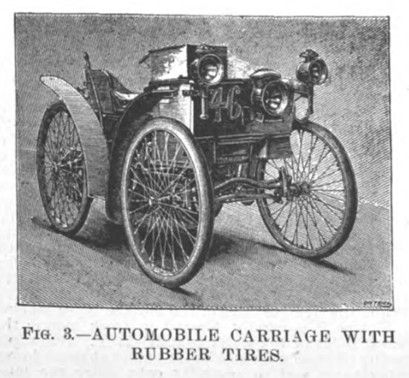
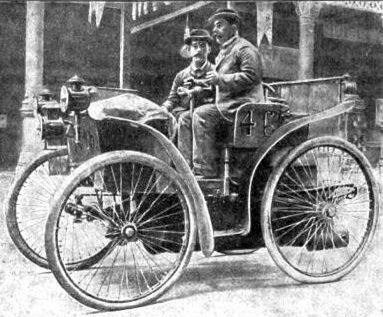
A second and very important infiltration of cycling into carriage building is certainly the adoption of the rubber tire. It was two or three years ago that the first experiments were made with it on the coupé of the manager of a large English bicycle manufactory; but the difficulty of putting on and taking off the type of tire selected gave a check to the idea for some time. The idea was taken up again in France. Upon the occasion of the race of auto-mobile carriages in June, the curious were not a little surprised to see among the competitors a quadricycle of the respectable weight of 2,400 pounds provided with four large rubber tires (Fig. 3). It was an innovation and a demonstration made by Mr. Michelin, the Pater Æneas of rubber tires in France.
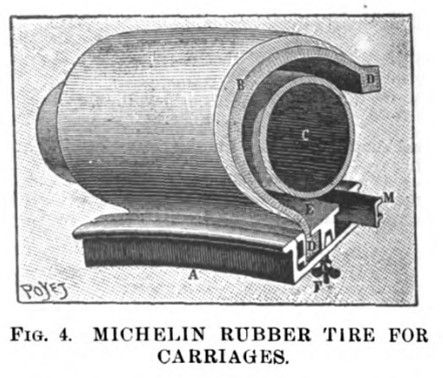
Of the total weight, the front wheels carried about 200 pounds each and the hind ones about 1.000. How would a rubber tire withstand such a weight, and how would it behave on curves, upon which there is always a great danger of the rubber being wrenched from the tire? Here was a new and difficult problem to be solved. Mr. Michelin devised the tire represented in section in Fig. 4. The felly, A. which is of first-class steel, has the form of a flattened U. In its center, large bolts E, having the form of a x, and screwed into the bottom of the felly by a series of thumbnuts, hold between them and the edge of the felly, the parts D, of the tire B, covering the air chamber, C. In order to increase the adhesion and prevent stripping on curves, it is well to interpose between the edge of the tire and that of the felly metallic pieces. M. which fill up the groove and are held firmly in place by the pressure of the air. Such a tire can be inflated, without any danger of explosion, to 8 atmospheres – a pressure that has never been practically reached, and that in any event the character of the valve permits of obtaining with a pump of small caliber. As for dangers of perforations by nails, they, so to speak, do not exist, the thickness and the number of the canvases necessitated by the pressure of the air and the stress of traction rendering punctures almost impossible.
The application of the rubber tire to carriages has drawn great progress, in that it suppresses, at least partially, the inequalities of the road and the shocks that it pro- duces – such shocks being very prejudicial to the carriage as well as to its motor. It will cause builders of auto-mobile carriages to get out of the rut in which they are moving – the construction so much the more resistant (that is to say, so much the heavier) in proportion as it is desired to run faster. The formula mv2 irrefutably bars the road to badly suspended auto-mobile carriages.
The objection is the fragility of the pneumatic tire; but this is not of much account, since, upon the whole, the rubber tires of carriages are difficult to perforate and the repair of them is in all cases much easier than that of the metallic assemblages that they protect from jarring. The adoption of ball bearings and rubber tires will gradually lead builders to seek a light and consequently so much the faster carriage. The huge three-and-four-thousand-pound vehicles have thus taken a lesson from the little twenty-five pound bicycle. – La Nature.
FIGS. 1 AND 2. – BALL BEARINGS FOR CARRIAGES. FIG. 3. – AUTOMOBILE CARRIAGE WITH RUBBER TIRES. FIG. 4. MICHELIN RUBBER TIRE FOR CARRIAGES.