Regarding the preparations for the 1903 Gordon Bennett Cup Race, already starting long before the event itself, some overview is given here on the proceedings of it. The British Automobile Club specially made an “Irish Automobile Fortnight”, a fifiteen-day program all around the Gordon Bennet Race. But not only the program, also some pictures of the route’s environment are shown.
Text and photos with courtesy of hathitrust hathitrust.org, compiled by motorracingistory.com.
THE AUTOMOBILE – Vol. 8, No. 15, April 11, 1903
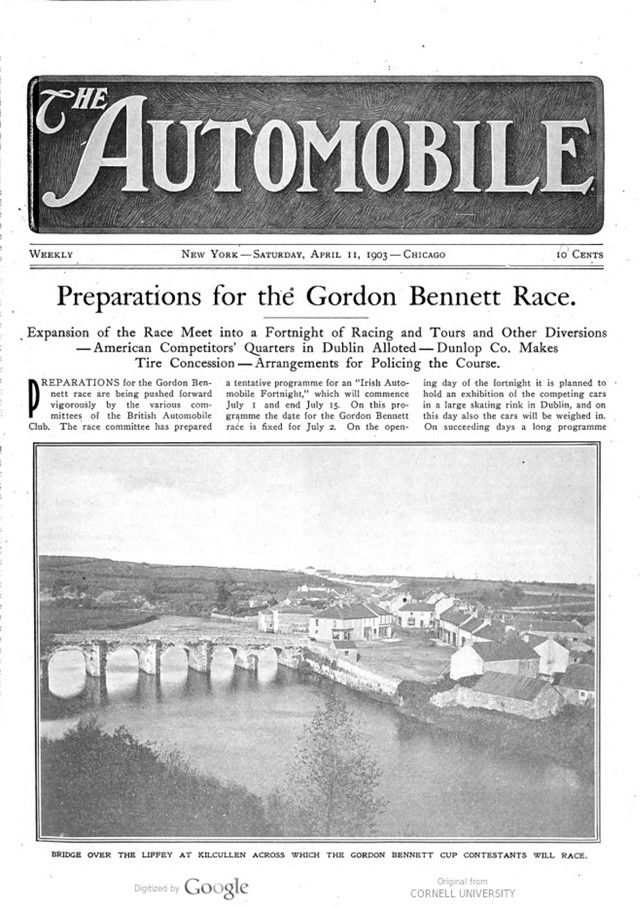
Preparations for the Gordon Bennett Race.
Expansion of the Race Meet into a Fortnight of Racing and Tours and Other Diversions – American Competitors’ Quarters in Dublin Alloted – Dunlop Co. Makes Tire Concession – Arrangements for Policing the Course.
PREPARATIONS for the Gordon Bennett race are being pushed forward vigorously by the various committees of the British Automobile Club. The race committee has prepared a tentative programme for an “Irish Automobile Fortnight,” which will commence July I and end July 15. On this programme the date for the Gordon Bennett race is fixed for July 2. On the opening day of the fortnight it is planned to hold an exhibition of the competing cars in a large skating rink in Dublin, and on this day also the cars will be weighed in. On succeeding days a long programme of speed and hill-climbing contests and tours is proposed, with intervals of rest on Sundays. At the conclusion of the official programme it is probable that groups of visitors will tour through some of the western and northern sections of the island, famous for their wildness and the grandeur of the coast scenery.
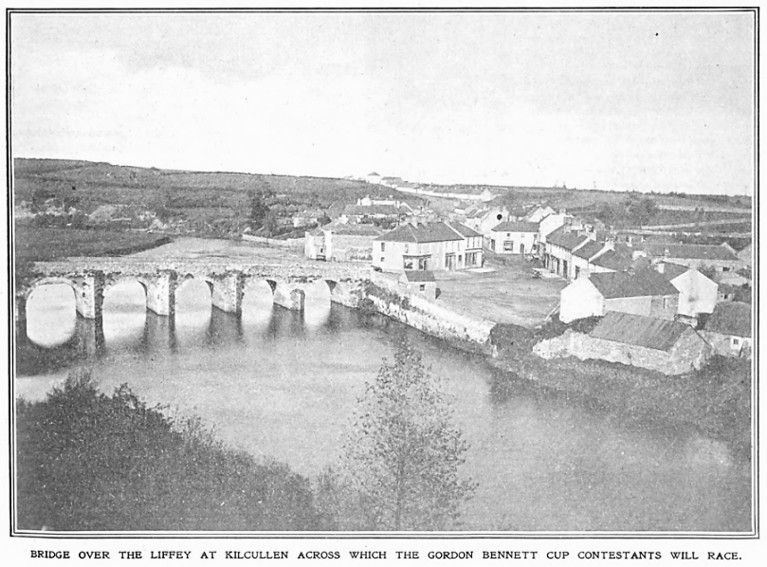
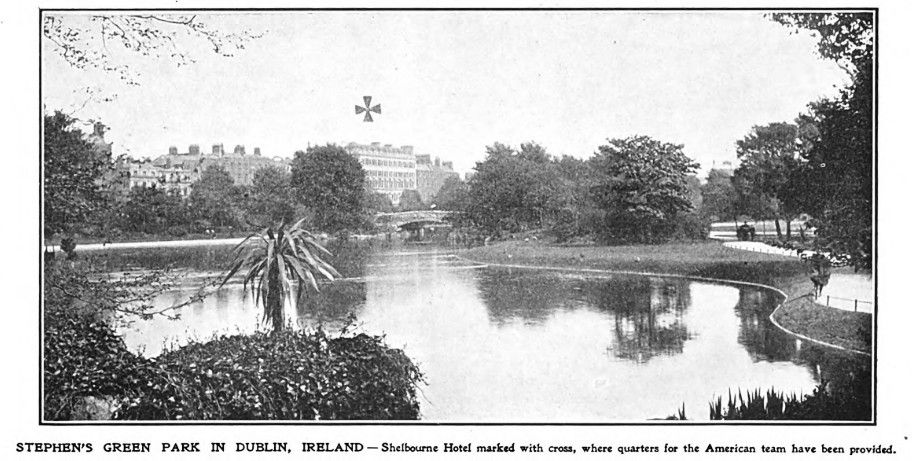
The preparations include an elaborate system of policing and control of the course during the great international race, and the social side of the event is engaging the attention of the Irish Automobile Club. Refusal of accommodations for the automobile clubs of America, France and Germany has been secured at the Shelbourne, the leading hotel in Dublin. By this arrangement the various competitors, the members of the International Commission and the British race officials, will all be housed under one roof.
A concession has been made by the Dunlop Co., which has withdrawn all patent restrictions in relation to tires that may be used on the cars run in the race, the British Club guaranteeing that any tires that may be an infringement of the company’s patents shall be taken out of the country after the race.
The safety of spectators is receiving a good deal of attention. It is proposed to divide the course into quarter mile sections and place these in control of responsible officials, or local residents, who will see that the course is kept clear of stray animals and that the spectators remain at a safe distance, preferably behind the fences. As the course lies across the Curragh, where the great permanent military camp in Ireland is located, the suggestion has been made that soldiers be employed to aid in policing the course. And following the continental custom, that military buglers give warning of the approach of each car during the race.
Another suggestion that has found favor is to send a pilot car over the course at high-speed half an hour before the start of the race. This is especially important in a district, such as is embraced in the Irish course, in which the greater part of the population can have no realizing sense of the terrific speed at which road racing cars travel, and so might not appreciate the necessity for keeping off the course during the race.
Both the course and all approaches will be cleared of all vehicular traffic for an hour before the start. Motor cyclists have been asked to volunteer as aides in the work of patrolling the course and carrying messages, and it is likely that the military authorities will be asked to establish a field telegraph service along the route.
Illustrated notices, printed in both the English and Irish languages, will probably be circulated prior to the race, calling attention to the necessity of public cooperation in keeping the course clear. Elaborate arrangements for accurate timing of the event are under consideration, including the appointment of timekeepers for the contestants in addition to the official club timekeepers.
The regulation of controls is receiving special attention from the committees in charge. It is proposed to place at each control an exact timepiece such as a ship’s chronometer, which is to be in plain view of the competitors and the spectators by which they can, if desired, check the timing of the official timekeepers, the latter being required to post the times of arrival conspicuously on a blackboard. The times of arrival and departure will also be marked on a card and handed to the competitor, so that he can constantly know his official times throughout the race. To prevent any competitor from crossing the arrival line of a control at full speed, and after slowing up, coming back for his time card, it is proposed to make two lines, about twenty feet apart, between which the time of arrival will be recorded only. Any competitor overrunning the second line will, therefore, have to recross it before his time is taken. By this he would needlessly lose time, and, therefore, care in regulating speed on the approach to a control will have to be exercised by all competitors.
If the Automobile Club of France consents, a rigid rule will be enforced that will disqualify any car on which the competitor “replenishes his car with either fuel, or water, or lubricating oil, or effects any adjustment whatever, between the time of arrival in a control and the expiration of the time allowed for that control.” When the time for the start of a car from the control has expired, the replenishment or adjustment will be permitted, but the time so occupied will be counted in as actual racing time. This severe restriction has been decided upon in a spirit of fairness to neutralize as far as possible the element of luck. Some minor mishap, for instance, might occur to a machine near enough to a control so that the machine could cross the line without a stop. If no restriction was placed on adjustments at controls, the operator could, possibly, speedily make repairs or replacements without loss of running time. On the other hand, a similar mishap occurring at a considerable distance from a control might necessitate a road stop for repairs, and the time so occupied would mean a loss of several minutes in running time.
To prevent too long delays in controls it is proposed also to limit the stop in each to the time equivalent of the passage through the control of a car running at the rate of twenty miles an hour.
Whether or not the driver and mechanic of any machine can employ help during the race to make repairs or adjustments is a question yet to be settled. The British club believes that either there should be no rule at all, or else that a rule should confine the available help to the driver and the mechanic of each car. In former races regular breakdown gangs of skilled men helped the contestants to keep the cars in condition to complete the run. Car construction certainly ought to be sufficiently advanced now to carry any one of the competitors through, barring unforeseen accidents.
The regular Gordon Bennett rules giving two-minute intervals between the cars at starting will be observed. And the time of starting is 7 o’clock, if the committee’s recommendation is carried out. At that time of the year in Ireland, the race would therefore be started in broad daylight.
We here reproduce the complete program of the “Irish Automobile Fortnight,” as framed by the race committee.
In carrying out the program, the Irish Automobile Club will give aid to the British club committees, the latter having an onerous task in carrying to a successful finish the international race. Mr. R. J. Mecredy, 2 Dame Court, Dublin, is honorary secretary of the Irish club, and he will be glad doubtless to give any information to motorists who intend to visit Ireland during the races.
In the gymkhana at the Phenix Park racecourse, it is probable that makers who have not been able to get machines into the great race, will have an opportunity to exhibit their machines doing “stunts.”
The speed trials on July 4 are conditional on the granting of special permission by the authorities. These trials will include sections for motorcycles, touring and racing cars. The proposition is made also to subdivide the touring car section into classes, according to selling price.
Irish Automobile Fortnight.
FIRST DAY, Wednesday, July 1st: Exhibition of the Competing Cars at Earlsfort Rink, Dublin, from 4 p. m. on Tuesday, June 30th, to 4 p. m. on Wednesday, July 1st; Weighing of the Racing Cars.
SECOND DAY, Thursday, July 2d: The Gordon Bennett Race.
THIRD DAY, Friday, July 3d: Gymkhana at the Phenix Park, Dublin, and if H. E. the Lord Lieutenant will consent, a torchlight procession to the Castle at night.
FOURTH DAY, Saturday, July 4th Speed Trials in the Phenix Park, Dublın.
FIFTH DAY, Sunday, July 5th: Rest.
SIXTH DAY Monday, July 6th Tour to Newcastle and Belfast. Some of the party might sleep at Newcastle and others at Belfast.
SEVENTH DAY, Tuesday, July 7th: Four-mile Time Test at Newcastle. Hill-climbing Trial for the Henry Edmunds Trophy. Sleep, some at Newcastle and some at Belfast.
EIGHTH DAY, Wednesday, July 8th: Return to Dublin and sleep there.
NINTH DAY, Thursday, July 9th Start for Cork. Some would drive to Cork direct (156 miles); others would go via Waterford and sleep there; others via Lismore and sleep there.
TENTH DAY, Friday, July 10th Arrival at Cork. Eliminating Race for Motor Boats at Queenstown, in the morning. Speed or Hill-climbing Trial at Cork in the afternoon.
ELEVENTH DAY, Saturday, July 11th: Motor Boat Race for the Alfred Harmswo.th Cup at Queenstown.
TWELFTH DAY, Sunday, July 12th: Rest.
THIRTEENTH DAY: Monday, July 13th: Start of tour through the beautiful scenery of the South, some of the party sleeping at one town, others at other towns.
FOURTEENTH DAY, Tuesday, July 14th: Arrival at Killarney.
FIFTEENTH DAY, Wednesday, July 15th: Hill-climbing Trial on the Killorglin-Tralee Road for the County of Kerry Cup, and Termination of the official tour.
These events may also include a contest for the Daily Mail 100-guinea cup, for the fastest car, weighing under 100 kilos, and employing any form of power. The cup is now in the possession of M. Serpollet, who won it in 1902.
Hill climbing contests will take place at Newcastle in the north of Ireland, and later in the south of Ireland, in the neighborhood of Killarney. The motorboat trials at Queenstown will also be an attractive feature of this comprehensive pro- gram of automobile midsummer sport.
In the big rare the first starter will be F. S. Edge, who is the cup winner of last year. He will be known as British No. I. Chevalier Rene de Knyff will be the second starter, and will be known as French No. 1. The next starter will be an American, and the third man of our team will start eleventh on the list.
Photos.
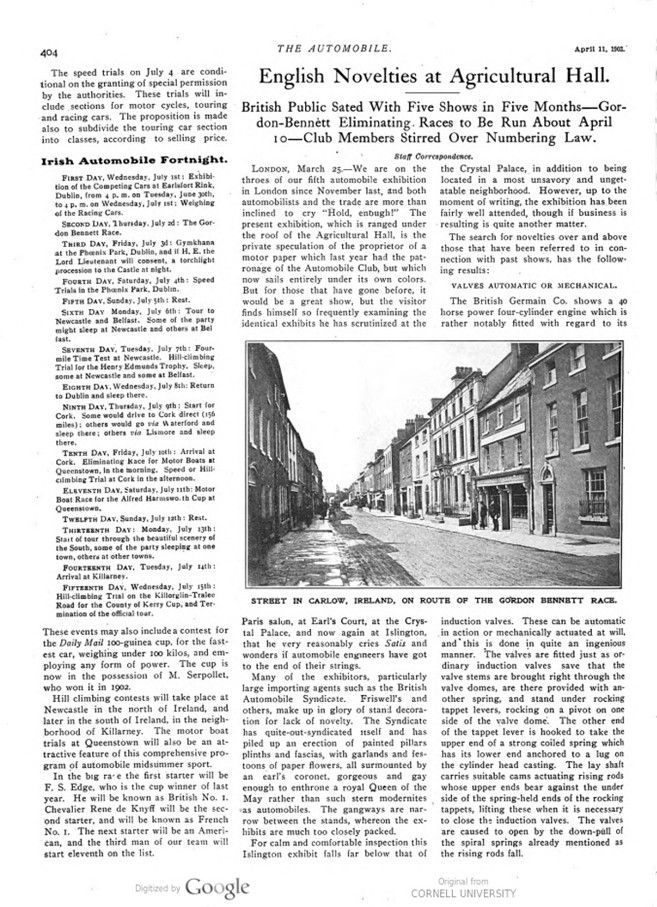
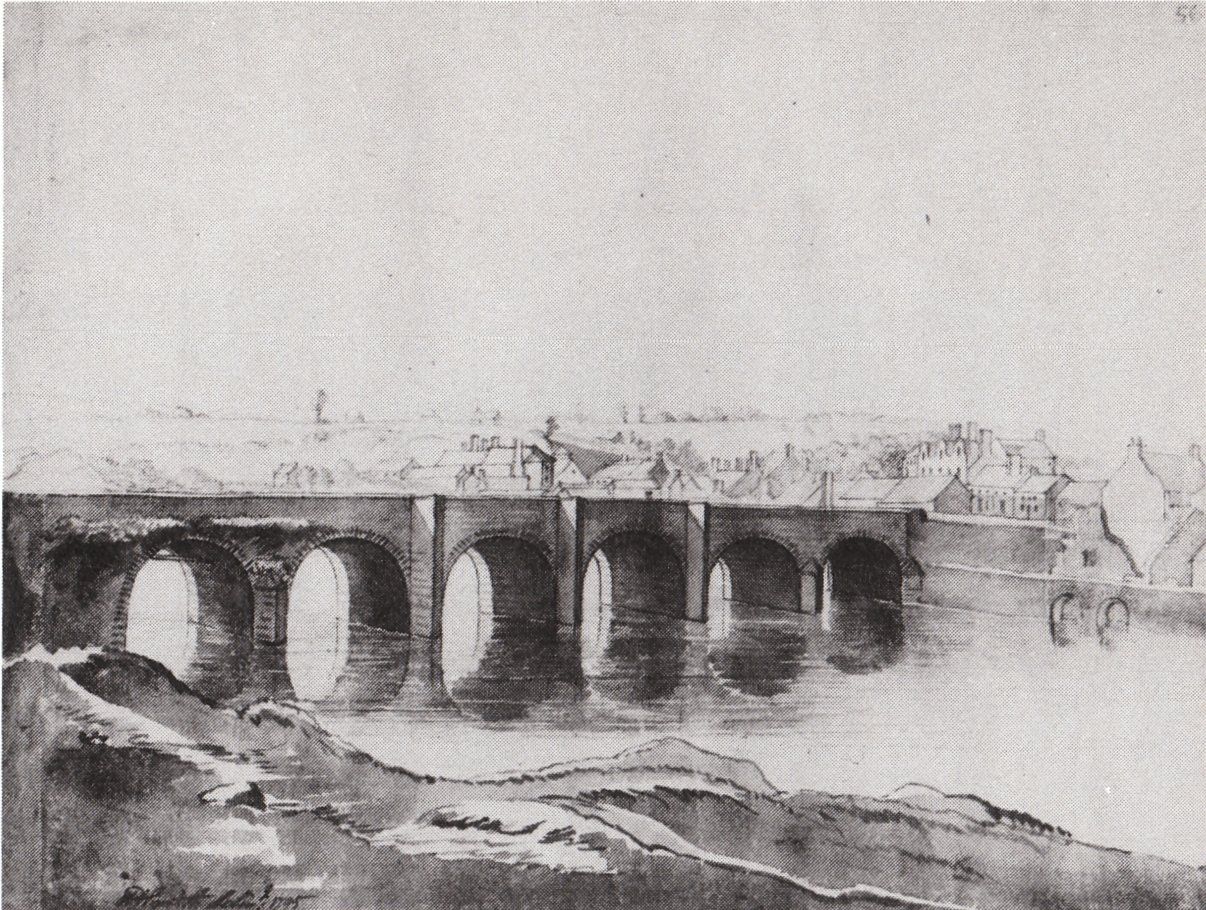
Page 395. BRIDGE OVER THE LIFFEY AT KILCULLEN ACROSS WHICH THE GORDON BENNETT CUP CONTESTANTS WILL RACE.
Page 403. STEPHEN’S GREEN PARK IN DUBLIN, IRELAND – Shelbourne Hotel marked with cross, where quarters for the American team have been provided
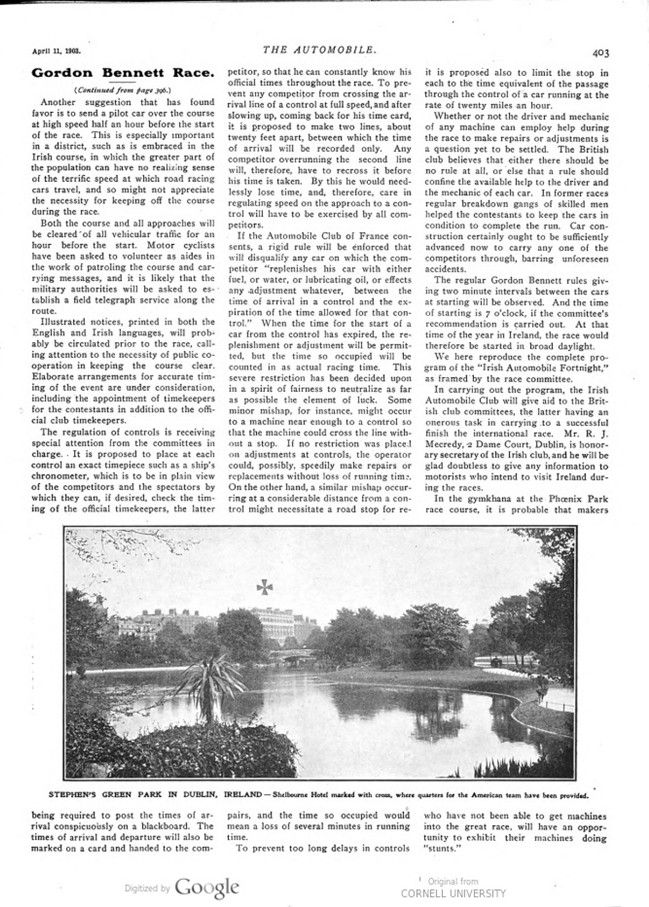
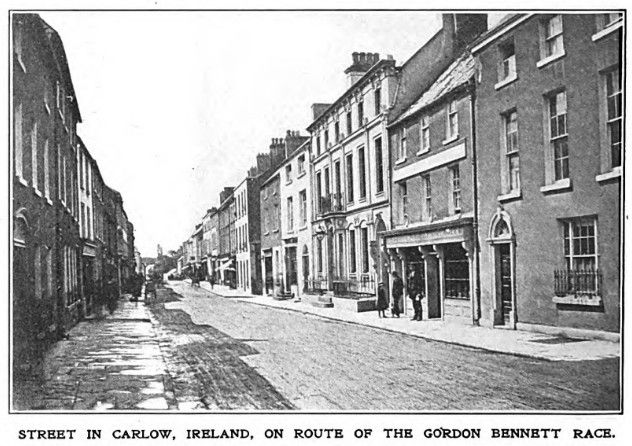
Page 404. STREET IN CARLOW, IRELAND, ON ROUTE OF THE GORDON BENNETT RACE