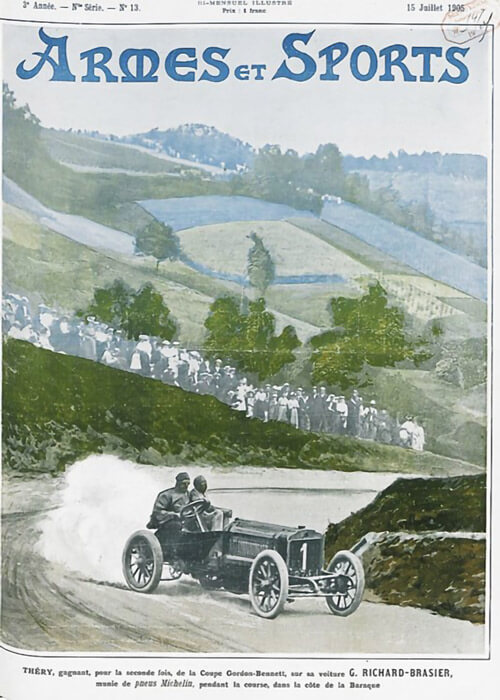
Here, the French automotive journalist Paul Dumas, who also writes for magazines such as Omnia, makes a thorough analysis of the 1930 Indianapolis race. A car with one of the smallest engine displacements, not running at the highest pace, but with the best durabilty for the 500 miles, won! A comparison is made with „the old story of the sprinter who failed to make his mark in the marathon“.
Text and jpegs by courtesy of hathitrust.org www.hathitrust.org, compiled by motorracinghistory.com
Automotive Industries, Vol. 62, No. 23, June 7, 1930
Speed With Reliability Shown at Indianapolis
Race cars under the 1930 rules show superiority in the 500-mile grind over the 91-in. supercharged jobs
By Paul Dumas
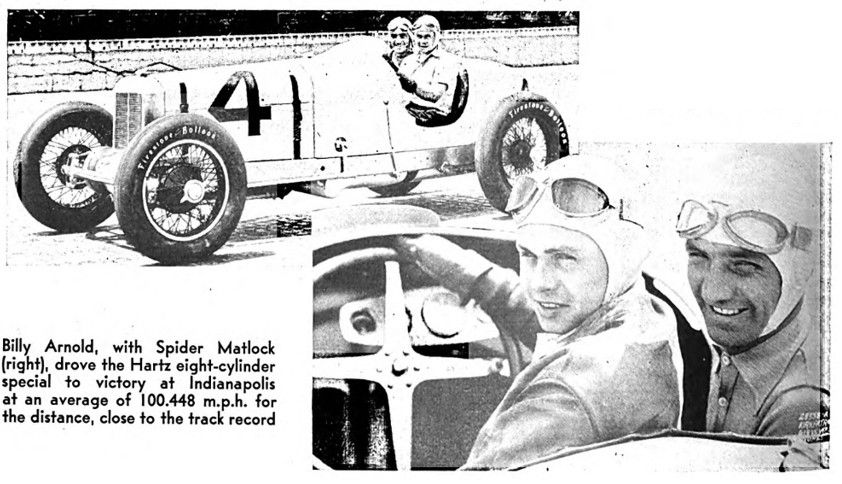
THE winning of the 1930 Indianapolis 500-mile race by Billy Arnold, besides being a tribute to his skill and the mechanical preparation ability of Jean Marsenac and the owner Harry Hartz, also divulges to the student of racing certain interesting observations. The first of these is that the 1930 model, non-supercharged, two-man race car can traverse the 500-mile distance on the Indianapolis type track at a higher average speed than either the 91 or the 122 cubic inch, one man, supercharged type. This despite the fact that the track record of 101 m.p.h. was established with a 122 cubic inch supercharged one-man Duesenberg, driven by Peter De Paolo.
De Paolo’s average was slightly less than a mile per hour faster than the 100.448 figure turned in by Arnold but, had not the 1930 field been flagged to caution speed, for about five minutes, due to a six-car pile-up, the average would easily have risen to 102 m.p.h. Furthermore, the winner was never seriously challenged and at all times after the 250-mile mark, except during his one pit stop, maintained a lead of four laps on the runner-up. Possessing such a lead, the driver wisely chose to play safe and ran most of the distance at well below his maximum safe driving speed. Correction of the average by calculating the effect of the two factors just mentioned establishes the fact that the 1930 jobs are faster at the 500-mile distance, but it does not tell the whole story, because the supercharged one-man jobs are admittedly faster as to top speed. It is the old story of the sprinter who failed to make his mark in the marathon.
The 1930 model race cars are not as fast at the short and sprint distances as the supercharged 91 or 122, but they surpass the latter in the 500-mile grind. Of the several reasons for their higher average over the long distance, probably the most important is reliability as expressed in fewer pit stops. Pit stop records covering the one-man supercharged type cars were not at hand at the time of writing. It is interesting to note, however, that this year there were only seven pit stops due to spark plug trouble and that these were confined to six cars. Furthermore, none of the ten place winners changed any spark plugs. Of the theories advanced for this good showing, the majority credit it to the absence of the supercharger, although this is open to discussion.
Many of the drivers and officials believe that one of the important factors enabling the high average was a considerable reduction in the amount of oil on the track surface. This is due to the fact that the 1930 cars leak less oil, which means better traction and a safer track for any given speed. The centrifugal-type supercharger is blamed by many as being the worst offender in the matter of oil leakage, due mainly to the methods used for lubrication. At any rate, the 1930 cars which were not equipped with superchargers are credited for the improvement. One driver who covered the course in a passenger car shortly after the event stated that there was only about one-fourth as much oil on the track as last year.
Although the top speed of this year’s cars was less than shown in recent Indianapolis races, the differential is small enough to indicate that they are within striking distance of former standards. The record qualifying speed is 122-plus m.p.h. made with a one- man supercharged Miller-built 91½-inch-engined car driven by Leon Duray. The fastest qualification this year was 113-plus m.p.h. Incidentally, it is the same qualification speed attained by Peter De Paolo the year he set the 500-mile record for the track at 101.13 m.p.h.
In their efforts to get power output, builders of this year’s race cars naturally turned to increased piston displacement to offset the removal of the supercharger. It is interesting to note, however, that the engine of the winning car was of 150 cu. in. displacement, that the engines of the first four cars were of less than 200 cu. in. displacement, and that only two of the thirteen cars that finished or were running at the finish had in excess of 251 cu. in. displacement.
Among the items contributory to the high power output of the 1930 Indianapolis rules engines is extremely high compression. Never before were the ratios as high as utilized this year. One of the 91½ cu. in. Miller eights carried a fourteen-to-one ratio. All but two of the Miller fours of 34-in. bore used a 9.7-to-one ratio, and with a few exceptions notably among the larger eight-cylinder engines the commonly used ratio was of the order of ten to one. All contestants with one exception used tetraethyl lead doped fuel in amounts as high as 13 cc. per gallon. It should be said to the credit of the supercharger that it probably was instrumental in providing the problem that caused plug makers to produce a spark plug that easily met the requirements of the non-supercharged high compression engines.
The generally higher rotative speeds of the supercharger equipped 91½ cu. in. engine was also productive of valves and valve springs of improved design. The introduction of these in the 1930 engines of slightly slower speed gave them a safety factor that contributes much to the reliability of the present cars. Three springs per valve were utilized in the Miller engine of the winning car. From the standpoint of plugs, valves, pistons and valve springs, the 911½ cu. in. supercharged engine should be credited with producing a better 1930 rules engine.
The 1930 rules placed the limit on number of carburetors at two and classed a duplex type as two carburetors. Such restrictions automatically brought about hurried research and experiment and although most of the contestants used the downdraft type of manifold, the detailed designs were many and varied. With a few exceptions, the carburetors were installed as two single units of downdraft type and Winfield manufacture.
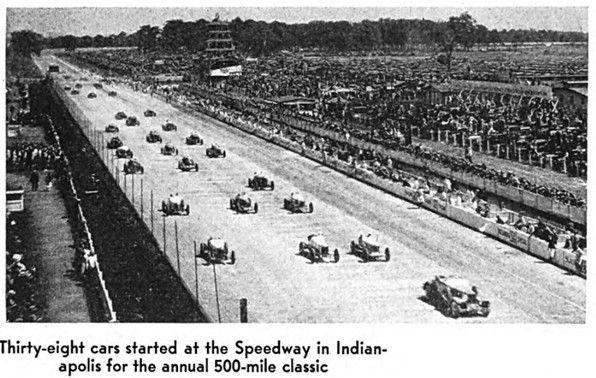
Soon after the new rules were announced last year, it was predicted that the cars starting in the 1930 race would be of widely varying design. To some extent the prediction has been fulfilled, because, among the starters were two sixteen-cylinder cars, twenty-four eight-cylinder models, two cars with six-cylinder engines, and ten with four-cylinder engines.
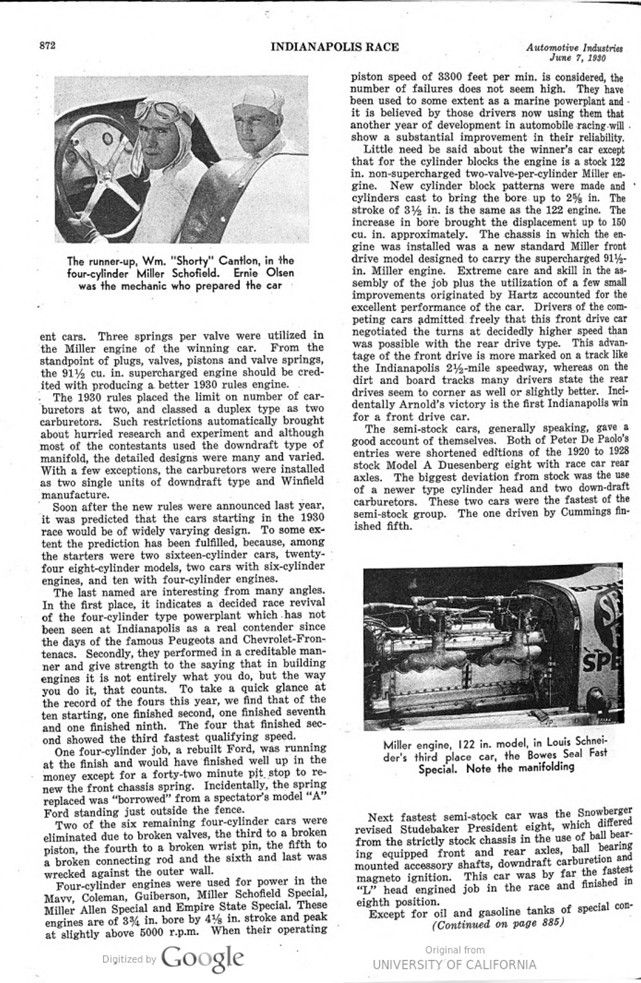
The last named are interesting from many angles. In the first place, it indicates a decided race revival of the four-cylinder type powerplant which has not been seen at Indianapolis as a real contender since the days of the famous Peugeots and Chevrolet-Frontenacs. Secondly, they performed in a creditable manner and give strength to the saying that in building engines it is not entirely what you do, but the way you do it, that counts. To take a quick glance at the record of the fours this year, we find that of the ten starting, one finished second, one finished seventh and one finished ninth. The four that finished second showed the third fastest qualifying speed.
One four-cylinder job, a rebuilt Ford, was running at the finish and would have finished well up in the money except for a forty-two minute pit stop to renew the front chassis spring. Incidentally, the spring replaced was „borrowed“ from a spectator’s model „A“ Ford standing just outside the fence.
Two of the six remaining four-cylinder cars were eliminated due to broken valves, the third to a broken piston, the fourth to a broken wrist pin, the fifth to a broken connecting rod and the sixth and last was wrecked against the outer wall.
Four-cylinder engines were used for power in the Mavv, Coleman, Guiberson, Miller Schofield Special, Miller Allen Special and Empire State Special. These engines are of 334 in. bore by 41/8 in. stroke and peak at slightly above 5000 r.p.m. When their operating piston speed of 3300 feet per min. is considered, the number of failures does not seem high. They have been used to some extent as a marine powerplant and it is believed by those drivers now using them that another year of development in automobile racing will show a substantial improvement in their reliability.
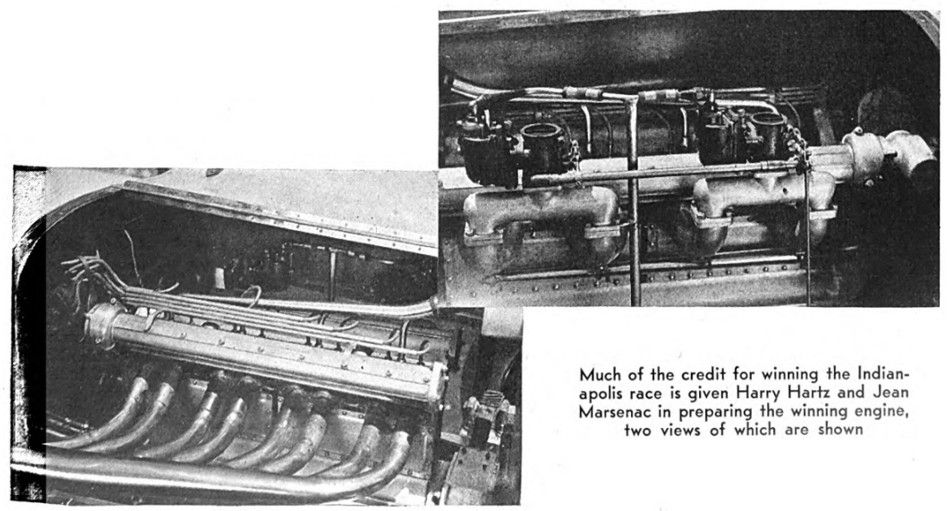
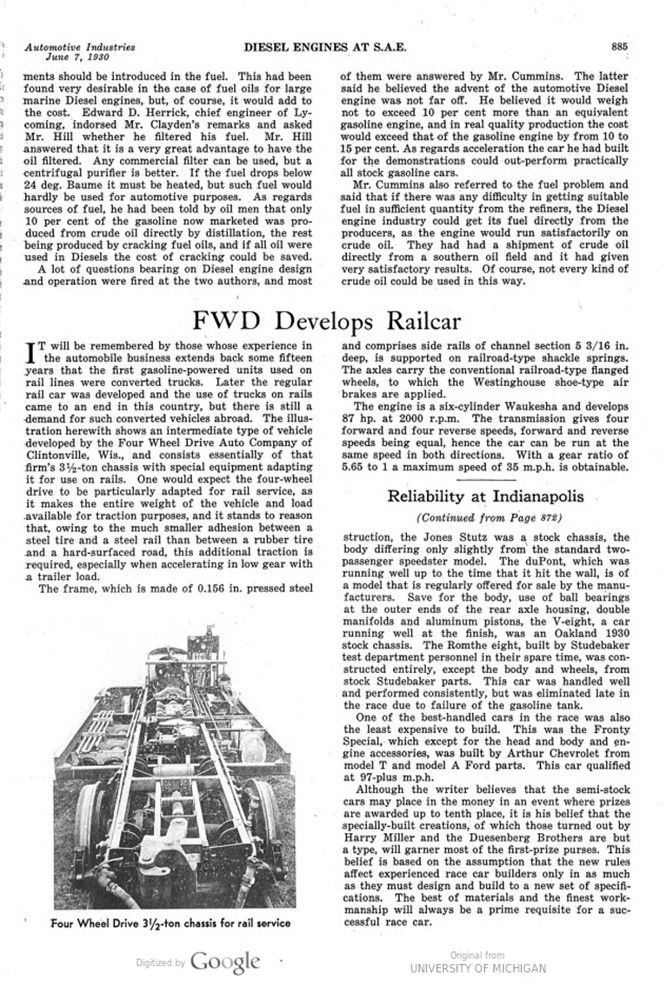
Little need be said about the winner’s car except that for the cylinder blocks the engine is a stock 122 in. non-supercharged two-valve-per-cylinder Miller engine. New cylinder block patterns were made and cylinders cast to bring the bore up to 2 5/8 in. The stroke of 3½ in. is the same as the 122 engine. The increase in bore brought the displacement up to 150 cu. in. approximately. The chassis in which the engine was installed was a new standard Miller front drive model designed to carry the supercharged 91½-in. Miller engine. Extreme care and skill in the assembly of the job plus the utilization of a few small improvements originated by Hartz accounted for the excellent performance of the car. Drivers of the competing cars admitted freely that this front drive car negotiated the turns at decidedly higher speed than was possible with the rear drive type. This advantage of the front drive is more marked on a track like the Indianapolis 2½-mile speedway, whereas on the dirt and board tracks many drivers state the rear drives seem to corner as well or slightly better. Inc dentally Arnold’s victory is the first Indianapolis win for a front drive car.
The semi-stock cars, generally speaking, gave a good account of themselves. Both of Peter De Paolo’s entries were shortened editions of the 1920 to 1928 stock Model A Duesenberg eight with race car rear axles. The biggest deviation from stock was the use of a newer type cylinder head and two down-draft carburetors. These two cars were the fastest of the semi-stock group. The one driven by Cummings finished fifth.
Next fastest semi-stock car was the Snowberger revised Studebaker President eight, which differed from the strictly stock chassis in the use of ball bearing equipped front and rear axles, ball bearing mounted accessory shafts, downdraft carburetion and magneto ignition. This car was by far the fastest „L“ head engined job in the race and finished in eighth position.
Except for oil and gasoline tanks of special construction, the Jones Stutz was a stock chassis, the body differing only slightly from the standard two- passenger speedster model. The duPont, which was running well up to the time that it hit the wall, is of a model that is regularly offered for sale by the manufacturers. Save for the body, use of ball bearings at the outer ends of the rear axle housing, double manifolds and aluminum pistons, the V-eight, a car running well at the finish, was an Oakland 1930 stock chassis. The Romthe eight, built by Studebaker test department personnel in their spare time, was constructed entirely, except the body and wheels, from stock Studebaker parts. This car was handled well and performed consistently but was eliminated late in the race due to failure of the gasoline tank.
One of the best-handled cars in the race was also the least expensive to build. This was the Fronty-Special, which except for the head and body and engine accessories, was built by Arthur Chevrolet from model-T and model-A Ford parts. This car qualified at 97-plus m.p.h.
Although the writer believes that the semi-stock cars may place in the money in an event where prizes are awarded up to tenth place, it is his belief that the specially-built creations, of which those turned out by Harry Miller and the Duesenberg Brothers are but a type, will garner most of the first-prize purses. This belief is based on the assumption that the new rules affect experienced race car builders only in as much as they must design and build to a new set of specifications. The best of materials and the finest workmanship will always be a prime requisite for a successful race car.
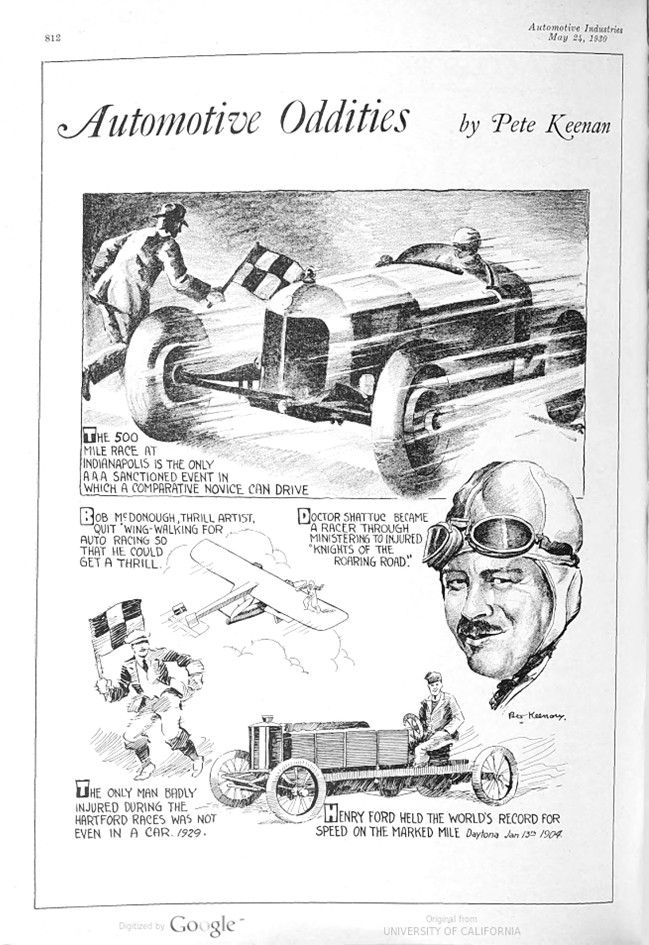
Automotive Industries 812 May 24, 1930
Automotive Oddities by Pete Keenan
THE 500 MILE RACE AT INDIANAPOLIS IS THE ONLY A.A.A SANCTIONED EVENT IN WHICH A COMPARATIVE NOVICE CAN DRIVE
BOB MC DONOUGH, THRILL ARTIST, „QUIT „WING-WALKING FOR AUTO RACING SO THAT HE COULD GET A THRILL.
DOCTOR SHATTUC BECAME A RACER THROUGH MINISTERING TO INJURED „KNIGHTS OF THE ROARING ROAD!“ Pet Keenary.
THE ONLY MAN BADLY INJURED DURING THE HARTFORD RACES WAS NOT EVEN IN A CAR. 1929.
HENRY FORD HELD THE WORLD’S RECORD FOR SPEED ON THE MARKED MILE Daytona Jan 13th, 1904.
Photos.
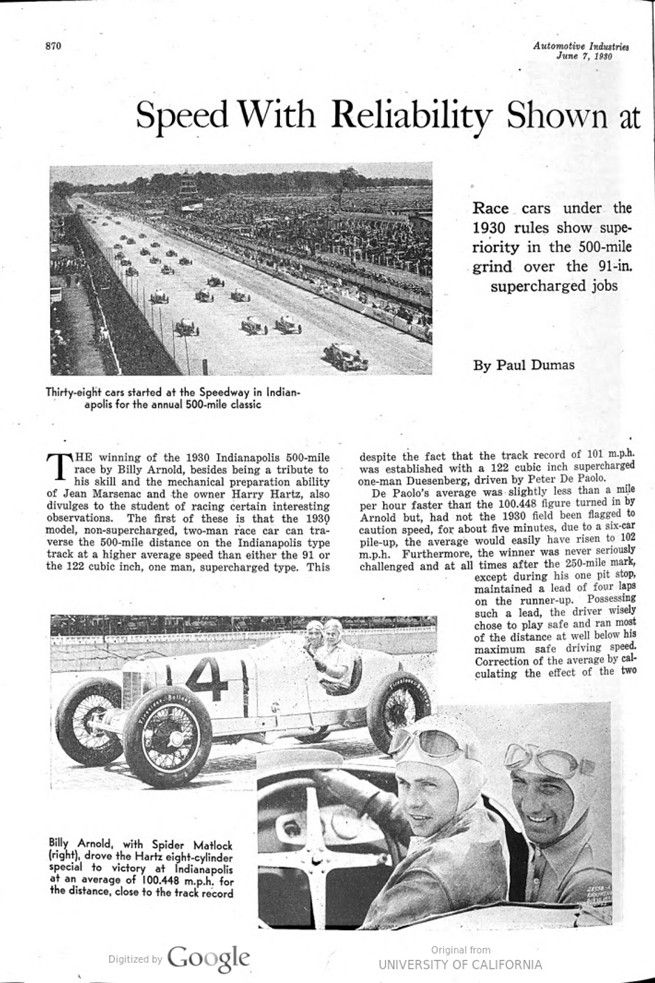
Page 870. Thirty-eight cars started at the Speedway in Indianapolis for the annual 500-mile classic – Billy Arnold, with Spider Matlock (right), drove the Hartz eight-cylinder special to victory at Indianapolis at an average of 100.448 m.p.h. for the distance, close to the track record
Page 871. Much of the credit for winning the Indianapolis race is given Harry Hartz and Jean Marsenac in preparing the winning engine, two views of which are shown
Page 872. The runner-up, Wm. „Shorty“ Cantlon, in the four-cylinder Miller Schofield. Ernie Olsen was the mechanic who prepared the car – Miller engine, 122 in. model, in Louis Schneider’s third place car, the Bowes Seal Fast Special. Note the manifolding