A race review of the 1930 Indianapolis 500. Incorporated also,some technical and financial backgrounds of some of the participating cars that appeared for the first time in Indianapolis race: stock cars! These would play an ever increasing role in the years to come.
Text and jpegs by courtesy of hathitrust.org www.hathitrust.org, compiled by motorracinghistory.com
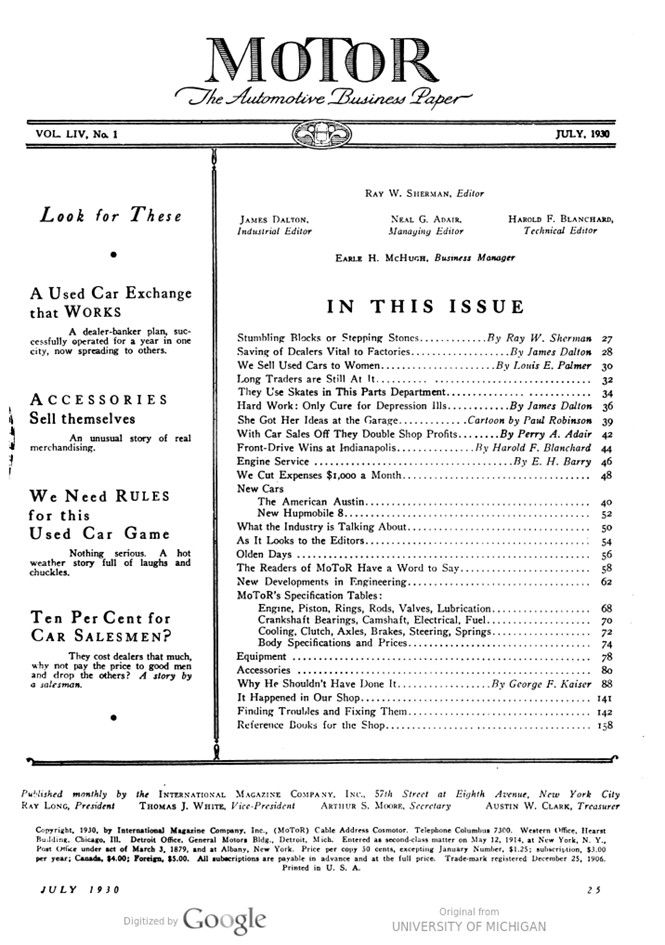
MoToR, Vol. LIV, 54, No. 1, July 1930
Front-Drive Wins
BILLY ARNOLD Takes Lead in Third Lap of Indianapolis 500-Mile Race and Holds it to the Finish…..
By HAROLD F. BLANCHARD Technical Editor of MOTOR
BILLY ARNOLD, in an eight-cylinder front-drive Miller-Hartz Special, ran away with the Indianapolis speedway classic on Decoration Day with the fast average of 100.448 miles per hour, almost equaling Peter De Paolo’s 1925 record of 101.13 miles per hour in a Duesenberg.
Some experts believe that Arnold would have broken De Paolo’s record had the cars not been slowed down for several laps immediately after the big spill on the north turn in the twenty-second lap. Be that as it may, Arnold no doubt would have broken the record if those behind him had been able to push him harder.
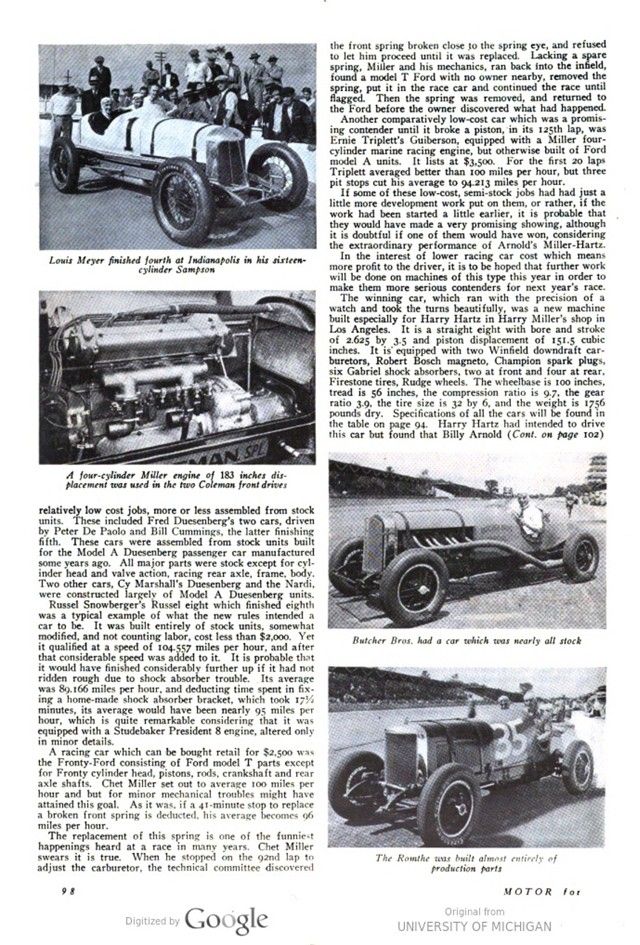
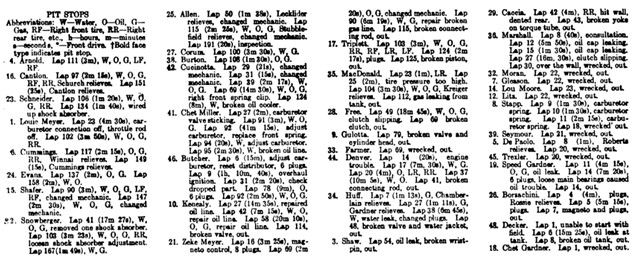
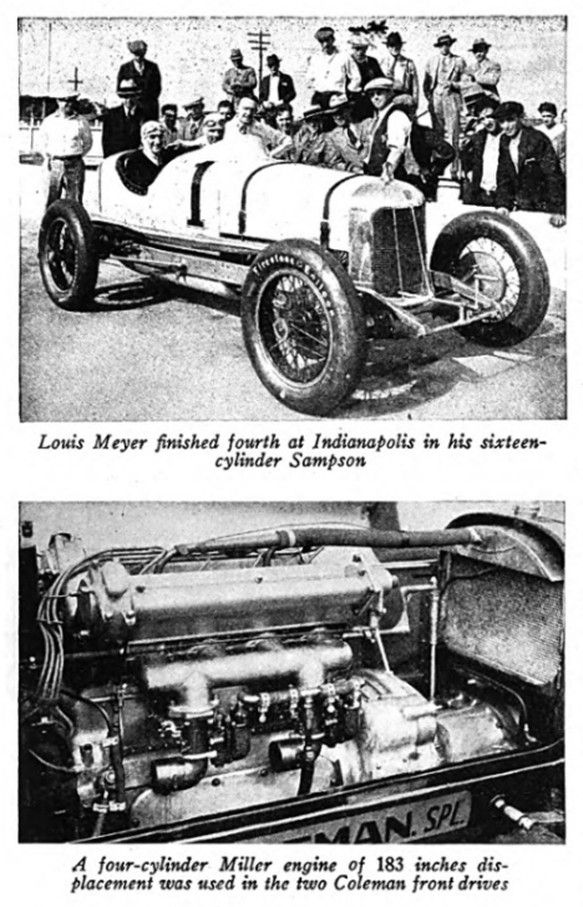
Arnold took the lead in the third lap and held it without effort throughout the race. Shortly Cantlon secured second place in a Miller-Schofield equipped with a Miller four-cylinder marine racing engine. Having a somewhat slower car, Cantlon wisely made no attempt to overtake Arnold although he was in second place throughout most of the race and never less than third. Cantlon was content to keep ahead of Louis Schneider who came in third. Louie Meyer, in his sixteen-cylinder Sampson built of Miller units, led during the first two laps with Arnold a couple of car lengths behind. Then Arnold took the lead in the third lap, with Meyer second and Cantlon third. In the twenty-third lap Meyer stopped to fix a broken throttle linkage and lost 42 minutes, dropping back to fourteenth place from which position he climbed steadily, finishing in fourth place.
Arnold drove the whole race, making only one stop in the 11th lap to take on gasoline, oil and water and to change both rear tires as a precaution. The race was not only unique in that it is the first one where a man took the lead almost at the start and held it thereafter, but it was also unique in that the car which qualified at the highest speed won. Louie Meyer’s sixteen-cylinder car may have had more speed on the straightaways, but it did not handle so well on the turns-some said because it was too heavy at the front. Since 1923 the fastest cars at Indianapolis have invariably broken down – but in Arnold’s case, quite the contrary happened; the fastest car won.
The race was also unique in that the positions of the first thirteen cars running at the finish did not change during the last 40 laps while the positions of the first three cars was unaltered for the last 90 laps or nearly half the race. Some may say that this lack of give and take took something away from the thrill of the sport, but the fact remains that, aside from the cars eliminated by spills and the few which went out with mechanical trouble, the cars won in the order of their merit with luck, a distinctly secondary factor. And that is something almost unheard of in automobile racing.
At 25 miles Arnold led Louie Meyer by 15 seconds with Cantlon third; speed 106.914.
At 100 miles Louie Meyer stopped to fix his throttle, putting Cantlon in second place, with Louis Schneider third and Wilbur Shaw fourth, Ernie Triplett fifth, and Bill Cummings sixth; speed 103.353.
At 150 miles the first three were in the same positions. with Arnold a lap ahead; speed 102.714.
At 200 miles, with 21 cars remaining out of the 38 starters, Arnold had a lap and a half on Cantlon who was three laps ahead of Schneider; speed 102.143.
At 250 miles, Arnold was 4 laps ahead-11 laps later he made his single stop for gasoline, oil, water and rear tires. Cantlon made a stop in the 97th lap for gasoline, oil, water, two tires and a relief driver. Schurch, which allowed Schneider to take second place but Schurch got his position back in the 106th lap, when Schneider stopped for supplies. From then on the positions of the leaders remained unchanged to the end.
At 300 miles the pace had slowed down to 100.058 miles per hour and this average was practically maintained to the finish. There were 18 cars in the running at 300 miles; fourteen cars at 350 miles and thirteen cars at the finish. For the last 100 miles Arnold was 10 miles ahead of Cantlon who relieved Schurch in the 151st lap.
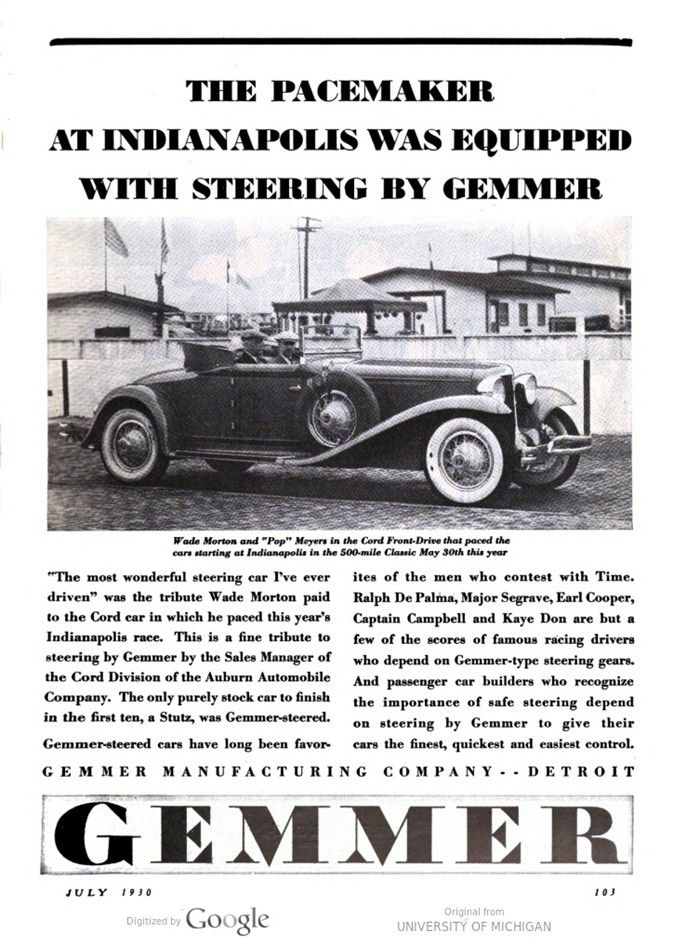
The race was filled with thrills – far too many in fact. Eleven cars spilled with seven in one mixup. On the very first lap, on the first turn, not half a mile from the starting line, Chet Gardner in a Duesenberg took a skid which might well have tangled up at least half the thirty-eight cars in what might have been the greatest catastrophe in automobile racing history. To picture the situation it must be recalled that before the race the cars are lined up three abreast, behind the starting line and exactly at 10 a.m. get under way slowly under the leadership of a pace car – this year a Cord front-drive driven by Wade Morton. When the preliminary lap had been completed the cars were running about 80 miles per hour.
With the cars still in close formation, they accelerated on the way to the south turn. Chet Gardner was one of the leaders of the pack when he lost his car. Fortunately, it skidded off the track down into the dirt, on the inside out of the way of the cars following and he was unhurt. But had his car skidded back up onto the track it is horrible to think of what the consequences might have been with his car blocking the path of thirty to thirty-five machines. There is no criticism of Gardner; he was simply the accidental victim of one of the hazards of racing. But this situation does raise the question as to whether it would not be wise to string the cars out at considerably greater distance in order to guard against the ever-present possibility of a mixup involving a large number of cars whenever a race is started with many cars competing.
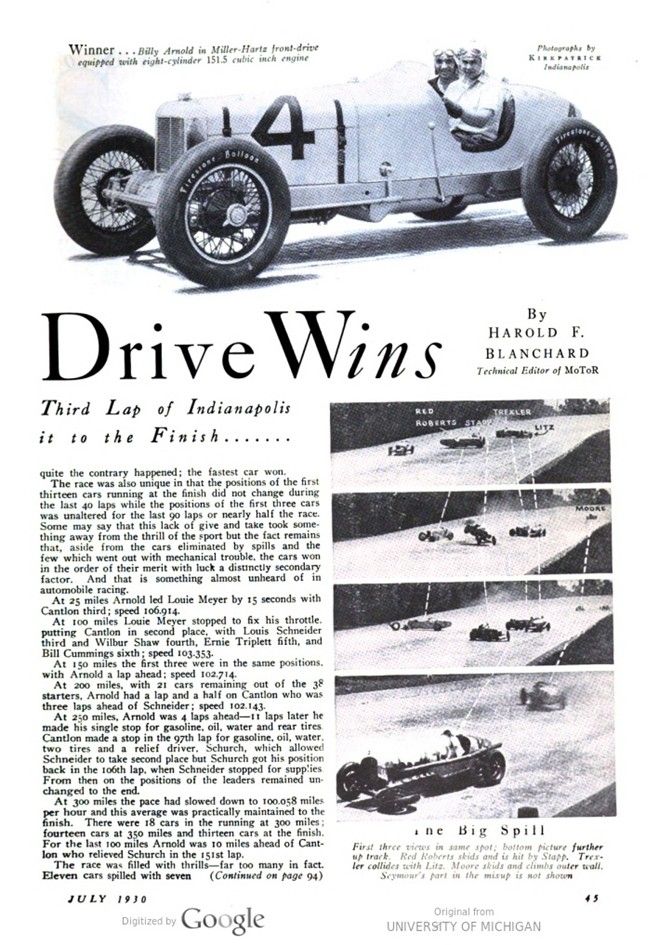
As it was, a spill occurred early in the race which involved seven cars, while others evaded the mixup by a hair’s breadth. Red Roberts, on his 20th lap, went into a spin entering the north turn (after leaving the back stretch). Peter De Paolo had relinquished the wheel of his car on the 8th lap because he said it was hard to steer. Stapp hit Roberts. Litz hit Trexler. Lou Moore climbed the wall. Johnny Seymour’s left front hub momentarily locked into the wires on Jimmy Gleason’s right rear wheel and later Seymour’s car hit the wall. With wheel locked, Gleason stepped on the gas and as a result broke a timing gear and bent some valves. Gleason coasted into the pits otherwise undamaged but was out of the race along with the others mentioned. Litz suffered a fractured wrist, Seymour cut his foot and Ted Evverrode, a mechanic, sprained his ankle.
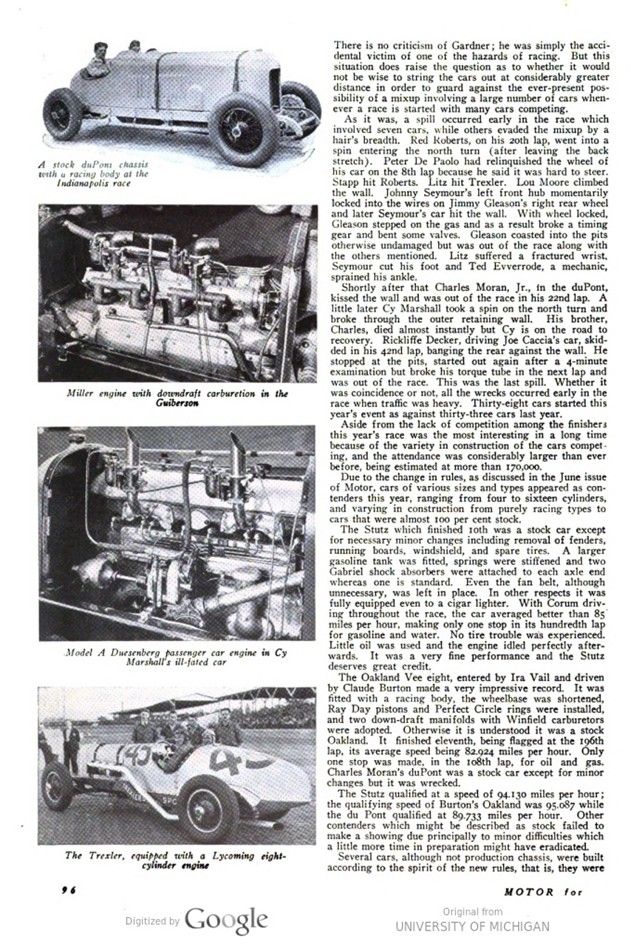
Shortly after that Charles Moran, Jr., in the duPont, kissed the wall and was out of the race in his 22nd lap. A little later Cy Marshall took a spin on the north turn and broke through the outer retaining wall. His brother, Charles, died almost instantly but Cy is on the road to recovery. Rickliffe Decker, driving Joe Caccia’s car, skidded in his 42nd lap, banging the rear against the wall. He stopped at the pits, started out again after a 4-minute examination but broke his torque tube in the next lap and was out of the race. This was the last spill. Whether it was coincidence or not, all the wrecks occurred early in the race when traffic was heavy. Thirty-eight cars started this year’s event as against thirty-three cars last year.
Aside from the lack of competition among the finishers this year’s race was the most interesting in a long time because of the variety in construction of the cars competing, and the attendance was considerably larger than ever before, being estimated at more than 170,000.
Due to the change in rules, as discussed in the June issue of Motor, cars of various sizes and types appeared as con- tenders this year, ranging from four to sixteen cylinders, and varying in construction from purely racing types to cars that were almost 100 per cent stock.
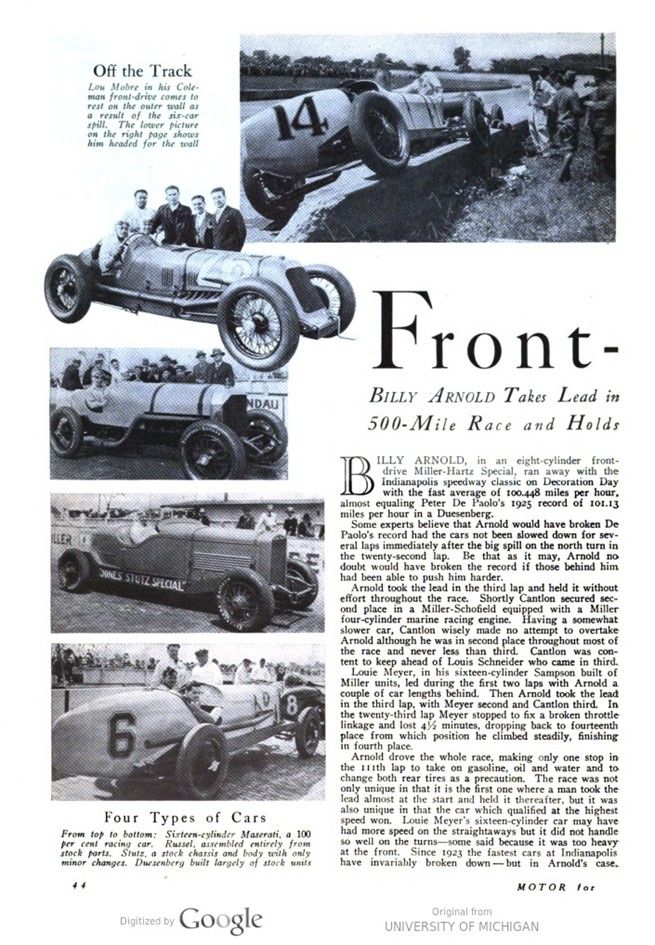
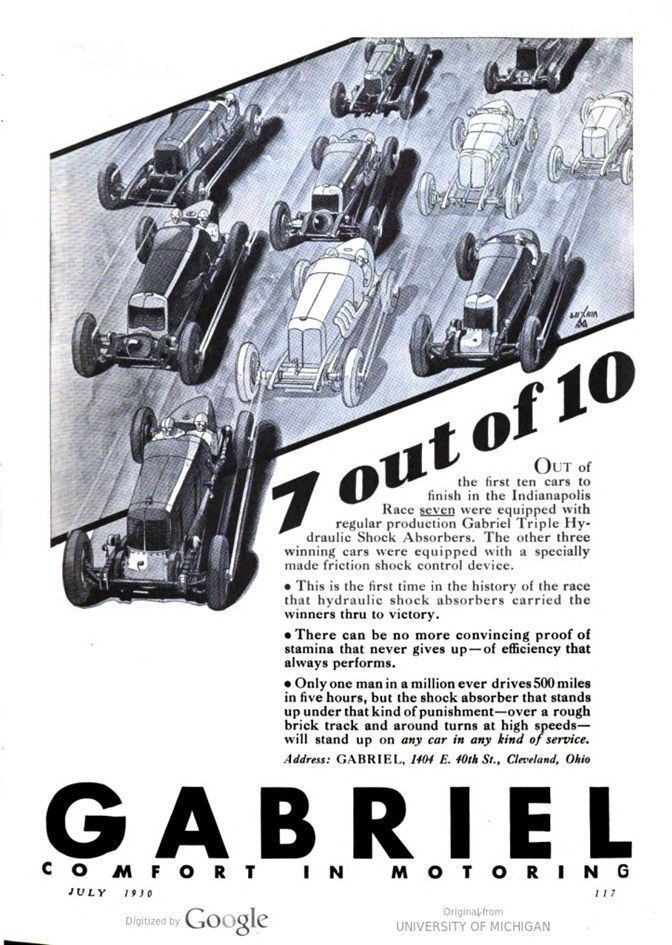
The Stutz, which finished 10th was a stock car except for necessary minor changes including removal of fenders, running boards, windshield, and spare tires. A larger gasoline tank was fitted, springs were stiffened and two Gabriel shock absorbers were attached to each axle end whereas one is standard. Even the fan belt, although unnecessary, was left in place. In other respects it was fully equipped even to a cigar lighter. With Corum driving throughout the race, the car averaged better than 85 miles per hour, making only one stop in its hundredth lap for gasoline and water. No tire trouble was experienced. Little oil was used and the engine idled perfectly afterwards. It was a very fine performance and the Stutz deserves great credit.
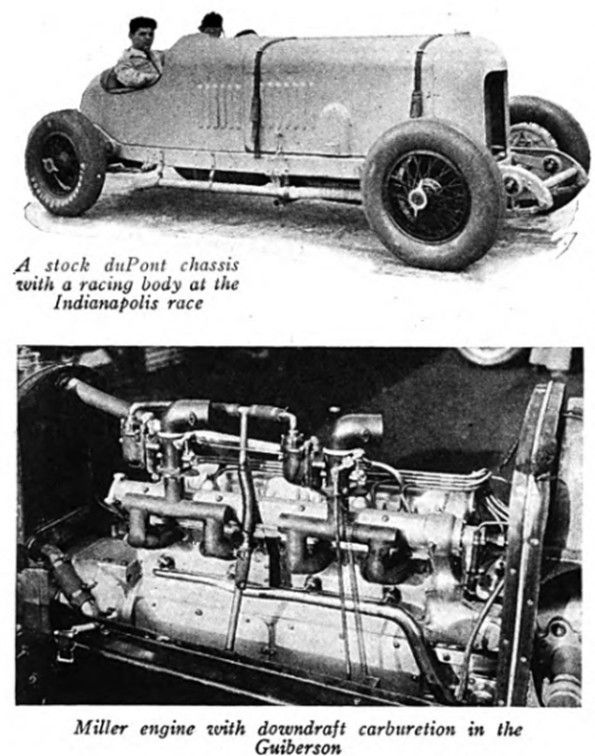
The Oakland Vee eight, entered by Ira Vail and driven by Claude Burton made a very impressive record. It was fitted with a racing body, the wheelbase was shortened, Ray Day pistons and Perfect Circle rings were installed, and two down-draft manifolds with Winfield carburetors were adopted. Otherwise it is understood it was a stock Oakland. It finished eleventh, being flagged at the 196th lap, its average speed being 82.924 miles per hour. Only one stop was made, in the 108th lap, for oil and gas. Charles Moran’s duPont was a stock car except for minor changes but it was wrecked.
The Stutz qualified at a speed of 94.130 miles per hour; the qualifying speed of Burton’s Oakland was 95.087 while the du Pont qualified at 89.733 miles per hour. Other contenders which might be described as stock failed to make a showing due principally to minor difficulties which a little more time in preparation might have eradicated.
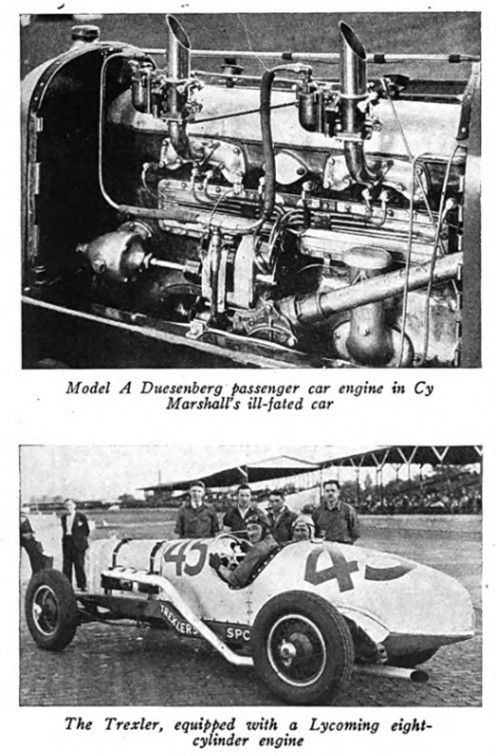
Several cars, although not production chassis, were built according to the spirit of the new rules, that is, they were relatively low cost jobs, more or less assembled from stock units. These included Fred Duesenberg’s two cars, driven by Peter De Paolo and Bill Cummings, the latter finishing fifth. These cars were assembled from stock units built for the Model A Duesenberg passenger car manufactured some years ago. All major parts were stock except for cylinder head and valve action, racing rear axle, frame, body. Two other cars, Cy Marshall’s Duesenberg and the Nardi, were constructed largely of Model A Duesenberg units.
Russel Snowberger’s Russel-eight which finished eighth was a typical example of what the new rules intended a car to be. It was built entirely of stock units, somewhat modified, and not counting labor, cost less than $2,000. Yet it qualified at a speed of 104.557 miles per hour, and after that considerable speed was added to it. It is probable that it would have finished considerably further up if it had not ridden rough due to shock absorber trouble. Its average was 89.166 miles per hour, and deducting time spent in fixing a home-made shock absorber bracket, which took 17½ minutes, its average would have been nearly 95 miles per hour, which is quite remarkable considering that it was equipped with a Studebaker President 8 engine, altered only in minor details.
A racing car which can be bought retail for $2,500 was the Fronty-Ford consisting of Ford model T parts except for Fronty cylinder head, pistons, rods, crankshaft and rear axle shafts. Chet Miller set out to average 100 miles per hour and but for minor mechanical troubles might have attained this goal. As it was, if a 41-minute stop to replace a broken front spring is deducted, his average becomes 96 miles per hour.
The replacement of this spring is one of the funniest happenings heard at a race in many years. Chet Miller swears it is true. When he stopped on the 92nd lap to adjust the carburetor, the technical committee discovered the front spring broken close to the spring eye, and refused to let him proceed until it was replaced. Lacking a spare spring, Miller and his mechanics, ran back into the infield, found a model T Ford with no owner nearby, removed the spring, put it in the race car and continued the race until flagged. Then the spring was removed, and returned to the Ford before the owner discovered what had happened.
Another comparatively low-cost car which was a promising contender until it broke a piston, in its 125th lap, was Ernie Triplett’s Guiberson, equipped with a Miller four-cylinder marine racing engine, but otherwise built of Ford model A units. It lists at $3,500. For the first 20 laps Triplett averaged better than 100 miles per hour, but three pit stops cut his average to 94.213 miles per hour.
If some of these low-cost, semi-stock jobs had had just a little more development work put on them, or rather, if the work had been started a little earlier, it is probable that they would have made a very promising showing, although it is doubtful if one of them would have won, considering the extraordinary performance of Arnold’s Miller-Hartz.
In the interest of lower racing car cost which means more profit to the driver, it is to be hoped that further work will be done on machines of this type this year in order to make them more serious contenders for next year’s race.
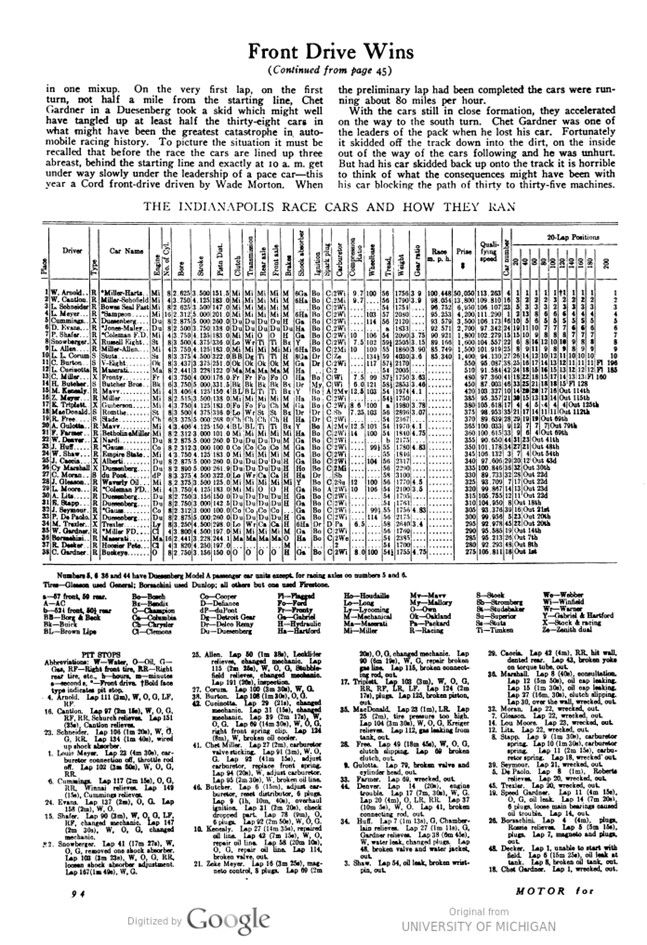
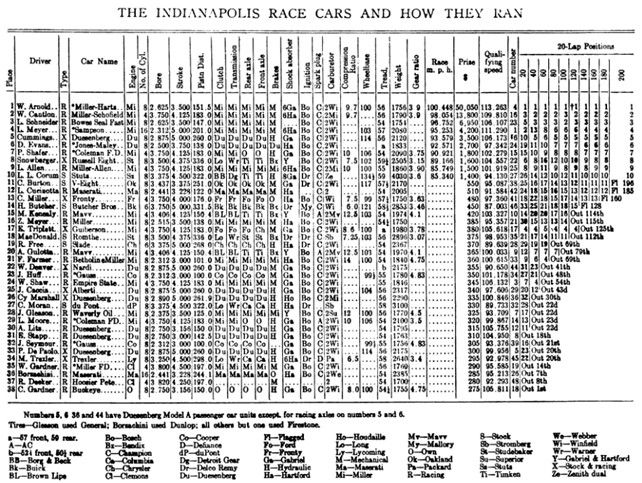
The winning car, which ran with the precision of a watch and took the turns beautifully, was a new machine built especially for Harry Hartz in Harry Miller’s shop in Los Angeles. It is a straight eight with bore and stroke of 2.625 by 3.5 and piston displacement of 151.5 cubic inches. It is equipped with two Winfield downdraft carburetors, Robert Bosch magneto, Champion spark plugs, six Gabriel shock absorbers, two at front and four at rear, Firestone tires, Rudge wheels. The wheelbase is 100 inches, tread is 56 inches, the compression ratio is 9.7, the gear ratio 3.9, the tire size is 32 by 6, and the weight is 1756 pounds dry. Specifications of all the cars will be found in the table on page 94. Harry Hartz had intended to drive this car but found that Billy Arnold could take it around faster and therefore engaged him.
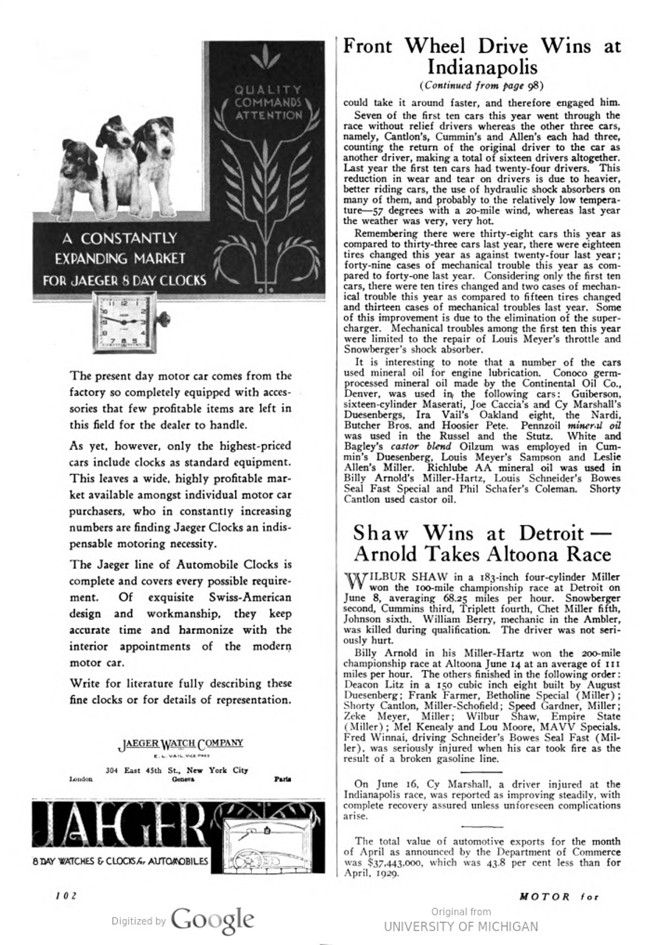
Seven of the first ten cars this year went through the race without relief drivers whereas the other three cars, namely, Cantlon’s, Cummin’s and Allen’s each had three, counting the return of the original driver to the car as another driver, making a total of sixteen drivers altogether. Last year the first ten cars had twenty-four drivers. This reduction in wear and tear on drivers is due to heavier, better riding cars, the use of hydraulic shock absorbers on many of them, and probably to the relatively low temperature 57 degrees with a 20-mile wind, whereas last year the weather was very, very hot.
Remembering there were thirty-eight cars this year as compared to thirty-three cars last year, there were eighteen tires changed this year as against twenty-four last year: forty-nine cases of mechanical trouble this year as com- pared to forty-one last year. Considering only the first ten cars, there were ten tires changed and two cases of mechanical trouble this year as compared to fifteen tires changed and thirteen cases of mechanical troubles last year. Some of this improvement is due to the elimination of the supercharger. Mechanical troubles among the first ten this year were limited to the repair of Louis Meyer’s throttle and Snowberger’s shock absorber.
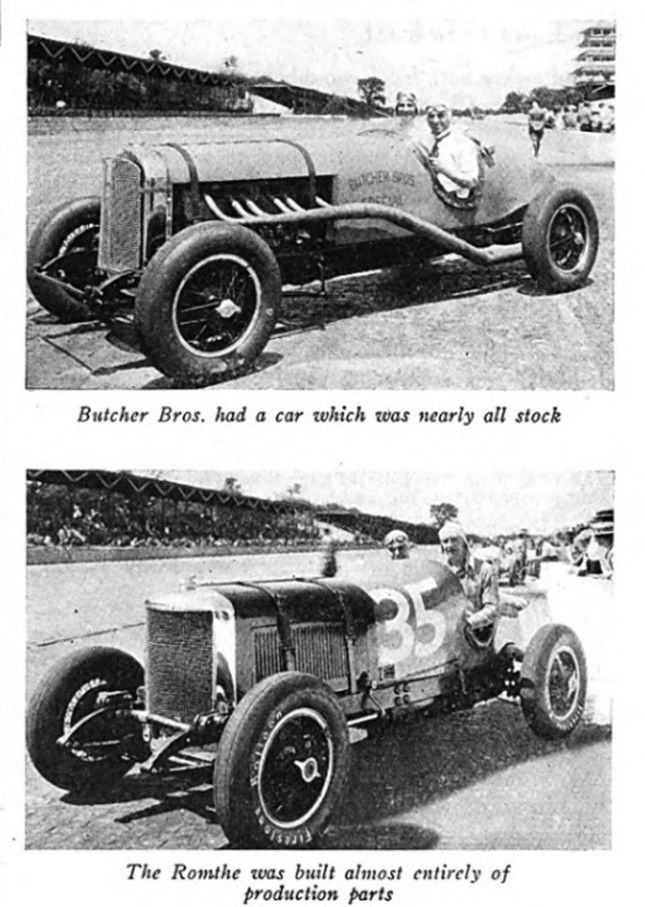
It is interesting to note that a number of the cars used mineral oil for engine lubrication. Conoco germ-processed mineral oil made by the Continental Oil Co., Denver, was used in the following cars: Guiberson, sixteen-cylinder Maserati, Joe Caccia’s and Cy Marshall’s Duesenbergs, Ira Vail’s Oakland eight, the Nardi, Butcher Bros. and Hoosier Pete. Pennzoil mineral oil was used in the Russel and the Stutz. White and Bagley’s castor blend Oilzum was employed in Cummin’s Duesenberg, Louis Meyer’s Sampson and Leslie Allen’s Miller. Richlube AA mineral oil was used in Billy Arnold’s Miller-Hartz, Louis Schneider’s Bowes Seal Fast Special and Phil Schafer’s Coleman. Shorty Cantlon used castor oil.
Photos.
Page 44.
Off the Track – Lou Mobre in his Coleman front-drive comes to rest on the outer wall as a result of the six-car spill. The lower picture on the right page shows him headed for the wall
Four Types of Cars – From top to bottom: Sixteen-cylinder Maserati, a 100 per cent racing car. – Russel, assembled entirely from stock parts. – Stutz, a stock chassis and body with only minor changes. – Duesenberg built largely of stock units
Page 45.
Winner… Billy Arnold in Miller-Harts front-drive equipped with eight-cylinder 151.5 cubic inch engine (Firestone Balloon) (Photographs by KIRKPATRICK Indianapolis)
The Big Spill – RED ROBERTS – TREXLER – STAPP – LITZ – MOORE. First three views in same spot; bottom picture further up track. Red Roberts skids and is hit by Stapp. Trexler collides with Litz. Moore skids and climbs outer wall. Seymour’s part in the mixup is not shown
Page 94. THE INDIANAPOLIS RACE CARS AND HOW THEY RAN
Page 96.
A stock duPont chassis with a racing body at the Indianapolis race – Miller engine with downdraft carburetion in the Guiberson – Model A Duesenberg passenger car engine in Cy Marshall’s ill-fated car – The Trexler, equipped with a Lycoming eight-cylinder engine TREXLERS SPC
Page 98.
Louis Meyer finished fourth at Indianapolis in his sixteen-cylinder Sampson – A four-cylinder Miller engine of 183 inches displacement was used in the two Coleman front drives – Butcher Bros. had a car which was nearly all stock – The Romthe was built almost entirely of production parts