As of this year, the engine displacement was raised from 91½ to 366 cubic inches, with some restrictions. Not only did this lead to larger cars and engines, but also to more engine types such as, four-, six- eight- and even sixteen cylinder engines. And not only tapical race cars with race engine designs, but also to near-stock cars with rebuilt stock engines.


Text and jpegs by courtesy of hathitrust.org www.hathitrust.org, compiled by motorracinghistory.com
MoToR, Vol. LIII, 53, No. 6, June 1930
Bigger Cars in the 500 MILE Race
By Harold F. Blanchard – Technical Editor of MoToR
BIGGER engines distinguished the cars entered in the 500-mile race which took place at Indianapolis on May 30, the piston displacement limit being 366 cubic inches, four times the previous limit of 91½ cubic inches. Thanks to the change in rules, there never has been such an interesting array of entries. Whereas during the past 4 years practically all race cars have had highly-developed, super-charged, overhead camshaft 91½ cubic inch eight-cylinder engines of almost identical construction mounted in 100-inch-wheelbase chassis weighing about 1500 pounds, this year there were fours, sixes, eights, and sixteens with piston displacements ranging from 100 to 336 cubic inches, with wheelbases from 100 to 135 inches, and weights of 1750 to more than 4000 pounds. Some of the new engines are strictly racing designs whereas others rebuilt stock car engines, generally are tuned-up or mounted in racing chassis although in a few cases stock cars were entered with but minor changes.
This radical departure in racing car design is due, of course, to the fact that this year the Indianapolis Motor Speedway Association instead of putting a limit of 91½ cubic inches on the piston displacement, raised the limit to 366 cubic inches with the following restrictions: super-chargers on four-cycle engines; not more than two poppet valves per cylinder; not more than two single carburetors or one dual ; a minimum weight of 1750 pounds, nor less than 7½ pounds per inch per cubic inch of piston displacement; a tread of 54 to 60 inches whereas most recent cars have been 52; a body width of 31 inches with provision for a mechanic as well as a driver; two independently operated sets of brakes including one set acting on all four wheels; a qualifying speed of 85 miles per hour. Under these rules a stock car is eligible although it could not be called a stock car because no provision was made for establishing its stock car status.
The aim of these new regulations was: 1 – to cut the cost of buying and maintaining a racing car; 2 – To revive the interest of automobile manufacturers in racing. Years ago, motor car producers were strong supporters racing and the lessons they learned aided them in the rapid development of the automobile but late years they have shown little enthusiasm because, it was argued, the little 12-inch cars were too specialized to be of practical value, that the experience gained in building and operating cars with engines running 6000 to 8000 revolutions per minute most recent cars have been 52; a body width of 31 inches could not be applied to passenger car practice.
It was believed that with a piston displacement of 366 cubic inches, motor car makers would produce race jobs which contained their production units, modified for maximum speed, and it was expected that the racing fraternity would follow a similar course with the result that the cost of buying and maintaining a racing car would be greatly reduced, for obviously it is cheaper to revise a stock car engine with a maximum speed of 3000 or 4000 revolutions per minute than to buy or build a racing engine running double this speed, and repairs to the former would cost less.
The limitation of two carburetors was imposed in order to keep down the expense as otherwise race car builders would be tempted to apply a carburetor to each cylinder to secure the last ounce of power. Poppet valves were limited to two per cylinder to discourage the building of special race engines instead of using modified stock car engines. Four valves per cylinder would give more power but there is only one recent American passenger car engine, the Duesenberg, with four valves and it is ineligible because its piston displacement is 420 cubic inches.
THE question of how many valves per cylinder was debated at considerable length a year ago last fall by the Technical Committee of the A. A. A. which acted in an advisory capacity to the Indianapolis Motor Speedway Association in formulating the new regulations. There was much to be said in favor of four valves but finally the two-valve limitation was recommended. Four valves would have permitted some of the fast semi-stock European cars to enter such as the Bentley and the Bugatti. It recognized that the two-valve limitation would give a sixteen-cylinder engine a marked power advantage over an eight because power, among other things, depends on the area of valve opening per cubic inch of piston dis- placement. To quote a rough but simple example, a six- teen cylinder engine with a 3-inch bore and a 2½ -inch stroke has double the valve opening area per cubic inch of piston displacement of an eight-cylinder engine with 3- inch bore and 5-inch stroke. In spite of these arguments in favor of allowing four valves per cylinder the committee was felt that a two-valve rule was desirable to encourage to the fullest degree the use of modified stock car engines.
The entry list reveals in a preliminary way to what extent these aims have been realized. There are several cars which may be roughly described as stock except for minor alterations and the fitting of racing bodies. On the other hand there are a few cars specially built almost from the ground up – an expensive proceeding which few could afford. For reasons of economy the majority of the cars have been constructed with a minimum use of specially built parts, most of the units being adapted from stock cars or previous race cars.
More than half the cars are revised 91’s or 122’s. Cars of 122 cubic inch displacement, it will be remembered, were used during the years 1923 to 1925 inclusive, while the 91’s have been employed from 1926 to 1929 inclusive. Both types are one-man super-charged eights. Minimum changes to comply with the new rules require the removal of the supercharger and the fitting of new carburetors and manifolding; construction of a (wider) two-man body together with a wider frame since the men must sit down between the frame side members to keep the body low for minimum wind resistance; lengthening of the axles to give a minimum tread of 54 inches.
Since a 91½-inch engine without supercharger and with a wider body probably would not be fast enough, the three entrants using this type enlarged the blocks slightly to give a piston dis- placement of 100 cubic inches.
To many, the older 122’s proved more attractive. A number of these cars were in good condition and in fact several of them were converted to 91’s in 1926 and raced ever since by fitting new crankshafts with shorter throws but retaining the same cylinder blocks. To change them back to 122’s it was simply necessary to reinstall the original equipment.
The seven 122’s entered have been fitted with new cylinder blocks, new crankshafts with greater throws or both, thus giving them piston displacements ranging from 138 to 151.5 inches.
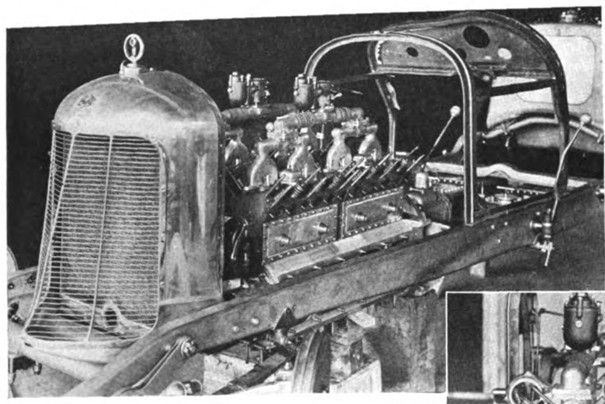
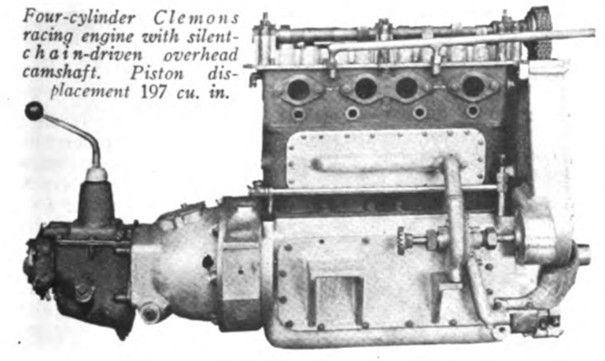
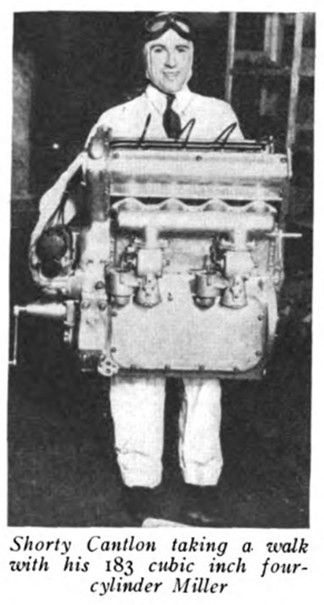
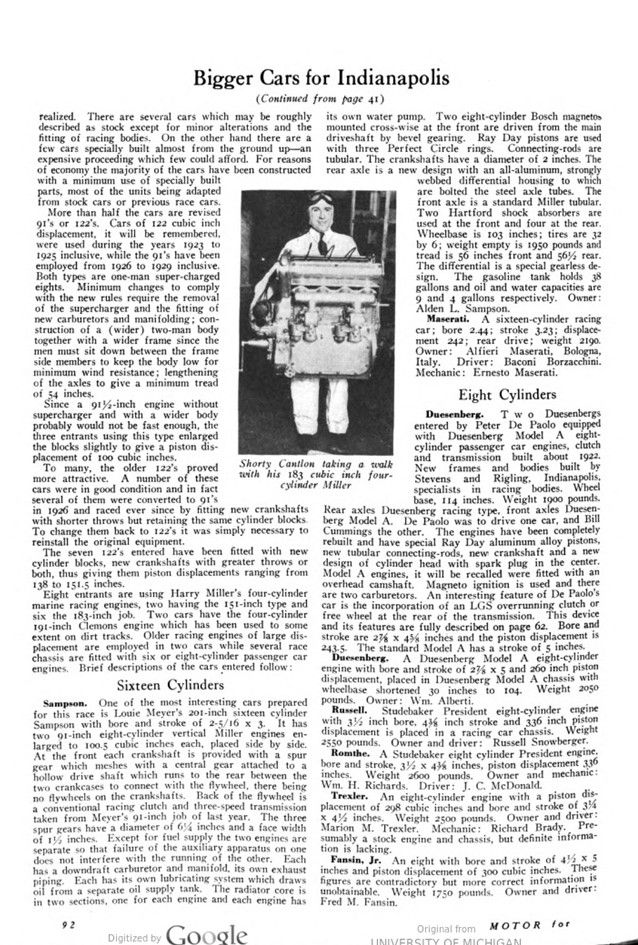
Eight entrants are using Harry Miller’s four-cylinder marine racing engines, two having the 151-inch type and six the 183-inch job. Two cars have the four-cylinder 191-inch Clemons engine which has been used to some extent on dirt tracks. Older racing engines of large displacement are employed in two cars while several race chassis are fitted with six or eight-cylinder passenger car engines. Brief descriptions of the cars entered follow:
Sixteen Cylinders
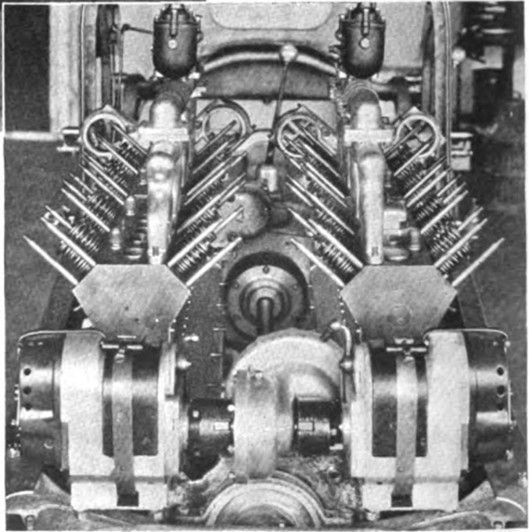
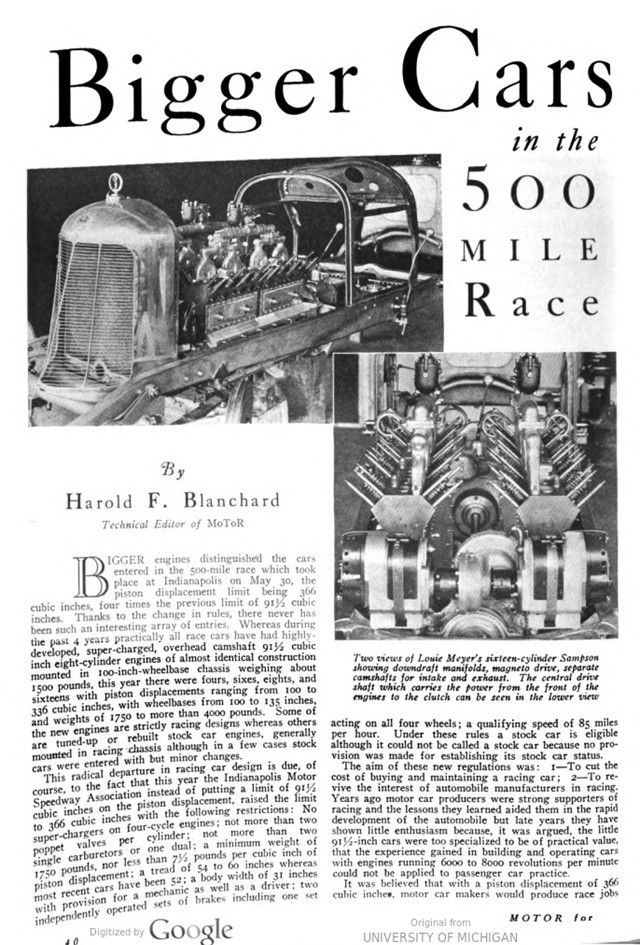
Sampson. One of the most interesting cars prepared for this race is Louie Meyer’s 201-inch sixteen-cylinder Sampson with bore and stroke of 2-5/16 x 3. It has two 91-inch eight-cylinder vertical Miller engines enlarged to 100.5 cubic inches each, placed side by side. At the front each crankshaft is provided with a spur gear which meshes with a central gear attached to a hollow drive shaft which runs to the rear between the two crankcases to connect with the flywheel, there being no flywheels on the crankshafts. Back of the flywheel is a conventional racing clutch and three-speed transmission taken from Meyer’s 91-inch job of last year. The three spur gears have a diameter of 6¼ inches and a face width of 1½ inches. Except for fuel supply, the two engines are separate so that failure of the auxiliary apparatus on one does not interfere with the running of the other. Each has a downdraft carburetor and manifold, its own exhaust piping. Each has its own lubricating system which draws oil from a separate oil supply tank. The radiator core is in two sections, one for each engine and each engine has its own water pump. Two eight-cylinder Bosch magnetos mounted cross-wise at the front are driven from the main driveshaft by bevel gearing. Ray Day pistons are used with three Perfect Circle rings. Connecting rods are tubular. The crankshafts have a diameter of 2 inches. The rear axle is a new design with an all-aluminum, strongly webbed differential housing to which are bolted the steel axle tubes. The front axle is a standard Miller tubular. Two Hartford shock absorbers are used at the front and four at the rear. Wheelbase is 103 inches; tires are 32 by 6; weight empty is 1950 pounds and tread is 56 inches front and 56½ rear. The differential is a special gearless design. The gasoline tank holds 38 gallons and oil and water capacities are 9 and 4 gallons respectively. Owner: Alden L. Sampson.
Maserati. A sixteen-cylinder racing car; bore 2.44; stroke 3.23; displace- ment 242; rear drive; weight 2190. Owner: Alfieri Maserati, Bologna, Italy. Driver: Baconi Borzacchini. Mechanic: Ernesto Maserati.
Eight Cylinders
Duesenberg. Two Duesenbergs entered by Peter De Paolo equipped with Duesenberg Model A eight-cylinder passenger car engines, clutch and transmission built about 1922. New frames and bodies built by Stevens and Rigling, Indianapolis, specialists in racing bodies. Wheelbase, 114 inches. Weight 1900 pounds. Rear axles Duesenberg racing type, front axles Duesenberg Model A. De Paolo was to drive one car, and Bill Cummings the other. The engines have been completely rebuilt and have special Ray Day aluminum alloy pistons, new tubular connecting-rods, new crankshaft and a new design of cylinder head with spark plug in the center. Model A engines, it will be recalled were fitted with an overhead camshaft. Magneto ignition is used and there are two carburetors. An interesting feature of De Paolo’s car is the incorporation of an LGS overrunning clutch or free wheel at the rear of the transmission. This device and its features are fully described on page 62. Bore and stroke are 278 x 45/8 inches and the piston displacement is 243.5. The standard Model A has a stroke of 5 inches.
Duesenberg. A Duesenberg Model A eight-cylinder engine with bore and stroke of 27% x 5 and 260 inch piston displacement, placed in Duesenberg Model A chassis with wheelbase shortened 30 inches to 104. Weight 2050 pounds. Owner: Wm. Alberti.
Russell. Studebaker President eight-cylinder engine with 32 inch bore, 438 inch stroke and 336 inch piston displacement is placed in a racing car chassis. Weight 2550 pounds. Owner and driver: Russell Snowberger.
Romthe. A Studebaker eight-cylinder President engine, bore and stroke, 3½ x 438 inches, piston displacement 336 inches. Weight 2600 pounds. Owner and mechanic: Wm. H. Richards. Driver: J. C. McDonald.
Trexler. An eight-cylinder engine with a piston displacement of 298 cubic inches and bore and stroke of 34 x 4½ inches. Weight 2500 pounds. Owner and driver: Marion M. Trexler. Mechanic: Richard Brady. Presumably a stock engine and chassis, but definite information is lacking.
Fansin, Jr. An eight with bore and stroke of 42 x 5 inches and piston displacement of 300 cubic inches. These figures are contradictory but more correct information is unobtainable. Weight 1750 pounds. Owner and driver: Fred M. Fansin.
Photos.
Page 40. – Two views of Louie Meyer’s sixteen-cylinder Sampson showing downdraft manifolds, magneto drive, separate camshafts for intake and exhaust. The central drive shaft which carries the power from the front of the engines to the clutch can be seen in the lower view
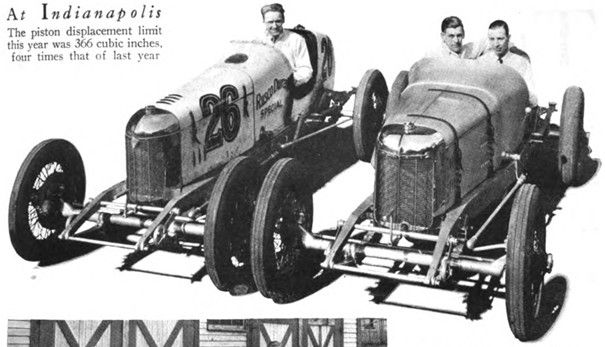
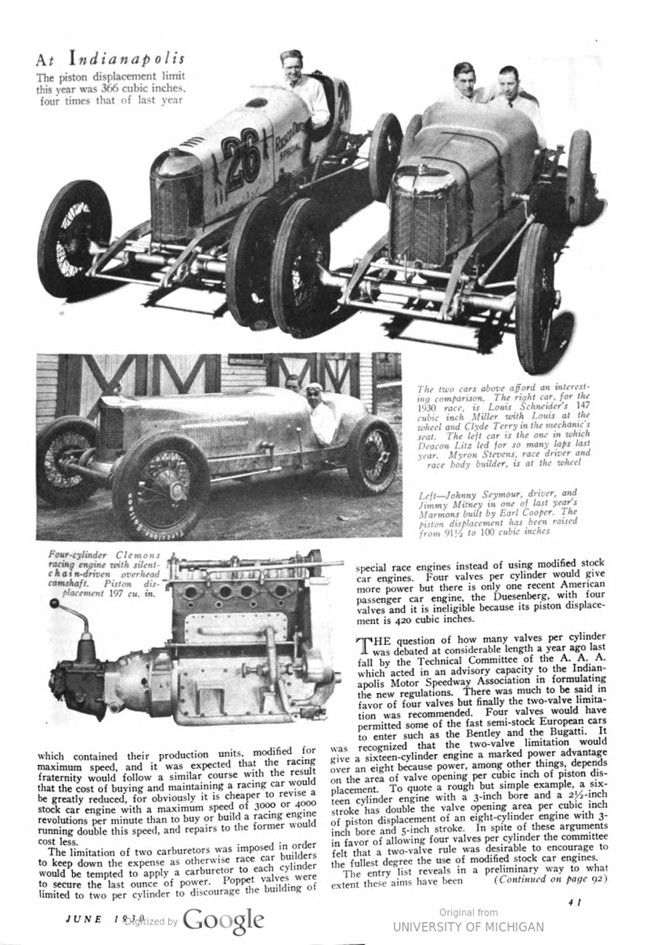
Page 41. – At Indianapolis. The piston displacement limit this year was 366 cubic inches, four times that of last year
The two cars above afford an interesting comparison. The right car, for the 1930 race, is Louis Schneider’s 147 cubic inch Miller with Louis at the wheel and Clyde Terry in the mechanic’s seat. The left car is the one in which Deacon Litz led for so many laps last year. Myron Stevens, race driver and race body builder, is at the wheel
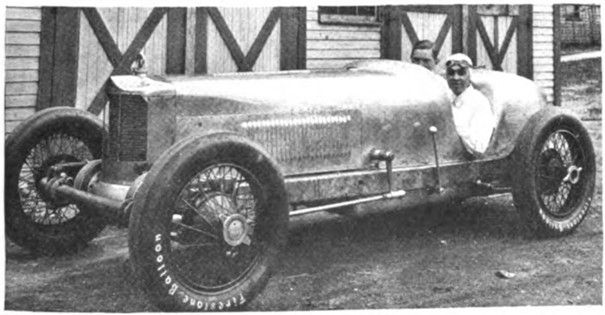
Left – Johnny Seymour, driver, and Jimmy Mitney in one of last year’s Marmons built by Earl Cooper. The piston displacement has been raised from 912 to 100 cubic inches
Four-cylinder Clemons racing engine with silent- chain-driven overhead camshaft. Piston displacement 197 cu. in.
Page 92. – Shorty Cantlon taking a walk with his 183 cubic inch four-cylinder Miller