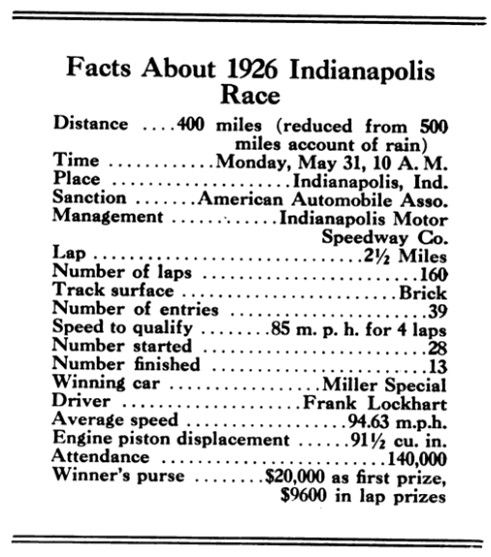
The 1926 edition of the Indianapolis 500 was run with a max 91½ cubic inch displacement; quite smaller than last year’s 122. But still, race speed was only moderatley lower. Due to two rainfalls during the race, it was called at 160 laps, coinciding with 400 miles . Winner was the rookie Frank Lockhart in a Miller, who started from 21st position. This year, it was complete Miller supremacy as 12 of the thirteen first final positions were occupied by Miller Specials. This race article of Automotive Industries mostly consists of technical descriptions of the cars, highlighting the Millers, the Duesenbergs, the superchargers as well as the Hamlin Front-wheel drive.
Text and jpegs by courtesy of hathitrust.org www.hathitrust.org, compiled by motorracinghistory.com
Automotive Industries, Vol. 54, No. 22, June 3, 1926
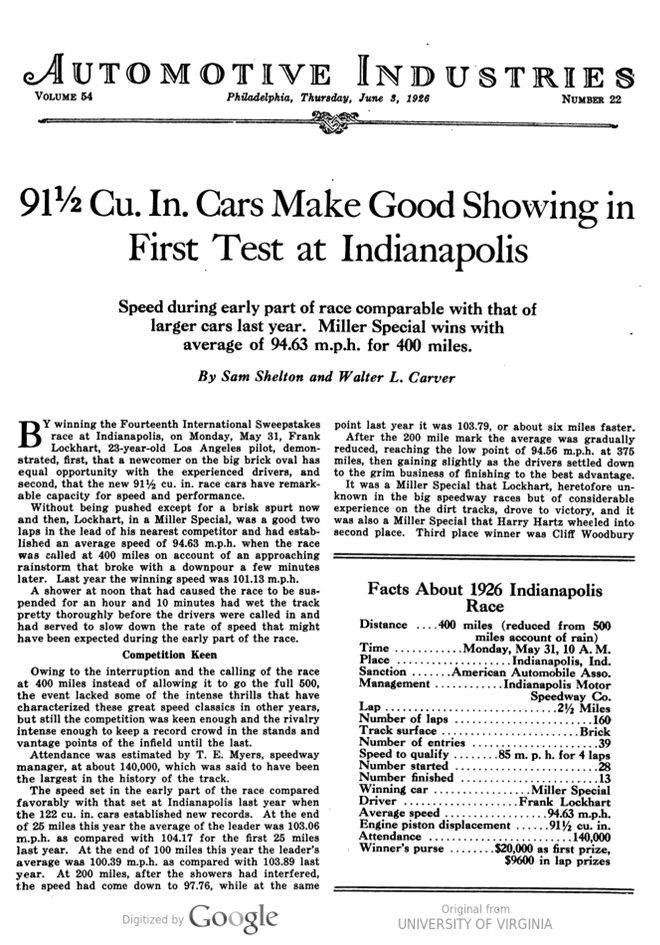
91½ Cu. In. Cars Make Good Showing in First Test at Indianapolis
Speed during early part of race comparable with that of larger cars last year.
Miller Special wins with average of 94.63 m.p.h. for 400 miles.
By Sam Shelton and Walter L. Carver
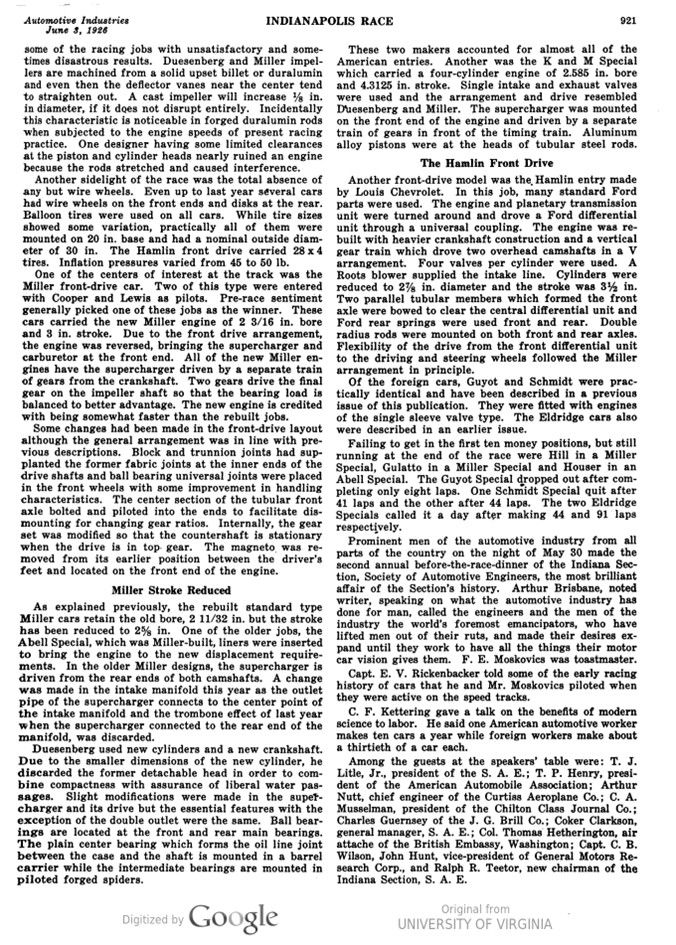
BY winning the Fourteenth International Sweepstakes race at Indianapolis, on Monday, May 31, Frank Lockhart, 23-year-old Los Angeles pilot, demonstrated, first, that a newcomer on the big brick oval has equal opportunity with the experienced drivers, and second, that the new 91 % cu. in. race cars have remarkable capacity for speed and performance.
Without being pushed except for a brisk spurt now and then, Lockhart, in a Miller Special, was a good two laps in the lead of his nearest competitor and had established an average speed of 94.63 m.p.h. when the race was called at 400 miles on account of an approaching rainstorm that broke with a downpour a few minutes later. Last year the winning speed was 101.13 m.p.h.
A shower at noon that had caused the race to be suspended for an hour and 10 minutes had wet the track pretty thoroughly before the drivers were called in and had served to slow down the rate of speed that might have been expected during the early part of the race.
Competition Keen
Owing to the interruption and the calling of the race at 400 miles instead of allowing it to go the full 500, the event lacked some of the intense thrills that have characterized these great speed classics in other years, but still the competition was keen enough and the rivalry intense enough to keep a record crowd in the stands and vantage points of the infield until the last.
Attendance was estimated by T. E. Myers, speedway manager, at about 140,000, which was said to have been the largest in the history of the track.
The speed set in the early part of the race compared favorably with that set at Indianapolis last year when the 122 cu. in. cars established new records. At the end of 25 miles this year the average of the leader was 103.06 m.p.h. as compared with 104.17 for the first 25 miles last year. At the end of 100 miles this year the leader’s average was 100.39 m.p.h. as compared with 103.89 last year. At 200 miles, after the showers had interfered, the speed had come down to 97.76, while at the same point last year it was 103.79, or about six miles faster.
After the 200 mile mark the average was gradually reduced, reaching the low point of 94.56 m.p.h. at 375 miles, then gaining slightly as the drivers settled down to the grim business of finishing to the best advantage.
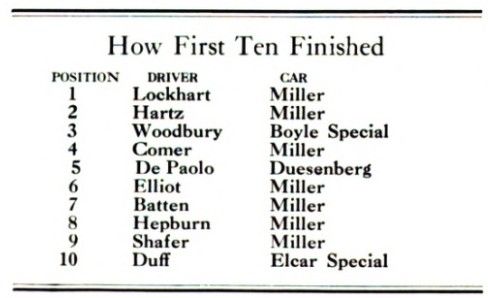
It was a Miller Special that Lockhart, heretofore unknown in the big speedway races but of considerable experience on the dirt tracks, drove to victory, and it was also a Miller Special that Harry Hartz wheeled into second place. Third place winner was Cliff Woodbury of Chicago, also a dirt track driver, whose mount, a Boyle Special, was of Miller construction but with engine equipped with Boyle valves.
Fourth place also went to a Miller Special, driven by Fred Comer.
The Duesenberg name, distinguished for successive and spectacular victories in 1924 and 1925, was kept in the front rank by Pete DePaolo, who finished fifth in a Duesenberg Special.
Only two Duesenbergs started, that driven by DePaolo and a two-cycle job driven by Ben Jones which went out of the race in its 53rd lap when it developed axle trouble and skidded into the wall. Three other Duesenbergs that had been entered were not ready to qualify.
Although the race was rather sketchy, due to the interference of rain, several pertinent facts from the engineering angle were demonstrated. Because of the wet condition of the track the average speed fell below last year’s record.
Early in the race the majority of stops at the pits was chargeable to fouled spark plugs. Apparently, this difficulty arose from the idling period at the line prior to the paced lap. Practically all engines are fitted with aluminum alloy pistons of the full skirt type and the clearance between these and the cylinder walls averages around .006 to .007 in. It may be deducted that this very liberal clearance permits an undue collection of oil above the pistons before they reach working temperatures and dimensions.
In the latter portion of the race the predictions of several engineers concerning valve trouble were verified. Of the twenty-eight qualifying entrants, only thirteen were running when flagged in. Many of those who fell by the wayside after the first 150 miles recited the same complaint, valve trouble. Some trouble at camshaft bearings was shown.
Of the two-cycle jobs, but one Duesenberg appeared and showed an average speed of about 92 to 94 miles per hour until the first storm. Just as Seth Klein, the starter, flagged the cars from the track, the driver, Ben Jones, hit one of the north walls and wrecked his car, fortunately with no injury to himself. However, much remains to be done to improve the starting characteristics of this engine as the supercharger does not develop enough pressure at cranking speeds to provide a sufficient intake charge after the exhaust valve ports are closed.
Fred Duesenberg’s suggestion of an electrically driven supercharger made at the January meeting of the Society of Automotive Engineers may be apropos of possible future developments. DePaolo’s four-cycle job, the only other Duesenberg car in the race, performed very creditably after some minor adjustments in the early laps. This car qualified early Sunday morning and arrived at the track only a few minutes before the start and finished fifth.
Miller front-drive jobs failed to live up to advance expectations, although Lewis won forty-three laps before a valve pulled down. As these cars were capable of higher average speeds, engine speeds were increased accordingly and the valve trouble confirmed some advance skepticism. Cooper’s front-wheel drive job passed out after 70 laps when he was in fourth position, due to transmission trouble. Connecting rod trouble finished the Hamlin rebuilt Ford front-drive car early in the race.
The foreign cars, Guyot and Schmidt Specials from France and the Eldridge Specials from England, were distinct disappointments, although lack of experience with present-day speed on this track seems to have been the chief trouble. With the Guyot and Schmidt cars, clutches and steering gears were the determining factor, although one final pit report showed engine trouble as the reason for quitting. One Eldridge went out due to a broken steering knuckle and the other developed a frozen camshaft. None of these cars compared with the Duesenberg and Millers for speed.
Lockhart and Hartz had Miller engines of the new type with bore of 2 3/16 in. and 3 in. stroke, as also did Comers, who finished fourth. Woodbury, who finished third in the Boyle Special, had a rebuilt Miller of last year’s series having a bore of 2.344 in. and a stroke of 2 5/8 in.
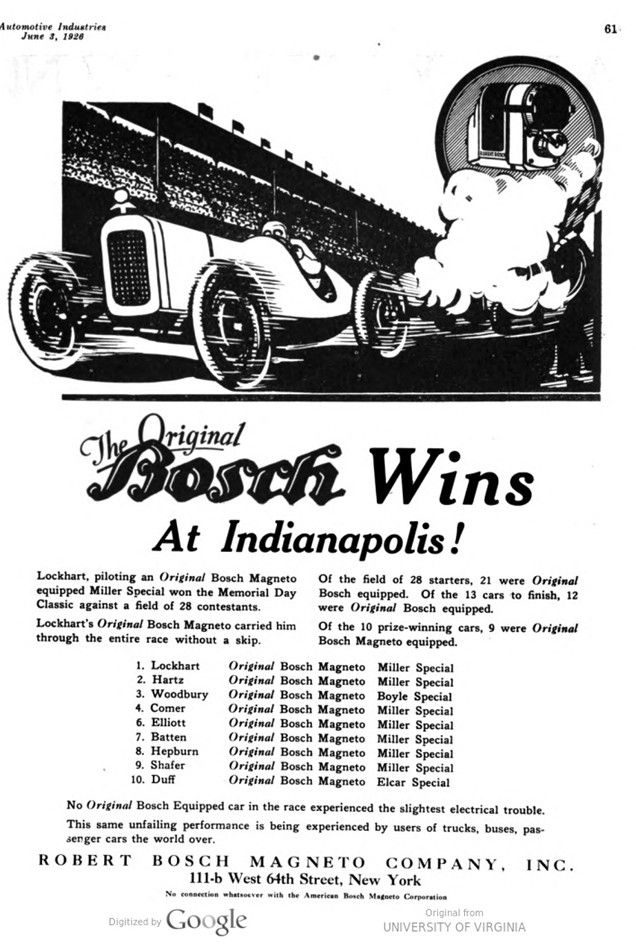
All cars in the race carried Hartford shock absorbers all around and all had wire wheels. Firestone tires were used on all American cars but the Hamlin, while the European entries had Dunlops. New Departure bearings were used generally in American cars. Bosch magnetos were used on 21 of the cars which started and 12 of those which finished were so equipped. American engines carried Winfield carburetors, and European, the Cozette. Champion spark plugs were used in most cases.
From the viewpoint of a railbird, the outstanding innovation from the engineering angle was the two-cycle eight-in-line Duesenberg engine used in the car which was wrecked when it skidded into a wall of the track.
The reason for the return of the two-cycle engine is obvious. Engines are a fourth smaller than those of the past three years and the reduction of 30.5 cu. in. has been made chiefly at the expense of the stroke, and rotating speeds are increased accordingly. Practically every job on the track was capable of at least 6000 r.p.m. at the engine. The necessity of higher rotating speeds combined with the hazard at the valve gear is directing thought toward alternative designs.
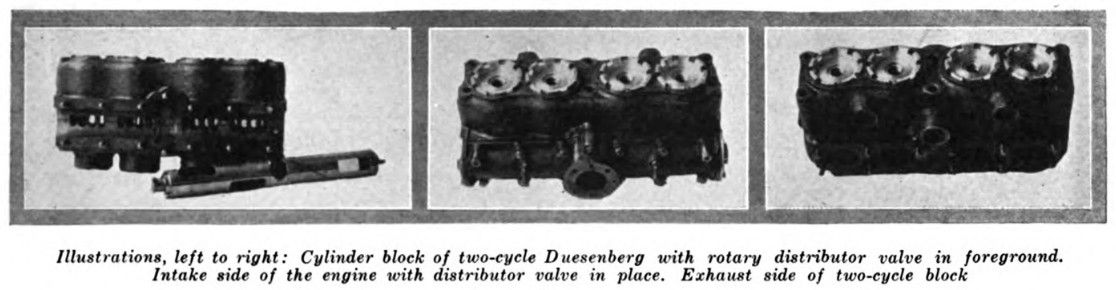
Superchargers are the rule and their use makes the utilization of two-cycle operation possible. Also, this combination, particularly as worked out in the Duesenberg design, has the earmarks of feasible application to passenger car use. Slotted ports, which are characteristic of two-cycle design, are located at opposite sides of the cylinders. The exhaust port at the right side is placed just above the lower limit of piston head travel while the intake port on the left side is somewhat higher. Pistons are equipped with the usual deflector rib on top of the head.
This location of the valve ports is made possible by a rotary distributor valve which is in line with the intake ports at the left side of the cylinder block. As two blocks of four are used, two hardened steel distributor cylinders are joined by a splined coupling at the middle of the engine and are driven from a gear in the spur timing train at the front. Each of these rotary distributor valves is drilled out to form the gas passage to each of four intake ports. Midway of the distributor valve’s length, three large cross holes are drilled to communicate with an enlarged annular chamber which in turn connects with one outlet from the supercharger. Although this unit is placed alongside the cylinders as in previous Duesenberg designs, the single outlet from the centrifugal blower and branch manifold have been supplanted by two supercharger outlets, each of which supplies four cylinders. This arrangement is common to both two and four-cylce Duesenberg engines.
Although the descending piston uncovers the intake ports before the exhaust is opened, longitudinal slots in the distributor valve are timed so that the cylinder is exhausted well before the supercharged intake stream enters. Some scavenging action occurs before the ascending piston covers the exhaust port. While the compression ratio in the new four-cycle engines is 5 to 1, that of the two-cycle engine is 5½ to 1. As the crankshaft is of 2-4-2 arrangement, which eliminates unbalanced couples, two cylinders fire simultaneously as follows: 1 and 8, 4 and 5, 2 and 7, 3 and 6. Using the center main bearing as the axis, symmetrical cylinders fire simultaneously. It is thought that this action may have some influence in the direction of reducing crankshaft whip. Both types of engine have the same bore and stroke, 2.286 in. and 2.75 in. respectively.
Another unusual feature in the Duesenberg two-cycle engines is the spark plug mounting. A hole of approximately 1 in. diameter is tapped in the center of the plain cylinder head. Into this is screwed a conical shaped aluminum shell which also is flanged to close a larger opening in the water jacket. This aluminum shell is tapped for the spark plug concentrically with the threaded portion which screws into the cylinder head. With this arrangement, it was anticipated that spark plug trouble due to excess heating would be eliminated, as the thin aluminum shell of high conductivity and relatively large area would transfer the heat at its lower end to the cooling water.
From the angles of engineering and design, the chassis of 1926 offered nothing new. In fact, Miller and Duesenberg cars, which formed the bulk of the field, had the same chassis as last year. Drivers for both lines insisted that well-enough should be let alone. In a general way, the same stipulation applies to engines in the two lines subject to the reduction in displacement. Many of the Miller engines in this year’s race had the same cylinder blocks as last year. The reduction in displacement has been made by a new crankshaft of shorter stroke characteristics. The same connecting rods are used but the pin location in the piston has been changed to maintain the correct compression ratio. Formerly the pin was placed close to the Tings. In the modified engines the pin is located near the bottom of the skirt.
One of the relatively new features of this year’s race was the use of drop center rims on the Eldridge, Guyot and Schmidt cars. All of these were fitted with Rudge wheels carrying Dunlop drop center or well-base rims. Tires were 30 x 4.75 in each case. However, no chances of throwing tires were taken by any of these cars. After the tire containing the tube was hooked over the rim, in the fashion made possible by the drop center construction, a rectangular rubber filler with beveled overlapping ends was worked into the well. This filler has practically the same cross section as the well so that for operating purposes, the tire is carried on what is substantially a flat base rim. At racing speeds, drivers of these cars state that no difference in steering or handling characteristics can be felt. However, some of the drivers were prone to criticize the rim and wheel construction as being too heavy.
Two Types of Superchargers
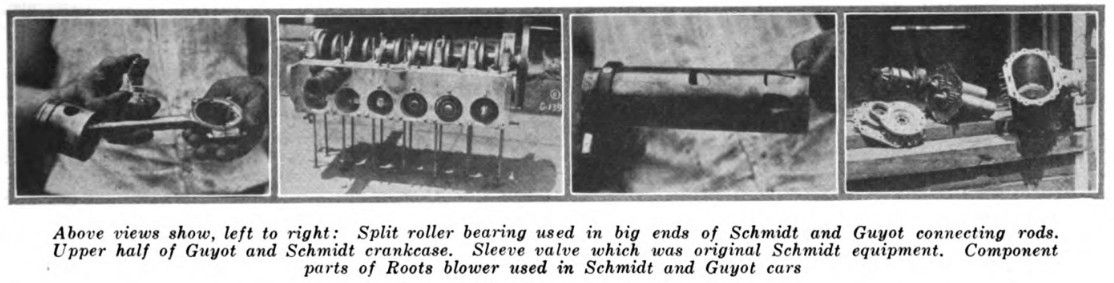
Superchargers offer some interesting sidelights this year. American engines were equipped with centrifugal blowers while every foreign engine carried a Roots blower. Duesenberg and Miller superchargers resembled closely the same units used on last year’s cars and only minor detail changes to increase efficiency were made.
Schmidt and Guyot drove the Roots blower at 1.9 crankshaft speed while Eldridge uses a change gear which drives the blower at crankshaft speed for long races and at 1.3 speed for shorter dashes. In practically every American design involving the centrifugal blower, the impeller is driven at about 5 times crankshaft speed so that 30,000 r.p.m. can be exceeded. In every case the carburetor is located on the intake side of the supercharger and is subject only to atmospheric conditions.
Discussion with American and European desginers develops some ambiguities and uncertainty. The former state that the centrifugal blower is simpler, that it is free from any pulsation and leaves the intake passage open in case of damage to the supercharger drive. Also they are of the opinion that less power is required to drive the centrifgual type. On the other hand, the European designers point to the excessive speed of the centrifugal blower, stating that the inertia forces in such a drive must be dangerous elements and that more power is required than for the Roots type. However, it seems that this question of power requirement is a matter of opinion on both sides. Figures for power requirement at any speed were unavailable from either school. Further, European designers advance the positive blower characteristics of the Roots unit and associate this factor with higher pressures at the supercharger outlet.
Experimenters with the centrifugal blower can learn one valuable lesson from racing practice. That is, never attempt cast impellers. They have been tried around some of the racing jobs with unsatisfactory and sometimes disastrous results. Duesenberg and Miller impellers are machined from a solid upset billet or duralumin and even then the deflector vanes near the center tend to straighten out. A cast impeller will increase 1/8 in. in diameter, if it does not disrupt entirely. Incidentally this characteristic is noticeable in forged duralumin rods when subjected to the engine speeds of present racing practice. One designer having some limited clearances at the piston and cylinder heads nearly ruined an engine because the rods stretched and caused interference.
Another sidelight of the race was the total absence of any but wire wheels. Even up to last year several cars had wire wheels on the front ends and disks at the rear. Balloon tires were used on all cars. While tire sizes showed some variation, practically all of them were mounted on 20 in. base and had a nominal outside diameter of 30 in. The Hamlin front drive carried 28 x 4 tires. Inflation pressures varied from 45 to 50 lb.
One of the centers of interest at the track was the Miller front-drive car. Two of this type were entered with Cooper and Lewis as pilots. Pre-race sentiment generally picked one of these jobs as the winner. These cars carried the new Miller engine of 2 3/16 in. bore and 3 in. stroke. Due to the front drive arrangement, the engine was reversed, bringing the supercharger and carburetor at the front end. All of the new Miller engines have the supercharger driven by a separate train of gears from the crankshaft. Two gears drive the final gear on the impeller shaft so that the bearing load is balanced to better advantage. The new engine is credited with being somewhat faster than the rebuilt jobs.
Some changes had been made in the front-drive layout although the general arrangement was in line with previous descriptions. Block and trunnion joints had supplanted the former fabric joints at the inner ends of the drive shafts and ball bearing universal joints were placed in the front wheels with some improvement in handling characteristics. The center section of the tubular front axle bolted and piloted into the ends to facilitate dismounting for changing gear ratios. Internally, the gear set was modified so that the countershaft is stationary when the drive is in top- gear. The magneto was removed from its earlier position between the driver’s feet and located on the front end of the engine.
Miller Stroke Reduced
As explained previously, the rebuilt standard type Miller cars retain the old bore, 2 11/32 in. but the stroke has been reduced to 2 5/8 in. One of the older jobs, the Abell Special, which was Miller-built, liners were inserted to bring the engine to the new displacement requirements. In the older Miller designs, the supercharger is driven from the rear ends of both camshafts. A change was made in the intake manifold this year as the outlet pipe of the supercharger connects to the center point of the intake manifold and the trombone effect of last year when the supercharger connected to the rear end of the manifold, was discarded.
Duesenberg used new cylinders and a new crankshaft. Due to the smaller dimensions of the new cylinder, he discarded the former detachable head in order to combine compactness with assurance of liberal water passages. Slight modifications were made in the supercharger and its drive but the essential features with the exception of the double outlet were the same. Ball bearings are located at the front and rear main bearings. The plain center bearing which forms the oil line joint between the case and the shaft is mounted in a barrel carrier while the intermediate bearings are mounted in piloted forged spiders.
These two makers accounted for almost all of the American entries. Another was the K and M Special which carried a four-cylinder engine of 2.585 in. bore and 4.3125 in. stroke. Single intake and exhaust valves were used and the arrangement and drive resembled Duesenberg and Miller. The supercharger was mounted on the front end of the engine and driven by a separate train of gears in front of the timing train. Aluminum alloy pistons were at the heads of tubular steel rods.
The Hamlin Front Drive
Another front-drive model was the. Hamlin entry made by Louis Chevrolet. In this job, many standard Ford parts were used. The engine and planetary transmission unit were turned around and drove a Ford differential unit through a universal coupling. The engine was rebuilt with heavier crankshaft construction and a vertical gear train which drove two overhead camshafts in a V arrangement. Four valves per cylinder were used. A Roots blower supplied the intake line. Cylinders were reduced to 2 7/8 in. diameter, and the stroke was 3½ in. Two parallel tubular members which formed the front axle were bowed to clear the central differential unit and Ford rear springs were used front and rear. Double radius rods were mounted on both front and rear axles. Flexibility of the drive from the front differential unit to the driving and steering wheels followed the Miller arrangement in principle.
Of the foreign cars, Guyot and Schmidt were practically identical and have been described in a previous issue of this publication. They were fitted with engines of the single sleeve valve type. The Eldridge cars also were described in an earlier issue.
Failing to get in the first ten money positions, but still running at the end of the race were Hill in a Miller Special, Gulatto in a Miller Special and Houser in an Abell Special. The Guyot Special dropped out after completing only eight laps. One Schmidt Special quit after 41 laps and the other after 44 laps. The two Eldridge Specials called it a day after making 44 and 91 laps respectively.
Prominent men of the automotive industry from all parts of the country on the night of May 30 made the second annual before-the-race-dinner of the Indiana Section, Society of Automotive Engineers, the most brilliant affair of the Section’s history. Arthur Brisbane, noted writer, speaking on what the automotive industry has done for man, called the engineers and the men of the industry the world’s foremost emancipators, who have lifted men out of their ruts, and made their desires expand until they work to have all the things their motor car vision gives them. F. E. Moskovics was toastmaster.
Capt. E. V. Rickenbacker told some of the early racing history of cars that he and Mr. Moskovics piloted when they were active on the speed tracks.
C. F. Kettering gave a talk on the benefits of modern science to labor. He said one American automotive worker makes ten cars a year while foreign workers make about a thirtieth of a car each.
Among the guests at the speakers‘ table were: T. J. Litle, Jr., president of the S. A. E.; T. P. Henry, president of the American Automobile Association; Arthur Nutt, chief engineer of the Curtiss Aeroplane Co.; C. A. Musselman, president of the Chilton Class Journal Co.; Charles Guernsey of the J. G. Brill Co.; Coker Clarkson, general manager, S. A. E.; Col. Thomas Hetherington, air attaché of the British Embassy, Washington; Capt. C. B. Wilson, John Hunt, vice-president of General Motors Re- search Corp., and Ralph R. Teetor, new chairman of the Indiana Section, S. A. E.
Photos.
Page 12.
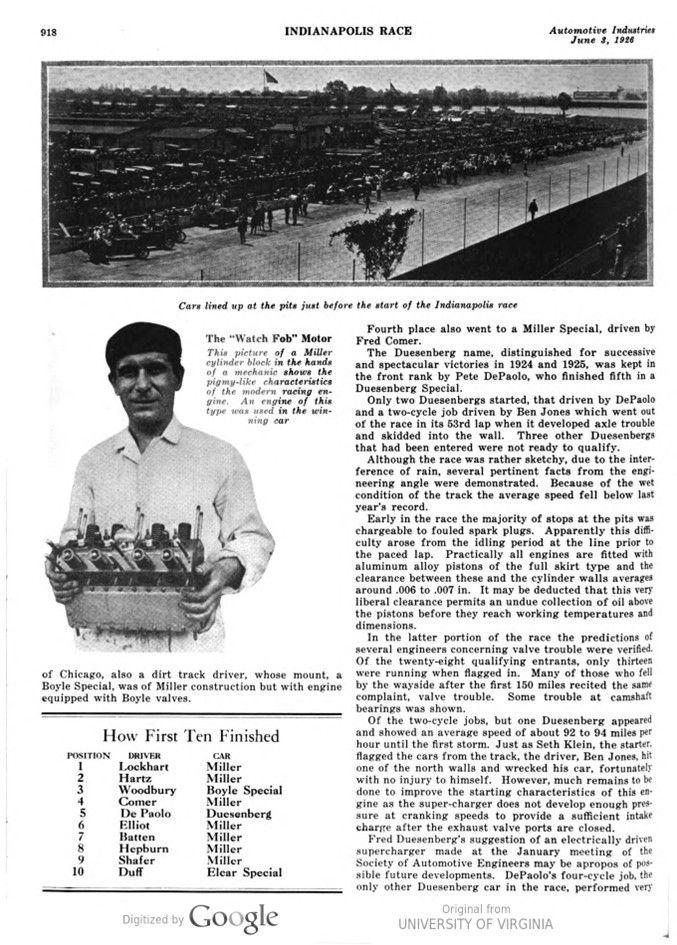
Cars lined up at the pits just before the start of the Indianapolis race
The „Watch Fob“ Motor
This picture of a Miller cylinder block in the hands of a mechanic shows the pigmy-like characteristics of the modern racing engine. An engine of this type was used in the winning car
Page 13. (see two of them here at the bottom)
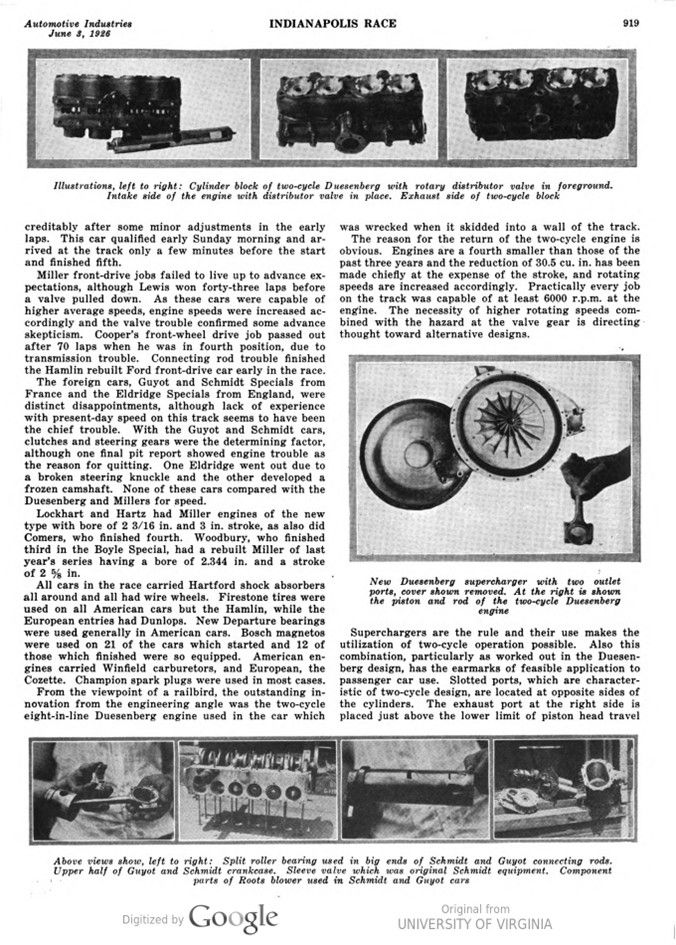
Illustrations, left to right: Cylinder block of two-cycle Duesenberg with rotary distributor valve in foreground. Intake side of the engine with distributor valve in place. Exhaust side of two-cycle block
(New Duesenberg supercharger with two outlet ports, cover shown removed. At the right is shown the piston and rod of the two-cycle Duesenberg engine)
Above views show, left to right: Split roller bearing used in big ends of Schmidt and Guyot connecting rods. Upper half of Guyot and Schmidt crankcase. Sleeve valve which was original Schmidt equipment. Component parts of Roots blower used in Schmidt and Guyot cars
Page 14.
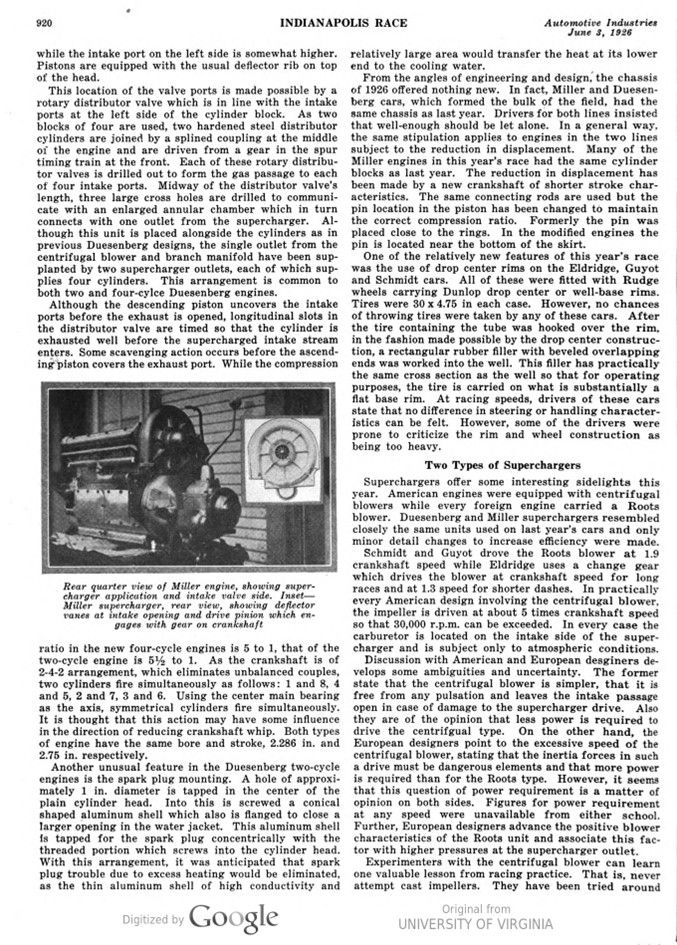
Rear quarter view of Miller engine, showing super- charger application and intake valve side. Inset — Miller supercharger, rear view, showing deflector vanes at intakepening and drive pinion which engages with gear on crankshaft