Text and jpegs by courtesy of hathitrust.org www.hathitrust.org, compiled by motorracinghistory.com
Motor Age, Vol. XLIV (49), No. 14, April 8, 1926
Europe’s Fours and Sixes To Compete with America’s Eights
Eldridge and Schmidt Specials Built in France for This Year’s Indianapolis Race Have Fewer Cylinders Than Millers and Duesenberg’s
By W. F Bradley
THIS year’s 500-mile Indianapolis Race, as is pretty generally known, will be for cars with a minimum weight of 1400 lbs. and engines not over 912 cu. in. piston displacement.
At the present time the race car builders in this country are busy working on their cars which are in various stages of completion. Out on the Pacific Coast is Harry Miller superintending the work on the Miller Specials and Indianapolis is buzzing with the activities of the Duesenberg brothers as well as the Chevrolet brothers, the latter building the Hamlin front drive job.
Over in Europe some of the same activity is going on regarding cars intended to be raced over the Indianapolis oval this year in the 500-mile classic.
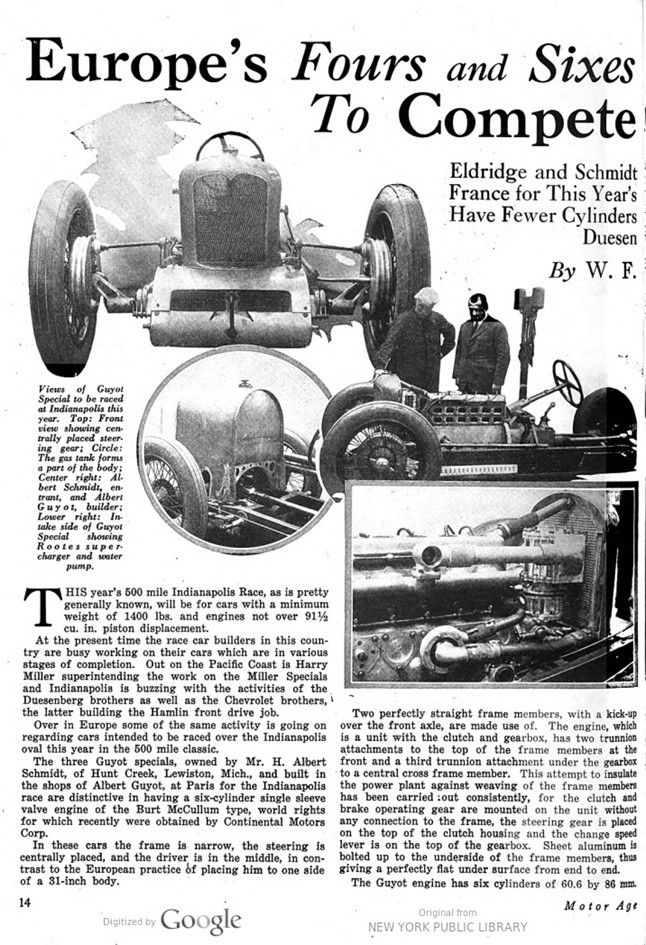
The three Guyot specials, owned by Mr. H. Albert Schmidt, of Hunt Creek, Lewiston, Mich., and built in the shops of Albert Guyot, at Paris for the Indianapolis race are distinctive in having a six-cylinder single sleeve valve engine of the Burt McCullum type, world rights for which recently were obtained by Continental Motors Corp.
In these cars the frame is narrow, the steering is centrally placed, and the driver is in the middle, in contrast to the European practice of placing him to one side of a 31-inch body.
Two perfectly straight frame members, with a kick-up over the front axle, are made use of. The engine, which is a unit with the clutch and gearbox, has two trunnion attachments to the top of the frame members at the front and a third trunnion attachment under the gearbox to a central cross frame member. This attempt to insulate the power plant against weaving of the frame members has been carried out consistently, for the clutch and t brake operating gear are mounted on the unit without any connection to the frame, the steering gear is placed on the top of the clutch housing and the change speed lever is on the top of the gearbox. Sheet aluminum is bolted up to the underside of the frame members, thus giving a perfectly flat under surface from end to end.
The Guyot engine has six cylinders of 60.6 by 86 mm, (2.38×3.38 ins.) bore and stroke, the cylinders being an iron casting mounted on an aluminum crankcase divided horizontally. Under the Burt McCullum patents, a single steel sleeve having a combined reciprocating and helical motion, is made use of.
A one-piece crankshaft with circular webs is used and a Hoffman roller bearing is placed between each cylinder. The connecting rods are tubular section, with split ends, also mounted with Hoffman roller bearings. A horizontal shaft on the right-hand side of the crankcase, and driven off the crankshaft by spur gearing, provides independent drive for the eccentrics operating the sleeves.
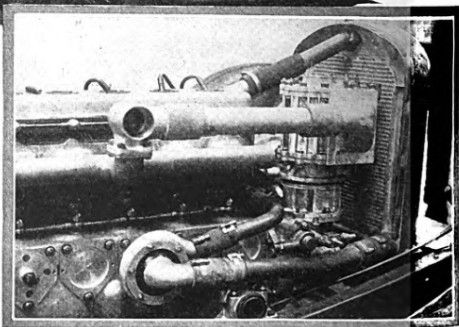
The engines are supercharged by means of a Rootes blower drawing a mixture through a Cozette carburetor. The blower is driven vertically by bevel gearing off the front end of the crankshaft, at a speed of 6000 revolutions for 5000 revolutions of the engine. The mixture is delivered through a horizontal pipe and an elbow containing a pressure relief valve into the straight intake manifold. In addition to the high-pressure lubrication assured by a scavenger and a feed pump, with a supply of oil under the cowl and an oil radiator between the horns of the frame, there is an auxiliary pump driven off an extension of the magneto shaft, by which oil is directed to the sleeve operating mechanism and to the supercharger. Ignition is by high tension magneto, at the front of the engine, driven from a cross shaft, with a single plug in the center of the cylinder.
The Guyot Specials have a height of 31 in. to the top of the radiator, the line increasing from this point to the maximum of 39 inches on the top of the gasoline tank. The four-wheel Perrot brakes are operated simultaneously.
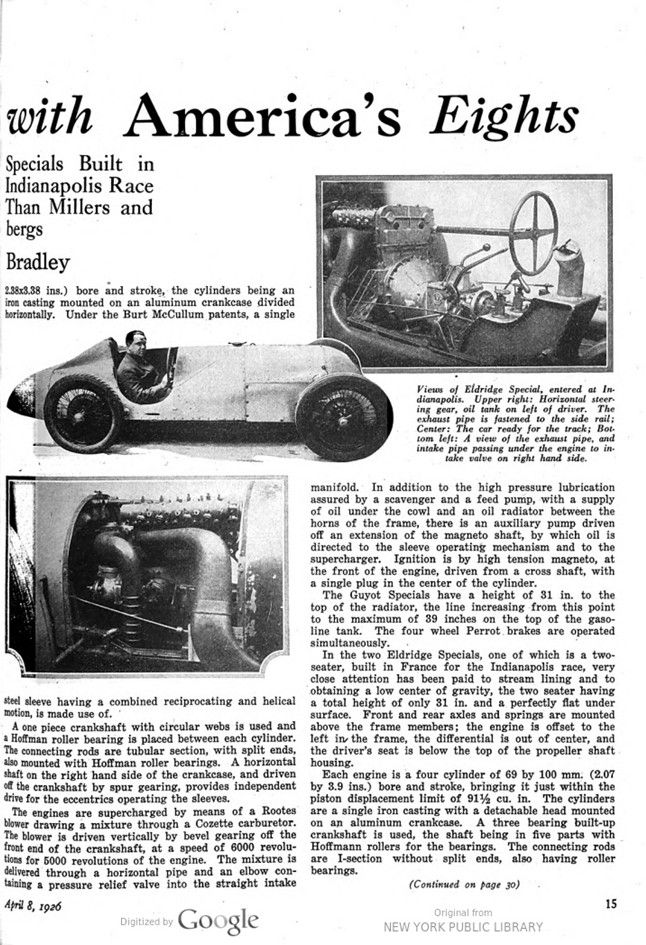
In the two Eldridge Specials, one of which is a two-seater, built in France for the Indianapolis race, very close attention has been paid to streamlining and to obtaining a low center of gravity, the two-seater having a total height of only 31 in. and a perfectly flat under surface. Front and rear axles and springs are mounted above the frame members; the engine is offset to the left in the frame, the differential is out of center, and the driver’s seat is below the top of the propeller shaft housing.
Each engine is a four cylinder of 69 by 100 mm. (2.07 by 3.9 ins.) bore and stroke, bringing it just within the piston displacement limit of 912 cu. in. The cylinders are a single iron casting with a detachable head mounted on an aluminum crankcase. A three-bearing built-up crankshaft is used, the shaft being in five parts with Hoffmann rollers for the bearings. The connecting rods are I-section without split ends, also having roller bearings.
The method of driving the two overhead camshafts is somewhat unusual. On the front end of the crankshaft is a spur pinion driving a half time shaft occupying the position of the camshaft in an ordinary L-head engine. On the rear end of this shaft is a sprocket by means of which chain drive is secured for the two overhead cam- shafts; the chain therefore runs at half engine speed. Adjustment of the chain is provided by an idler sprocket.
The valves, at an angle of 90 deg., have screwed on their extremity a small steel piston sliding in a cast iron guide in the cylinder head, and having set in it a hardened roller with which the cam comes in contact. To secure adjustment between cam and valve, the rollers are changed, this being done by removing the pin carrying them in the yoke on the head of the piston. Various sizes of rollers varying by one-tenth of a millimeter up and down from a standard, are kept for adjustment. This device eliminates all side thrust on the valve stems and even with 100 lbs. valve springs gives a very easy camshaft drive.
Use is being made of a special type of shrouded valve by means of which the port is not uncovered during the first portion of the movement of the valve, but practically maximum opening is obtained at a given point and the shut off is almost instantaneous.
The cooling water is circulated by a combination of pump and thermo-syphon. The main piping is sufficiently big to allow a thermo-syphon flow, but within this are set copper water pipes of about 10 mm. (.39 in.) internal diameter by means of which the water is directed under pressure around the exhaust valve seatings.
Lubrication is under pressure, with a very big supply of oil carried in a reserve tank alongside the driver’s seat. The sump is dry, two pumps being used, one for scavenging and the other for feeding the engine, and the lubricant is passed through an oil radiator under the water radiator.
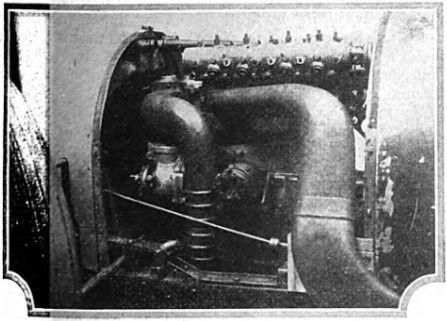
A vertical Rootes blower, driven by skew gearing from the front end of the crankshaft, is used in conjunction with a Solex carburetor. For short distance work the blower runs at one and one-third engine speed, but for long distance racing it probably will be run at engine speed. The carburetor is on the forward right-hand side of the cylinder block, with its funnel shaped air inlet facing forward through the engine hood.
Unit construction of engine and gear box has been adopted, the two-seater car having center control with the driver on the right. The steering column is perfectly horizontal.
A standard type Perrot front axle with Perrot brakes is used on both cars. All brake gear, with the exception of the short lengths of brake camshafts, is enclosed and adjustment of both front and rear set can be carried out from the driver’s seat. The single-seater car differs from its companion in being narrower and in having quarter elliptic springs at the rear.
Photos.
Page 14.
Views of Guyot Special to be raced at Indianapolis this year. Top: Front view showing centrally placed steering gear; Circle: The gas tank forms a part of the body; Center right: Albert Schmidt, entrant, and Albert Guyot, builder; Lower right: Intake side of Guyot Special showing Rootes supercharger and water T pump.
Page 15.
Views of Eldridge Special, entered at Indianapolis. Upper right: Horizontal steering gear, oil tank on left of driver. The exhaust pipe is fastened to the side rail; Center: The car ready for the track; Bottom left: A view of the exhaust pipe, and intake pipe passing under the engine to intake valve on right hand side.