Text and jpegs by courtesy of hathitrust.org www.hathitrust.org, compiled by motorracinghistory.com
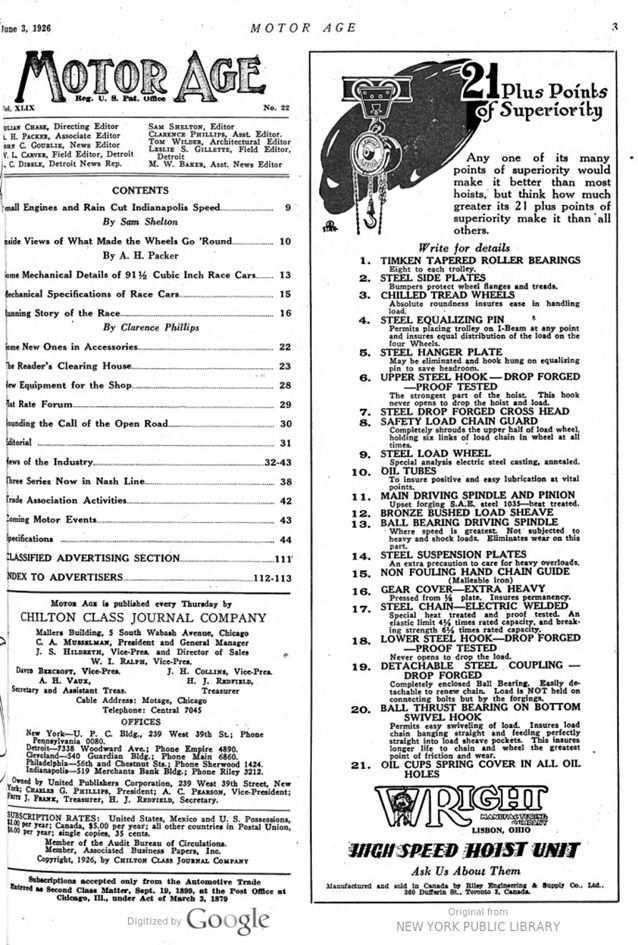
Motor Age, Vol. XLIX, 49, No. 22, June 3, 1926
Small Engines and Rain Cut Indianapolis Speed
But 912 Cubic Inch Race Cars Show Up Well in First Trial
By SAM SHELTON
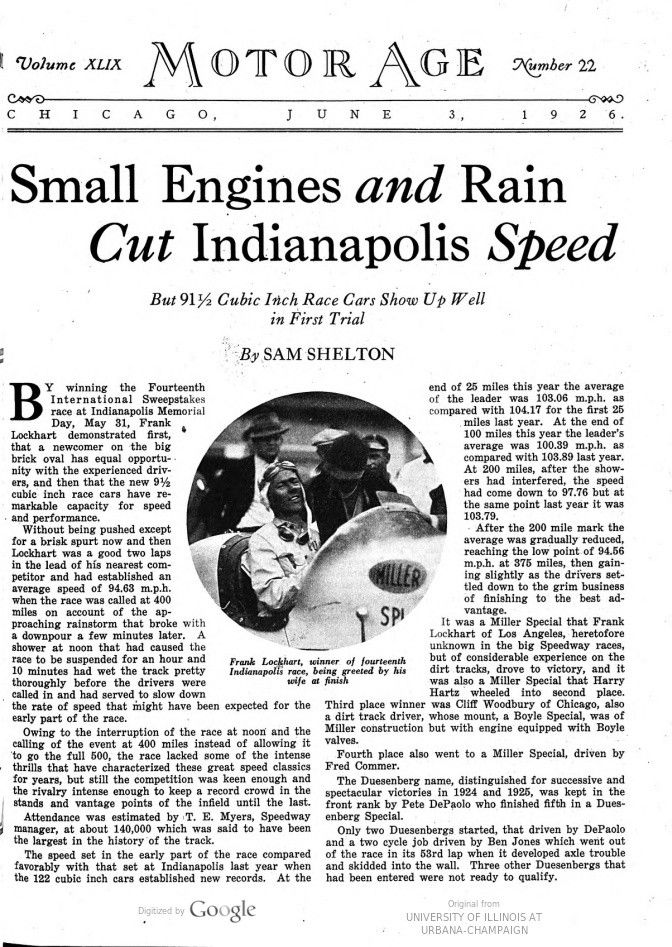
BY winning the Fourteenth International Sweepstakes race at Indianapolis Memorial Day, May 31, Frank Lockhart demonstrated first, that a newcomer on the big brick oval has equal opportunity with the experienced drivers, and then that the new 9½ cubic inch race cars have remarkable capacity for speed and performance.
Without being pushed except for a brisk spurt now and then Lockhart was a good two laps in the lead of his nearest competitor and had established an average speed of 94.63 m.p.h. when the race was called at 400 miles on account of the approaching rainstorm that broke with a downpour a few minutes later. A shower at noon that had caused the race to be suspended for an hour and 10 minutes had wet the track pretty thoroughly before the drivers were called in and had served to slow down the rate of speed that might have been expected for the early part of the race.
Owing to the interruption of the race at noon and the calling of the event at 400 miles instead of allowing it ‚to go the full 500, the race lacked some of the intense thrills that have characterized these great speed classics for years, but still the competition was keen enough and the rivalry intense enough to keep a record crowd in the stands and vantage points of the infield until the last.
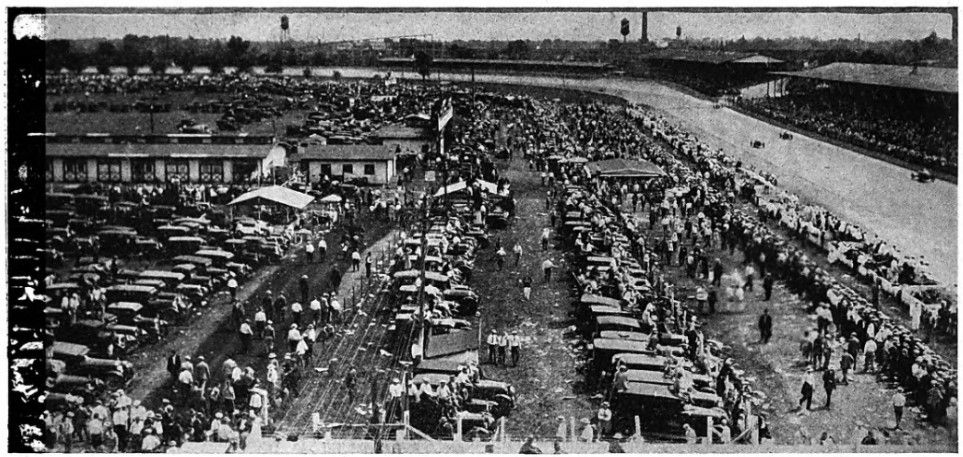
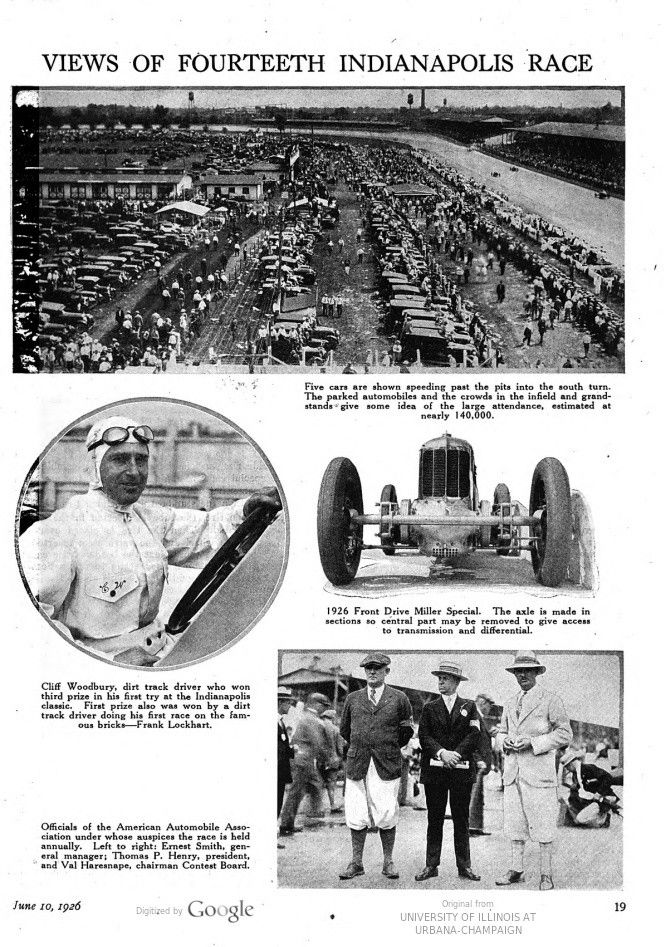
Attendance was estimated by T. E. Myers, Speedway manager, at about 140,000 which was said to have been the largest in the history of the track.
The speed set in the early part of the race compared favorably with that set at Indianapolis last year when the 122 cubic inch cars established new records. At the end of 25 miles this year the average of the leader was 103.06 m.p.h. as compared with 104.17 for the first 25 miles last year. At the end of 100 miles this year the leader’s average was 100.39 m.p.h. as compared with 103.89 last year. At 200 miles, after the showers had interfered, the speed had come down to 97.76 but at the same point last year it was 103.79.
After the 200 mile mark the average was gradually reduced, reaching the low point of 94.56 m.p.h. at 375 miles, then gaining slightly as the drivers settled down to the grim business of finishing to the best advantage.
It was a Miller Special that Frank Lockhart of Los Angeles, heretofore unknown in the big Speedway races, but of considerable experience on the dirt tracks, drove to victory, and it was also a Miller Special that Harry Hartz wheeled into second place. Third place winner was Cliff Woodbury of Chicago, also a dirt track driver, whose mount, a Boyle Special, was of Miller construction but with engine equipped with Boyle valves.
Fourth place also went to a Miller Special, driven by Fred Commer.
The Duesenberg name, distinguished for successive and spectacular victories in 1924 and 1925, was kept in the front rank by Pete DePaolo who finished fifth in a Duesenberg Special. Only two Duesenberg’s started, that driven by DePaolo and a two cycle job driven by Ben Jones which went out of the race in its 53rd lap when it developed axle trouble and skidded into the wall. Three other Duesenberg’s that had been entered were not ready to qualify.
Photos.
Frank Lockhart, winner of fourteenth Indianapolis race, being greeted by his wife at finish.
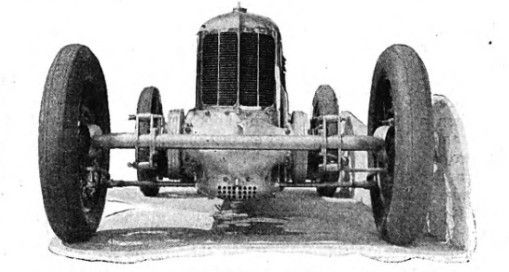
1926 Front Drive Miller Special. The axle is made in sections so central part may be removed to give access to transmission and differential.Five cars are shown speeding past the pits into the south turn. The parked automobiles and the crowds in the infield and grand- stands give some idea of the large attendance, estimated at nearly 140,000.
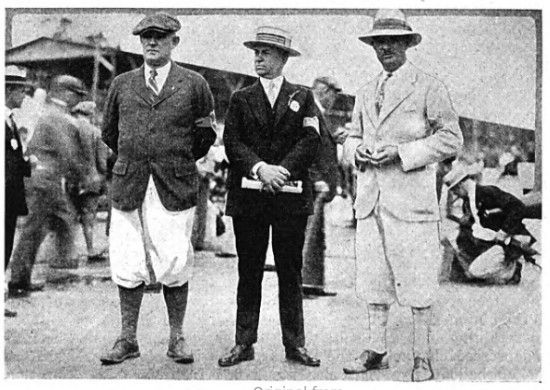
Officials of the American Automobile Association under whose auspices the race is held annually. Left to right: Ernest Smith, general manager; Thomas P. Henry, president, and Val Haresnape, chairman Contest Board.
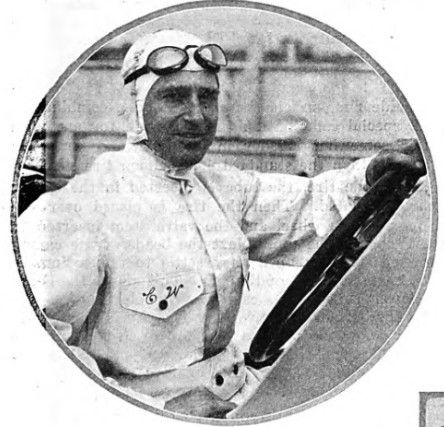
Cliff Woodbury, dirt track driver who won third prize in his first try at the Indianapolis classic. First prize also was won by a dirt track driver doing his first race on the famous bricks – Frank Lockhart.