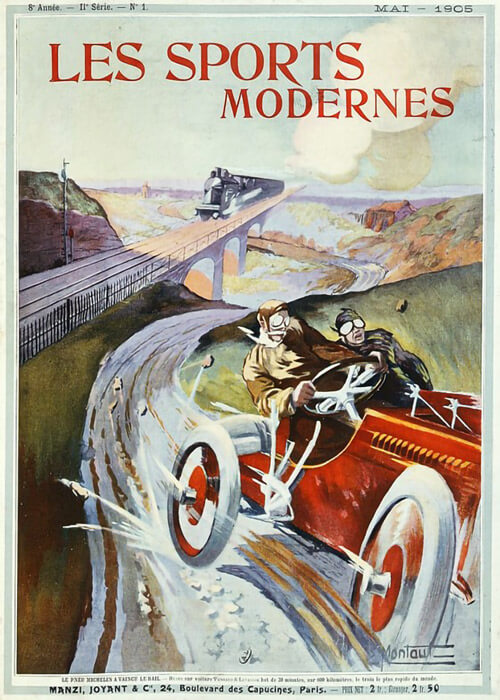
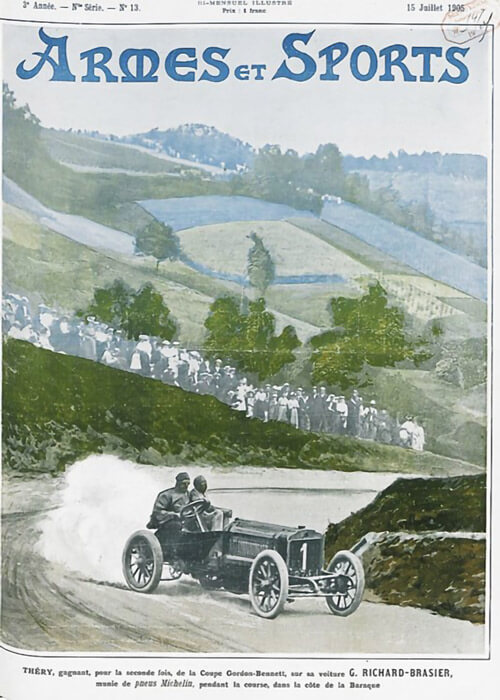
The American automotive magazine “Motor Age” covered the 1904 Gordon Bennet Cup race as well as its preparations in a really thoroughly manner. This June 17 article briefly summarizes the results of that Cup race, together with a short look on the three preceding Cup races.
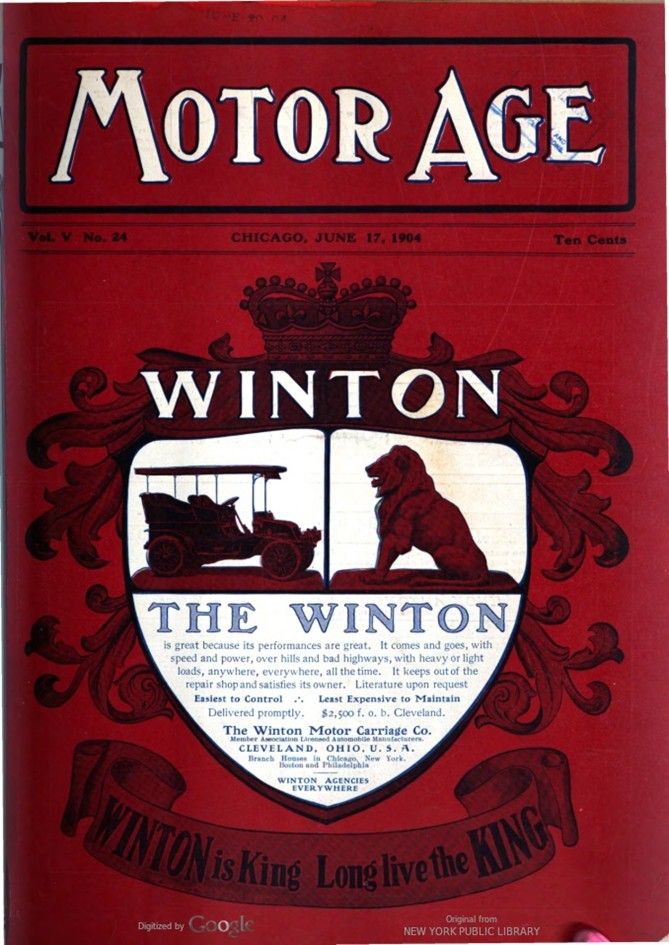
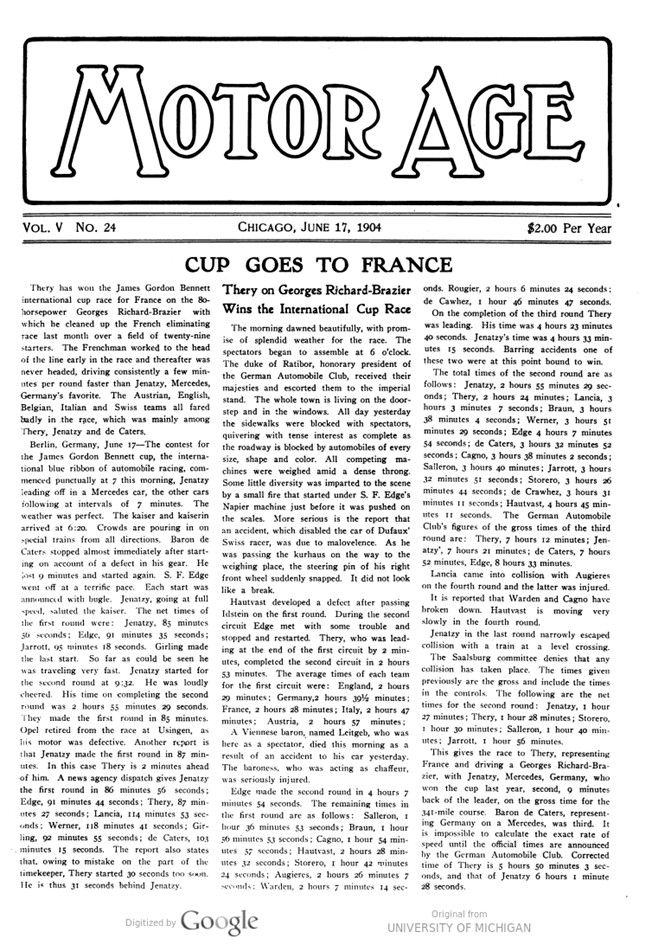
Text and photos with courtesy of hathitrust hathitrust.org, compiled by motorracingistory.com.
MOTOR AGE VOL. V. NO. 24. JUNE 17, 1904.
CUP GOES TO FRANCE
Thery on Georges Richard-Brazier Wins the International Cup Race
Thery has won the James Gordon Bennett international cup race for France on the 80-horsepower Georges Richard-Brazier with which he cleaned up the French eliminating race last month over a field of twenty-nine starters. The Frenchman worked to the head of the line early in the race and thereafter was never headed, driving consistently a few minutes per round faster than Jenatzy, Mercedes, Germany’s favorite. The Austrian, English, Belgian, Italian and Swiss teams all fared badly in the race, which was mainly among Thery, Jenatzy and de Caters.
Berlin, Germany, June 17 – The contest for the James Gordon Bennett cup, the international blue ribbon of automobile racing, commenced punctually at 7 this morning, Jenatzy leading off in a Mercedes car, the other cars following at intervals of 7 minutes. The weather was perfect. The kaiser and kaiserin arrived at 6:20. Crowds are pouring in on special trains from all directions. Baron de Caters stopped almost immediately after starting on account of a defect in his gear. He lost 9 minutes and started again. S. F. Edge went off at a terrific pace. Each start was announced with bugle. Jenatzy, going at full speed, saluted the kaiser. The net times of the first round were: Jenatzy, 85 minutes 56 seconds; Edge, 91 minutes 35 seconds; Jarrott, 95 minutes 18 seconds. Girling made the last start. So far as could be seen he was traveling very fast. Jenatzy started for the second round at 9:32. He was loudly cheered. His time on completing the second round was 2 hours 55 minutes 29 seconds. They made the first round in 85 minutes. Opel retired from the race at Usingen, as his motor was defective. Another report is that Jenatzy made the first round in 87 minutes. In this case Thery is 2 minutes ahead of him. A news agency dispatch gives Jenatzy the first round in 86 minutes 56 seconds; Edge, 91 minutes 44 seconds; Thery, 87 minutes 27 seconds; Lancia, 114 minutes 53 seconds; Werner, 118 minutes 41 seconds; Girling, 92 minutes 55 seconds; de Caters, 103 minutes 15 seconds. The report also states that, owing to mistake on the part of the timekeeper, Thery started 30 seconds too soon. He is thus 31 seconds behind Jenatzy.
The morning dawned beautifully, with promise of splendid weather for the race. The spectators began to assemble at 6 o’clock. The duke of Ratibor, honorary president of the German Automobile Club, received their majesties and escorted them to the imperial stand. The whole town is living on the doorstep and in the windows. All day yesterday the sidewalks were blocked with spectators, quivering with tense interest as complete as the roadway is blocked by automobiles of every size, shape and color. All competing machines were weighed amid a dense throng. Some little diversity was imparted to the scene by a small fire that started under S. F. Edge’s Napier machine just before it was pushed on the scales. More serious is the report that an accident, which disabled the car of Dufaux’ Swiss racer, was due to malovelence. As he was passing the Kurhaus on the way to the weighing place, the steering pin of his right front wheel suddenly snapped. It did not look like a break.
Hautvast developed a defect after passing Idstein on the first round. During the second circuit Edge met with some trouble and stopped and restarted. Thery, who was leading at the end of the first circuit by 2 minutes, completed the second circuit in 2 hours 53 minutes. The average times of each team for the first circuit were: England, 2 hours 29 minutes; Germany,2 hours 392 minutes; France, 2 hours 28 minutes; Italy, 2 hours 47 minutes; Austria, 2 hours 57 minutes.
A Viennese baron, named Leitgeb, who was here as a spectator, died this morning as a result of an accident to his car yesterday. The baroness, who was acting as chaffeur, was seriously injured.
Edge made the second round in 4 hours 7 minutes 54 seconds. The remaining times in the first round are as follows: Salleron, I hour 36 minutes 53 seconds; Braun, 1 hour 56 minutes 53 seconds; Cagno, 1 hour 54 minutes 57 seconds; Hautvast, 2 hours 28 minutes 32 seconds; Storero, 1 hour 42 minutes 24 seconds; Augieres, 2 hours 26 minutes 7 seconds; Warden, 2 hours 7 minutes 14 seconds. Rougier, 2 hours 6 minutes 24 seconds; de Cawhez, 1 hour 46 minutes 47 seconds.
On the completion of the third round Thery was leading. His time was 4 hours 23 minutes 40 seconds. Jenatzy’s time was 4 hours 33 minutes 15 seconds. Barring accidents one of these two were at this point bound to win. The total times of the second round are as follows: Jenatzy, 2 hours 55 minutes 29 seconds; Thery, 2 hours 24 minutes; Lancia, 3 hours 3 minutes 7 seconds; Braun, 3 hours 38 minutes 4 seconds; Werner, 3 hours 51 minutes 29 seconds; Edge 4 hours 7 minutes 54 seconds; de Caters, 3 hours 32 minutes 52 seconds; Cagno, 3 hours 38 minutes 2 seconds; Salleron, 3 hours 40 minutes; Jarrott, 3 hours 32 minutes 51 seconds; Storero, 3 hours 26 minutes 44 seconds; de Crawhez, 3 hours 31 minutes II seconds; Hautvast, 4 hours 45 minutes 11 seconds. The German Automobile Club’s figures of the gross times of the third round are: Thery, 7 hours 12 minutes; Jenatzy, 7 hours 21 minutes; de Caters, 7 hours 52 minutes, Edge, 8 hours 33 minutes.
Lancia came into collision with Augieres on the fourth round and the latter was injured. It is reported that Warden and Cagno have broken down. Hautvast is moving very slowly in the fourth round.
Jenatzy in the last round narrowly escaped collision with a train at a level crossing.
The Saalsburg committee denies that any collision has taken place. The times given previously are the gross and include the times in the controls. The following are the net times for the second round: Jenatzy, 1 hour 27 minutes; Thery, 1 hour 28 minutes; Storero, 1 hour 30 minutes; Salleron, 1 hour 40 minutes; Jarrott, 1 hour 56 minutes.
This gives the race to Thery, representing France and driving a Georges Richard-Brazier, with Jenatzy, Mercedes, Germany, who won the cup last year, second, 9 minutes back of the leader, on the gross time for the 341-mile course. Baron de Caters, representing Germany on a Mercedes, was third. It is impossible to calculate the exact rate of speed until the official times are announced by the German Automobile Club. Corrected time of Thery is 5 hours 50 minutes 3 seconds, and that of Jenatzy 6 hours 1 minute 28 seconds.
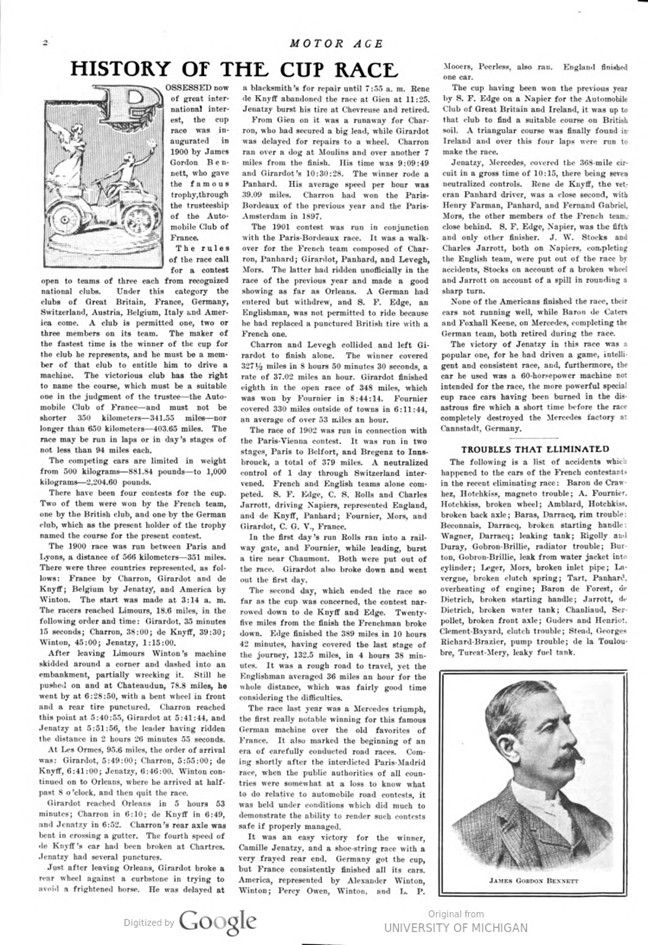
HISTORY OF THE CUP RACE
POSSESSED now of great international interest, the cup race was inaugurated in 1900 by James Gordon Bennett, who gave the famous trophy, through the trusteeship of the Automobile Club of France.
The rules of the race call for a contest open to teams of three each from recognized national clubs. Under this category the clubs of Great Britain, France, Germany, Switzerland, Austria, Belgium, Italy and America come. A club is permitted one, two or three members on its team. The maker of the fastest time is the winner of the cup for the club he represents, and he must be a member of that club to entitle him to drive a machine. The victorious club has the right to name the course, which must be a suitable one in the judgment of the trustee – the Automobile Club of France – and must not be shorter 350 kilometers-341.55 miles-nor longer than 650 kilometers-403.65 miles. The race may be run in laps or in day’s stages of not less than 94 miles each.
The competing cars are limited in weight from 500 kilograms-881.84 pounds-to 1,000 kilograms-2,204.60 pounds.
There have been four contests for the cup. Two of them were won by the French team, one by the British club, and one by the German club, which as the present holder of the trophy named the course for the present contest.
The 1900 race was run between Paris and Lyons, a distance of 566 kilometers-351 miles. There were three countries represented, as follows: France by Charron, Girardot and de Knyff; Belgium by Jenatzy, and America by Winton. The start was made at 3:14 a. m. The racers reached Limours, 18.6 miles, in the following order and time: Girardot, 35 minutes 15 seconds; Charron, 38:00; de Knyff, 39:30; Winton, 45:00; Jenatzy, 1:15:00.
After leaving Limours, Winton’s machine skidded around a corner and dashed into an embankment, partially wrecking it. Still, he pushed on and at Chateaudun, 78.8 miles, he went by at 6:28:50, with a bent wheel in front and a rear tire punctured. Charron reached this point at 5:40:55, Girardot at 5:41:44, and Jenatzy at 5:51:56, the leader having ridden the distance in 2 hours 26 minutes 55 seconds.
At Les Ormes, 95.6 miles, the order of arrival was: Girardot, 5:49:00; Charron, 5:55:00; de Knyff, 6:41:00; Jenatzy, 6:46:00. Winton continued on to Orleans, where he arrived at half-past 8 o’clock, and then quit the race.
Girardot reached Orleans in 5 hours 53 minutes; Charron in 6:10; de Knyff in 6:49, and Jenatzy in 6:52. Charron’s rear axle was bent in crossing a gutter. The fourth speed of de Knyff’s car had been broken at Chartres. Jenatzy had several punctures.
Just after leaving Orleans, Girardot broke a rear wheel against a curbstone in trying to avoid a frightened horse. He was delayed at a blacksmith’s for repair until 7:55 a. m. Rene de Knyff abandoned the race at Gien at 11:25. Jenatzy burst his tire at Chevreuse and retired.
From Gien on it was a runaway for Charron, who had secured a big lead, while Girardot was delayed for repairs to a wheel. Charron ran over a dog at Moulins and over another 7 miles from the finish. His time was 9:09:49 and Girardot’s 10:30:28. The winner rode a Panhard. His average speed per hour was 39.09 miles. Charron had won the Paris-Bordeaux of the previous year and the Paris-Amsterdam in 1897.
The 1901 contest was run in conjunction with the Paris-Bordeaux race. It was a walk-over for the French team composed of Charron, Panhard; Girardot, Panhard, and Levegh, Mors. The latter had ridden unofficially in the race of the previous year and made a good showing as far as Orleans. A German had entered but withdrew, and S. F. Edge, an Englishman, was not permitted to ride because he had replaced a punctured British tire with a French one.
Charron and Levegh collided and left Girardot to finish alone. The winner covered 327½ miles in 8 hours 50 minutes 30 seconds, a rate of 37.02 miles an hour. Girardot finished eighth in the open race of 348 miles, which was won by Fournier in 8:44:14. Fournier covered 330 miles outside of towns in 6:11:44, an average of over 53 miles an hour.
The race of 1902 was run in connection with the Paris-Vienna contest. It was run in two stages, Paris to Belfort, and Bregenz to Innsbrouck, a total of 379 miles. A neutralized control of 1 day through Switzerland intervened. French and English teams alone competed. S. F. Edge, C. S. Rolls and Charles Jarrott, driving Napiers, represented England, and de Knyff, Panhard; Fournier, Mors, and Girardot, C. G. V., France.
In the first day’s run Rolls ran into a railway gate, and Fournier, while leading, burst a tire near Chaumont. Both were put out of the race. Girardot also broke down and went out the first day.
The second day, which ended the race far as the cup was concerned, the contest narrowed down to de Knyff and Edge. Twenty-five miles from the finish the Frenchman broke down. Edge finished the 389 miles in 10 hours 42 minutes, having covered the last stage of the journey, 132.5 miles, in 4 hours 38 minutes. It was a rough road to travel, yet the Englishman averaged 36 miles an hour for the whole distance, which was fairly good time considering the difficulties.
The race last year was a Mercedes triumph, the first really notable winning for this famous German machine over the old favorites of France. It also marked the beginning of an era of carefully conducted road races. Coming shortly after the interdicted Paris-Madrid race, when the public authorities of all countries were somewhat at a loss to know what to do relative to automobile road contests, it was held under conditions which did much to demonstrate the ability to render such contests safe if properly managed.
It was an easy victory for the winner, Camille Jenatzy, and a shoe-string race with a very frayed rear end. Germany got the cup, but France consistently finished all its cars. America, represented by Alexander Winton, Winton; Percy Owen, Winton, and L. P. Mooers, Peerless, also ran. England finished one car.
The cup having been won the previous year by S. F. Edge on a Napier for the Automobile Club of Great Britain and Ireland, it was up to that club to find a suitable course on British soil. A triangular course was finally found in Ireland and over this four laps were run to make the race.
Jenatzy, Mercedes, covered the 368-mile circuit in a gross time of 10:15, there being seven neutralized controls. Rene de Knyff, the veteran Panhard driver, was a close second, with Henry Farman, Panhard, and Fernand Gabriel, Mors, the other members of the French team, close behind. S. F. Edge, Napier, was the fifth and only other finisher. J. W. Stocks and Charles Jarrott, both on Napiers, completing the English team, were put out of the race by accidents, Stocks on account of a broken wheel and Jarrott on account of a spill in rounding a sharp turn.
None of the Americans finished the race, their cars not running well, while Baron de Caters and Foxhall Keene, on Mercedes, completing the German team, both retired during the race.
The victory of Jenatzy in this race was a popular one, for he had driven a game, intelligent and consistent race, and, furthermore, the car he used was a 60-horsepower machine not intended for the race, the more powerful special cup race cars having been burned in the disastrous fire which a short time before the race completely destroyed the Mercedes factory at Cannstadt, Germany.
TROUBLES THAT ELIMINATED
The following is a list of accidents which happened to the cars of the French contestants in the recent eliminating race: Baron de Crawhez, Hotchkiss, magneto trouble; A. Fournier, Hotchkiss, broken wheel; Amblard, Hotchkiss, broken back axle; Baras, Darracq, rim trouble: Beconnais, Darracq, broken starting handle: Wagner, Darracq; leaking tank; Rigolly and Duray, Gobron-Brillie, radiator trouble; Burton, Gobron-Brillie, leak from water jacket into cylinder; Leger, Mors, broken inlet pipe; Lavergne, broken clutch spring; Tart, Panhard, overheating of engine; Baron de Forest, de Dietrich, broken starting handle; Jarrott, de Dietrich, broken water tank; Chanliaud, Serpollet, broken front axle; Guders and Henriot, Clement-Bayard, clutch trouble; Stead, Georges Richard-Brazier, pump trouble; de la Touloubre, Turcat-Mery, leaky fuel tank.