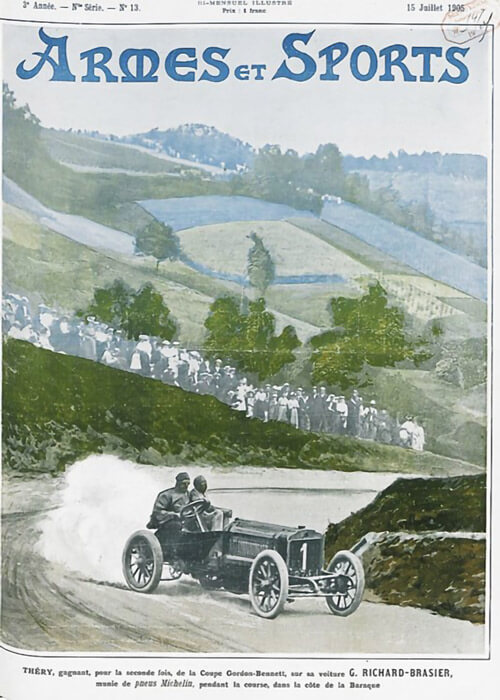
This last article in a series of four in the French La Vie automobile describes the race for the 1904 Gordon Bennett Cup in the German Taunus. Already in the beginning, the perception is gained that “to go fast, it is better to be light than powerful”. How right that was! And how sweet the taste of victory must have been for the French automobile industry over its German competitor. The race consisted of four laps, each lasting about one and a half hours. The thrill came in the last lap. The battle was between Camille Jenatzy driving a Mercedes for Germany and Léon Théry in a Richard-Brasier for France, Due to the starting schedule, Jenatzy arrived at the finish earlier than his French contestant. Anxious waiting on Théry, who came in later, but who won by just over 10 minutes. A small margin of about less than 3%, compared to the race time of about 6 hours.




With kind permission of Le Conservatoire numérique des Arts et Métiers (Cnum) – https://cnum.cnam.fr Text and photos compiled by motorracingistory.com., translation by DeepL.com
La Vie Automobile Vol. 4. — N° 143. – Saturday, June 25, 1904.
The return of the Cup to France
The Richard-Brasier company has made French sportsmen proud. It has just brought the Gordon Bennett Cup back to France, which England had rather stolen from us when won in 1902, and which Germany had narrowly taken from us in 1903; I say us, the French, because England proved once again, through the poor quality of its machines, how irregular its windfall of 1902 was.
But now is not the time for recrimination, but for rejoicing. Let us quickly weave three wreaths: one for Mr. Cuénod, the skillful administrator of the Richard-Brasier establishments, who knew how to get his brand up to speed so quickly and entrusted the factories to hands as expert as those of Mr. Brasier; the second to the eminent engineer of the Richard-Brasier factories, Mr. Brasier, who, in 1901, was already the organizer of the victory in the “Paris-Berlin” race with a Mors driven by Henri Fournier, and who became the pontifex maximus of the French and, consequently, international automotive industry.
Finally, the third crown will go to the driver of the machine, Théry, who knew not to abuse the wheeled stopwatch entrusted to him, who knew how to protect himself from fever, a bad advisor, who kept him cool throughout the race despite Jenatzy’s desperate pursuit.
***
Théry, who was once one of Decauville’s courageous champions, is now one of the foremen at the Ivry factories. In the Eliminatories and in the Cup, he demonstrated the key quality that every driver of one of our road-devouring machines must possess: composure, the composure that allows the will to reign supreme and keep madness and nervousness at bay.
When you carry on your shoulders so many hopes, so much capital, so many legitimate ambitions; when you know that every cable in the world is carrying the results of the struggle hour by hour; when you know that you hold in your hands the fate of a small fortune, and that a “red devil “— probably Mephistopheles, who has left Faust for twenty-four hours to wreak havoc in the Taunus — is riding in hot pursuit in the inexorable Mercedes, you really need to possess Horace’s triplex to push panic out of your mind and continue, without dangerous nervousness, to beat your opponent with the sole weapon of regularity! Théry has thus revealed himself to be a tough man!
***
What can be said about the machine? Nothing too hasty at this point. This, however: the winning engine is the least powerful of the lot. Théry’s car, which is the lightest, reminds me of the current play, La plus faible, in which a young woman with 60 horsepower ends up defeating, all by herself, the coalition of many wise ladies with 90 horsepower bent on her downfall. It also shows, once again, how much “the road” sometimes resembles “the race,” how clumsy it is to burden oneself with overly powerful machines in order to make rapid progress, and my old conviction is confirmed more and more each year that, to go fast, it is better to be light than powerful!
***
Finally, this quick victory report would be incomplete without mentioning one characteristic fact: the French team alone had no failures in the Cup. We saw our three champions, Théry, Rougier, and Salleron, finish in the rankings.
So, the day in Taunus was indeed a great industrial victory for us. Its results show once again to the rest of the world that, overall, the French automotive industry remains unrivalled.
I think our compatriots have always been well enough informed to never have doubted this. We must leave to the snobs and neurasthenics the sad habit of always looking beyond our borders to find what is good and right. The good and the right still live here, decidedly.
L. Baudry de Saunier.
THE RACE
Our editor-in-chief has just summarized the moral results of this great event. It remains for us to examine the race in detail and recount some anecdotes. Overall, one feeling stands out above all others: the enormous disappointment felt by the Germans at seeing us take back the Cup. The race, which had been prepared for a long time by our neighbors, had become a national event. We know how much importance the German emperor attaches to the development of the automotive industry among his subjects. His constant presence on the “battlefield,” alongside the empress, is both extraordinary and indisputable proof of this. It is a source of pride for the automobile that, even in its infancy, it is sought after by intelligent heads of state.
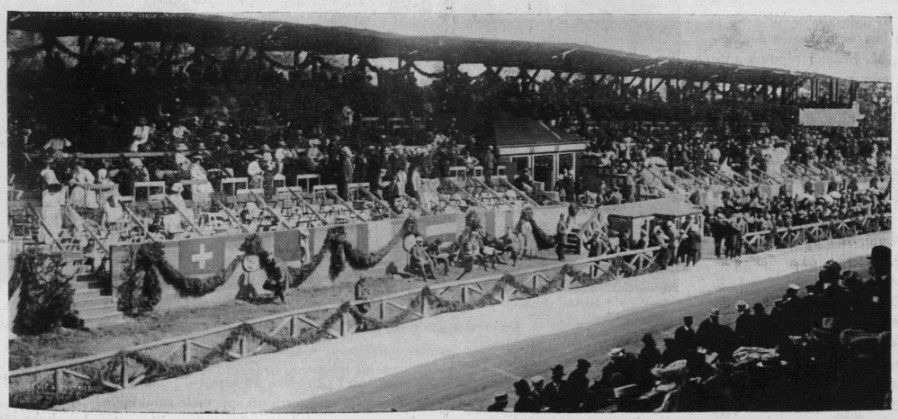
The German authorities and the German Automobile Club’s racing commission had long since undertaken the necessary work to repair the road, so that the course was in perfect condition several days before the event. Official and private grandstands were erected throughout the area to allow the many spectators to watch the race comfortably and safely. As a result, there were no accidents to report, however minor.
As the start was to take place in Saalburg, and the emperor was to be present, huge grandstands had been erected just beyond the starting line. In the middle of them was a pavilion reserved for the emperor and his guests. Our penultimate issue provided views of all these preparations.
On Wednesday, June 15, two days before the Cup, almost all the competitors were gathered in Homburg and planned to reconnoiter the course a number of times. Their hopes were in vain; torrential rain fell continuously that day.
The next day, the weather improved significantly and the day was interrupted only by light showers. Under these circumstances, most of the competitors decided to equip themselves with anti-skid devices and… to try them out.
The French team therefore fitted their wheels with studded anti-skid devices, which Michelin had wisely stocked up on in anticipation of the rain.
After completing three laps, Théry found that these Michelin anti-skid devices offered absolute safety and, unusually, did not slow down his car, or only very slightly. But after examining the tires, it was noticed that several studs had been torn from the tread. When Mr. Michelin himself was asked about his fears that these tires might fail the drivers during the race, he replied: “Don’t worry!
“These tires have been specially designed for the Cup to last four laps. Their resistance is calculated for the duration of the race. What does it matter to you as long as they last the distance, and… they will.”
Faced with this confident assurance and logical reasoning, the drivers’ minds were put at ease, and they waited for the next day without too much apprehension.
Each competitor had two cars at his disposal: his own, marked with his number, and his second car, bearing the same number but followed by the letter B (bis). Until the last moment, the drivers therefore had the choice between one of the two vehicles.
The weighing formalities were completed fairly quickly, and the vigil began, a real vigil during which the cars were not left for a moment by their drivers or their men. Despite a cordial welcome, a certain mistrust nevertheless prevailed. On the morning of the race, the sun rose brightly. At 5 a.m., even though the start was not until 7 a.m., the stands began to fill up. Security was quickly and very well organized, perhaps too well; in some cases, precautions were taken to the point of exaggeration.
At 6:40 a.m., Emperor Wilhelm II—an early riser, as we can see—arrived on horseback, followed by a small escort, quickly made his way to his grandstand, and a few minutes later, the Empress joined him there. The Emperor was dressed in the uniform of a colonel of the guard; the Empress wore a very pretty city dress.
Both were surrounded by a large entourage in brilliant uniforms.
As the start time approached, Mr. Tampier, official timekeeper of the Automobile Club de France and general timekeeper of the Cup, signaled to the competitors to get ready. Jenatzy, the Cup holder, wearing number 1, took his place on the starting line. At that moment, a solemn silence fell over the crowd, and the timekeeper’s countdown could be heard clearly: “Ten to go, five to go, three to go, two, one… go!”
Jenatzy’s car started and quickly passed in front of the stands, greeted with a wave from the emperor, who thus honored the Belgian driver, in this case the champion of German industry.
The long-awaited big race had begun, and every seven minutes, the drivers set off in their order of numbers for the fantastic lap. The eighteen starts took exactly 1 hour and 59 minutes. Meanwhile, dispatches began to arrive from the various checkpoints and points along the course, giving the passing times of the leaders. These dispatches were immediately reproduced on a luminous board raised in front of the stands, so that everyone could follow all the twists and turns of the race without leaving their seats. At each lap, the time of each competitor was also known.
The organization was perfect.
The total distance of each lap was 141 kilometers, from which 13 kilometers of neutralizations had to be deducted; the racecourse was therefore 128 kilometers.
The time allocated for crossing the neutralization was 58 minutes per lap.
And here is the system that was used to time the neutralization periods:
Each neutralization checkpoint was equipped with a dozen stopwatches with a single hand marking the seconds. As soon as a car arrived, the checkpoint supervisor pressed the button on one of the watches and handed it to a cyclist. The cyclist would ride ahead of the car and hand the watch to the exit control chief. The control chief would then wait until the neutralization time had elapsed and give the driver the signal to start again.
This system is simple, as we can see, and allows the exact time of each driver to be calculated immediately, lap by lap, since there are no records to check! However, in our opinion, it is very flawed: we are forced to rely entirely on the good faith of the control chiefs, who may not all be elite individuals and who may have preferences or interests that favor certain drivers; under these conditions, the race may be distorted. We are not saying that this has happened, we are simply pointing out that it could happen.
***
First lap. —The last driver had long since started, when suddenly a car appeared. Jenatzy sped past the stands. He had been on the road for 2 hours and 24 minutes. He had therefore completed the first lap in 1 hour, 26 minutes, and 56 seconds. Shouts, cheers, and applause greeted this result; the German camp was jubilant. Jenatzy, their champion, had long since disappeared, but the cheers continued to resound.
A few minutes of calm followed, and then Edge arrived at a run. He had taken 1 hour and 31 minutes. Now it was the English camp’s turn to rejoice!
Shortly afterwards, another driver arrives. It is number 5, Théry, who also passes at high speed, looking very calm in front of the crowd gathered in the stands. His time is, to within 1 second, the same as Jenatzy’s. It is our turn to be happy with the progress of our champion, whose pace impresses the Germans.
But despite everything, the very cosmopolitan audience in the stands warmly cheers the French champion.
Then, one by one, the drivers follow, their times giving an accurate idea of their pace; we see that de Caters is making up some of the ground he lost at the start, and that the English team is performing admirably.
Results of the first lap. — Jenatzy, 1 hr. 26 min. 56 sec.; Théry, 1 hr. 26 min. 57 sec.; Edge, 1 hr. 31 min. 44 sec.; Girling, 1 hr. 32 min. 55 sec.; Jarrott, 1 hr. 35 min. 18 sec.; Salleron, 1 hr. 36 min. 53 sec.; Cagno, 1 hr. 42 min. 22 sec.; de Caters, 1 hr. 43 min. 15 sec.; Hautvast, 1 hr. 46 min. 47 sec.; Lancia, 1 hr. 54 min. 53 sec.; Braun, 1 hr 56 min 24 sec; Werner, 1 hr 58 min 41 sec; Rougier, 2 hr 6 min; Warden, 2 hr 7 min 14 sec; Augières, 2 hr 23 min 7 sec; de Crawhez, 2 hr 28 min 32 sec; Opel (retired).
***
Second lap. — While waiting for the second lap, conversations continue, with lively discussion and gesticulation. The duel between Jenatzy and Théry arouses great interest. Meanwhile, the emperor, who has been introduced to Baron de Zuylen, strolls familiarly with him among the crowd.
Prince Henry of Prussia has lunch like a commoner at the buffet, which is literally stormed.
Then calm gradually returns. According to calculations, Jenatzy should not be far behind, and anxiety begins to set in.
Two minutes later, Jenatzy reappears, cheered loudly; then, for us, the anxiety returns: where is Théry? Here he is! He is one minute and 46 seconds ahead of Jenatzy.
The duel between the two men grows in intensity. All the spectators are gripped, and the battle between the two champions makes them forget the other competitors.
Results of the second round. — Théry, 2 hours, 53 minutes, 43 seconds; Jenatzy, 2 hours, 55 minutes, 29 seconds; Girling, 3 hours, 7 minutes, 21 seconds; Cagno, 3 hours, 26 minutes, 44 seconds; Jarrott, 3 hours 32 minutes; de Gaters, 3 hours 32 minutes 52 seconds; Lancia, 3 hours 31 minutes 7 seconds; Storero, 3 hours 38 minutes 2 seconds; Braun, 3 hours 38 minutes 4 seconds; Salleron, 3 hours 40 minutes 44 seconds; Hautvast, 3 hrs 41 mins 11 secs; Rougier, 3 hrs 43 mins 24 secs; Werner, 3 hrs 51 mins 29 secs; Warden, 4 hrs 4 mins 32 secs; Edge, 4 hrs 7 mins 54 secs; Crawhez, 4 hours 45 minutes 11 seconds. Théry’s time for this second lap is 1 hour 26 minutes 46 seconds. Jenatzy’s time is 1 hour 28 minutes 33 seconds.
Théry has therefore gained 11 seconds on his time in the first lap. Will he be able to keep this up until the end?
***
The third lap. — Jenatzy came in first again in the third lap. His time was much slower than in the first two laps. He had suffered a breakdown in Limburg (unable to restart his engine), which caused him to lose six minutes.
Twenty-four minutes later, Théry came roaring past, paying no attention to the cheers that greeted him.
Théry was now in the lead with a ten-minute advantage, but his time was also slightly slower: 1 hour, 29 minutes, and 57 seconds, three minutes slower than in the other laps. He too had suffered a minor breakdown (broken fan blade).
Results of the third lap. — Théry, 4 hours, 23 minutes, 4 seconds; Jenatzy, 4 hours, 33 minutes, 15 seconds; de Caters, 5 hours, 6 minutes, 25 seconds; Cagno, 5 hours, 10 minutes, 17 seconds; Rougier, 5 hours 14 minutes 48 seconds; Hautvast, 5 hours 22 minutes 28 seconds; Girling, 5 hours 23 minutes 15 seconds; Lancia, 5 hours 25 minutes 35 seconds; Jarrott, 5 hours 33 minutes 12 seconds; Salleron, 5 hours 34 minutes 35 seconds; Werner, 5 hours 45 minutes 25 seconds; Edge, 5 hours 45 minutes 36 seconds; de Crawhez, 7 hours 6 minutes 3 seconds (retired).
***
The fourth lap. — From that moment on, the race became thrilling; the last lap was beginning. Jenatzy continued his “infernal” lap, pursued by Théry, who had already made up 10 minutes on him. Everyone was very anxious. What would happen in this last lap?
Would a stupid accident bring this magnificent duel to an end?
Emperor Wilhelm, who had been absent, returned at this moment and was introduced to Mr. Brasier, whom he kept close to him for nearly three quarters of an hour, asking him numerous questions about the automotive industry and seeking his opinion on “the future of heavy goods vehicles and motorized carriages.”
Mr. Brasier answered these numerous questions as best he could, but it is certain that, as flattered as he was by the sovereign’s attention, his mind must have been elsewhere, accompanying Théry in his wild race, following him in his thoughts through the many twists and turns of the road, climbing the hills and plunging down the descents with him.
This anxiety had spread to all those present, and all the spectators waited feverishly for the end of this battle of giants. Finally, a racing car hurtled down the road and Jenatzy emerged in front of the stands. Jenatzy, covered in dust and oil, looking devilish with his glasses and goatee, which had turned from red to gray…
The wait began again. One can only imagine what must have been going through the Belgian driver’s mind as the minutes ticked by. Could he still hope? Would luck be on his side, and would his opponent fall victim to a breakdown? About twenty minutes passed in this way. Then Théry’s car, faster than ever, arrived in front of the stands and crossed the finish line. Théry won by 11 minutes! The Cup was returning to France!
***
In the French camp, it was pandemonium. Brasier ran to congratulate his driver; the two men understood each other with a glance and fell into each other’s arms.
Jenatzy, with tears in his eyes, came over to congratulate the lucky winner. The poor boy had done everything humanly possible to win; he was defeated. But a defeat like that is as good as a victory. Ah! Perhaps racing fans will never again witness such a spectacle!
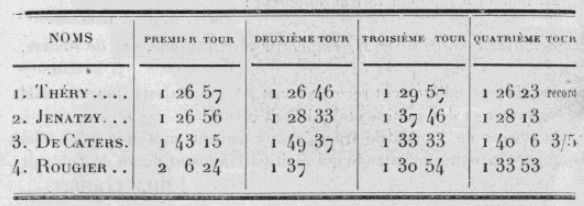
The other arrivals took place amid indescribable hubbub, and twelve drivers out of eighteen starters completed the course. Below are the results of the fourth lap, which was covered by Théry in 1 hour, 26 minutes, and 23 seconds (a record) and by Jenatzy in 1 hour, 28 minutes, and 13 seconds.
Results for the fourth lap. — Théry, 5 hours, 50 minutes, and 8 seconds; Jenatzy, 6 hours, 1 minute, and 28 seconds; de Caters, 6 hours, 46 minutes, and 31 seconds; Rougier, 6 hours, 48 minutes, and 11 seconds; Braun, 6 hours 59 minutes 6 seconds; Hautvast, 7 hours 2 minutes 36 seconds; Salleron, 7 hours 15 minutes 3 seconds; Lancia, 7 hours 17 minutes 54 seconds; Girling, 7 hours 22 minutes 54 seconds; Cagno, 7 hours 23 minutes 36 seconds; Werner, 7 hours 32 minutes 14 seconds; Jarrott, 7 hours 36 minutes 32 seconds. If we compare Théry’s lap times, we see that he completed the first, second, and fourth laps in 1 hour 26 minutes and a few seconds; only the third lap was covered in 1 hr 29 min, but on this lap Théry had the three-minute breakdown that we mentioned, without which the French champion’s pace would have been as steady as Tampier’s stopwatch. We also give the comparative lap times of the first four divers.
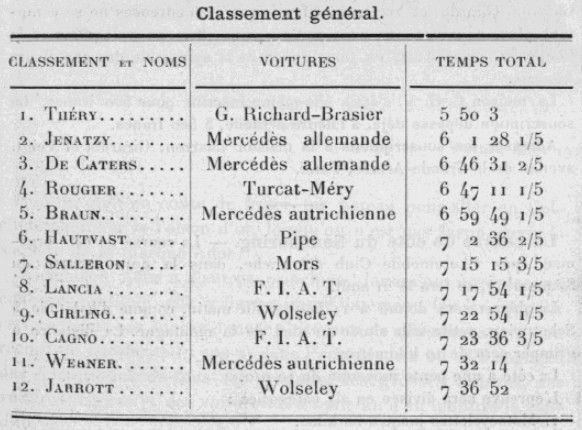
General Classification.
CLASSIFICATION and NAMES – VEHICLES/CARS – TOTAL TIME
1. Théry – G. Richard-Brasier – 5 50 3
2. Jenatzy – Mercédès german – 6 1 28 1/5
3. De Caters – Mercédès german – 6 46 31 2/5
4- Rougier – Turcat-Méry – 6 47 11 1/5
5. Braun Mercédès austrian – 6 59 49 1/5
6. Hautvast – Pipe – 7 2 36 2/5
7. Salleron – Mors – 7 15 15 3/5
8. Lancia – F. I. A. T. – 7 17 54 1/5
9. Girling – Wolseley – 7 22 54 1/5
10. Cagno – F. I. A. T. – 7 23 36 3/5
11. Wehner – Mercédès austrian – 7 32 11
12. Jarrott – Wolseley – 7 36 52
After the race, the emperor had his portrait presented to Mr. Brasier with this flattering dedication:
To the distinguished engineer Brasier, With friendly memory, Guillaume
The rare distinction bestowed upon Mr. Brasier will give us an opportunity to share with our readers the industrial “track record” of the engineer Richard Brasier.
Mr. Brasier, an engineer from Arts et Métiers, is a graduate of the Châlons school. After graduating some twenty years ago, he joined the Mors factories as a designer. He worked successively on steamboats, railway equipment, and finally telegraphy.
When Mors decided in 1895 to start manufacturing automobiles, the management of the new division was entrusted to the young engineer, who threw himself wholeheartedly into this new venture, where his inventive spirit could be put to best use. Since that time, his name has been closely linked to the history of the automobile.
Before the Tour de France race in 1899, the Panhard brand had always been unbeatable, and the factories on Avenue d’Ivry had no rivals. A new star was about to rise, creating, thanks to rivalry, a sporting interest that did not yet exist.
For the Tour de France, Mr. Brasier built a 16-horsepower car. This first type of car was still a rather imperfect design; the engineer lacked experience, the components were too weak, and the gear changes lacked solidity. However, despite these flaws, Levegh won the Mantes-Cabourg stage and took third place in the final classification.
The same car, reworked the following year, won Paris-Saint-Malo and Paris-Trouville by a wide margin, driven in both races by Antony.
Next came Paris-Ostend and Bordeaux-Périgueux, won by Levegh, who then took Bordeaux-Biarritz ahead of Antony, who took second place with a similar vehicle.
The following year, Brasier developed a 24-horsepower model which, still driven by Levegh, won the major Paris-Toulouse-Paris and Bordeaux-Périgueux races.
That same year, the Ostend races, all the speed races, and almost all the records went to the Mors company.
Finally, crowning this series of victories were the unforgettable successes in Paris-Bordeaux and Paris-Berlin, which also propelled Henry Fournier to the top of the French drivers’ rankings. That same year, Fournier also broke all the world records!
In 1902, Mr. Brasier joined the Georges Richard company. The cars now bore the name Georges Richard-Brasier.
That year, Mr. Brasier only built light cars, which performed very respectably in their debut in the Paris-Vienna race. These vehicles were powered by 24-horsepower engines similar to those used in commercial vehicles.
In 1903, too late for Paris-Madrid, he was still unable to field large cars, and the new brand had to settle for trying its luck with light cars. These quickly put themselves in an excellent position, as Mr. Georges Richard, who was driving one of these cars himself, was leading the small car category when he was the victim of the terrible accident at Sainte-Maure that we all know about.
At the end of 1903, the Georges Richard brand set records for small cars in Dourdan and Château-Thierry. The successes of the Trèfle-à-Quatre in Monaco, the two victories in the Qualifiers and the Cup crowned this brilliant series of successes in 1904.
BREAKDOWNS
This is a very informative chapter for everyone:
Théry completed the entire race without a flat tire and had only one minor accident on the third lap: a broken fan blade. Théry decided to remove the fan, so he stopped for three minutes to dismantle it.
Jenatzy. — Having stopped his engine at the Limburg checkpoint, he lost six minutes restarting it. Jenatzy also had no flat tires.
De Caters lost more than a quarter of an hour at the start because his igniters were flooded with oil. For the rest of the race, he was slower than the first two drivers.
Rougier had a punctured carburetor float, which caused him to lose a considerable amount of time (half an hour) to repair it; he was unable to catch up with de Caters, who finished 40 seconds ahead of him.
Braun, champion of the Austrian team, had a rather uneven pace; with a car that was less well tuned than his German counterparts, he had to battle with his engine several times.
Hautvast (Belgian), who was driving one of the Pipe cars, finished in a very respectable position. His engine overheated, causing him to lose a lot of time refilling with water at the checkpoints.
Salleron broke a chain.
Lancia (Belgian) took eighth place in the rankings with his Fiat. The Fiats in the Cup are close copies of the Mercedes. Consistent performance.
Girling (English) was very dangerous for a moment in the first two laps, and the Wolseley’s horizontal engine performed valiantly. It is claimed that one of the gearbox bearings was overheating.
Cagno (Italian, Queen Marguerite’s driver) and his Fiat were in exactly the same condition as Lancia and his car.
Werner had several engine and gearbox failures. All in all, the car was in pretty bad shape.
Jarrott, who was driving the second Wolseley, finished last in the standings. Although fast, with an average speed of 100 kilometers per hour, he had a car that suffered from various minor breakdowns.
Edge, driving a Napier, had breakdown after breakdown and was unable to finish. He was nowhere to be seen for a single moment.
De Crawhez, the renowned Belgian driver, was unable to finish the race. His engine overheated.
Opel, who was driving the third German car, was unable to cover more than 7 kilometers, as his gearbox suddenly broke down.
Dufaux (Switzerland) was unable to start, as his steering broke down the day before the race.
***
And now that the Cup is in France, let’s prepare to defend it seriously, because the Germans will do—as their emperor has said—everything in their power to take it from us in 1905. Forewarned is forearmed.
Adrien Gatoux.
Photos.
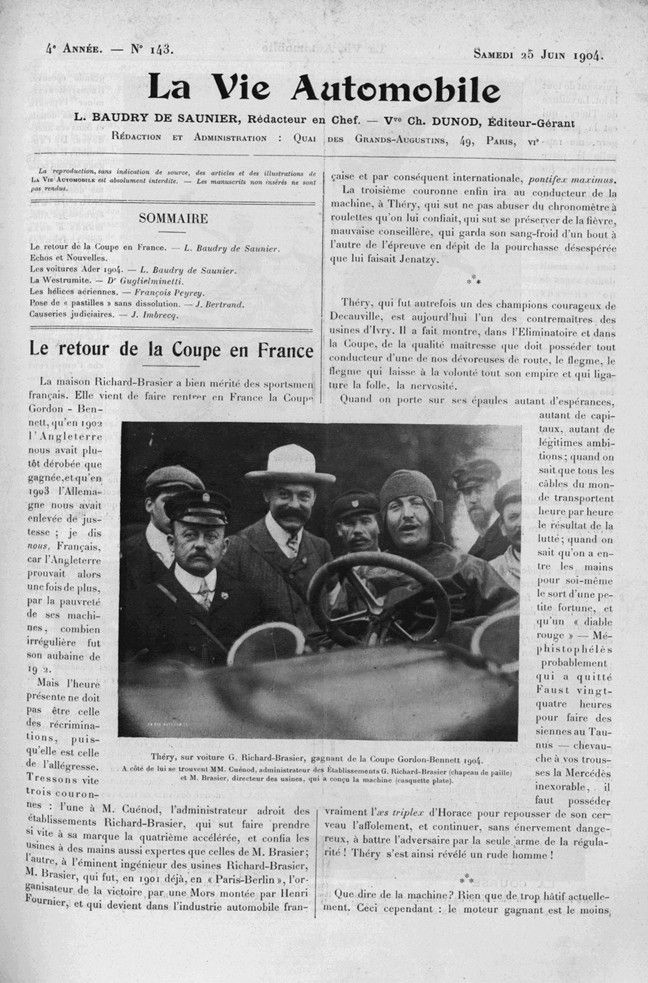
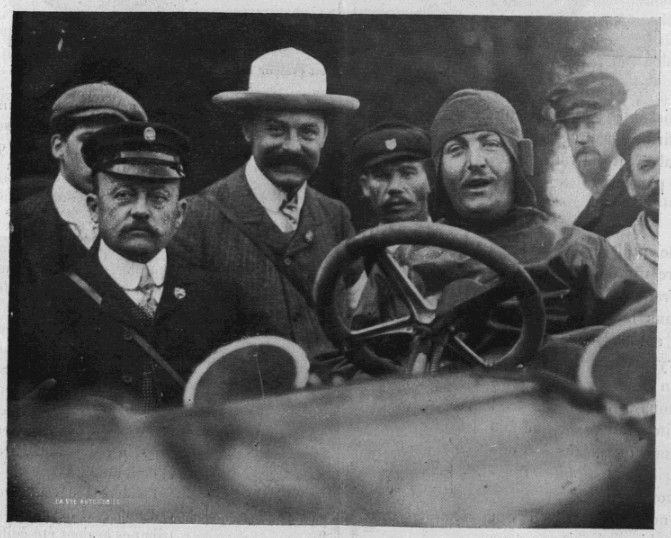
401. Théry, in a G. Richard-Brasier car, winner of the 1904 Gordon Bennett Cup.
Next to him are Mr. Cuénod, administrator of Etablissements G. Richard-Brasier (straw hat), and Mr. Brasier, factory director, who designed the machine (flat cap).
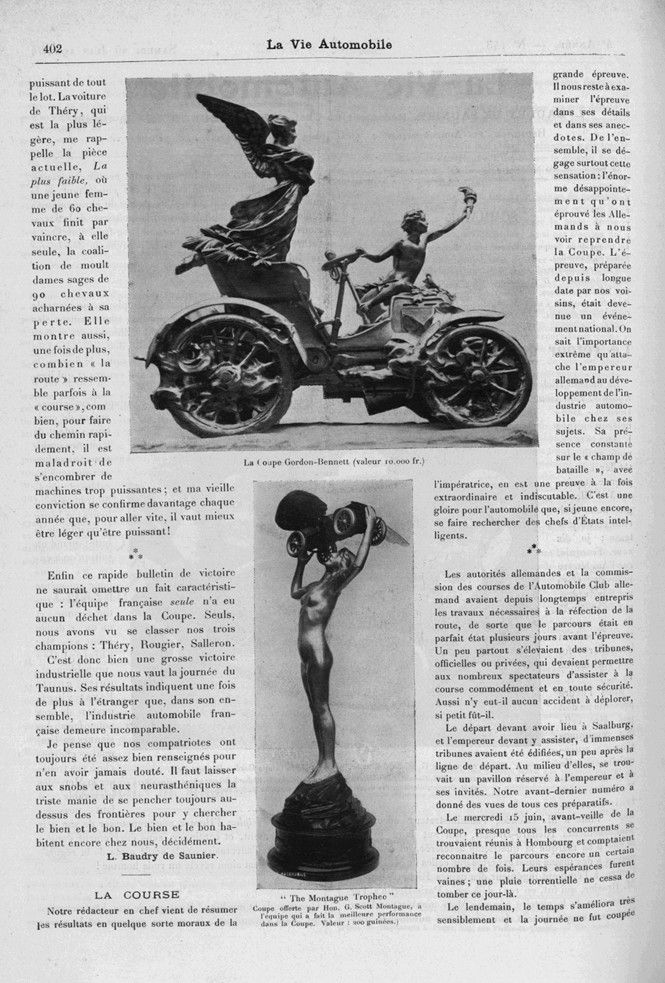
402. The Gordon Bennett Cup (worth 10,000 francs).
“The Montague Trophy” Cup offered by Hon. G. Scott Montague to the team that performed best in the Cup. Value: 200 guineas.
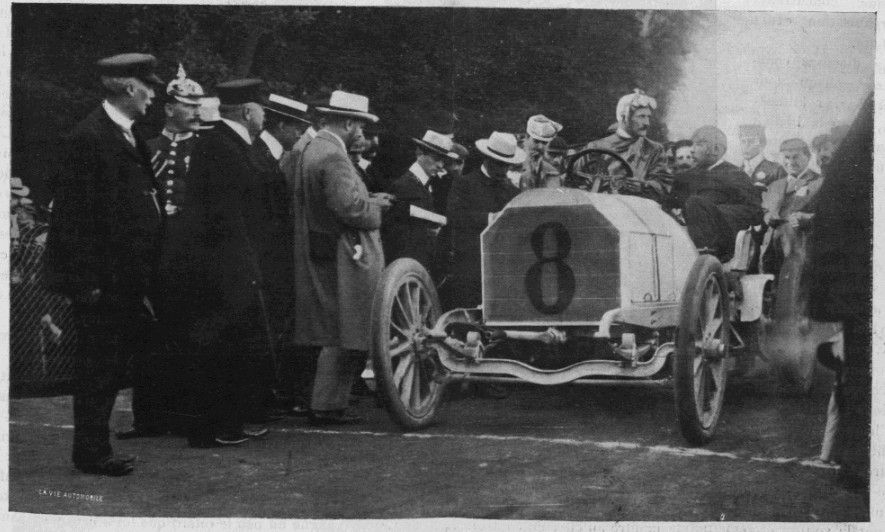
403. Second in the Cup. — Jenatzy, nicknamed the Red Devil by the Germans, in a Mercedes car.
Third in the Cup. — Baron de Caters, in a Mercedes car.
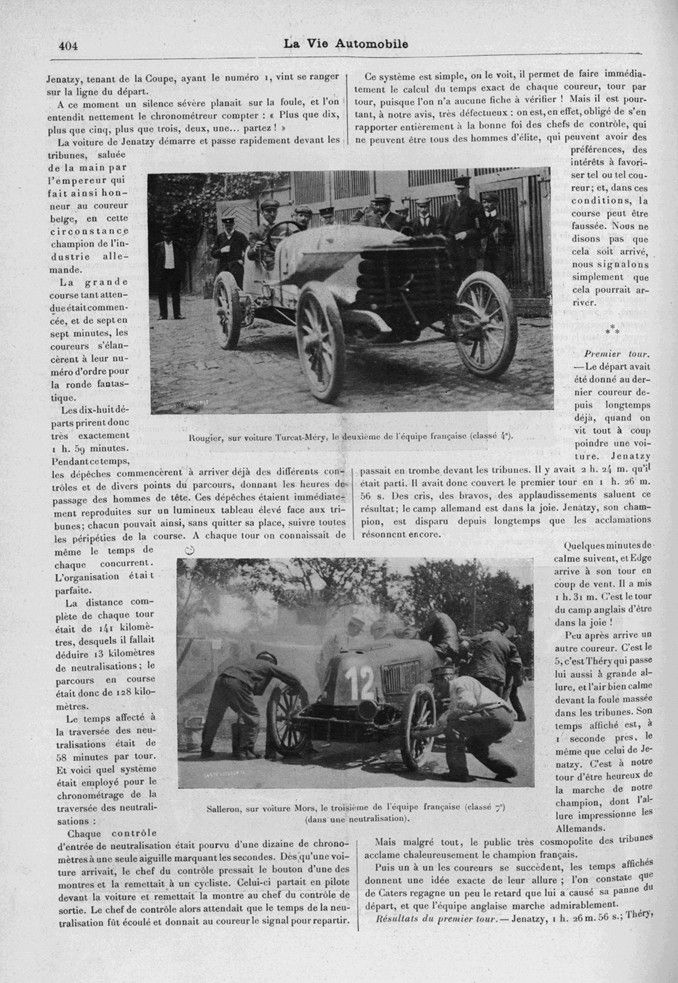
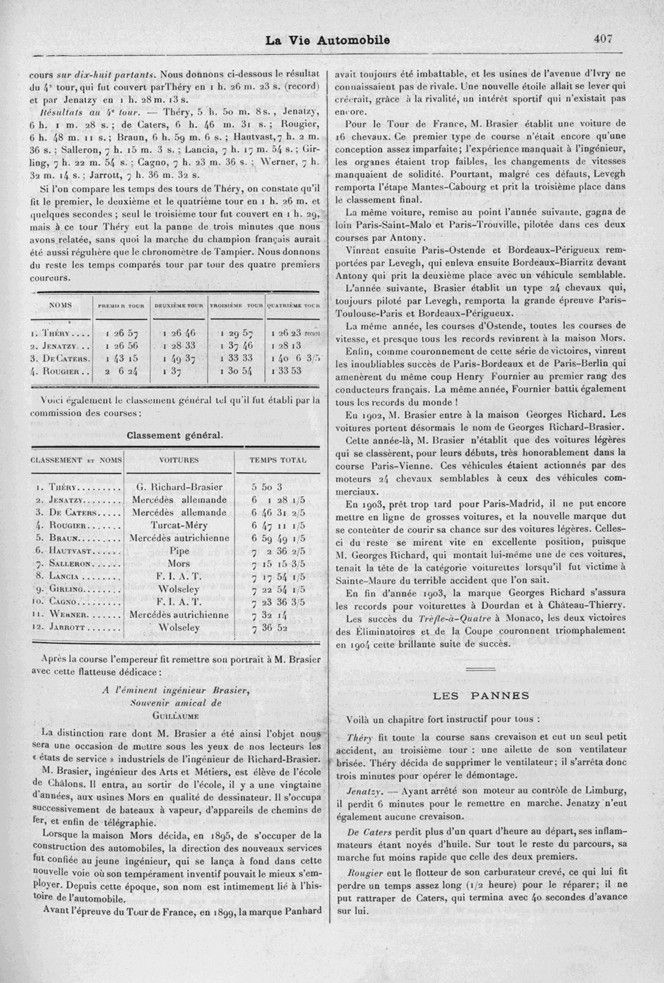
404. Rougier, in a Turcat-Méry car, second in the French team (ranked 4th).
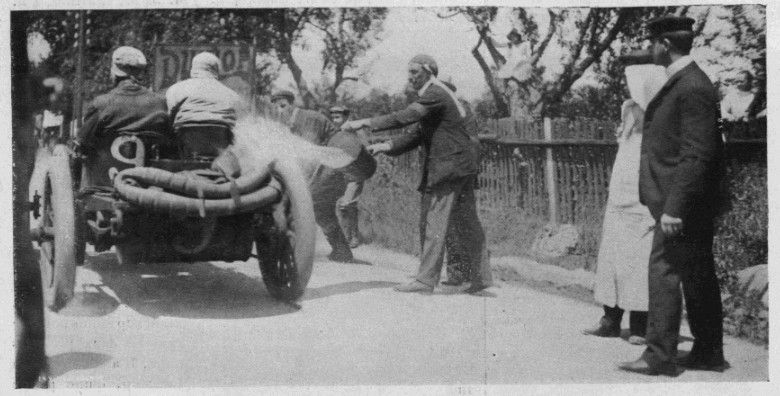
Salleron, in a Mors car, third in the French team (ranked 7th) (in a neutralization).
405. First in the English team, Girling (ranked 9th). – View of the grandstand opposite the finish line.
406. A bucket of water on the tires as they pass! – Decoration of a street in Homburg in honor of the Cup.