In 1911, the Grand Prix scene slowly came out of her hybernation. The regional Automobile Club de la Sarthe et de l’Ouest decided to organise an event, which was nicknamed by Grand Prix des Tacots (something like the old cars). Not more than 14 registrations and finally a mere three finishers could be noted in the books. But tragedy struck, as Maurice Fournier and his mechanic Georges Souvel both were killed when their car summersaulted and landed in a ditch. The race itself was quite exciting though, making Hémery the winner and leading the motorracing scene believe that the former winner of the 1905 Circuit des Ardennes and the Vanderbilt Cup was destined to play a dominant role in this 1911 season.
Text and photos with autorisation of Bibliothèque national francais, gallica.bnf.fr, www.gallica.bnf.fr, compiled by motorracinghistory.com and translation by DeepL.com
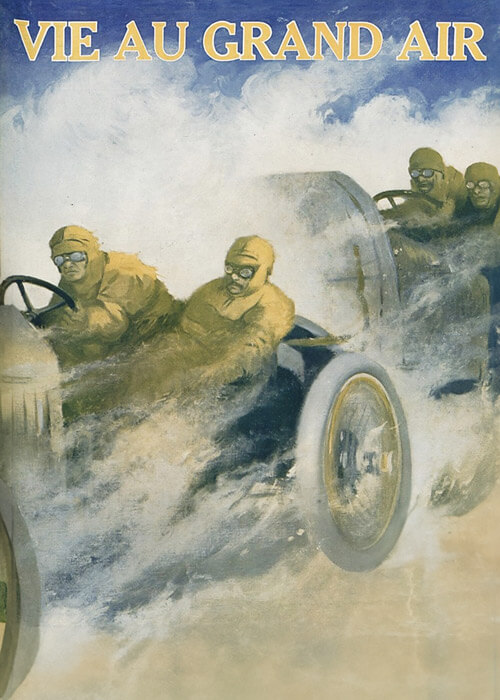
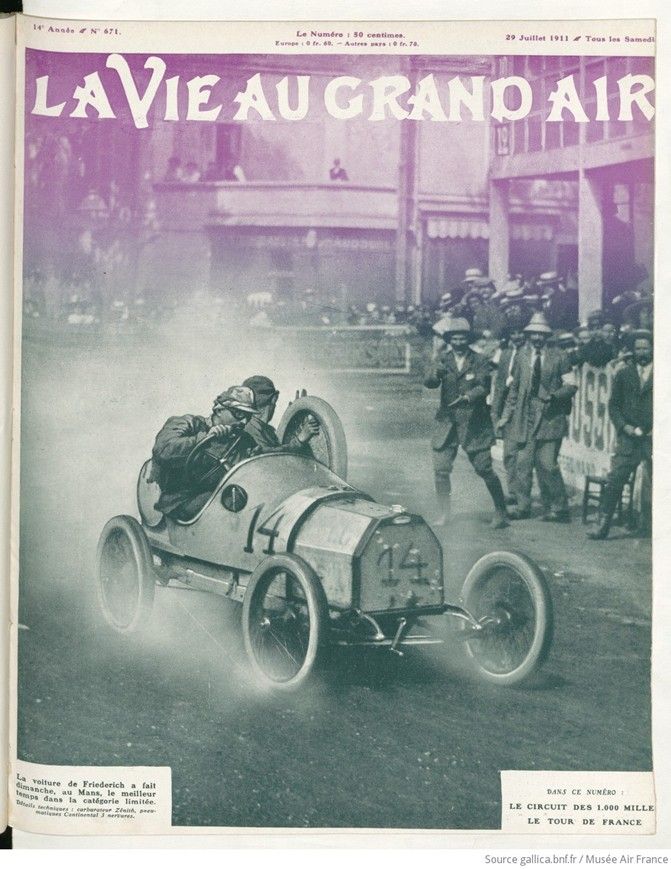
La Vie au Grand Air, Volume 14, No. 671, July 29, 1911
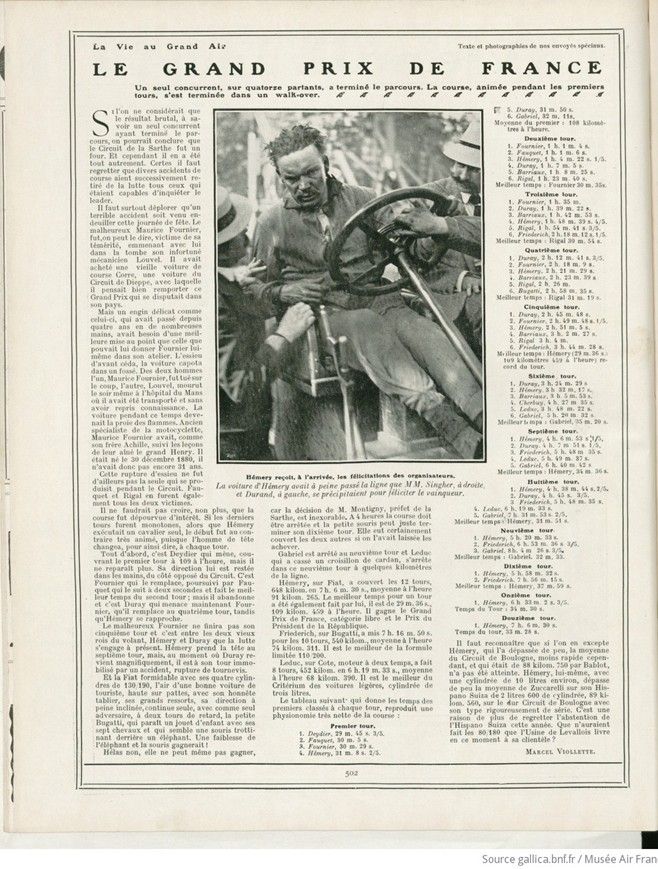
THE FRENCH GRAND PRIX
Only one competitor out of fourteen starters finished the race. The race, which was lively during the first few laps, ended in a walkover.
If we only considered the brutal result, namely that only one competitor finished the race, we might conclude that the Circuit de la Sarthe was a flop. However, this was not the case at all. It is certainly regrettable that various racing accidents successively removed from the fray all those who were capable of challenging the leader.
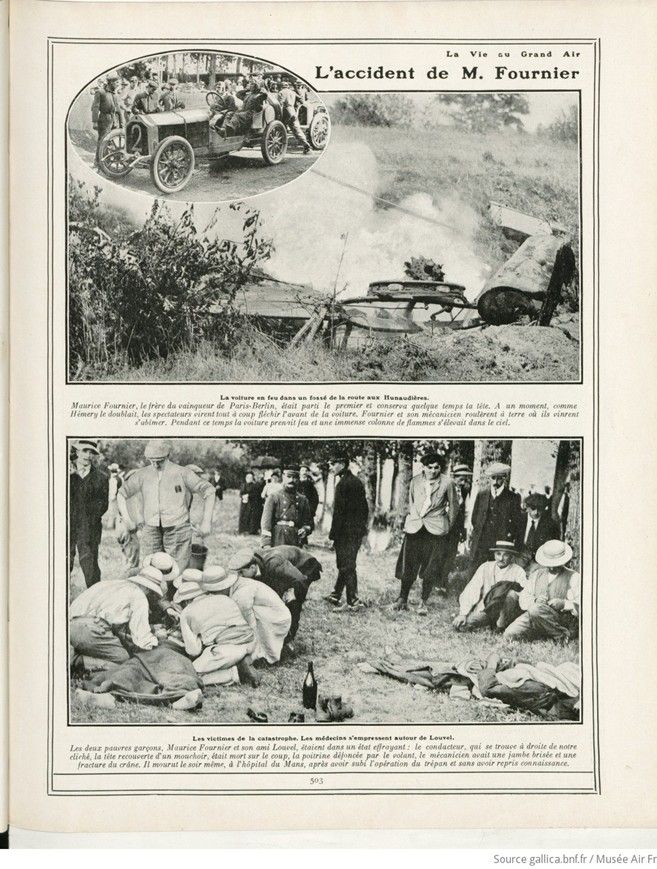
Above all, it is deplorable that a terrible accident cast a shadow over this day of celebration. The unfortunate Maurice Fournier was, it can be said, a victim of his own recklessness, taking his unfortunate mechanic Louvel with him to the grave. He had bought an old Corre racing car, a car from the Dieppe Circuit, with which he thought he could win this Grand Prix, which was being held in his own country.
But a delicate machine like this, which had passed through many hands over the past four years, needed better tuning than Fournier himself could provide in his workshop. The front axle gave way and the car overturned in a ditch. Of the two men, Maurice Fournier was killed instantly, while Louvel died that same evening at the Le Mans hospital where he had been taken, without ever regaining consciousness. Meanwhile, the car was engulfed in flames. A former motorcycle specialist, Maurice Fournier, like his brother Achille, had taken lessons from their elder, the great Henry. He was born on December 30, 1880, so he was not yet 31 years old.
This axle breakage was not the only one to occur during the Circuit. Fauquet and Rigal were also victims.
It would be wrong to think that the race was uninteresting. Although the final laps were monotonous, with Hémery riding alone in the lead, the start was very lively, with the lead changing almost every lap.
First, Deydier took the lead, covering the first lap at 109 mph, but he did not reappear. His steering wheel remained in his hands, on the opposite side of the circuit. Fournier replaced him, followed by Fauquet, who was two seconds behind and set the fastest time in the second lap, but he gave up and Duray now threatened Fournier, replacing him in the fourth lap, while Hémery closed in.
The unfortunate Fournier did not finish his fifth lap, and the battle now began between the two old kings of the wheel, Hémery and Duray. Hémery took the lead on the seventh lap, but just as Duray was making a magnificent comeback, he too was immobilized by an accident, a broken screwdriver.
And the formidable Fiat with its 130/190 four-cylinder engine, looking like a good touring car, high on its legs, with its honest apron, its large springs, its barely inclined steering, continued alone, with its only opponent, two laps behind, the little Bugatti, which looks like a child’s toy with its seven horsepower and seems like a mouse trotting behind an elephant. One weakness from the elephant and the mouse would win!
Alas, no, it cannot even win, because the decision of Mr. Montigny, prefect of the Sarthe, is inexorable. At 4 o’clock, the race must be stopped and the little mouse can just finish its tenth lap. It would certainly have covered the other two if it had been allowed to finish them.
Gabriel is stopped on the ninth lap and Leduc, who has broken a cardan joint, stops on the ninth lap a few kilometers from the finish line.
Hémery, in a Fiat, completed the 12 laps, 648 kilometers, in 7 hours, 6 minutes, and 30 seconds, averaging 91 kilometers per hour. He also set the fastest lap time, 29 minutes and 36 seconds, at 109 kilometers per hour. He won the French Grand Prix, open category, and the Prize of the President of the Republic.
Friederich, driving a Bugatti, took 7 hours, 16 minutes, and 50 seconds to complete the 10 laps, covering 540 kilometers at an average speed of 74.311 kilometers per hour. He was the best in the 110/200 limited formula.
Leduc, driving a Cote with a two-stroke engine, completed 8 laps, 452 kilometers, in 6 hours, 19 minutes, and 33 seconds, with an average speed of 68 kilometers per hour. He was the best in the Critérium for light cars with a three-liter engine.
The following table, which gives the times of the leaders at each lap, provides a very clear picture of the race:
First lap.
1. Deydier, 29 min. 45 sec. 3/5.
2. Fauquet, 30 min. 5 sec.
3. Fournier, 30 min. 29 sec.
4. Hémery, 31 min. 8 sec. 2/5.
5. Duray, 31 min. 50 sec.
6. Gabriel, 32 min. 11 sec.
First lap average: 108 kilometers per hour.
Second lap.
1. Fournier, 1 hr. 1 min. 4 sec.
2. Fauquet, 1 hr. 1 min. 6 sec.
3. Hémery, 1 hr. 4 min. 22 sec. 1/5.
4. Duray, 1 hr 7 min 5 sec.
5. Barriaux, 1 hr 8 min 25 sec.
6. Rigal, 1 hr 23 min 40 sec.
Best time: Fournier 30 min 35 sec.
Third day.
1. Fournier, 1 hr 35 min.
2. Duray, 1 hr. 39 min. 22 sec.
3. Barriaux, 1 hr. 42 min. 53 sec.
4. Hémery, 1 hr. 48 min. 39 sec. 4/5.
5. Rigal, 1 hr. 54 min. 41 sec. 3/5.
6. Friederich, 2 hrs 18 mins 12 secs 1/5.
Fastest lap: Rigal 30 secs 54.
Fourth lap.
1. Duray, 2 hrs 12 mins 41 secs 3/5.
2. Fournier, 2 hrs 18 mins 9 secs
3. Hémery, 2 hrs 21 mins 29 secs.
4. Barriaux, 2 hrs 23 mins 39 secs
5. Rigal, 2 hrs 26 mins.
6. Bugatti, 2 hrs 58 mins 35 secs.
Fastest lap: Rigal 31 mins 19 secs.
Fifth lap.
1. Duray, 2 hrs 45 mins 48 secs.
2. Fournier, 2 hrs 49 mins 48 secs 1/5.
3. Hémery, 2 hrs 51 mins 5 secs.
4. Barriaux, 3 hrs 2 mins 27 secs.
5. Rigal 3 hrs 4 mins.
6. Friederich, 3 hrs 44 mins 28 secs.
Best time: Hémery (29 mins 36 secs: 109 kilometers 459 per hour) lap record.
Sixth lap.
1. Duray, 3 hrs 24 mins 29 secs
2. Hémery. 3 hrs 32 mins. 17 min.
3. Barriaux, 3 hrs 5 min. 53 sec.
4. Cherbuy, 4 hrs 27 min 35 sec.
5. Leduc, 3 hrs 48 min. 22 sec.
6. Gabriel, 5 hrs 20 min. 32 sec
Best time: Gabriel, 35 min. 20 sec.
Seventh lap.
1. Hémery, 4 hrs 6 min 53 sec:1/5.
2. Duray. 4 hrs 7 min 51 sec. 1/5.
3. Friederich, 5 hrs 48 min 35 sec.
4. Leduc, 5 hrs 49 min 37 sec.
5. Gabriel, 6 hrs 40 min 42 sec
Best time: Hémery, 34 min 36 sec.
Eighth lap.
1. Hémery, 4 hrs 38 min 44 sec 2/5.
2. Duray, 4 hrs 45 sec 3/5.
3 Friederich, 5 hrs 48 mins 35 secs.
4. Leduc, 6 hrs 19 mins 33 secs.
5. Gabriel, 7 hrs 31 mins 53 secs. 2/5.
Best time: Hémery, 31 mins 51 secs.
Ninth lap.
1. Hémery, 5 hours 20 minutes 33 seconds.
2. Friederich, 6 hours 53 minutes 36 seconds 3/5.
3. Gabriel, 8 hours 4 minutes 26 seconds 3/5.
Best time: Gabriel. 32 minutes 33 seconds.
Tenth lap.
1. Hémery, 5 hrs 58 mins 32 secs.
2. Friederich. 7 hrs 56 mins 15 secs.
Best time: Hémery, 37 mins 59 secs.
Eleventh lap.
1. Hémery, 6 hours 33 minutes 2 seconds. 3/5.
Lap time: 34 minutes 30 seconds.
Twelfth lap.
1. Hémery, 7 hours 6 minutes 30 seconds.
Lap time: 33 minutes 28 seconds.
It must be acknowledged that, with the exception of Hémery, who narrowly surpassed it, the average speed on the Boulogne Circuit, which was less fast, set by Bablot at 88.750 km/h, was not achieved. Hémery himself, with an engine capacity of around 10 liters, slightly exceeded Zuccarelli’s average on his 2.6-liter Hispano Suiza, 89 km/h, on the tough Boulogne Circuit with his strictly standard model. This is yet another reason to regret Hispano Suiza’s absence this year. What might the 80/180s that the Levallois factory is currently delivering to its customers have achieved?
MARCEL VIOLLETTE.
Photos.
Page 502.
Hémery receives congratulations from the organizers at the finish line.
Hémery’s car had barely crossed the line when Mr. Singher, on the right, and Mr. Durand, on the left, rushed to congratulate the winner.
Page 503.
Mr. Fournier’s accident
The car on fire in a ditch on the road at Les Hunaudières.
Maurice Fournier, brother of the Paris-Berlin winner, had started first and remained in the lead for some time.
At one point, as Hémery overtook him, spectators suddenly saw the front of the car buckle. Fournier and his mechanic were thrown to the ground, where they were seriously injured. Meanwhile, the car caught fire and a huge column of flames rose into the sky.
The victims of the disaster. Doctors rush to Louvel’s aid.
The two poor boys, Maurice Fournier and his friend Louvel, were in a terrible state: the driver, on the right of our photo, his head covered with a handkerchief, was killed instantly, his chest crushed by the steering wheel; the mechanic had a broken leg and a fractured skull. He died that same evening at the hospital in Le Mans, after undergoing trepanation surgery and without regaining consciousness
Page 504.
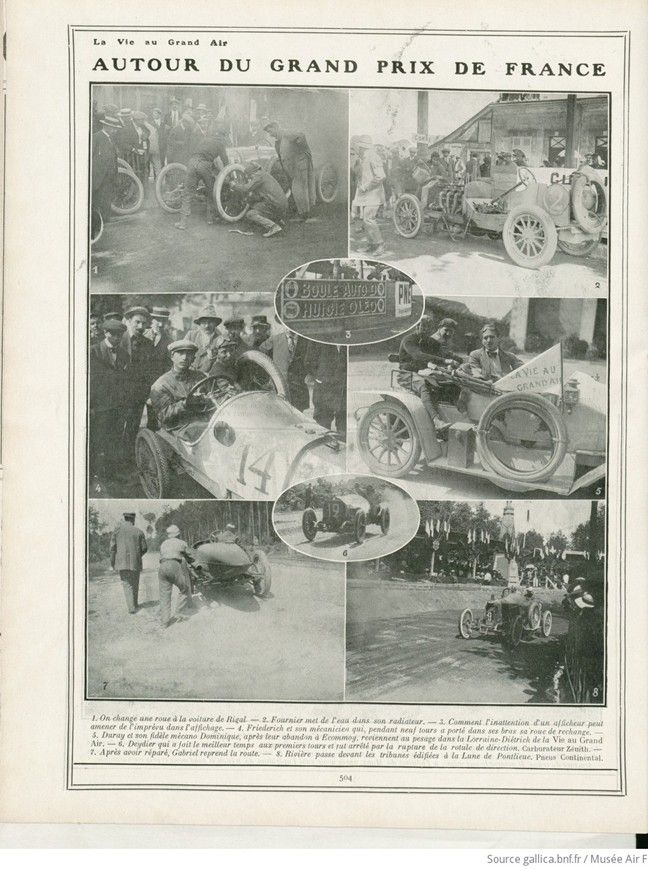
AROUND THE FRENCH GRAND PRIX
1. A wheel is changed on Rigal’s car. — 2. Fournier puts water in his radiator. – 3. How a display operator’s inattention can lead to unexpected results. — 4. Friederich and his mechanic, who carried his spare wheel in his arms for nine laps. — 5. Duray and his loyal mechanic Dominique, after retiring at Ecommoy, return to the weigh-in in the Lorraine-Diétrich de la Vie au Grand Air. — 6. Deydier, who set the fastest time in the early laps, was stopped by a broken steering ball joint. Zéuith carburetor. — 7. After repairs, Gabriel gets back on the road. — 8. Rivière passes in front of the grandstands built at La Lune de Pontlieue. Continental tires.
Page 505.
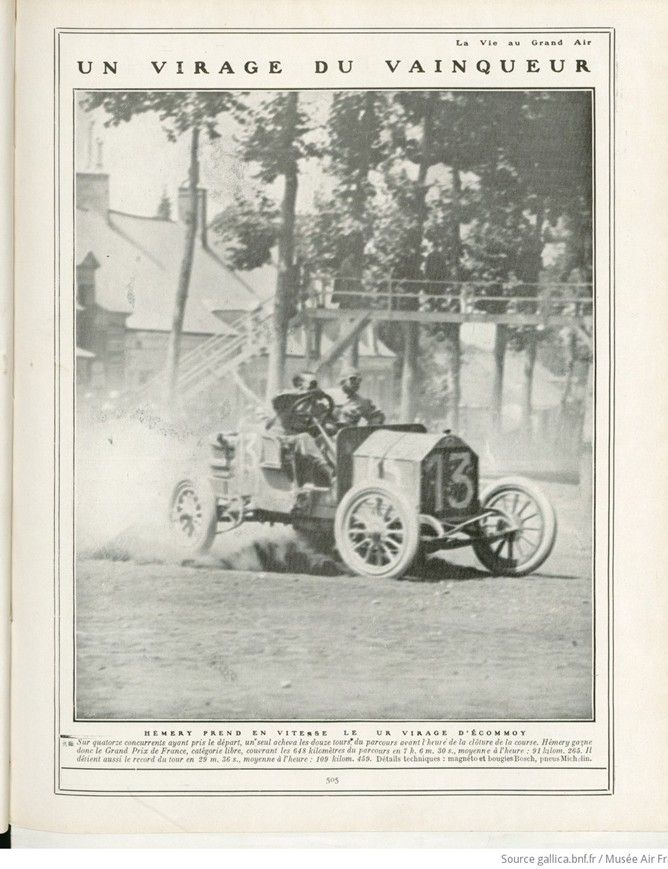
A CURVE BY THE WINNER
HÉMERY TAKES THE TURN AT ÉCOMMOY AT SPEED
Of the fourteen competitors who started, only one completed the twelve laps of the course before the race closed. Hémery therefore wins the French Grand Prix, open category, covering the 648 kilometers of the course in 7 hours.
6 min. 30 sec., average speed: 91 kilometers per hour. He also holds the lap record at 29 min. 36 sec., average speed: 109 kilometers per hour. Technical details: Bosch magneto and spark plugs, Michelin tires.