Text and photos by authorisation of Bibliothèque national francais, gallica.bnf.fr, www.gallica.bnf.fr, compiled by motorracinghistory.com
Les Sports Modernes, 8e Année, IIe Série, No. 2, juin 1905
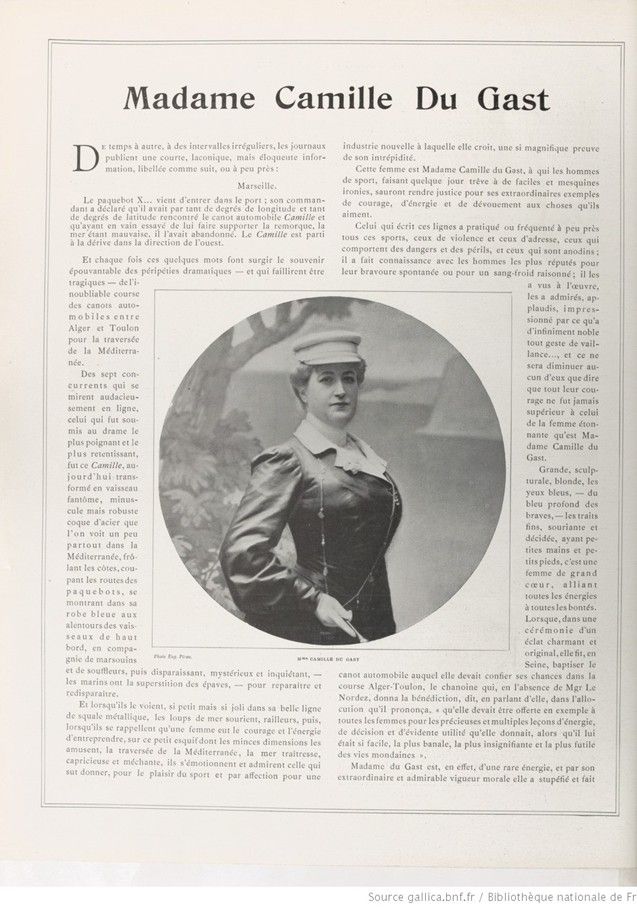
Mrs. Camille Du Gast
From time to time, at irregular intervals, newspapers publish a short, laconic, but eloquent piece of information, worded as follows, or thereabouts:
Marseille.
The liner X… has just entered the port; its captain reported that at such and such degrees of longitude and latitude, he encountered the motorboat Camille and, having tried in vain to tow it due to rough seas, abandoned it. The Camille drifted westward.
And each time these few words bring back the terrible memory of the dramatic events—which could have been tragic—of the unforgettable motorboat race between Algiers and Toulon across the Mediterranean.
Of the seven competitors who boldly lined up at the start, the one that suffered the most poignant and resounding drama was the Camille, now transformed into a ghost ship, a tiny but sturdy steel hull that can be seen everywhere in the Mediterranean, skimming the coastline, cutting across the paths of ocean liners, showing itself in its blue dress around deep-sea vessels, accompanied by porpoises and blowfish, then disappearing, mysterious and disturbing—sailors are superstitious about shipwrecks—only to reappear and disappear again.
And when they see it, so small but so pretty in its beautiful metallic shark-like form, the sea dogs smile mockingly, then, when they remember that a woman had the courage and energy to undertake, on this small skiff whose slim dimensions amuse them, the crossing of the Mediterranean, the treacherous, capricious, and cruel sea, they are moved and admire the woman who, for the pleasure of the sport and out of affection for a new industry in which she believes, gave such magnificent proof of her fearlessness.
That woman is Madame Camille du Gast, to whom sportsmen, putting aside their facile and petty ironies for a day, will do justice for her extraordinary examples of courage, energy, and devotion to the things they love.
The author of these lines has practiced or frequented almost all of these sports, those involving violence and those involving skill, those involving danger and peril, and those that are harmless; he has become acquainted with the men most renowned for their spontaneous bravery or their reasoned composure; he has seen them in action, admired them, applauded them, impressed by the infinite nobility of every act of valor… and it would be no slight to any of them to say that their courage was never greater than that of the astonishing woman who is Madame Camille du Gast.
Tall, statuesque, blonde, with blue eyes—the deep blue of the brave—fine features, smiling and determined, with small hands and feet, she is a woman of great heart, combining all energies with all kindness. When, in a charming and original ceremony, she had the motorboat christened on the Seine, to which she was to entrust her chances in the Algiers-Toulon race, the canon who, in the absence of Monsignor Le Nordez, gave the blessing, said of her in his speech, “that she should be held up as an example to all women for the valuable and manifold lessons in energy, determination, and obvious usefulness that she gave, when it would have been so easy for her to lead the most banal, insignificant, and futile of social lives.”
Madame du Gast is, indeed, a woman of rare energy, and with her extraordinary and admirable moral vigor, she has astonished and earned the most genuine and absolute admiration of all the officers of the cruisers and destroyers to whom Admiral Gourdon, commander of the Mediterranean squadron, had entrusted the safety of the competitors in the Algiers-Toulon race.
Madame du Gast’s life is nothing but a series of fearless acts and gestures of kindness; it is permissible to speak of the former, but discretion is the way to respect the latter.
An accomplished sportswoman—there is certainly no one more complete—she has successfully and brilliantly practiced all the fastest, most violent, most difficult, and most elegant sports. A distinguished mountaineer, she has accomplished the most difficult and daring ascents, on the most famous glaciers and the steepest peaks. she has been captivated by ice sports; she has experienced the exhilarating sensations of tobogganing down snowy slopes at breakneck speed and the light and harmonious swaying of bodies gliding across the ice under the attack of steel skates; as an excursionist, she has traveled far north to Sweden and Norway.
A fencer with a supple and sure hand, she rolls the counter-fourth with speed and precision; she wields the foil and the sword.
She also wields the rifle and the pistol, for she is passionate about hunting sports. She has hunted on foot and on horseback, spending a great deal of time on horseback, with a particular fondness for hunting with hounds. She has also achieved great feats in this field, serving a superb wild boar with a knife and a steady hand.
As a huntress, Madame Camille du Gast is therefore an accomplished horsewoman; she rides to perfection, with the skill of a horsewoman and the strength of a horseman; she has two saddle horses that she adores, the black Sigurd and the chestnut Hieda, with which she trots and gallops through all the paths of the Bois de Boulogne and jumps the obstacles at the Tir aux Pigeons.
Inevitably, modern sports were bound to win over this energetic woman: ballooning, motor cars, and motorboats captivated her in turn.
In ballooning, she engaged in experiments that few men had the courage to attempt; if ascending in a free balloon is already marked by a certain degree of bravado, descending by parachute from an altitude of five or six hundred meters is an act of heroism.
In 1895, Madame du Gast made two parachute descent attempts that nearly proved fatal. She made them in the company of the famous aeronaut Capazza; both took place in Paris; the first attempt was particularly thrilling.
Capazza piloted the balloon, which carried the closed parachute carrying Madame du Gast, suspended by a rope from its basket. When the moment came to cut the rope, Capazza feared for the intrepid woman and, in a strangled voice, begged her to abandon her plan.
“It’s time to cut the rope,” she replied. “Cut it!”
Capazza refused, and several hundred meters in the air, a struggle ensued between Madame du Gast, who was determined to jump, and Capazza, who regretted having agreed to the experiment.
Madame du Gast prevailed.
“Cut it,” she said, “or I’ll be reckless!”
Reckless! The word was charming in the circumstances. Capazza drew his knife, and slowly the blade cut the cable holding the parachute. The landing was most eventful; after a dizzying descent, the apparatus opened under the pressure of the air and descended on Paris, reaching the Faubourg Saint-Antoine, where, caught by the wind, it made a perilous excursion over the houses.
“The basket played with the chimneys like a ball with skittles,” declared Madame du Gast, who took… landed on a roof.
And the fact is that on that day, the Parisians of the Faubourg Saint-Antoine could have believed in some celestial phenomenon; bricks rained down on their heads.
Having acquired a taste for it, Madame Camille du Gast renewed her attempt in 1895. This time, she descended on Rothschild Island; and came within a few meters of falling into the Seine and drowning.
Many women drive cars today, but Madame du Gast took up motor racing from the very beginning of the sport.
Holding the wheel with rare precision and admirable composure, Madame du Gast raced, and raced successfully. Her finest performance was in the Paris-Madrid race.
Starting among the last, she had passed most of her competitors one by one and, upon arriving in Angoulême, was ranked among the winners who had achieved the highest speed between Paris and Tours, when she saw, at the side of the road, the broken car of one of her rivals, Stead, who was lying in a desperate state, bleeding, at the foot of a tree.
She stopped, abandoned the race, gave up the glory of success, and lavished care on the injured man, which probably saved his life.
The last sport to win her over was motor yachting.
She began in 1904, in races held on the Seine, in the Juvisy basin; she proved herself to be a skilled and decisive helmswoman in the Monaco meeting this year; the daring challenge of the Matin Alger-Toulon race decided her, and she signed up.
Second in the first stage from Algiers to Mahon, she seems to have gone the furthest in the second stage from Mahon to Toulon. It is indisputably her boat, the Camille, which, in a straight line, on the Algiers-Toulon crossing, covered the longest distance in the shortest time; and it is she, if anyone, who should win the Mediterranean Cup.
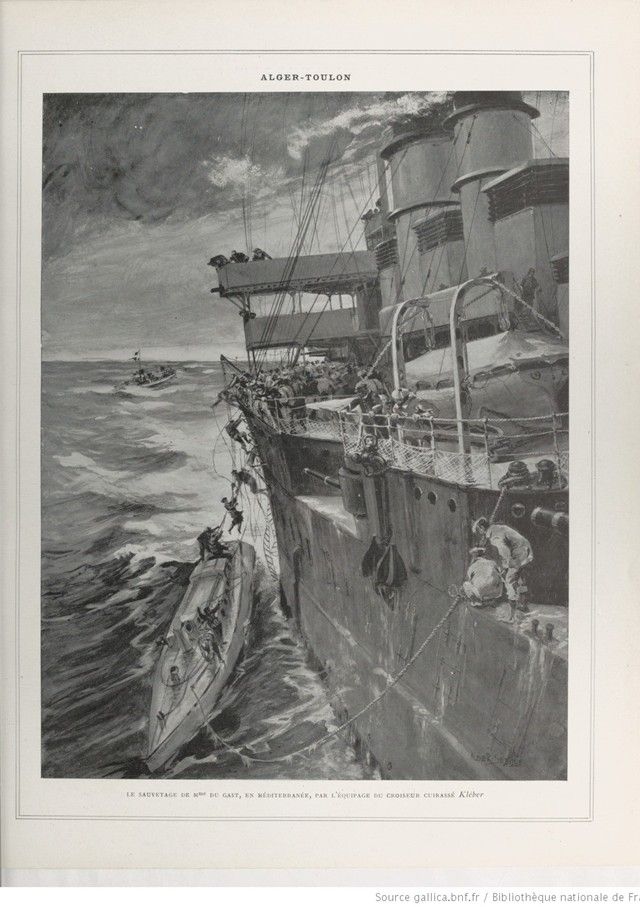
Caught in the storm, Madame du Gast and her valiant companion in the struggle, Lieutenant Menier, were forced to abandon the race, brought to distress by the physical exhaustion of their crew. The newspapers then recounted the moving rescue by the Kléber of this heroic woman, whose first words were a touching “thank you” to the cruiser’s sailors, and her second a quip:
“What a great story for the journalists! “
A woman of wit, an incomparable musician, a scholar, and a sportswoman, Madame du Gast was entitled to a place of honor in the social gallery of modern sports.
FRANTZ REICHEL.
Photo captions.
Page 4. Photo by Eug. Pirou. Mrs. CAMILLE DU GAST Page 5. ALGIERS-TOULON – THE RESCUE OF MRS. DU GAST IN THE MEDITERRANEAN BY THE CREW OF THE ARMORED CRUISER Kléber