
Text and jpegs by courtesy of hathitrust.org www.hathitrust.org, compiled by motorracinghistory.com
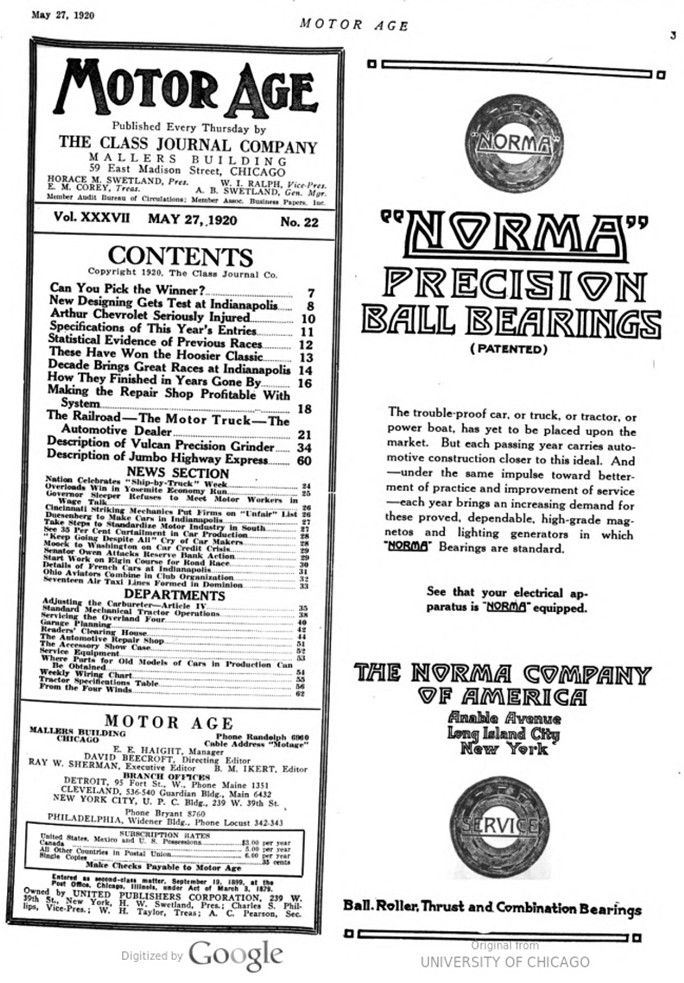
Motor Age, Vol. XXXVII, No. 22, May 27, 1920, page 7 – 13 / In This Issue: Indianapolis Race Entries
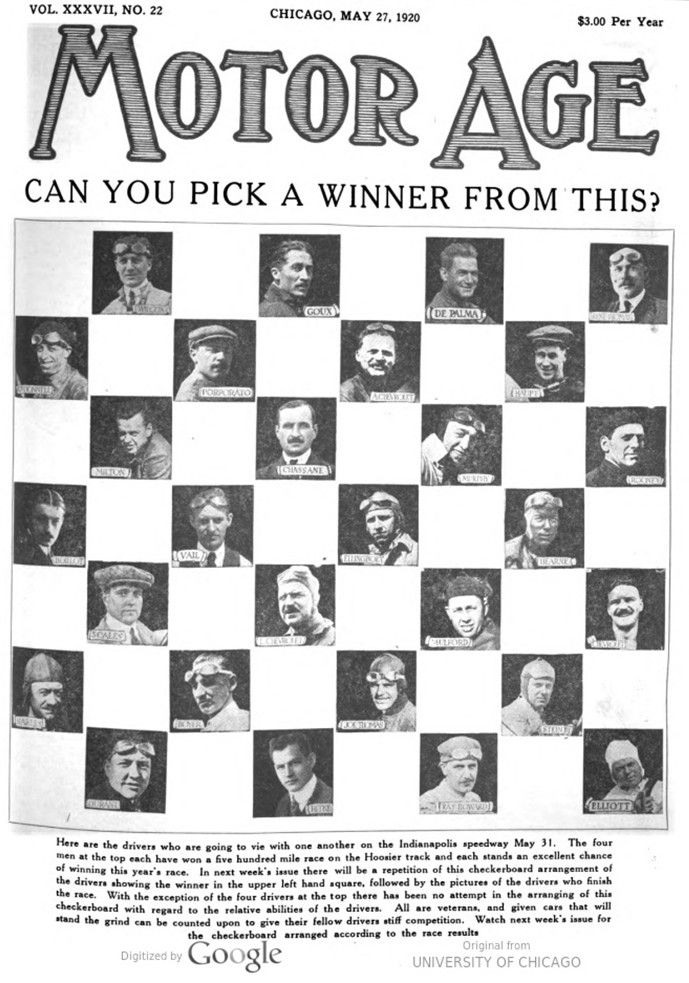
CAN YOU PICK A WINNER FROM THIS?
O’DONNELL – MILTON – WILCOX – BOILLOT – VAIL – SCALES – PORPORATO – GOUX – DE PALMA – CHASSANGE – L. CHEVROLET – A. CHEVROLET – HAUPT – ELLINGBOE – JOE THOMAS – SARLES – BOYER – A. MURPHY – HEARNE – RENE THOMAS – MULFORD – CHEVROLET – STEIN – ROONEY – DURANT – HITKE – FRAY – HOWARD -ELLIOTT
Here are the drivers who are going to vie with one another on the Indianapolis speedway May 31. The four men at the top each have won a five-hundred-mile race on the Hoosier track and each stands an excellent chance of winning this year’s race. the drivers showing the winner in the upper left-hand square, followed by the pictures of the drivers who finish In next week’s issue there will be a repetition of this checkerboard arrangement of the race. With the exception of the four drivers at the top there has been no attempt in the arranging of this checkerboard with regard to the relative abilities of the drivers. stand the grind can be counted upon to give their fellow drivers stiff, competition. Watch next week’s issue for All are veterans, and given cars that will the checkerboard arranged according to the race results
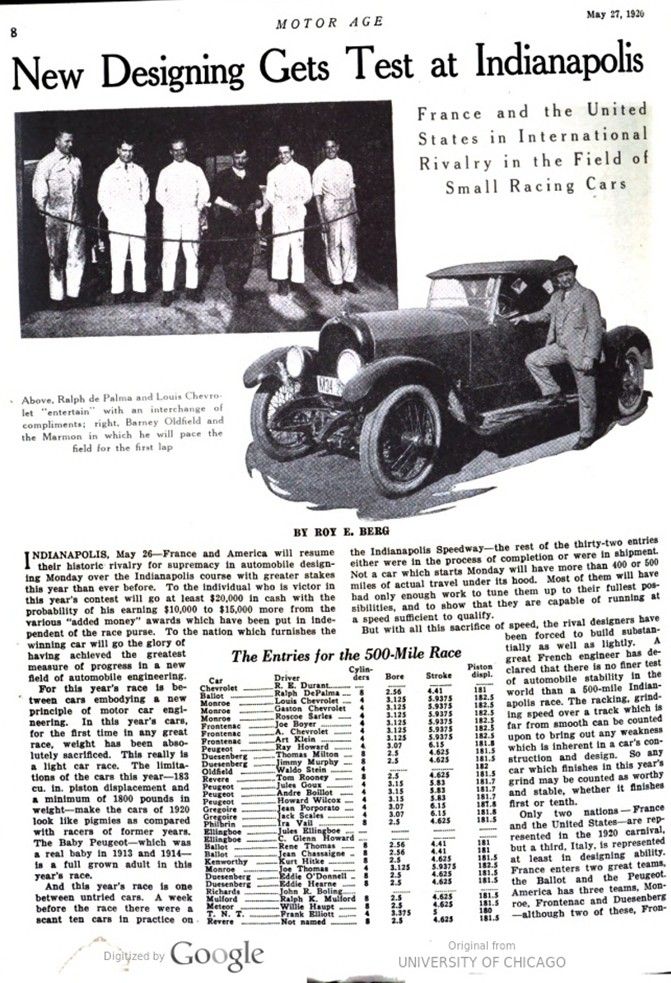
New Designing Gets Test at Indianapolis
Performance of Racers at Indianapolis.
France and the and the United States in International Rivalry in the Field of Small Racing Cars
BY ROY E. BERG
INDIANAPOLIS, May 26 – France and America will resume their historic rivalry for supremacy in automobile designing Monday over the Indianapolis course with greater stakes this year than ever before. To the individual who is victor in this year’s contest will go at least $20,000 in cash with the probability of his earning $10,000 to $15,000 more from the various „added money“ awards which have been put in independent of the race purse. To the nation which furnishes the winning car will go the glory of having achieved the greatest measure of progress in a new field of automobile engineering.
For this year’s race is between cars embodying a new principle of motor car engineering. In this year’s cars, for the first time in any great race, weight has been absolutely sacrificed. This really is a light car race. The limitations of the cars this year – 183 cu. in. displacement and a minimum of 1800 pounds in weight – make the cars of 1920 look like pigmies as compared with racers of former years. The Baby Peugeot – which was a real baby in 1913 and 1914 – Is a full grown adult in this year’s race.
And this year’s race is one between untried cars. A week before the race there were a scant ten cars in practice on the Indianapolis Speedway – the rest of the thirty-two entries either were in the process of completion or were in shipment. Not a car which starts Monday will have more than 400 or 500 miles of actual travel under its hood. Most of them will have had only enough work to tune them up to their fullest possibilities, and to show that they are capable of running at a speed sufficient to qualify.
But with all this sacrifice of speed, the rival designers have been forced to build substantially as well as lightly. A great French engineer has declared that there is no finer test of automobile stability in the world than a 500-mile Indianapolis race. The racking, grinding speed over a track which is far from smooth can be counted upon to bring out any weakness which is inherent in a car’s construction and design. So any car which finishes in this year’s grind may be counted as worthy and stable, whether it finishes first or tenth.
Only two nations – Rrance and the United States – are represented in the 1920 carnival, but a third, Italy, is represented at least in designing ability. France enters two great teams, the Ballot and the Peugeot. America has three teams, Monroe, Frontenac and Duesenberg – although two of these, Frontenac and Monroe, are identical in design. But America has several individual entries aside from its teams, so the United States may be held to have a considerably greater preponderance of design entries than its chief rival.
Gregoire’s French-Italian Combination
Italy is represented only in part, for the Gregoire cars are ostensibly of French design and originally were designed by French engineers, only to be redesigned and changed by Porporato, an Italian. England disappointed by failing to give her entry on account of the inability of the English engineers of the Sunbeam to get their cars ready; Italy lost a chance for full representation because of similar inability on the part of Fiat engineers; Germany is not represented because German engineers were given to understand that their presence was not desired, this year at least.
The very appearance of the cars this year bears out the improvements which have been made in automobile design and building. Instead of huge engines depending upon the brute force of terrific power for their speed, we have this year small, lightly designed machinery of almost superhuman cunningness of operation. Quantity in excess has been replaced with quantity reduced minimum. to a Quality is the dominating factor in this year’s cars; quality in materials; quality in workmanship; quality in design.
Designer’s Work Is Apparent
One cannot but see the hand of the designer in the cars. It is a touch here and a touch there; the streamlining of the front axles; the tie rods; the more nearly perfect contour of the bodies; the perfection of the lubricating system; the chassis oiling. All denote the progress toward the one ideal-perfect trans- formation of gasoline energy into forward motion. The fact that few cars had put in an appearance on the track less than a week before the race is not alarming when one considers the obstacles which have been overcome in the construction of those cars since last year.
Cars Seem to Be Speedy
Those cars which have made their appearance on the track to date are decidedly fast. Ralph DePalma has been working his Ballot at the rate of 95 to 100 m.p.h. Chassagne, also in a Ballot, has made several laps at better than 95 m.p.h. These Ballot cars are a redevelopment of the four Ballot jobs that were here last year, except, of course, that they are smaller as regards piston dis- placement. They weight, with the majority of the weight are very light in carried at an exceptionally low center of gravity. The three cars are representative of European practice in that the driver’s seat was placed rather high. Ralph DePalma has rebuilt the seating arrangement in his car, lowering it, which gives the car a smarter appearance.
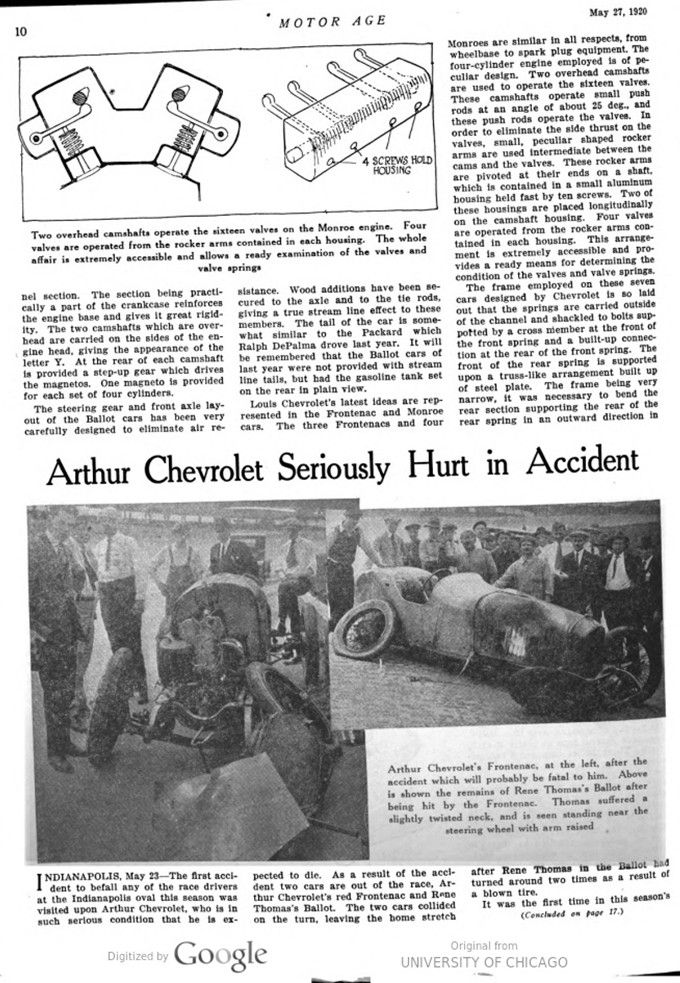
The engines in the Ballot cars are carried in a sub-frame made of a channel section. The section being practically a part of the crankcase, reinforces the engine base and gives it great rigidity. The two camshafts which are overhead are carried on the sides of the engine head, giving the appearance of the letter Y. At the rear of each camshaft is provided a step-up gear which drives the magnetos. One magneto is provided for each set of four cylinders.
The steering gear and front axle layout of the Ballot cars has been very carefully designed to eliminate air resistance. Wood additions have been secured to the axle and to the tie rods, giving a true streamline effect to these members. The tail of the car is somewhat similar to the Packard which Ralph DePalma drove last year. It will be remembered that the Ballot cars of last year were not provided with streamline tails, but had the gasoline tank set on the rear in plain view.
Louis Chevrolet’s latest ideas are represented in the Frontenac and Monroe cars. The three Frontenacs and four Monroes are similar in all respects, from wheelbase to spark plug equipment. The four-cylinder engine employed is of peculiar design. Two overhead camshafts are used to operate the sixteen valves. These camshafts operate small push rods at an angle of about 25 deg., and these push rods operate the valves. In order to eliminate the side thrust on the valves, small, peculiar shaped rocker arms are used intermediate between the cams and the valves. These rocker arms are pivoted at their ends on a shaft, which is contained in a small aluminum housing held fast by ten screws. Two of these housings are placed longitudinally on the camshaft housing. Four valves are operated from the rocker arms contained in each housing. This arrangement is extremely accessible and pro- vides a ready means for determining the condition of the valves and valve springs.
The frame employed on these seven cars designed by Chevrolet is so laid out that the springs are carried outside of the channel and shackled to bolts supported by a cross member at the front of the front spring and a built-up connection at the rear of the front spring. The front of the rear spring is supported upon a truss-like arrangement built up of steel plate. The frame being very narrow, it was necessary to bend the rear section supporting the rear of the rear spring in an outward direction in order that the spring pads of the axles would be as close to the outside as possible.
A great deal of tuning up has been going on with all of these seven cars.
Different timing is being tried out, and apparently some of the tryouts have produced satisfying results, for the speed has been very fast.
There have been so few cars on the track to date that it is impossible to give a representative statement concerning the relative speed possibilities of the cars. However, all of them are faster by at least ten miles than the speed at which the race will probably be won. The track is not in the best condition. The hollow at the turn leaving the home stretch is still existent and the drivers are very cautious when entering this turn.
It seems as if the entrants are trying to force a winner through by combination and strategy. The entry list includes three Ballots, four Monroes, three Frontenacs, three Peugeots, two Gregoires, four Duesenbergs and six other Duesenberg engine cars entered by individuals. There are also other individual cars entered singly. The teams are care- fully picked. The master drivers from the four corners of the earth are presnt. Included in the list of drivers is Jimmy Murphy, who recently obtained a speed of 157 m.p.h. at Daytona, and who won the Los Angeles race.
FACTS ABOUT THIS YEAR’S RACE AT INDIANAPOLIS BRIEFLY TOLD
Distance – 500 miles.
Purse $50,000; $20,000 to first; $10,000 to second; $5,000 to third; $3,500 to fourth; $3,000 to fifth; $2,200 to sixth; $1,800 to seventh; $1,600 to eighth; $1,500 to ninth; $1,400 to tenth.
Added prizes-$20,000 added by Indianapolis businessmen, $100 to leader at end of each lap; $15,000 added by accessory manufacturers to winners using their products.
Race starts-10 a. m. Probable duration – About five and one-half hours. Total number of entries-32; probable starters, 29.
Grandstand accommodates 60,000 persons; parking spaces accommodate 200,000; expected attendance, 125,000.
Track measures 2½ miles to the lap, is 60 ft. wide with 2000 ft. turns banked at angle of 16 deg.
Former Winners M.P.H.
1911. R. Harroun (Marmon)….74.49
1912 J. Dawson (National)….78.72
1913 J. Goux (Peugeot)……75.92
1914 R. Thomas (Delage)……82.47
1915 R. De Palma (Mercedes)…89.84
1916 Dario Resta (Peugeot)…84.05
1919 H. Wilcox (Peugeot)……87.95
Statistical Evidence of Indianapolis Races
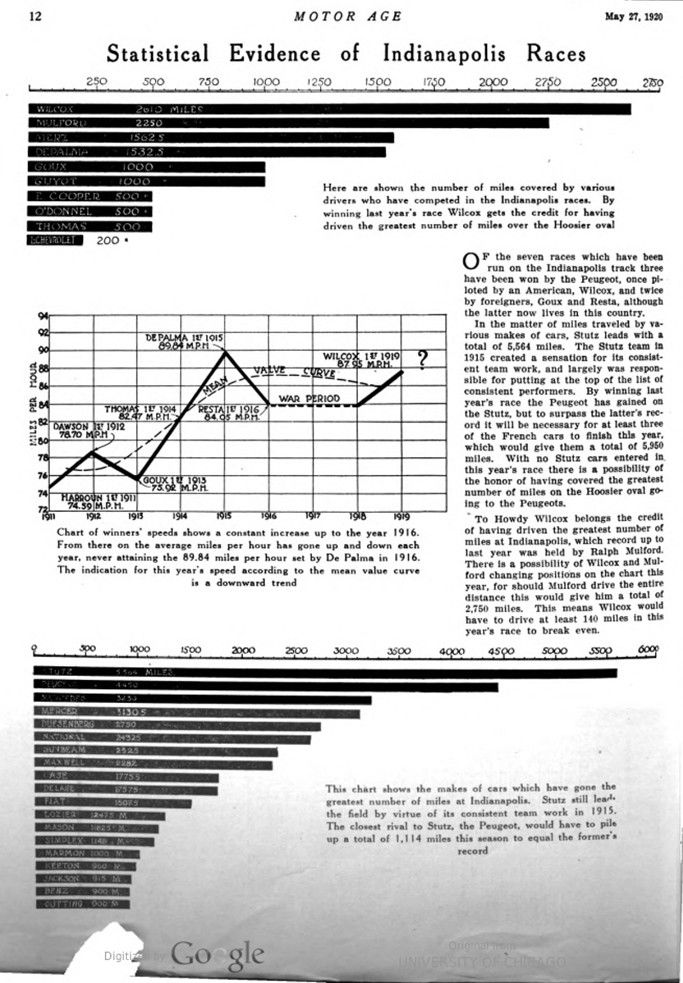
OF the seven races which have been run on the Indianapolis track three have been won by the Peugeot, once piloted by an American, Wilcox, and twice by foreigners, Goux and Resta, although the latter now lives in this country.
In the matter of miles traveled by various makes of cars, Stutz leads with a total of 5,564 miles. The Stutz team in 1915 created a sensation for its consistent team work, and largely was responsible for putting at the top of the list of consistent performers. By winning last year’s race the Peugeot has gained on the Stutz, but to surpass the latter’s record it will be necessary for at least three of the French cars to finish this year, which would give them a total of 5,950 miles. With no Stutz cars entered in this year’s race there is a possibility of the honor of having covered the greatest number of miles on the Hoosier oval going to the Peugeots.
To Howdy Wilcox belongs the credit of having driven the greatest number of miles at Indianapolis, which record up to last year was held by Ralph Mulford. There is a possibility of Wilcox and Mul- ford changing positions on the chart this year, for should Mulford drive the entire distance this would give him a total of 2,750 miles. This means Wilcox would have to drive at least 140 miles in this year’s race to break even.
WILCOX 2610 MILES – MULFORD 2250 – MERZ 1562.5 – DEPALMA 1532.5 – GOUX 1000 – GUYOT 1000 – E. COOPER 500 – O’DONNEL 500 – THOMAS 500 – L. CHEVROLET 200. Here are shown the number of miles covered by various drivers who have competed in the Indianapolis races. By winning last year’s race Wilcox gets the credit for having driven the greatest number of miles over the Hoosier oval
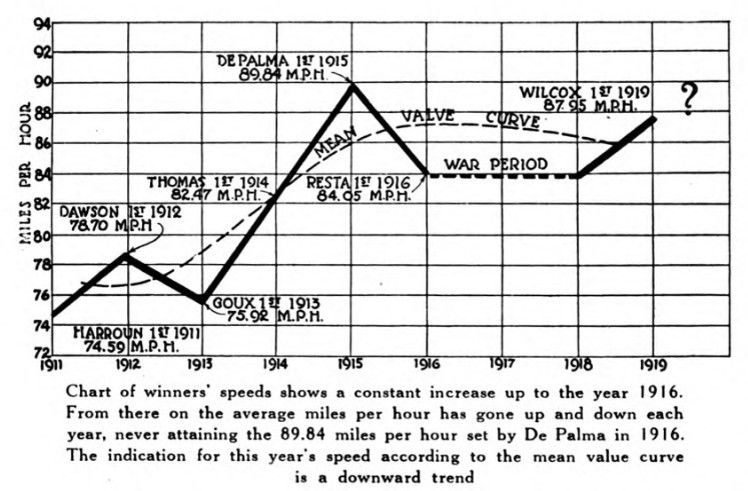
HARROUN 1ST 1911 74.59 M.P.H.
DAWSON 1ST 1912 78.70 M.P.H.
GOUX 1ST 1913 75.92 M.P.H.
THOMAS 1ST 1914 82.47 M.P.H.
DE PALMA 1ST 1915 89.84 M.P.H.
RESTA 1ST 1916 84.05 M.P.H.
WILCOX 1ST 1919 87.95 M.P.H.
MEAN VALVE CURVE – WAR PERIOD
Chart of winners‘ speeds shows a constant increase up to the year 1916. From there on the average miles per hour has gone up and down each year, never attaining the 89.84 miles per hour set by De Palma in 1916. The indication for this year’s speed according to the mean value curve is a downward trend
STUTZ 5564 MILES – PEUGEOT 4450 – MERCEDES 3230 – MERCER 3130.5 – DUESENBERG 2750 – NATIONAL 2432.5 – SUNBEAM 232.5 – MAXWELL 228.2 – CASE 1775.5 – DELAGE 1757.5 FIAT 1507.5 – LOZIER 1247.5 – MASON 1182.5 – SIMPLEX 1148 – MARMON 1000 – KEETON 960 . JACKSON 915 – BENZ 900 – CUTTING 900
This chart shows the makes of cars which have gone the greatest number of miles at Indianapolis. Stutz still leads the field by virtue of its consistent team work in 1915. The closest rival to Stutz, the Peugeot, would have to pile up a total of 1,114 miles this season to equal the former’s record
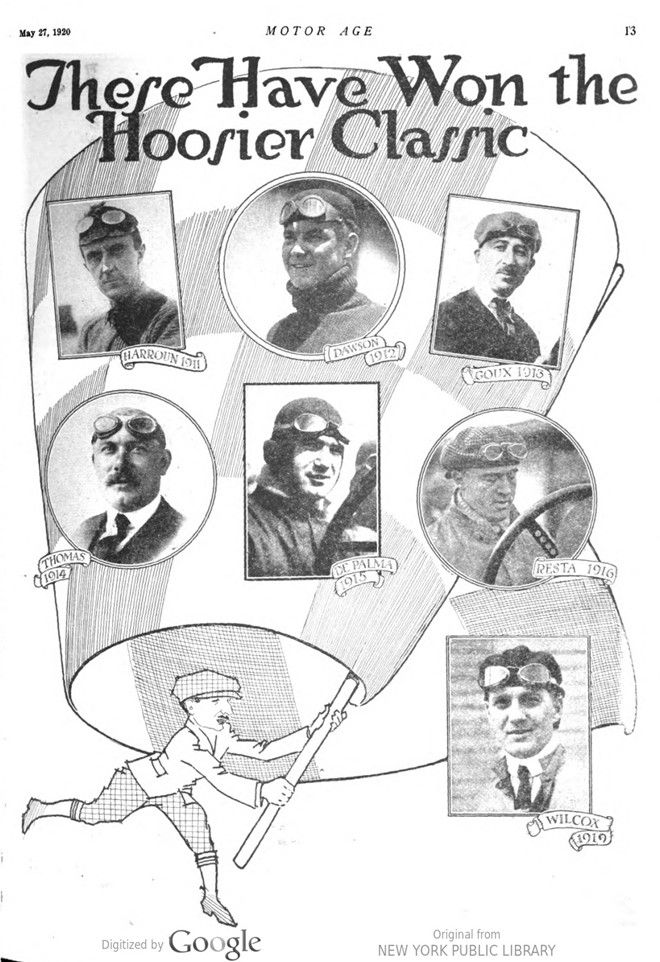
These Have Won the Hoosier Classic
THOMAS 1914 – HARROUN 1911 – DAWSON 1912 – GOUX 1913 – DE PALMA 1915 – RESTA 1916 – WILCOX 1919
Photo captions.
Page 8.
Above, Ralph de Palma and Louis Chevrolet „entertain“ with an interchange of compliments; right, Barney Oldfield and the Marmon in which he will pace the field for the first lap.
Page 9.
1. Rene Thomas’s Ballot. 2. L. Chevrolet’s Monroe looks like a bullet in flight. 3. The Peugeot has all the refinements of the thoroughbred racer. 4. The Ballot De Palma will pilot. 5. Porporato’s Gregoire. 6. One of the older Peugeots to be tooled by Howard
Page 10.
Two overhead camshafts operate the sixteen valves on the Monroe engine. Four valves are operated from the rocker arms contained in each housing. The whole affair is extremely accessible and allows a ready examination of the valves and valve springs.
Arthur Chevrolet’s Frontenac, at the left, after the accident which will probably be fatal to him. Above is shown the remains of Rene Thomas’s Ballot after being hit by the Frontenac. Thomas suffered a slightly twisted neck, and is seen standing near the steering wheel with arm raised.
Page 11.
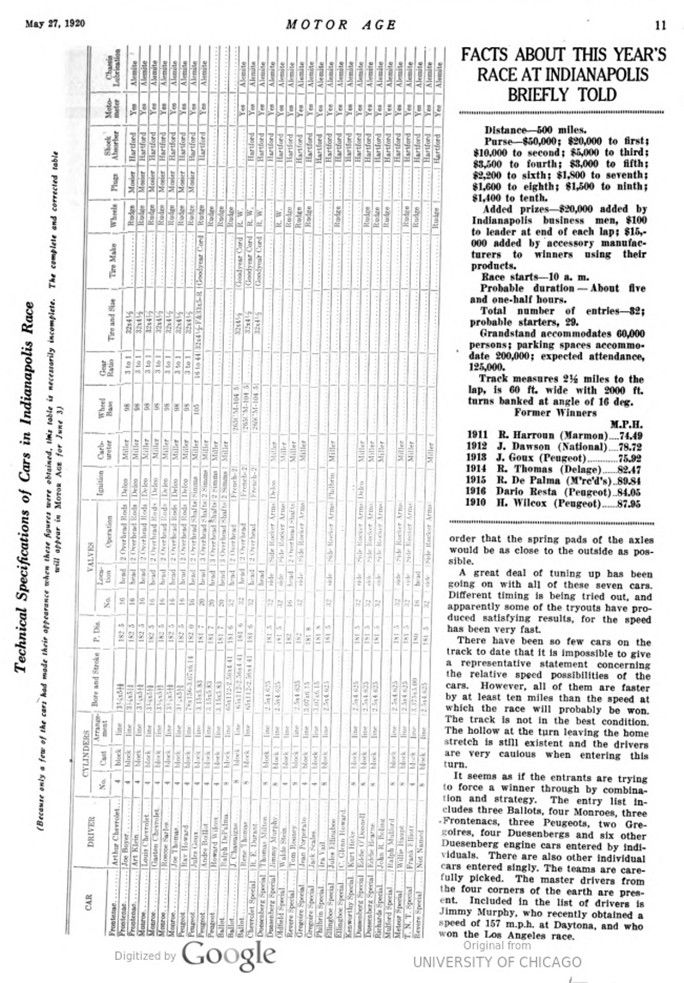
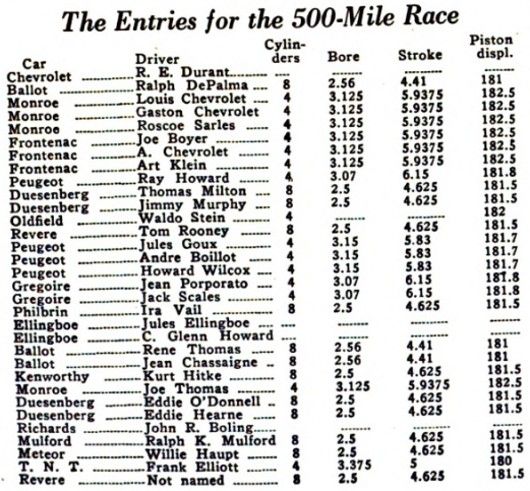
Technical Specifications of Cars in Indianapolis Race
(Because only a few of the cars had made their appearance when these figures were obtained, this table is necessarily incomplete. The complete and corrected table will appear in MOTOR AGE for June 3)