Text and jpegs by courtesy of hathitrust.org www.hathitrust.org, compiled by motorracinghistory.com
THE AUTOMOBILE VOL. XXVI, No. 23 NEW YORK-CHICAGO, THURSDAY, JUNE 6, 1912 page 1263-1266
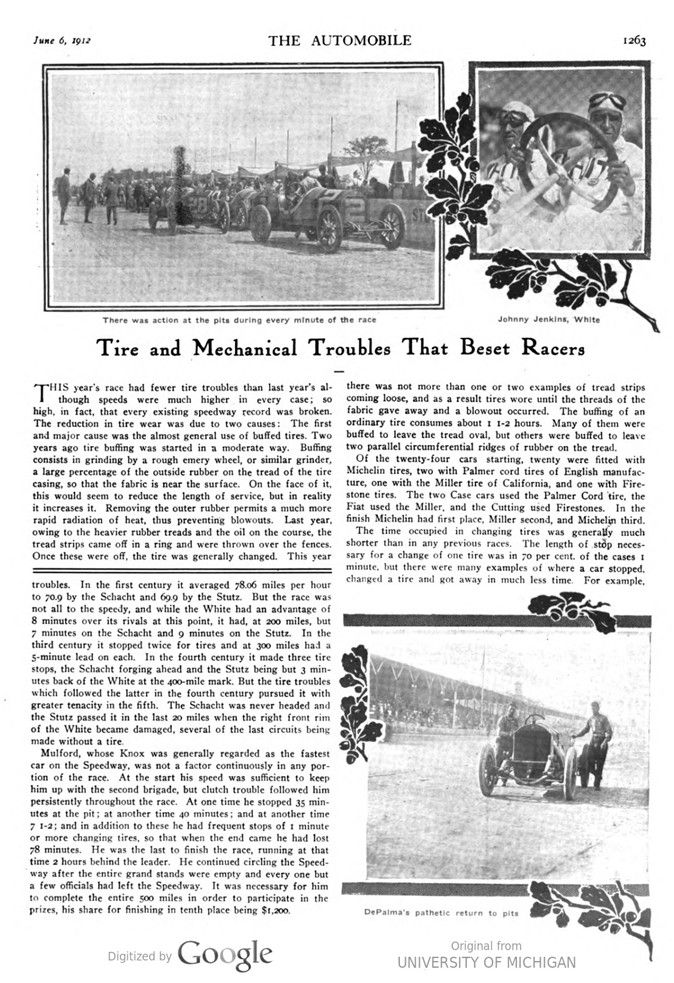
Tire and Mechanical Troubles That Beset Racers
THIS year’s race had fewer tire troubles than last year’s al- though speeds were much higher in every case; high, in fact, that every existing speedway record was broken. The reduction in tire wear was due to two causes : The first and major cause was the almost general use of buffed tires. Two years ago tire buffing was started in a moderate way. Buffing consists in grinding by a rough emery wheel, or similar grinder, a large percentage of the outside rubber on the tread of the tire casing, so that the fabric is near the surface. On the face of it, this would seem to reduce the length of service, but in reality it increases it. Removing the outer rubber permits a much more rapid radiation of heat, thus preventing blowouts. Last year, owing to the heavier rubber treads and the oil on the course, the tread strips came off in a ring and were thrown over the fences. Once these were off, the tire was generally changed. This year there was not more than one or two examples of tread strips coming loose, and as a result tires wore until the threads of the fabric gave away and a blowout occurred. The buffing of an ordinary tire consumes about 1 1-2 hours. Many of them were buffed to leave the tread oval, but others were buffed to leave two parallel circumferential ridges of rubber on the tread.
Of the twenty-four cars starting, twenty were fitted with Michelin tires, two with Palmer cord tires of English manufacture, one with the Miller tire of California, and one with Fire- stone tires. The two Case cars used the Palmer Cord tire, the Fiat used the Miller, and the Cutting used Firestones. In the finish Michelin had first place, Miller second, and Michelin third. The time occupied in changing tires was generally much shorter than in any previous races. The length of stop necessary for a change of one tire was in 70 per cent. of the cases I minute, but there were many examples of where a car stopped, changed a tire and got away in much less time. For example, DePalma in lap 88 stopped, changed a right front, and was gone in the remarkable time of 30 seconds. Wishart in another Mercedes completed the operation of changing a right rear tire in lap 52 in the same time.
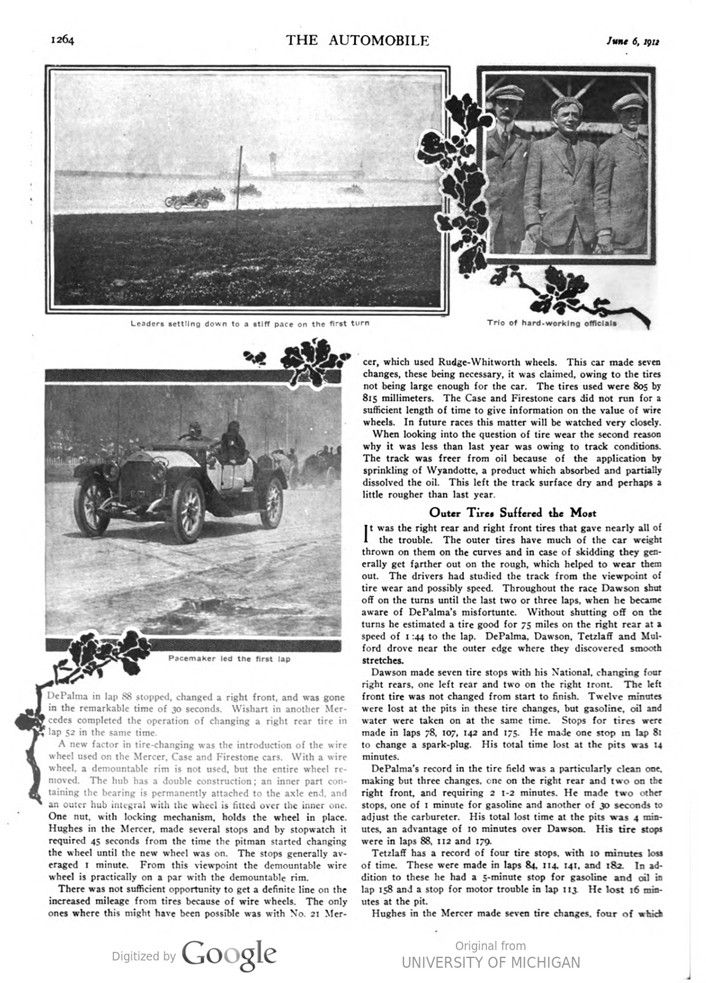
A new factor in tire-changing was the introduction of the wire wheel used on the Mercer, Case and Firestone cars. With a wire wheel, a demountable rim is not used, but the entire wheel removed. The hub has a double construction; an inner part containing the bearing is permanently attached to the axle end, and an outer hub integral with the wheel is fitted over the inner one. One nut, with locking mechanism, holds the wheel in place. Hughes in the Mercer, made several stops and by stopwatch it required 45 seconds from the time the pitman started changing the wheel until the new wheel was on. The stops generally averaged 1 minute. From this viewpoint the demountable wire wheel is practically on a par with the demountable rim.
There was not sufficient opportunity to get a definite line on the increased mileage from tires because of wire wheels. The only ones where this might have been possible was with No. 21 Mercer, which used Rudge-Whitworth wheels. This car made seven changes, these being necessary, it was claimed, owing to the tires not being large enough for the car. The tires used were 805 by 815 millimeters. The Case and Firestone cars did not run for a sufficient length of time to give information on the value of wire wheels. In future races this matter will be watched very closely.
When looking into the question of tire wear the second reason why it was less than last year was owing to track conditions. The track was freer from oil because of the application by sprinkling of Wyandotte, a product which absorbed and partially dissolved the oil. This left the track surface dry and perhaps a little rougher than last year.
Outer Tires Suffered the Most
It was the right rear and right front tires that gave nearly all of the trouble. The outer tires have much of the car weight thrown on them on the curves and in case of skidding they generally get farther out on the rough, which helped to wear them out. The drivers had studied the track from the viewpoint of tire wear and possibly speed. Throughout the race Dawson shut off on the turns until the last two or three laps, when he became aware of DePalma’s misfortunte. Without shutting off on the turns he estimated a tire good for 75 miles on the right rear at a speed of 1:44 to the lap. DePalma, Dawson, Tetzlaff and Mulford drove near the outer edge where they discovered smooth stretches.
Dawson made seven tire stops with his National, changing four right rears, one left rear and two on the right front. The left front tire was not changed from start to finish. Twelve minutes were lost at the pits in these tire changes, but gasoline, oil and water were taken on at the same time. Stops for tires were made in laps 78, 107, 142 and 175. He made one stop in lap 81 to change a spark-plug. His total time lost at the pits was 14 minutes.
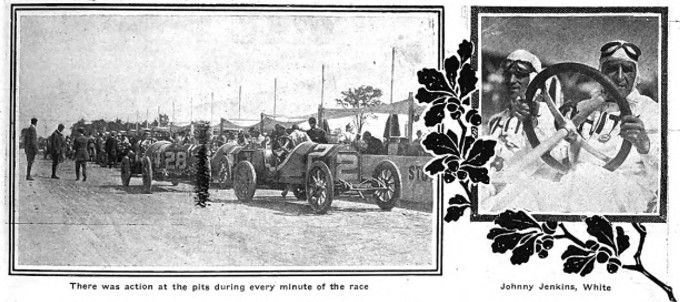
DePalma’s record in the tire field was a particularly clean one, making but three changes, one on the right rear and two on the right front, and requiring 2 1-2 minutes. He made two other stops, one of 1 minute for gasoline and another of 30 seconds to adjust the carbureter. His total lost time at the pits was 4 minutes, an advantage of 10 minutes over Dawson. His tire stops were in laps 88, 112 and 179.
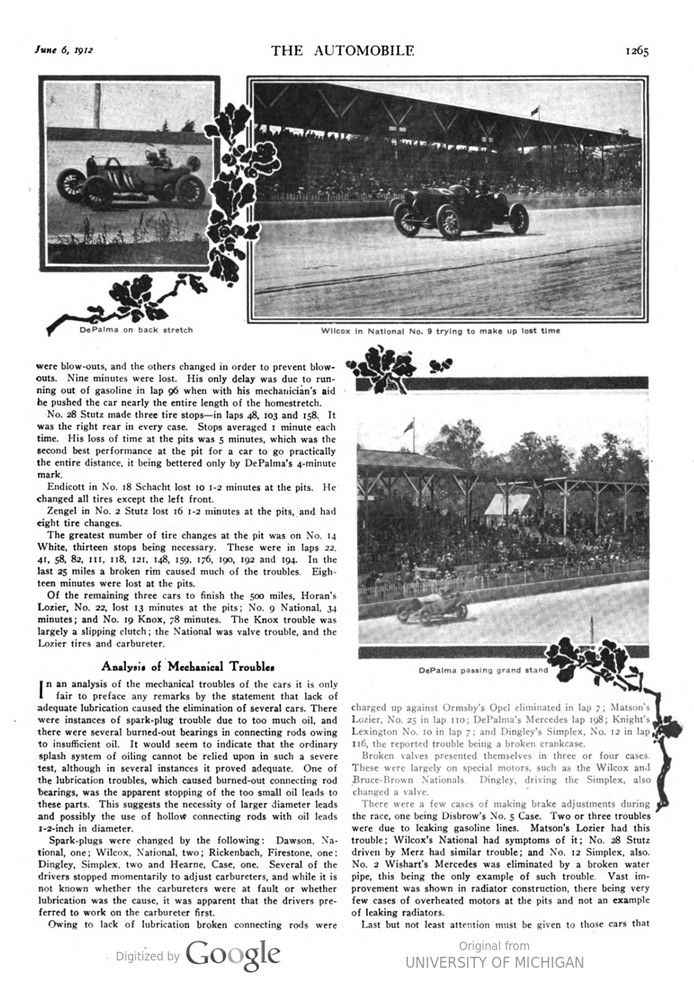
Tetzlaff has a record of four tire stops, with 10 minutes loss of time. These were made in laps 84, 114, 141, and 182. In addition to these he had a 5-minute stop for gasoline and oil in lap 158 and a stop for motor trouble in lap 113. He lost 16 minutes at the pit. Hughes in the Mercer made seven tire changes, four of which were blow-outs, and the others changed in order to prevent blowouts. Nine minutes were lost. His only delay was due to running out of gasoline in lap 96 when with his mechanician’s aid he pushed the car nearly the entire length of the homestretch.
No. 28 Stutz made three tire stops-in laps 48, 103 and 158. It was the right rear in every case. Stops averaged i minute each time. His loss of time at the pits was 5 minutes, which was the second-best performance at the pit for a car to go practically the entire distance, it being bettered only by De Palma’s 4-minute mark.
Endicott in No. 18 Schacht lost 10 1-2 minutes at the pits. He changed all tires except the left front.
Zengel in No. 2 Stutz lost 16 1-2 minutes at the pits, and had eight tire changes.
The greatest number of tire changes at the pit was on No. 14 White, thirteen stops being necessary. These were in laps 22, 41, 58, 82, 111, 118, 121, 148, 159, 176, 190, 192 and 194. In the last 25 miles a broken rim caused much of the troubles. Eighteen minutes were lost at the pits.
Of the remaining three cars to finish the 500 miles, Horan’s Lozier, No. 22, lost 13 minutes at the pits; No. 9 National, 34 minutes; and No. 19 Knox, 78 minutes. The Knox trouble was largely a slipping clutch; the National was valve trouble, and the Lozier tires and carbureter.
Analysis of Mechanical Troubles
In an analysis of the mechanical troubles of the cars it is only fair to preface any remarks by the statement that lack of adequate lubrication caused the elimination of several cars. There were instances of spark-plug trouble due to too much oil, and there were several burned-out bearings in connecting rods owing to insufficient oil. It would seem to indicate that the ordinary splash system of oiling cannot be relied upon in such a severe test, although in several instances it proved adequate. One of the lubrication troubles, which caused burned-out connecting rod bearings, was the apparent stopping of the too small oil leads to these parts. This suggests the necessity of larger diameter leads and possibly the use of hollow connecting rods, with oil leads 1-2-inch in diameter.
Spark-plugs were changed by the following: Dawson, National, one; Wilcox, National, two; Rickenbach, Firestone, one; Several of the Dingley, Simplex, two and Hearne, Case, one. drivers stopped momentarily to adjust carbureters, and while it is not known whether the carbureters were at fault or whether lubrication was the cause, it was apparent that the drivers preferred to work on the carbureter first.
Owing to lack of lubrication broken connecting rods were charged up against Ormsby’s Opel eliminated in lap 7; Matson’s Lozier, No. 25 in lap 110; DePalma’s Mercedes lap 198; Knight’s Lexington No. 10 in lap 7; and Dingley’s Simplex, No. 12 in lap 116, the reported trouble being a broken crankcase.
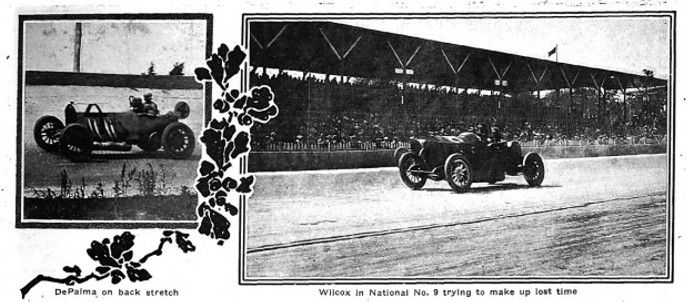
Broken yalves presented themselves in three or four cases. These were largely on special motors, such as the Wilcox and Bruce-Brown Nationals. Dingley, driving the Simplex, also changed a valve.
There were a few cases of making brake adjustments during the race, one being Disbrow’s No. 5 Case. Two or three troubles were due to leaking gasoline lines. Matson’s Lozier had this trouble; Wilcox’s National had symptoms of it; No. 28 Stutz driven by Merz had similar trouble; and No. 12 Simplex, also. No. 2 Wishart’s Mercedes was eliminated by a broken water pipe, this being the only example of such trouble. Vast improvement was shown in radiator construction, there being very few cases of overheated motors at the pits and not an example of leaking radiators.
Last but not least attention must be given to those cars that were entirely free from mechanical trouble and whose only stops at the pits were for tires, gasoline, oil and water. In this class are No. 21 Mercer, No. 18 Schacht, No. 2 Stutz, and No. 14 White. There were others free from mechanical troubles, but they did not finish the race, these being No. 1 Stutz, out in lap 80, No. 15 Cutting out in lap 156; and No. 17 Marquette-Buick out in lap 71. From the way many of these cars performed it seems as though they could have kept on going for a day or two without having to raise the hood. The motors fired with the utmost regularity though the speed was not so great as in some of the cars that had mechanical troubles.
Photo captions.
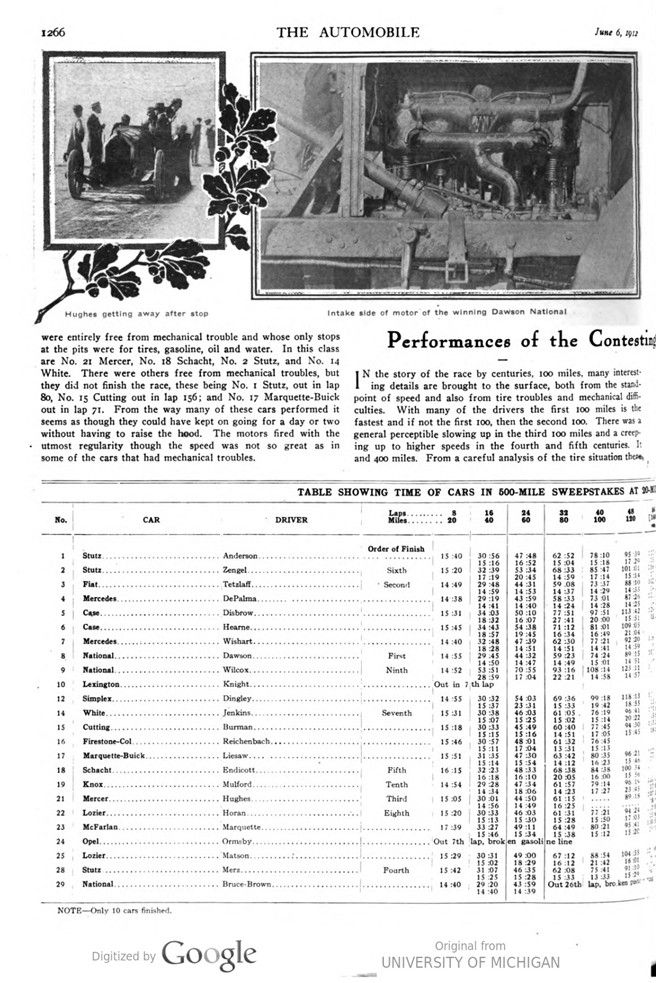
Page 1263. There was action at the pits during every minute of the race – Johnny Jenkins, White – De Palma’s pathetic return to pits
Page 1264. Leaders settling down to a stiff pace on the first turn – Trio of hard-working officials – Pacemaker led the first lap
Page 1265. De Palma on back stretch – Wilcox in National No. 9 trying to make up lost time – DePalma passing grand stand
Page 1266. Hughes getting away after stop – Intake side of motor of the winning Dawson National