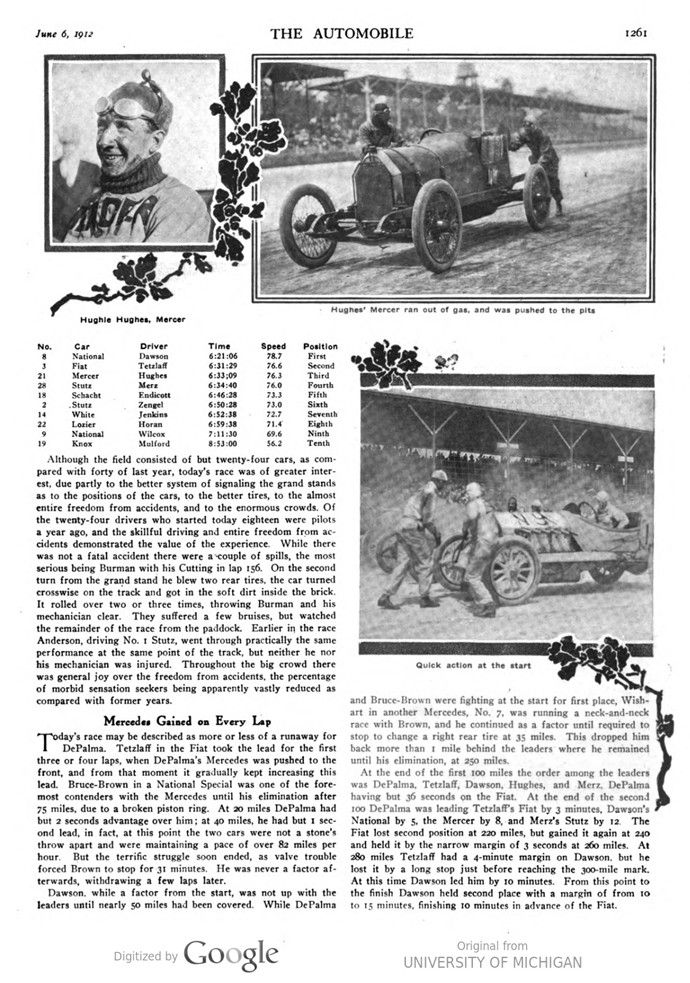
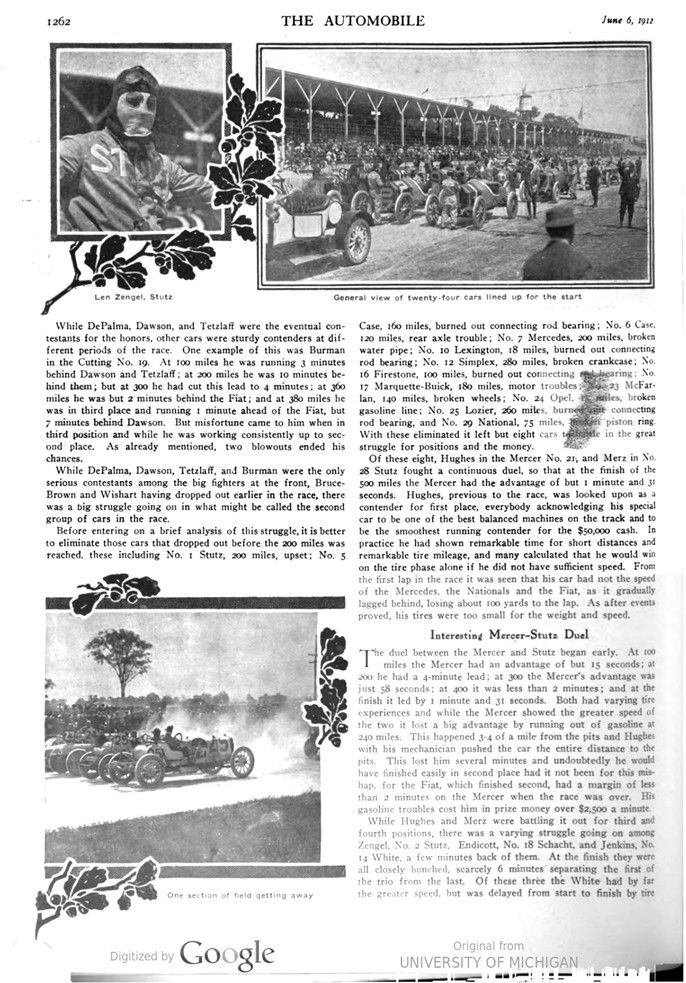
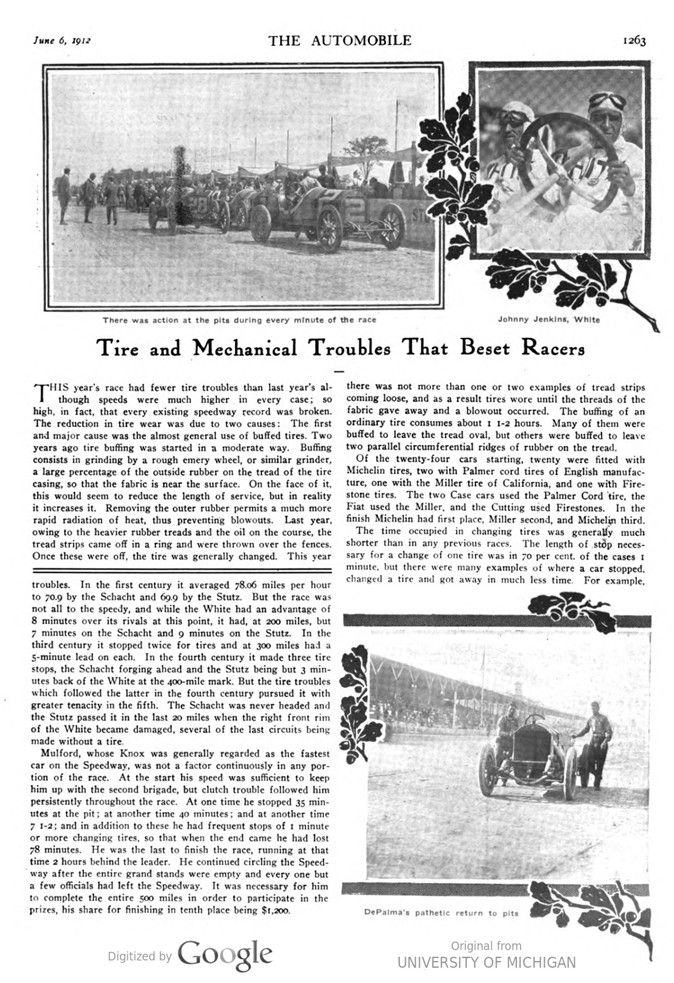
Text and jpegs by courtesy of hathitrust.org www.hathitrust.org, compiled by motorracinghistory.com
THE AUTOMOBILE VOL. XXVI, No. 23 NEW YORK-CHICAGO, THURSDAY, JUNE 6, 1912 page 1259-1262
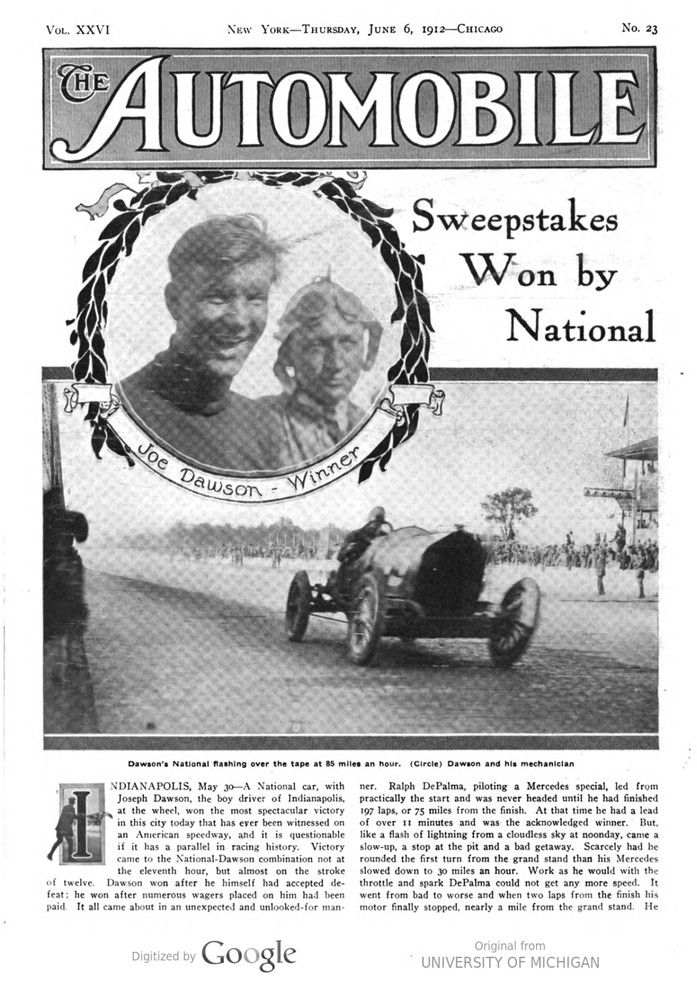
Sweepstakes Won by National
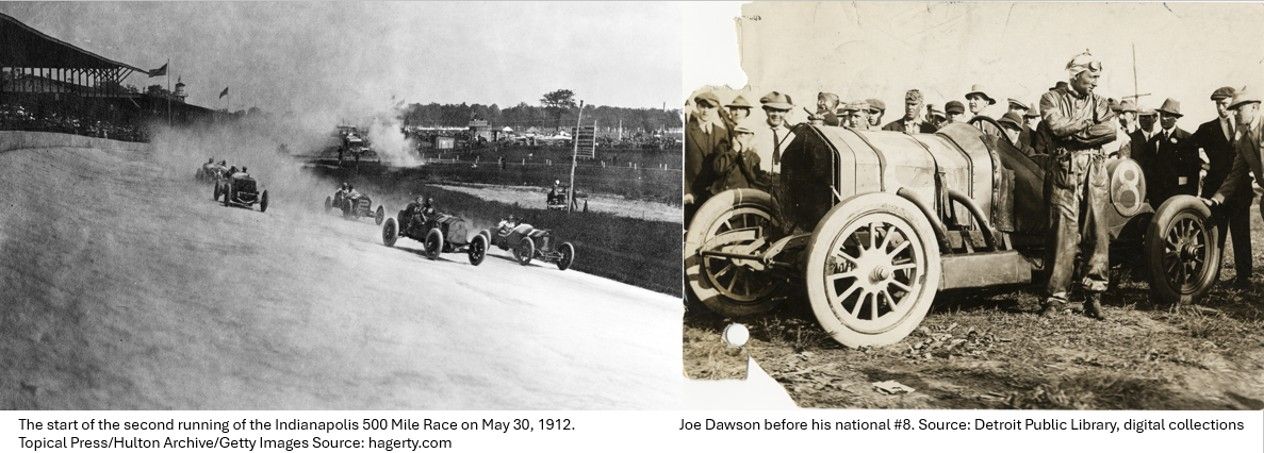
INDIANAPOLIS, May 30 – A National car, with Joseph Dawson, the boy driver of Indianapolis, at the wheel, won the most spectacular victory in this city today that has ever been witnessed on an American speedway, and it is questionable if it has a parallel in racing history. Victory came to the National-Dawson combination not at the eleventh hour, but almost on the stroke of twelve. Dawson won after he himself had accepted de- feat; he won after numerous wagers placed on him had been paid. It all came about in an unexpected and unlooked-for manner. Ralph DePalma, piloting a Mercedes special, led from practically the start and was never headed until he had finished 197 laps, or 75 miles from the finish. At that time he had a lead of over II minutes and was the acknowledged winner. But, like a flash of lightning from a cloudless sky at noonday, came a slow-up, a stop at the pit and a bad getaway. Scarcely had he rounded the first turn from the grand stand than his Mercedes slowed down to 30 miles an hour. Work as he would with the throttle and spark DePalma could not get any more speed. It went from bad to worse and when two laps from the finish his motor finally stopped, nearly a mile from the grand stand. He and his mechanician with true heroism pushed the heavy machine. Harroun-Marmon across the tape but two laps from the finish. Before this Dawson realizing the condition of his heretofore invincible rival pushed his car to the limit, not even shutting off on the turns to save tires, which precaution, he had exercised up to this point in the race. Before DePalma could make a single lap with his Mercedes in its crippled condition the National had gained the 11 minutes and was leader. Tremendous applause greeted the Indianapolis-built car and the Indianapolis boy driver as they swung into first position.
Among the 80,000 spectators the period from the first symptoms of DePalma’s weakness until Dawson’s victory was one of the most intense excitement, the great masses in the grand stands with true American spirit all hoping for the victory of an American car and an American driver. Throughout the race there was great approval whenever Dawson got the slightest advantage over the foreign car at the pits, and when the Mercedes’ weakness appeared the entire motordrome reverberated with ore mighty shout for the Hoosier driver and the Hoosier car. From that instant until Dawson flashed across the line a winner at a pace of 85 miles per hour, there was one resounding, continuous roar of applause.
But the plaudits were not all for the victor, and when, several minutes after Dawson had received the checkered flag, DePalma and his mechanician came down the home stretch bathed in perspiration and pushing their racing steed over the tape, the applause which greeted them was of equal volume. The great crowd, while lauding the winner, manifested equal enthusiasm for the defeated, who from start to finish showed the greatest sportsmanship and the greatest driving ever seen on a speedway. in America.
Dawson’s time for the 500 miles was 6:21:06 or an average speed of 78.7 miles per hour. At this pace he shattered every record made in last year’s classic on this speedway. At the 100-mile mark he had cut 4 minutes from last year’s record. At 200 miles he had clipped 10 minutes; at 300 miles 12 minutes; at 400 miles he had dropped to a 6-minute lead; and at the finish of the 500 he had 21 minutes leeway on the figures set by Harroun in a Marmon a year ago.
De Palma Smashed Most Records
The speed and smashing of records is an honor that must go to DePalma and his Mercedes, for he shattered every mark from I mile to 495. Here are his figures as compared with the records made in last year’s race:
Car 1911 1912 Car Distance
Bruce-Brown-Fiat 78:22 73:01 DePalma-Mercedes 200 Miles
Bruce-Brown-Fiat 159:28 144:47 DePalma-Mercedes 200 Miles
Harroun-Marmon 241:25 223:21 DePalma-Mercedes 300 Miles
Harroun-Marmon 323:15 296:34 DePalma-Mercedes 400 Miles
Harroun-Marmon 402:08 381:06 Dawson-National 500 Miles
From this it is seen that today’s race was 5 minutes faster at 100 miles, 15 minutes at 200, 18 at 300, 27 at 400, and 21 at 500 miles.
The pace set by DePalma from start to finish was a terrific one. He averaged 82.1 miles an hour for the first 100 miles; 83.6 for the second hundred, 79.7 for the third hundred, and 81 for the fourth hundred. Dawson’s pace, while somewhat slower, was very consistent, averaging 80.7 for the first 100; 80.3 for the second 100, 75.2 for the third 100 and 79.4 for the fourth 100, and 78.5 on the last century.
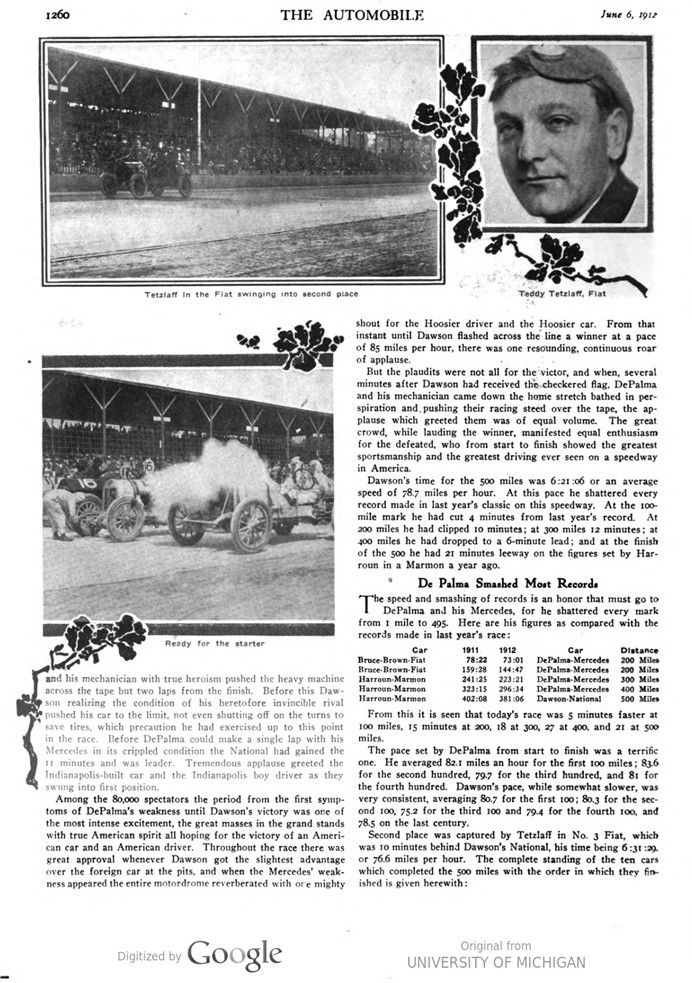
Second place was captured by Tetzlaff in No. 3 Fiat, which was 10 minutes behind Dawson’s National, his time being 6:31:29, or 76.6 miles per hour. The complete standing of the ten cars which completed the 500 miles with the order in which they finished is given herewith:
No. Car Driver Time Speed Position
8 National Dawson 6:21:06 78.7 First
3 Fiat Tetzlaff 6:31:29 76.6 Second
21 Mercer Hughes 6:33:09 76.3 Third
28 Stutz Merz 6:34:40 76.0 Fourth
18 Schacht Endicott 6:46:28 73.3 Fifth
2 Stutz Zengel 6:50:28 73.0 Sixth
14 White Jenkins 6:52:38 72.7 Seventh
22 Lozier Horan 6:59:38 71.4 Eighth
9 National Wilcox 7:11:30 69.6 Ninth
19 Knox Mulford 8:53:00 56.2 Tenth
Although the field consisted of but twenty-four cars, as compared with forty of last year, today’s race was of greater interest, due partly to the better system of signaling the grand stands as to the positions of the cars, to the better tires, to the almost entire freedom from accidents, and to the enormous crowds. Of the twenty-four drivers who started today eighteen were pilots a year ago, and the skillful driving and entire freedom from accidents demonstrated the value of the experience. While there was not a fatal accident there were a couple of spills, the most serious being Burman with his Cutting in lap 156. On the second turn from the grand stand he blew two rear tires, the car turned crosswise on the track and got in the soft dirt inside the brick. It rolled over two or three times, throwing Burman and his mechanician clear. They suffered a few bruises, but watched the remainder of the race from the paddock. Earlier in the race Anderson, driving No. 1 Stutz, went through practically the same performance at the same point of the track, but neither he nor his mechanician was injured. Throughout the big crowd there was general joy over the freedom from accidents, the percentage of morbid sensation seekers being apparently vastly reduced as compared with former years. Today
Mercedes Gained on Every Lap
Today’s race may be described as more or less of a runaway for DePalma. Tetzlaff in the Fiat took the lead for the first three or four laps, when De Palma’s Mercedes was pushed to the front, and from that moment it gradually kept increasing this lead. Bruce-Brown in a National Special was one of the foremost contenders with the Mercedes until his elimination after 75 miles, due to a broken piston ring. At 20 miles DePalma had but 2 seconds advantage over him; at 40 miles, he had but 1 second lead, in fact, at this point the two cars were not a stone’s throw apart and were maintaining a pace of over 82 miles per hour. But the terrific struggle soon ended, as valve trouble forced Brown to stop for 31 minutes. He was never a factor afterwards, withdrawing a few laps later.
Dawson, while a factor from the start, was not up with the leaders until nearly 50 miles had been covered. While De Palma and Bruce-Brown were fighting at the start for first place, Wishart in another Mercedes, No. 7, was running a neck-and-neck race with Brown, and he continued as a factor until required to stop to change a right rear tire at 35 miles. This dropped him back more than 1 mile behind the leaders where he remained until his elimination, at 250 miles.
At the end of the first 100 miles the order among the leaders was DePalma, Tetzlaff, Dawson, Hughes, and Merz, DePalma having but 36 seconds on the Fiat. At the end of the second 100 DePalma was leading Tetzlaff’s Fiat by 3 minutes, Dawson’s National by 5, the Mercer by 8, and Merz’s Stutz by 12. The Fiat lost second position at 220 miles, but gained it again at 240 and held it by the narrow margin of 3 seconds at. 260 miles. At 280 miles Tetzlaff had a 4-minute margin on Dawson, but he lost it by a long stop just before reaching the 300-mile mark. At this time Dawson led him by 10 minutes. From this point to the finish Dawson held second place with a margin of from 10 to 15 minutes, finishing 10 minutes in advance of the Fiat.
While DePalma, Dawson, and Tetzlaff were the eventual contestants for the honors, other cars were sturdy contenders at different periods of the race. One example of this was Burman in the Cutting No. 19. At 100 miles he was running 3 minutes behind Dawson and Tetzlaff; at 200 miles he was 10 minutes be- hind them; but at 300 he had cut this lead to 4 minutes; at 360 miles he was but 2 minutes behind the Fiat; and at 380 miles he was in third place and running 1 minute ahead of the Fiat, but 7 minutes behind Dawson. But misfortune came to him when in third position and while he was working consistently up to second place. As already mentioned, two blowouts ended his chances.
While DePalma, Dawson, Tetzlaff, and Burman were the only serious contestants among the big fighters at the front, Bruce-Brown and Wishart having dropped out earlier in the race, there was a big struggle going on in what might be called the second group of cars in the race.
Before entering on a brief analysis of this struggle, it is better to eliminate those cars that dropped out before the 200 miles was reached, these including No. 1 Stutz, 200 miles, upset; No. 5 Case, 160 miles, burned out connecting rod bearing; No. 6 Case, 120 miles, rear axle trouble; No. 7 Mercedes, 200 miles, broken water pipe; No. 10 Lexington, 18 miles, burned out connecting rod bearing; No. 12 Simplex, 280 miles, broken crankcase; No. 16 Firestone, 100 miles, burned out connecting rod bearing; No. 17 Marquette-Buick, 180 miles, motor troubles; No. 23 McFarlan, 140 miles, broken wheels; No 24 Opel, 15 miles, broken gasoline line; No. 25 Lozier, 260 mile burned out connecting rod bearing, and No. 29 National, 75 miles, broken piston ring. With these eliminated it left but eight cars to battle in the great struggle for positions and the money.
Of these eight, Hughes in the Mercer No. 21, and Merz in No. 28 Stutz fought a continuous duel, so that at the finish of the 500 miles the Mercer had the advantage of but 1 minute and 31 seconds. Hughes, previous to the race, was looked upon as a contender for first place, everybody acknowledging his special car to be one of the best balanced machines on the track and to be the smoothest running contender for the $50,000 cash. In practice he had shown remarkable time for short distances and remarkable tire mileage, and many calculated that he would win on the tire phase alone if he did not have sufficient speed. From the first lap in the race it was seen that his car had not the speed of the Mercedes, the Nationals and the Fiat, as it gradually lagged behind, losing about 100 yards to the lap. As after events proved, his tires were too small for the weight and speed.
Interesting Mercer-Stutz Duel
The duel between the Mercer and Stutz began early. At 100 miles the Mercer had an advantage of but 15 seconds; at 200 he had a 4-minute lead; at 300 the Mercer’s advantage was just 58 seconds; at 400 it was less than 2 minutes; and at the finish it led by 1 minute and 31 seconds. Both had varying tire experiences and while the Mercer showed the greater speed of the two it lost a big advantage by running out of gasoline at 240 miles. This happened 3-4 of a mile from the pits and Hughes with his mechanician pushed the car the entire distance to the pits. This lost him several minutes and undoubtedly he would have finished easily in second place had it not been for this mishap, for the Fiat, which finished second, had a margin of less than 2 minutes on the Mercer when the race was over. His gasoline troubles cost him in prize money over $2,500 a minute.
While Hughes and Merz were battling it out for third and fourth positions, there was a varying struggle going on among Zengel, No. 2 Stutz, Endicott, No. 18 Schacht, and Jenkins, No. 14 White, a few minutes back of them. At the finish they were all closely bunched, scarcely 6 minutes separating the first of the trio from the last. Of these three the White had by far the greater speed, but was delayed from start to finish by tire troubles. In the first century it averaged 78.06 miles per hour to 70.9 by the Schacht and 69.9 by the Stutz. But the race was not all to the speedy, and while the White had an advantage of 8 minutes over its rivals at this point, it had, at 200 miles, but 7 minutes on the Schacht and 9 minutes on the Stutz. In the third century it stopped twice for tires and at 300 miles had a 5-minute lead on each. In the fourth century it made three tire stops, the Schacht forging ahead and the Stutz being but 3 minutes back of the White at the 400-mile mark. But the tire troubles which followed the latter in the fourth century pursued it with greater tenacity in the fifth. The Schacht was never headed and the Stutz passed it in the last 20 miles when the right front rim of the White became damaged, several of the last circuits being made without a tire.
Mulford, whose Knox was generally regarded as the fastest car on the Speedway, was not a factor continuously in any portion of the race. At the start his speed was sufficient to keep him up with the second brigade, but clutch trouble followed him persistently throughout the race. At one time he stopped 35 minutes at the pit; at another time 40 minutes; and at another time 7 I-2; and in addition to these he had frequent stops of 1 minute or more changing tires, so that when the end came he had lost 78 minutes. He was the last to finish the race, running at that time 2 hours behind the leader. He continued circling the Speedway after the entire grand stands were empty and every one but a few officials had left the Speedway. It was necessary for him to complete the entire 500 miles in order to participate in the prizes, his share for finishing in tenth place being $1,200.