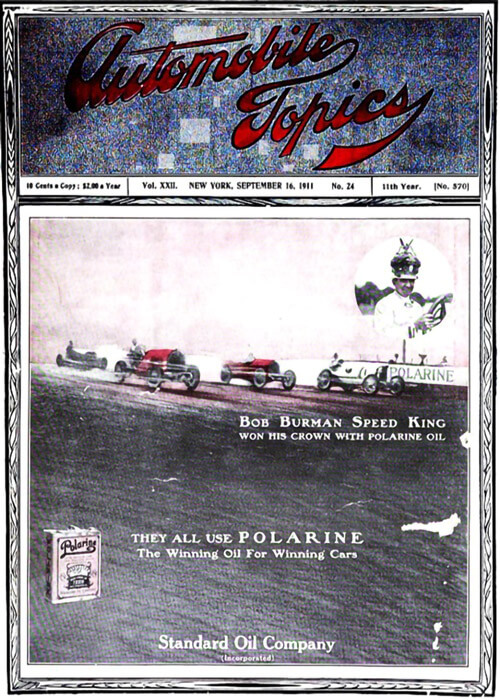
The magazine Automobile Topics was known for their very extended reports, combined with ample illustrations; so this one on the first Indianapolis 500-mile race. Very extended and very informative, specially for race interested. I’ve divided the entire article in three sections: part 1 Introduction, part 2 How the Race was Run and part 3 discussing most contestants and race specifics. Nontheless, each of the three parts is a whole lot of information. Enjoy reading this second part: How the Race was Run.
Text and jpegs by courtesy of hathitrust.org www.hathitrust.org, compiled by motorracinghistory.com
AUTOMOBILE TOPICS. Vol. XXII, No. 9, June 3, 1911
How the Race Was Run
As the hour for the start approached the excitement grew extremely intense, not only among the drivers and mechanicians who were assigned to participate in the big race, but also with the spectators, who had been pouring into the big grandstands from early morning. Starter Fred VVagner and his assistants were the busiest persons at the track, arranging the line up of the cars back of the tape, and at five minutes before ten o’clock the first of a series of aerial bombs were exploded as a signal to prepare for the start. C. G. Fisher, president of Indianapolis Speedway Company, and his partner, J. Q. Allison, went to the tape in a runabout to act as a pacemaker.
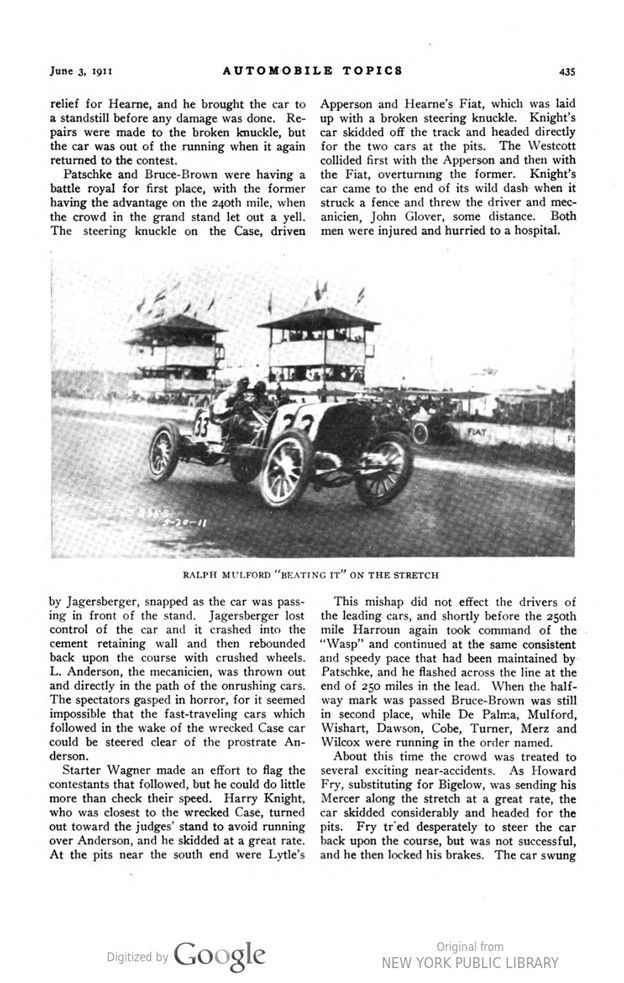
Fisher’s car had the pole and abreast in the front row were the Case car, Lewis Strang; Simplex, Ralph De Palma; Inter-State, Harry Endicott, and National, ]ohnny Aitken. In the second row were the two Pope-Hartfords, carrying Louis Disbrow and Frank Fox; \Vestcott, Harry Knight, and the two Case cars with Jagersberger and Will Jones. The Stutz car, with Anderson at the wheel, was the first in the third row, with the Mercedes, Spencer Wishart next, and the Amplex, W. H. Turner; Knox, Fred Belcher, and Buick, Arthur Chevrolet, in the order named. In the fourth row were the Buick, Fiat, Alco and two Nationals, carrying Charley Basle, Eddie Hearne, Harry Grant, Charles Merz and Howard Wilcox, respectively, while in the following row were the McFarlan_ Bert Adams; the three Jackson cars, carrying Harry Cobe, ]ack Tower and Fred Ellis, and a Cutting with Ernest Delaney at the wheel. In the sixth row were David Bruce—Brown, in a Fiat; Lee Frayer, in a Firestone-Columbus; Joe Dawson and Ray Harroun, in Marmons, and Ralph Mulford in a Lozier. The cars in the seventh row were the Lozier, Apperson, two Mercers and the Simplex, carrying Teddy Tetzlaff, Herbert Lytle, Hughie Hughes, Charley Bigelow and Ralph Beardsley, respectively. Caleb Bragg in his Fiat was at the pole in the eighth row, and with him were Howard Hall in a Velie; Bill Endicott in a Cole: Al Griener in an Amplex, and Bob Burman in a Benz. Billy Knipper in a Benz was in the rear of this line.
President Fisher set a pace of about forty miles an hour and the contesting cars began to string out around the course, the drivers jockeying for a favorable position for the real start of the long grind. The pace was increased as the string turned into the home- stretch several minutes before ten o’clock. As the cars approached the tape a big bomb exploded and an American flag was unfurled high in the air. This was a signal that the race had commenced in earnest. Mr. Fisher sent his car to the side and left the field clear for the contestants. Johnny Aitken was close behind Mr. Fisher when the latter drew aside and at the bomb he sent his National to the front and crossed the tape first with Ralph De Palma in his Simplex a short distance behind. The following crossed the tape after these two: Wishart, Belcher, Disbrow, Turner, Hearne, Fox, Endicott (Harry), and Strang.
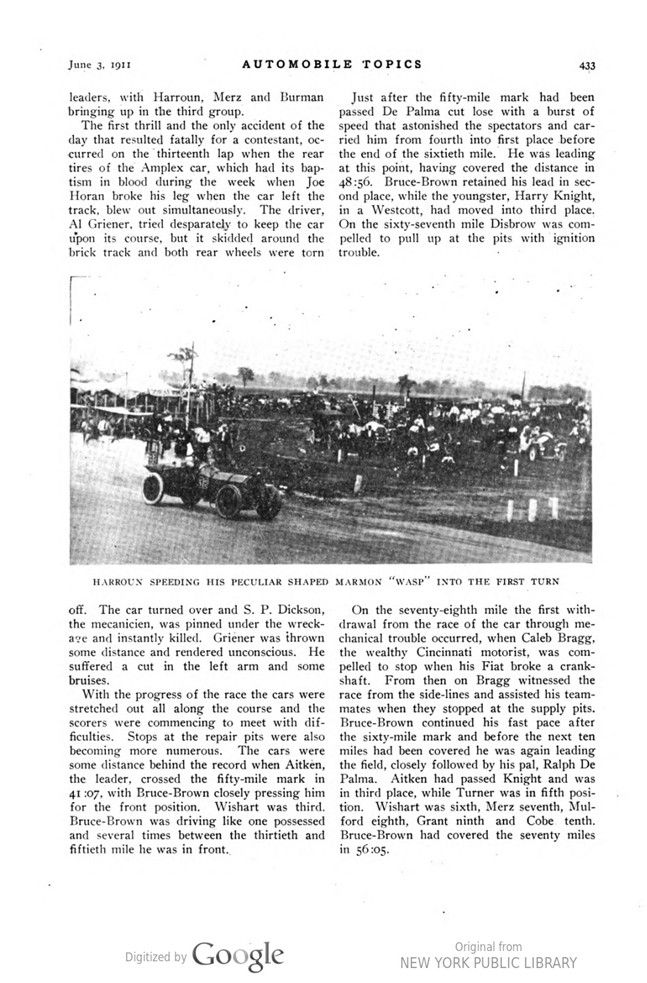
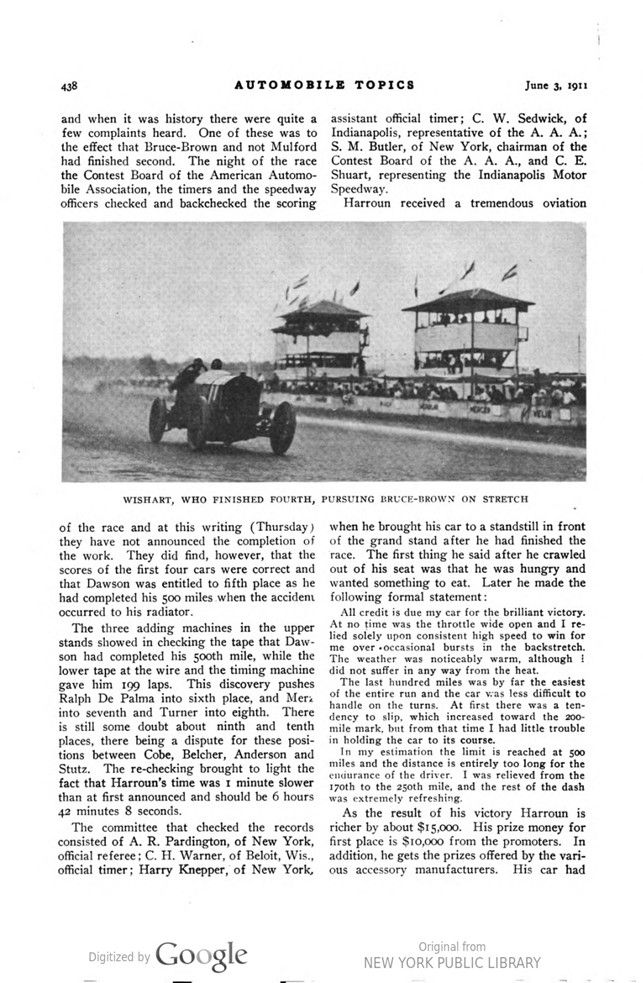
The crowd rose upon its feet and let loose a terrific roar as the cars completed the first of the 200 laps, but the noise of the barking exhausts completely drowned the demonstration. The drivers were now devoting their entire attention to the cars and the course and paid little heed to the plaudits of the spectators. Harroun was content during the first few laps to keep his “Wasp” in the rear of the procession. Arthur Chevrolet was the first driver to stop, he pulling up to the pits with a flat tire on the tenth mile. Spencer Wishart, the young Westchester (New York) sportsman, had his Mercedes going at a great rate and battled with Belcher’s six-cylinder Knox for the lead, when Aitken had dropped back to third place.
Wishart was leading the field at the end of twenty miles which were covered in 15:06, a minute behind the record. Belcher’ was second, Aitken third, De Palma fourth. Bruce-Brown fifth, Harroun sixth, Dawson seventh, Turner eighth, Lytle ninth and Disbrow tenth.
The terrific strain of the cars speeding over the brick surface began to show upon the tires at this stage of the race and there were quite a few stops at the repair pits for new shoes. Basle had trouble with his tires on the twentieth mile and again on the thirtieth mile, while Wishart lost the lead to Belcher shortly after the twenty mile mark was passed through a tire stop. At thirty miles Belcher had ‘his Knox in front, covering the twelve laps of the two-and-a-half-mile course in 25′:07. Wilcox was still hurling the National on at a terrific clip and running a close second. The Fiats and Simplex cars roared on after the two leaders, with Harroun, Merz and Burman bringing up in the third group.
The first thrill and the only accident of the day that resulted fatally for a contestant, occurred on the thirteenth lap when the rear tires of the Amplex car, which had its baptism in blood during the week when Joe Horan broke his leg when the car left the track, blew out simultaneously. The driver, Al Griener, tried desperately to keep the car upon its course, but it skidded around the brick track and both rear wheels were torn off. The car turned over and S. P. Dickson, the mechanician, was pinned under the wreckage and instantly killed. Griener was thrown some distance and rendered unconscious. He suffered a cut in the left arm and some bruises.
With the progress of the race the cars were stretched out all along the course and the scorers were commencing to meet with difficulties. Stops at the repair pits were also becoming more numerous. The cars were some distance behind the record when Aitken, the leader, crossed the fifty-mile mark in 41:07, with Bruce-Brown closely pressing him for the front position. Wishart was third. Bruce-Brown was driving like one possessed and several times between the thirtieth and fiftieth mile he was in front.
Just after the fifty-mile mark had been passed De Palma cut lose with a burst of speed that astonished the spectators and carried him from fourth into first place before the end of the sixtieth mile. He was leading at this point, having covered the distance in 48:56. Bruce-Brown retained his lead in second place, while the youngster, Harry Knight, in a Westcott, had moved into third place. On the sixty-seventh mile Disbrow was compelled to pull up at the pits with ignition trouble.
On the seventy-eighth mile the first withdrawal from the race of the car through mechanical trouble occurred, when Caleb Bragg, the wealthy Cincinnati motorist, was compelled to stop when his Fiat broke a crankshaft. From then on Bragg witnessed the race from the side-lines and assisted his teammates when they stopped at the supply pits. Bruce-Brown continued his fast pace after the sixty-mile mark and before the next ten miles had been covered he was again leading the field, closely followed by his pal, Ralph De Palma. Aitken had passed Knight and was in third place, while Turner was in fifth position. Wishart was sixth, Merz seventh, Mulford eighth, Grant ninth and Cobe tenth. Bruce-Brown had covered the seventy miles in 56:05.
Bruce-Brown maintained his advantage, but during the next twenty miles the Lozier combination of Tetzlaff and Mulford, began to show and at the end of the ninetieth mile they were in second and third places, respectively. Knight was in fourth place and Aitken immediately back of him.
Arthur Chevrolet had been having considerable trouble with his tires, the fast pace in which he sent his car over the brick surface virtually burning them to the rims. On the ninetieth mile his Buick broke a crankshaft, and the daring Swiss pilot was compelled to stop. Bruce-Brown was still leading when the first century mark was passed in 1:22:16, but the time was behind the record. During the next ten miles De Palma again showed a burst of speed and moved his Simplex into third position, behind Mulford, who was following in the wake of Bruce-Brown. The relative positions of the leaders remained unhanged during the next ten miles, but before three more laps had been covered after the 120-mile mark an accident occurred that resulted in the elimination of two of the strong contenders in the race and almost culminated in another fatality.
As the Lozier, driven by Tetzlaff, and the Pope-Hartford, with Disbrow up, were speeding down the stretch toward the tape a tire on the former car blew out and the car veered off its course and directly in the way of the closely following Pope-Hartford. Disbrow did not have time to steer out of the way and the Pope-Hartford struck the Lozier squarely and sent it spinning in the direction of the fence back of which a number of spectators were gathered. The spectators were too frightened to move and stood spellbound. Just before reaching the fence the white car containing Tetzlaff and his mechanician turned over and the occupants were thrown out. Dave Lewis, of Los Angeles, Cal., the mechanician, sustained a fracture of the left pulvis and a cut between his second and third toe on his right foot. He was hurried to a hospital. Tetzlaff was uninjured. The force of the collision caused the Pope-Hartford to spin around the track, but Disbrow cleverly con- trolled the machine and it brought up near the pole without doing any further damage. Disbrow and his mechanician, Richard Ulbrecht, were uninjured, but the car was damaged to such an extent that it had to be withdrawn from the race. Tetz1afi’s car was also taken out of the contest.
The accident to Tetzlaff and Disbrow occurred on their 125th mile. About this time a great duel was in progress between Harroun and Knight for fifth place. Bruce-Brown completed 130 miles in 1:45:26. The completion of 140 miles saw the elimination of another car. This time it was Harry Grant’s Alco that fell by the wayside. Grant was rendered hors de combat with a burned out bearing, which had been holding him in the rear for some time. De Palma just nosed out Mulford for second place at the end of the 140th mile, which distance was covered by Bruce-Brown, who was still leading, in 1:53:18. Knight was still running fourth. Charles Basle about this time withdrew his Buick from the race with a broken crankshaft, and Ellis also dropped out with his Jackson.
Bruce-Brown was leading by a close margin over Ralph De Palma when the 150th mile was passed in the record time of 1:59:12. This time was a trifle less than two minutes better than the record of 2:01:09.43, made by Joe Dawson in a Marmon on the Atlanta speedway on November 7, 1910. Ralph De Palma was displaced in second position by Harroun after the 150-mile mark was passed, and at 160 miles, which were covered in 2:20:51, Bruce-Brown, Harroun and Mulford were running in the order named.
On the 180th mile Harroun, whose car seats but one, stopped at the pits and Cyrus Patschke, winner of a number of 24-hour races, took his place in the “Wasp.” Just as soon as Patschke got going, he started a pace that made the other drivers look up, and before the 190th mile had been passed the peculiar-looking yellow Marmon was leading the field. He completed 200 miles in 2:43:21, which surpassed the previous record for that distance, made by a car of the same make, driven by Joe Dawson on the same track on July 4, 1910. Dawson’s mark was 2:43:20.14. Patschke was closely pressed by Bruce-Brown, with Mulford in third place. Wishart was in fourth place, followed by Knight, De Palma, Dawson, Turner, Lytle and Henry Cobe.
As Hearne’s Fiat was speeding down the homestretch on its eighty-first lap, or 202.5 miles, the steering knuckle snapped, and the car left the course and ran into the infield. Parker was driving at the time, acting as a relief for Hearne, and he brought the car to a standstill before any damage was done. Repairs were made to the broken knuckle, but the car was out of the running when it again returned to the contest.
Patschke and Bruce-Brown were having a battle royal for first place, with the former having the advantage on the 240th mile, when the crowd in the grand stand let out a yell. The steering knuckle on the Case, driven by Jagersberger, snapped as the car was passing in front of the stand. Jagersberger lost control of the car, and it crashed into the cement retaining wall and then rebounded back upon the course with crushed wheels. L. Anderson, the mechanician, was thrown out and directly in the path of the onrushing cars. The spectators gasped in horror, for it seemed impossible that the fast-traveling cars which followed in the wake of the wrecked Case car could be steered clear of the prostrate Anderson.
Starter Wagner made an effort to flag the contestants that followed, but he could do little more than check their speed. Harry Knight, who was closest to the wrecked Case, turned out toward the judges’ stand to avoid running over Anderson, and he skidded at a great rate. At the pits near the south end were Lytle’s Apperson and Hearne’s Fiat, which was laid up with a broken steering knuckle. Knight’s car skidded off the track and headed directly for the two cars at the pits. The Westcott collided first with the Apperson and then with the Fiat, overturning the former. Knight’s car came to the end of its wild dash- when it struck a fence and threw the driver and mechanician, John Glover, some distance. Both men were injured and hurried to a hospital.
This mishap did not effect the drivers of the leading cars, and shortly before the 250th mile Harroun again took command of the “Wasp” and continued at the same consistent and speedy pace that had been maintained by Patschke, and he flashed across the line at the end of 250 miles in the lead. When the halfway mark was passed Bruce-Brown was still in second place, while De Palma, Mulford, Wishart, Dawson, Cobe, Turner, Merz and Wilcox were running in the order named.
About this time the crowd was treated to several exciting near-accidents. As Howard Fry, substituting for Bigelow, was sending his Mercer along the stretch at a great rate, the car skidded considerably and headed for the pits. Fry tried desperately to steer the car back upon the course, but was not successful, and he then locked his brakes. The car swung completely around before it came to a standstill. When Fry again started in the race he received a round of applause from the spectators who had witnessed his display of skill and coolness. Another accident took place on the backstretch when the Jackson car, with Bob Evans, acting as substitute for Jack Tower, skidded off the track when the driver turned out for a passing competitor. Evans was thrown from his car and sustained a broken ankle. Assisted by his mechanician, he drove back to the repair pits and \vas relieved. He was sent to a hospital, where it was said that he was suffering from nervous collapse in addition to a broken ankle. Bob Burman showed his coolness and daring when one of the rear tires on his Benz blew out with a loud report on the 220th mile. The car swerved. but Burman continued and the tire loosened and jumped over the stone wall at the south curve. He completed the round on the bare rim.
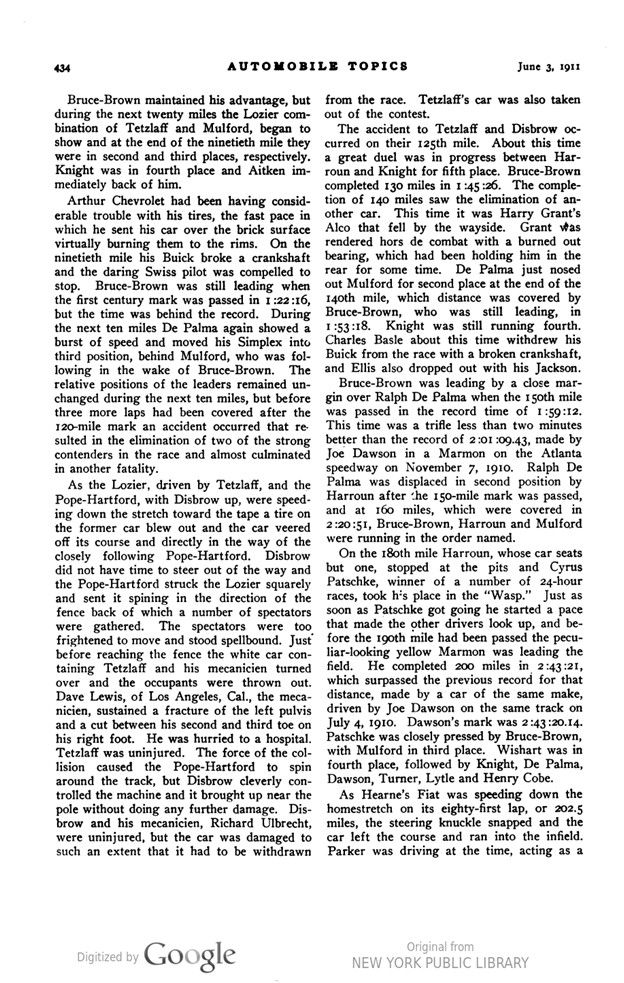
During the entire latter half of the race Harroun was never headed, though at times he was closely pressed by De Palma and Mulford. The pace had settled down at this period to a steady grind, and lap after lap was reeled off at record-breaking speed. Interest centered chiefly in the first three cars, as these were the only ones for which the scores were posted. The time of the first car was only given. At the end of 300 miles Harroun was first and Mulford was in second place, while Bruce-Brown \vas third and De Palma fourth. Harry Cobe was fifth, Aitken sixth, Wishart seventh, Turner eighth, Merz ninth and Gil Anderson tenth. The time for the 300 miles was 4 :03 :24. All marks above 250 miles were new records, as that was previously the longest race ever run on a speedway.
On the 330th mile Aitken, whose National has been a strong contender during the early part of the race, dropped out of the running, his car having developed a broken steering knuckle. At the end of 350 miles Harroun was still in the lead, and the cars making from seventy-three to seventy—five miles an hour. The cars were beginning to show the wear and tear and so were the drivers also, their jaded appearance when stopping at the pits indicating the terrible strain to which they had been subjected.
Another car was eliminated and a serious accident narrowly averted when shortly after the leaders had passed the 350th mile the steering knuckle on Strang’s Case broke as he was coming down the stretch. The car crashed into the cement wall just north of the pits, but it glanced off and the driver, with the application of the brakes, was able to stop it. The car was in the center of the track, but by clever driving several of the racing cars were successfully guided around it by their pilots.
Harroun completed the 350 miles in 4:44:14. Of the forty starters there were twenty-seven still in the race, when but 150 miles had to be covered by the leaders to bring it to an end.
Instead of decreasing his speed as the race neared an end, Harroun did the opposite, and the average pace was increased from 73.94 miles an hour to 74.49 miles an hour. The race had now developed into a three-cornered fight between Harroun, Mulford and Bruce-Brown, with Joe Dawson a good fourth. Harroun completed the fourth century in 5:22:15, and turned into the last I00 miles with a lead of about a lap. Ralph Mulford was second and Bruce-Brown was third. Dawson was fourth, Wishart fifth, Turner sixth, Merz seventh, Cobe eighth and Frayer had taken his Firestone-Columbus into ninth place, while De Palma was back in tenth place.
The crowd became greatly interested in the battle now, that is as far as the first three cars were concerned, the scores of the others not being announced, but its sympathy was with the second and third cars, the drivers of which were desperately trying to overhaul their fleeter companion in the “Wasp.” Although Harroun made only four stops for tires, each time that he did go to the pit he lost valuable ground to the pursuing Lozier and Fiat. Things were evened in this respect, however, when the latter cars were troubled with tires. As had been predicted, the race was one in which tires played a most important part and the blow out of a tube or the wearing down of a shoe was likely to result disastrously with the driver who had this misfortune befall him.
At 470 miles, Bruce-Brown had again forged into second place and Mulford was in the following position with Dawson behind him and the latter closely followed by De Palma, who had again jumped forward in his Simplex. As the flying cars reeled off mile after mile, the crowd began to get restless. The strain was almost too much for human nerves stretched to the breaking point by the pranks of Fate. The continuous dropping of oil upon the brick course had put it into a most dangerous condition and extreme caution had to be used by the drivers in making the turns to prevent their cars from skidding off the track.
The first three cars were several miles ahead of the rest of the field, but the distances separating the three leaders were very small. The fact that there were as many cars still running in the race surprised a majority of the “sharps” who had predicted that the end would see but one, or perhaps two cars, in the front and the twenty-seven cars still on the track went to demonstrate to the big crowd the quality of the material in the make-up of the American cars.
As the finish approached the leaders were going at a dizzy pace, particularly Mulford and Bruce-Brown, who were attempting to overhaul Harroun. At 490 miles Harroun was speeding his car on the stretches, but taking things easier on the turns. In order to avoid the slippery section of the track at the pole Harroun drove his car wide. Bruce-Brown was thundering at his heels with Mulford, Dawson, Wishart, De Palma and Turner following in the order named.
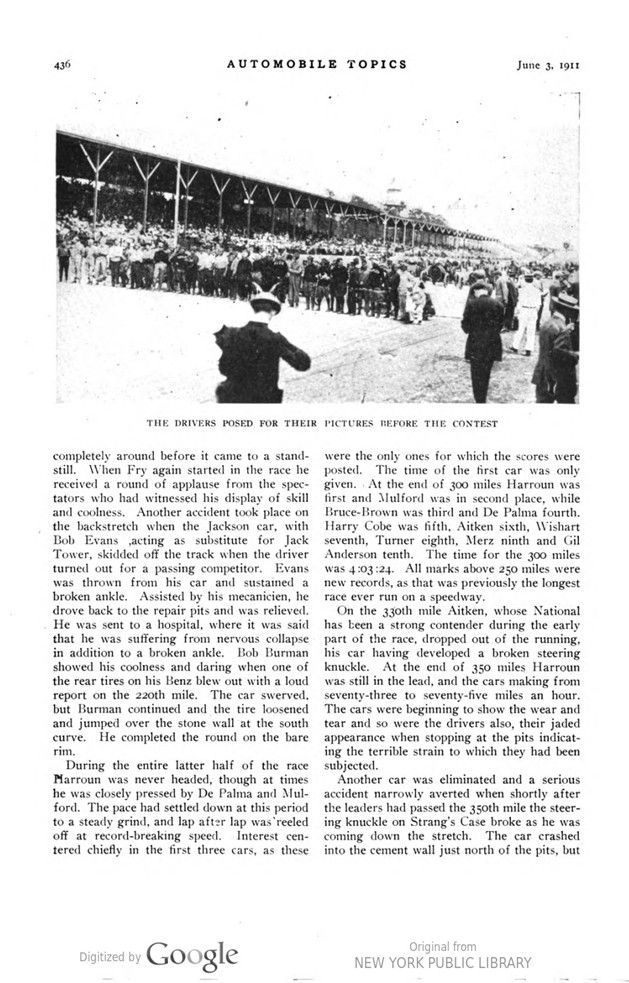
The crowd was upon its feet as the long grind was close to end and it let loose a great cheer as Harroun received the green flag from Starter Wagner, as a signal that he was on his last lap, and as he approached the tape for the final time a tumult of applause that lasted until several seconds after he had finished broke loose from the spectators. There was but a narrow margin separating the Fiat and the Lozier from second and third place, and when Bruce-Brown was compelled to stop with mechanical trouble the general crowd let out a groan, while those who favored Mulford cheered the blond driver on. Mulford was officially credited with crossing the line in second place, while Bruce-Brown was third. Wishart in a Mercedes finished fourth. A piece of metal thrown against the radiator of the Marmon, driven by Dawson, brought that car to a stop on what was thought to be its 199th lap, but which after investigation later proved to be his 201st, and that driver was awarded fifth place.
The first announcement after the finish of the race gave fifth place to De Palma. sixth to Merz, seventh to Turner, eighth to Cobe, ninth to Belcher, tenth to Hughes. eleventh to Frayer and twelfth to Anderson.
There was considerable confusion attached to the gigantic task of scoring the big race and when it was history there were quite a few complaints heard. One of these was to the effect that Bruce-Brown and not Mulford had finished second. The night of the race the Contest Board of the American Automobile Association, the timers and the speedway officers checked and backchecked the scoring of the race and at this writing (Thursday) they have not announced the completion of the work. They did find, however, that the scores of the first four cars were correct and that Dawson was entitled to fifth place as he had completed his 500 miles when the accident occurred to his radiator.
The three adding machines in the upper stands showed in checking the tape that Daw- son had completed his 500th mile, while the lower tape at the wire and the timing machine gave him I99 laps. This discovery pushes Ralph De Palma into sixth place, and Merz into seventh and Turner into eighth. There is still some doubt about ninth and tenth places, there being a dispute for these positions between Cobe, Belcher, Anderson and Stutz. The re-checking brought to light the fact that Harroun’s time was 1 minute slower than at first announced and should be 6 hours 42 minutes 8 seconds.
The committee that checked the records consisted of A. R. Pardington, of New York, official referee; C. H. Warner, of Beloit, Wis., official timer; Harry Knepper, of New York, assistant official timer; C. W. Sedwick, of Indianapolis, representative of the A. A. A.; S. M. Butler, of New York, chairman of the Contest Board of the A. A. A., and C. E. Shuart, representing the Indianapolis Motor Speedway.
Harroun received a tremendous ovation when he brought his car to a standstill in front of the grand stand after he had finished the race. The first thing he said after he crawled out of his seat was that he was hungry and wanted something to eat. Later he made the following formal statement:
All credit is due my car for the brilliant victory. At no time was the throttle wide open and I relied solely upon consistent high speed to win for me over occasional bursts in the backstretch. The weather was noticeably warm, although Z did not suffer in any way from the heat.
The last hundred miles was by far the easiest of the entire run and the car was less difficult to handle on the turns. At first there was a tendency to slip. which increased toward the 200-mile mark. but from that time, I had little trouble in holding the car to its course.
In my estimation the limit is reached at 500 miles and the distance is entirely too long for the endurance of the driver. I was relieved from the 170th to the 250th mile. and the rest of the dash was extremely refreshing.
As the result of his victory Harroun is richer by about $15,000. His prize money for first place is $10,000 from the promoters. In addition, he gets the prizes offered by the various accessory manufacturers. His car had Dorian rims, which gets him a part of the Dorian purse, amounting to $250. The Schebler carburetor, with which the machine was equipped, means $2,500 more. The Remy magneto that his car carried to victory, or rather that carried his car to victory, will fetch him the $1,000 bonus offered by its manufacturers, and the Columbia Lubricants Co. gave $500 because Monogram oil was used.
In addition to all this the Firestone Tire & Rubber Co. will probably provide a bonus, as it was their make of tire that made the wonderful win possible for Harroun. The brick track, with its well-known reputation as a “tire eater,” only required Harroun to stop four times for tire changes, and these changes were all made on the rear right wheel. The other tires remained on the car throughout the race. Dawson’s car was also equipped with Firestones, as was the Firestone-Columbus, which finished the race in twelfth place, according to the first revised scores.
While the Firestone people deserve credit, the Michelin Tire Company cannot be overlooked, for, “as usual,” the first seven finishers after Harroun, with the exception of Dawson, were cars with Michelin equipment. Hughes’ Mercer, which finished eleventh, also carried Michelins. Belcher’s Knox was equipped with Fisks and the Stutz with Goodyear products.
The two finishing Marmons had Dorian rims and Schebler carburetors. The winning car had a Remy magneto, with Bosch spark plugs, and the Dawson car had a Bosch magneto and spark plugs. The second, third and fourth cars had Michelin rims. The Lozier had a Stromberg carburetor and a Bosch magneto, with Rajah spark plugs. The Fiat had a Fiat carburetor and a Bosch magneto and spark plugs, while the Mercedes had a Mercedes carburetor and Bosch magneto and spark plugs. With the exception of the Lozier, which used Oilzum, the first four cars used Monogram lubricant.
De Palma’s Simplex had the greatest piston displacement of those that finished in the first dozen, being close to the limit of 600 cubic inches, with 597 cubic inches. Next was Bruce-Brown’s Fiat, with 589 cubic inches; then Wishart’s Mercedes, with 583 cubic inches. Mulford, 544 and Belcher, 559, Lozier and Knox respectively, had the other cars over 500 cubic inches. The winner, the Harroun Marmon, has 477 cubic inches displacement and was the only six-cylinder machine in the race to finish in the money outside of Belcher’s Knox. Dawson’s four-cylinder Marmon had 495 cubic inches. Of the other cars in the first dozen, Merz’s National had 447 cubic inches displacement; Turner’s Amplex, 443; Cobe’s Jackson, 432, the same as Frayer’s Firestone-Columbus; Anders0n’s Stutz, 390 cubic inches, and Hugh Hughes’ Mercer, 300 cubic inches.
The officials at the race were A. R. Pardington, referee; R. P. Hooper, president of the A. A. A., honorary referee; Fred J. Wagner, starter; E. J. McShane, assistant starter; Charles P. Root, clerk of course; Charles A. Warner, chief timer; Harry Knepper, assist- ant timer, and John Cox, in charge of the scoring.
Photo captions.
HARROUN SPEEDING HIS PECULIAR SHAPED MARMON ”WASP” INTO THE FIRST TURN
RALPH MULFORD “BEATING IT” ON THE STRETCH
DRIVERS POSED FOR THEIR PICTURES BEFORE THE CONTEST
WISHART, WHO FINISHED FOURTH, PURSUING BRUCE—BROWN ON STRETCH