



Text and jpegs by courtesy of hathitrust.org www.hathitrust.org, compiled by motorracinghistory.com
Automobile Trade Journal, Vol. XXX, 30, No. 10, April 1, 1926
7,000 r.p.m. From 91½ in. Racer
LOS ANGELES and Indianapolis will as usual be well represented at the annual 500 mile sweepstakes race to be held May 31st in the latter city. There will be at least five Duesenberg’s, ten or more Miller-built cars and one or two modified Fords.
New Engines in Old Duesenberg Chassis
Duesenberg will start with the same running gear and bodies as used on the 122 in. jobs of last year, but will install in these chassis his new 91½ in. engines. According to Fred Duesenberg, who released preliminary data to the Automobile Trade Journal’s Indianapolis correspondent, the new engines will have eight supercharged cylinders as heretofore. The bore is 2 3/16 and the stroke 3 in. approximately.
While admitting the new jobs will turn up much faster, he did not care to specify exact engine speeds. He stated that it would not be surprising to see the 91½ in. jobs give the same or better track speeds than the bigger engines of last year. New quirks in details of the engine and application of things he has discovered during the year makes it look as though the smaller engines will develop even greater brake hp. than the 122 in. jobs.
Hamlin Chevrolet Front Drive Specials
Patented Hamlin front drive universals will be employed on the modified Ford being built in the Chevrolet shops. The remaining chassis components are the development of the Fronty-Ford types that have performed dependably on the track in recent years. Ford parts will be quite extensively used throughout with a sixteen valve Fronty-Ford engine of only 2 7/8 in. bore by 32 in. stroke. A supercharger will be fitted and the jobs will turn up to 6000 r.p.m., according to Arthur Chevrolet.
The regular Ford rear cross elliptic spring will be used at front and rear in conjunction with double front axles of the tubular type which are bent forward at the center to accommodate the central universal, from which drive shafts inter- posed between upper and lower tubes will transmit the drive to front wheels. This construction is somewhat like the front wheel drive British Alvis. Ford transmission and rear wheel brakes will be employed.
Miller Engines Have Possible 7000 r.p.m.
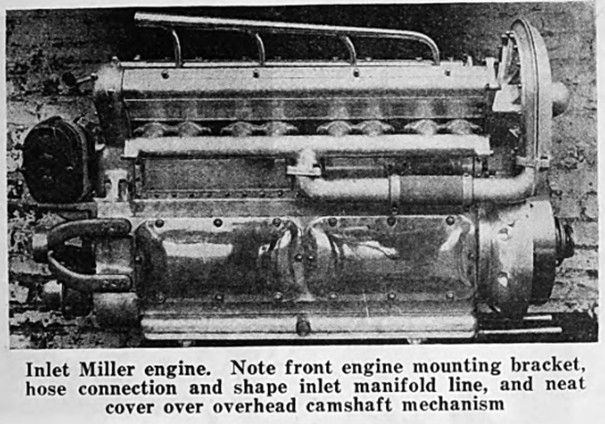
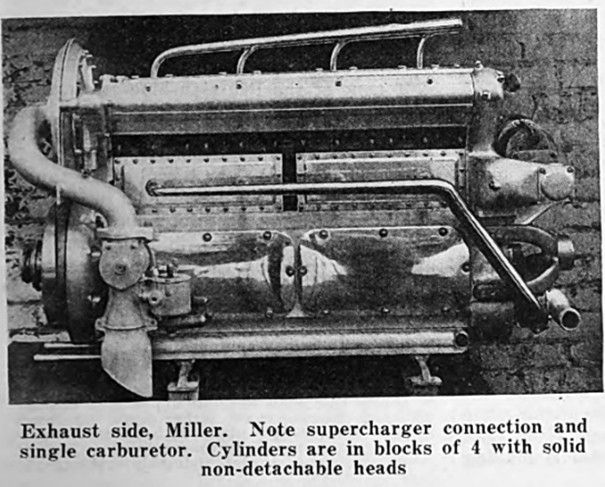
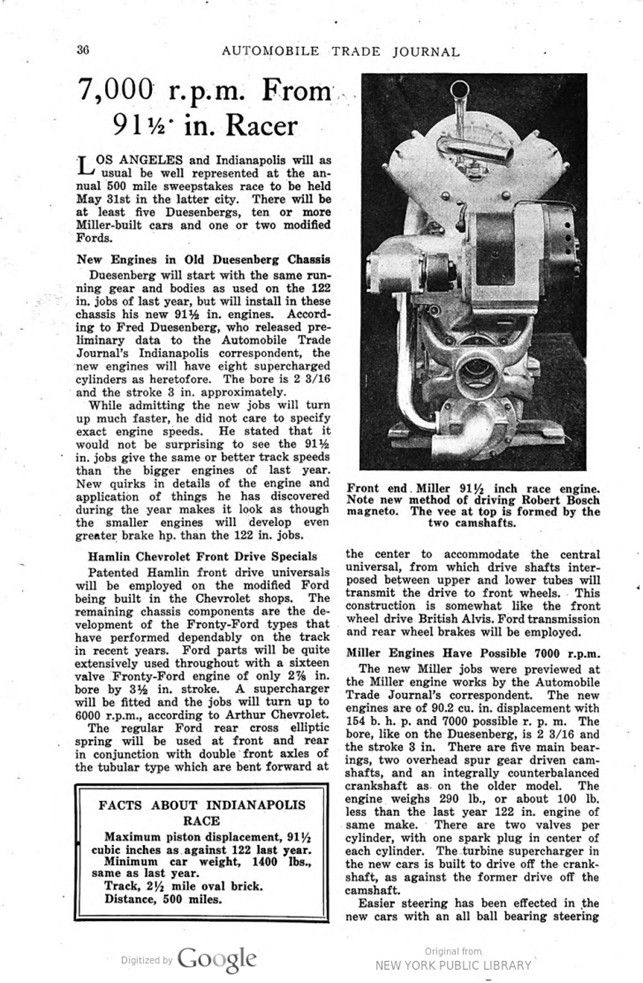
The new Miller jobs were previewed at the Miller engine works by the Automobile Trade Journal’s correspondent. The new engines are of 90.2 cu. in. displacement with 154 b. h. p. and 7000 possible r. p. m. The bore, like on the Duesenberg, is 2 3/16 and the stroke 3 in. There are five main bearings, two overhead spur gear driven camshafts, and an integrally counterbalanced crankshaft as on the older model. The engine weighs 290 lb., or about 100 lb. less than the last year 122 in. engine of same make. There are two valves per cylinder, with one spark plug in center of each cylinder. The turbine supercharger in the new cars is built to drive off the crankshaft, as against the former drive off the camshaft.
Easier steering has been effected in the new cars with an all ball bearing steering gear. Another feature is a positive lock for the clutch. Dogs dropping in slots in the flywheel prevent any possibility of clutch slipping when car is racing at high speed.
In exterior appearance the new Miller cars will look much the same as the Miller 122’s, no important changes having been made in the construction of the body.
Miller has chosen New Departure Bearings, Robert Bosch magneto, Champion Spark Plugs, Rudge Whitworth wheels and Eskimo radiator core.
One of the problems in the construction of the new cars, says Miller, was to distribute the required weight that was released from the engine with its reduction in size from the 122 cu. in. displacement to the maximum 91/2 in. The necessary weight was added for the most part as low as possible. The front axles were made considerably heavier than necessary, as was the frame. Heavier metal was also used in the bottom oil and gas tanks. The body is two gauges heavier than on the old cars.
The oil tanks, one on each side of the frame, are welded to the gasoline tanks. The oil tanks have a capacity of six gal., the lower gas tanks 15 gallons and top tank at back of car 12 gallons.
Miller believes that the weight requirements (1400 lbs.) established are too high, declaring that much of the added weight is not necessary.
FACTS ABOUT INDIANAPOLIS RACE
Maximum piston displacement, 91½ cubic inches as against 122 last year.
Minimum car weight, 1400 lbs., same as last year.
Track, 2½ mile oval brick. Distance, 500 miles
Photos.
Page 36.
Front end. Miller 91½ inch race engine. Note new method of driving Robert Bosch magneto. The vee at top is formed by the two camshafts.
Page 37.
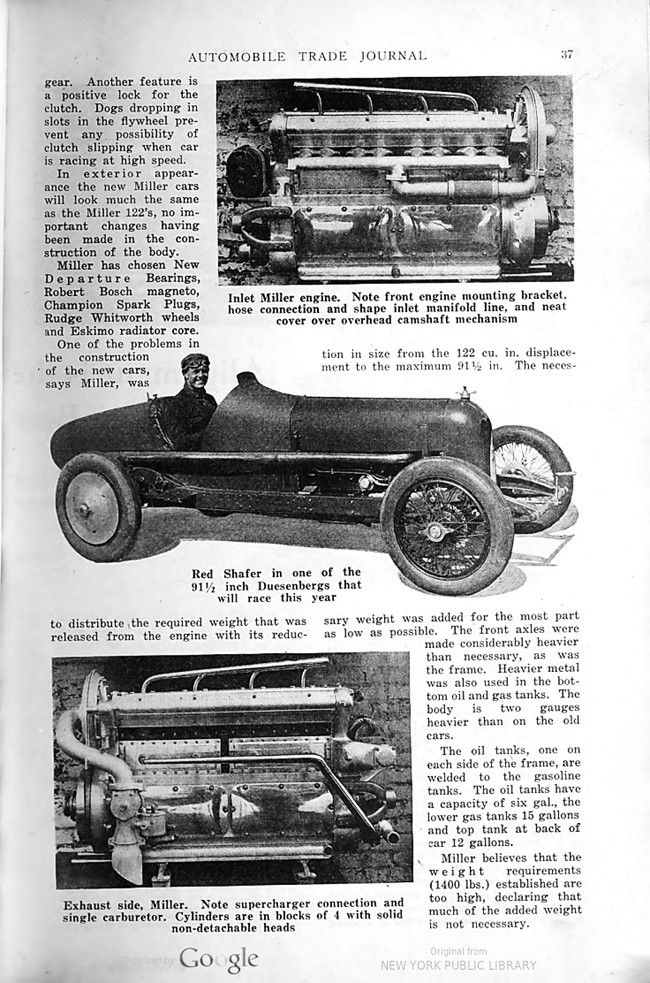
Inlet Miller engine. Note front engine mounting bracket, hose connection and shape inlet manifold line, and neat cover over overhead camshaft mechanism
Red Shafer in one of the 91½ inch Duesenberg’s that will race this year
Exhaust side, Miller. Note supercharger connection and single carburetor. Cylinders are in blocks of 4 with solid non-detachable heads