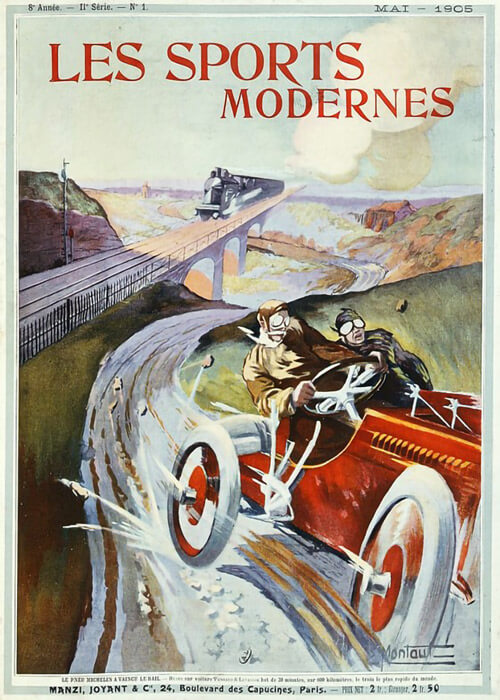
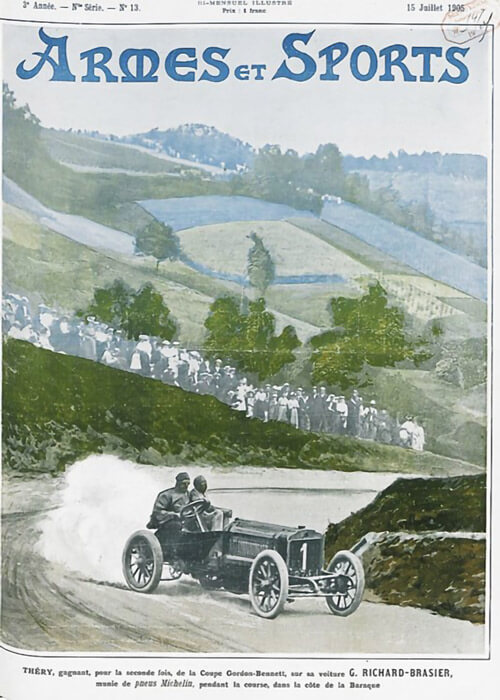
In this issue of „Motor Age“ of their series on the 1904 Gordon Bennet Cup, the contesting teams are described. The German, French, English, Austrian, Belgian ,Italian teams, as well as the sole Swiss representative. The last one, alas, wouldn’t participate, leaving „only“ 18 teams for the 1904 edition of the Gordon Bennet Cup Race.
Text and photos with courtesy of hathitrust hathitrust.org, compiled by motorracingistory.com.
MOTOR AGE VOL. V. NO. 24. JUNE 17, 1904.
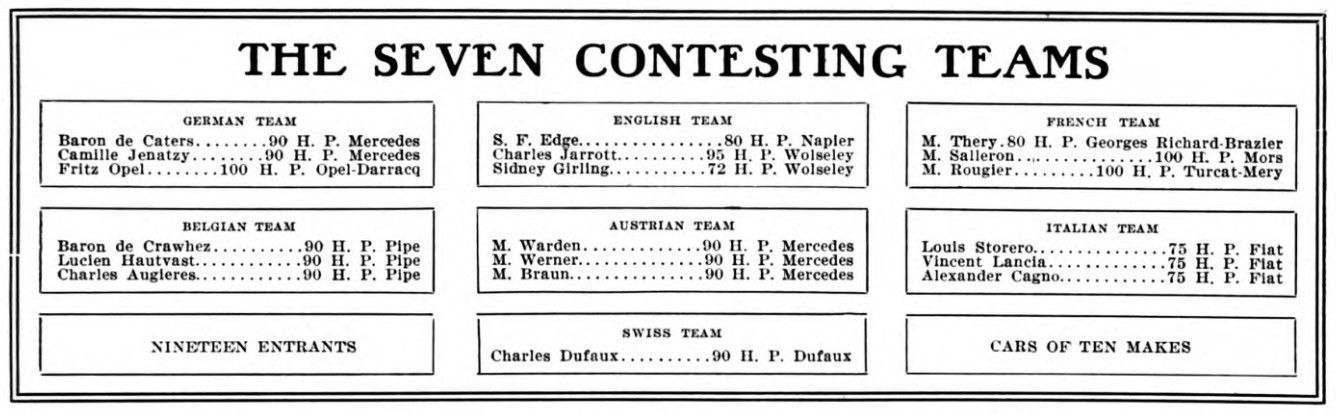
THE SEVEN CONTESTING TEAMS
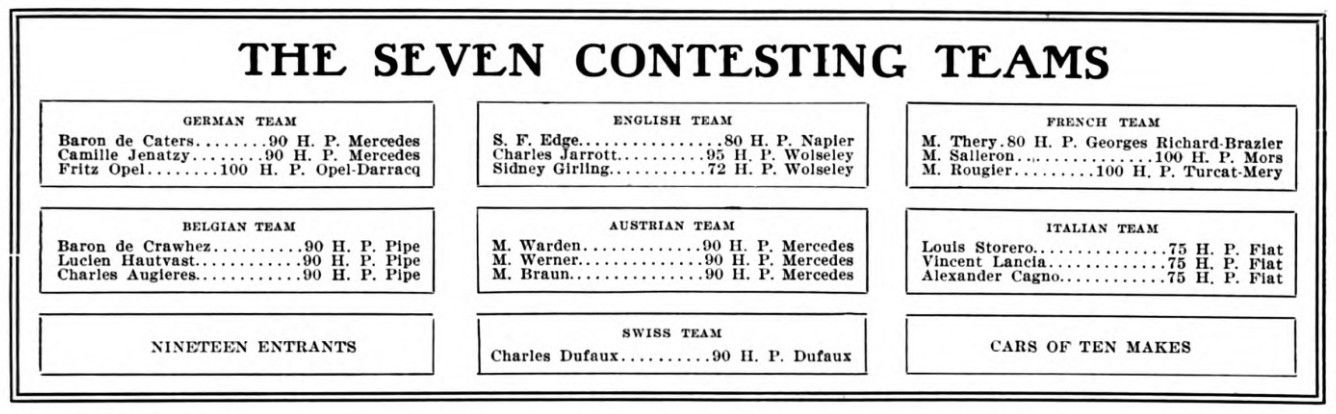
THE GERMAN TEAM
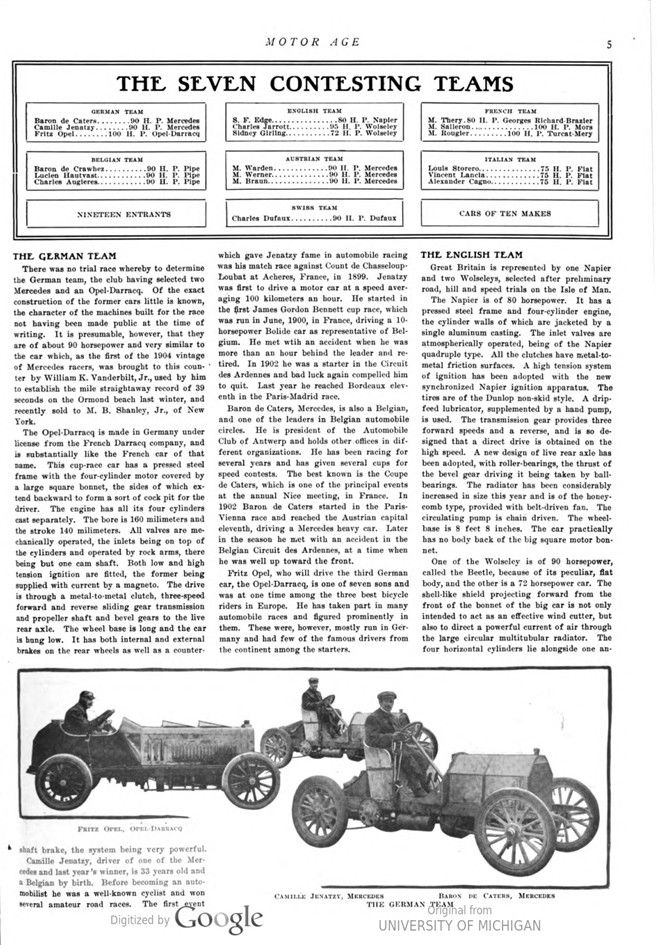
There was no trial race whereby to determine the German team, the club having selected two Mercedes and an Opel-Darracq. Of the exact construction of the former cars little is known, the character of the machines built for the race not having been made public at the time of writing. It is presumable, however, that they are of about 90 horsepower and very similar to the car which, as the first of the 1904 vintage of Mercedes racers, was brought to this counter by William K. Vanderbilt, Jr., used by him to establish the mile straightaway record of 39 seconds on the Ormond beach last winter, and recently sold to M. B. Shanley, Jr., of New York. name.
The Opel-Darracq is made in Germany under license from the French Darracq company and is substantially like the French car of that This cup-race car has a pressed steel frame with the four-cylinder motor covered by a large square bonnet, the sides of which ex- tend backward to form a sort of cock pit for the driver. The engine has all its four cylinders cast separately. The bore is 160 millimeters and the stroke 140 millimeters. All valves are mechanically operated, the inlets being on top of the cylinders and operated by rock arms, there being but one cam shaft. Both low- and high-tension ignition are fitted, the former being supplied with current by a magneto. The drive is through a metal-to-metal clutch, three-speed forward and reverse sliding gear transmission and propeller shaft and bevel gears to the live rear axle. The wheelbase is long, and the car is hung low. It has both internal and external brakes on the rear wheels as well as a counter-shaft brake, the system being very powerful.
Camille Jenatzy, driver of one of the Mercedes and last year’s winner, is 33 years old and a Belgian by birth. Before becoming an auto- mobilist he was a well-known cyclist and won several amateur road races. The first event which gave Jenatzy fame in automobile racing was his match race against Count de Chasseloup-Loubat at Acheres, France, in 1899. Jenatzy was first to drive a motor car at a speed averaging 100 kilometers an hour. He started in the first James Gordon Bennett cup race, which was run in June 1900, in France, driving a 10-horsepower Bolide car as representative of Belgium. He met with an accident when he was more than an hour behind the leader and retired. In 1902 he was a starter in the Circuit des Ardennes and bad luck again compelled him to quit. Last year he reached Bordeaux eleventh in the Paris-Madrid race.
Baron de Caters, Mercedes, is also a Belgian, and one of the leaders in Belgian automobile circles. He is president of the Automobile Club of Antwerp and holds other offices in different organizations. He has been racing for several years and has given several cups for speed contests. The best known is the Coupe de Caters, which is one of the principal events at the annual Nice meeting, in France. In 1902 Baron de Caters started in the Paris-Vienna race and reached the Austrian capital eleventh, driving a Mercedes heavy car. Later in the season he met with an accident in the Belgian Circuit des Ardennes, at a time when he was well up toward the front.
Fritz Opel, who will drive the third German car, the Opel-Darracq, is one of seven sons and was at one time among the three best bicycle riders in Europe. He has taken part in many automobile races and figured prominently in them. These were, however, mostly run in Ger- many and had few of the famous drivers from the continent among the starters.
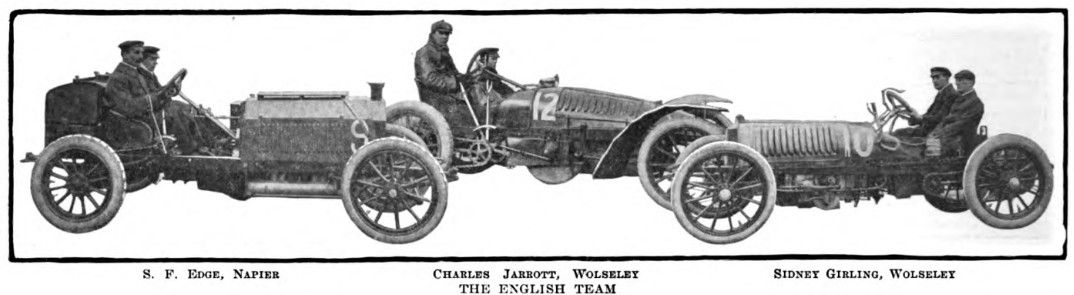
THE ENGLISH TEAM
Great Britain is represented by one Napier and two Wolseleys, selected after preliminary road, hill and speed trials on the Isle of Man.
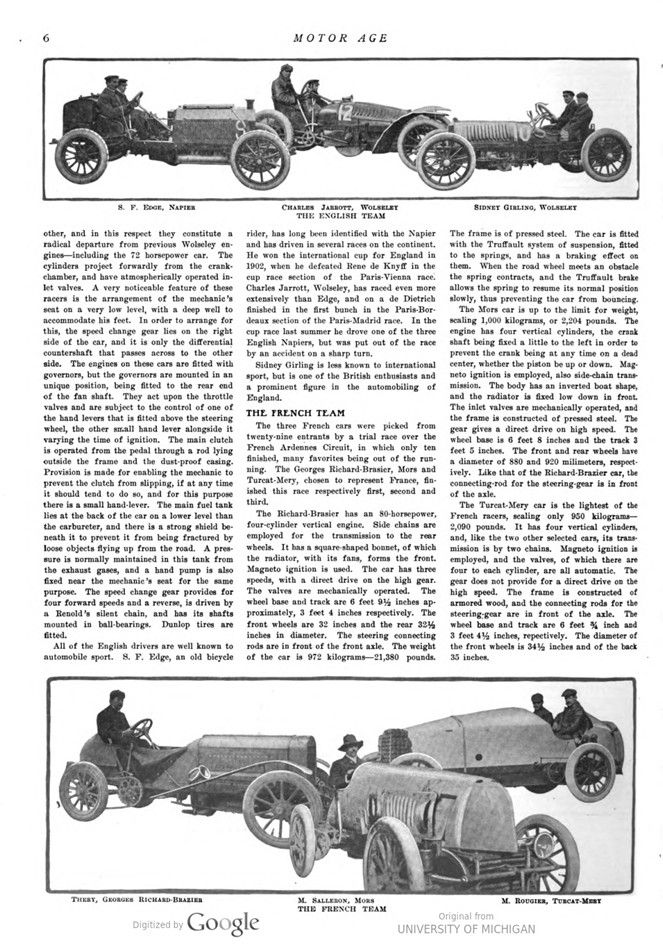
The Napier is of 80 horsepower. It has a pressed steel frame and four-cylinder engine, the cylinder walls of which are jacketed by a single aluminum casting. The inlet valves are atmospherically operated, being of the Napier quadruple type. All the clutches have metal-to-metal friction surfaces. A high-tension system of ignition has been adopted with the new synchronized Napier ignition apparatus. The tires are of the Dunlop non-skid style. A drip-feed lubricator, supplemented by a hand pump, is used. The transmission gear provides three forward speeds and a reverse and is so designed that a direct drive is obtained on the high speed. A new design of live rear axle has been adopted, with roller-bearings, the thrust of the bevel gear driving it being taken by ball-bearings. The radiator has been considerably increased in size this year and is of the honeycomb type, provided with belt-driven fan. The circulating pump is chain driven. The wheelbase is 8 feet 8 inches. The car practically has no body back of the big square motor bonnet.
One of the Wolseley is of 90 horsepower, called the Beetle, because of its peculiar, flat body, and the other is a 72-horsepower car. The shell-like shield projecting forward from the front of the bonnet of the big car is not only intended to act as an effective wind cutter, but also to direct a powerful current of air through the large circular multi-tubular radiator. The four horizontal cylinders lie alongside one another, and in this respect, they constitute a radical departure from previous Wolseley engines – including the 72-horsepower car. The cylinders project forwardly from the crank chamber and have atmospherically operated inlet valves.
A very noticeable feature of these racers is the arrangement of the mechanic’s seat on a very low level, with a deep well to accommodate his feet. In order to arrange for this, the speed change gear lies on the right side of the car, and it is only the differential countershaft that passes across to the other side. The engines on these cars are fitted with governors, but the governors are mounted in a unique position, being fitted to the rear end of the fan shaft. They act upon the throttle valves and are subject to the control of one of the hand levers that is fitted above the steering wheel, the other small hand lever alongside it varying the time of ignition. The main clutch is operated from the pedal through a rod lying outside the frame and the dust-proof casing. Provision is made for enabling the mechanic to prevent the clutch from slipping, if at any time it should tend to do so, and for this purpose there is a small hand-lever. The main fuel tank lies at the back of the car on a lower level than the carbureter, and there is a strong shield beneath it to prevent it from being fractured by loose objects flying up from the road. A pressure is normally maintained in this tank from the exhaust gases, and a hand pump is also fixed near the mechanic’s seat for the same purpose. The speed change gear provides for four forward speeds and a reverse, is driven by a Renold’s silent chain, and has its shafts mounted in ball-bearings. Dunlop tires are fitted. All of the English drivers are well known to automobile sport. S. F. Edge, an old bicycle rider, has long been identified with the Napier and has driven in several races on the continent. He won the international cup for England in 1902, when he defeated Rene de Knyff in the cup race section of the Paris-Vienna race. Charles Jarrott, Wolseley, has raced even more extensively than Edge, and on a de Dietrich finished in the first bunch in the Paris-Bor- deaux section of the Paris-Madrid race. In the cup race last summer, he drove one of the three English Napiers, but was put out of the race by an accident on a sharp turn. Sidney Girling is less known to international sport but is one of the British enthusiasts and a prominent figure in the automobiling of England.
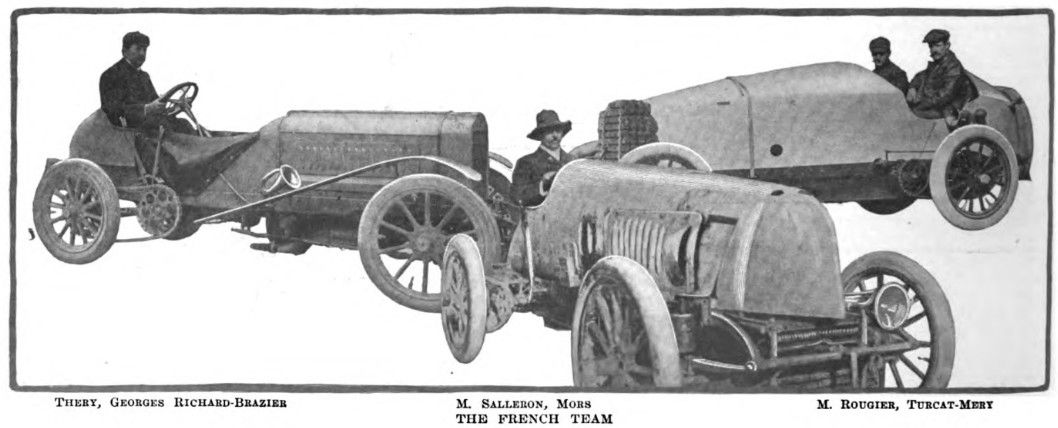
THE FRENCH TEAM
The three French cars were picked from twenty-nine entrants by a trial race over the French Ardennes Circuit, in which only ten finished, many favorites being out of the running. The Georges Richard-Brasier, Mors and Turcat-Mery, chosen to represent France, finished this race respectively first, second and third.
The Richard-Brasier has an 80-horsepower, four-cylinder vertical engine. Side chains are employed for the transmission to the rear wheels. It has a square-shaped bonnet, of which the radiator, with its fans, forms the front. Magneto ignition is used. The car has three speeds, with a direct drive on the high gear. The valves are mechanically operated. The wheelbase and track are 6 feet 9½ inches ap- proximately, 3 feet 4 inches respectively. The front wheels are 32 inches and the rear 32½ inches in diameter. The steering connecting rods are in front of the front axle. The weight of the car is 972 kilograms – 21,380 pounds. The frame is of pressed steel. The car is fitted with the Truffault system of suspension, fitted to the springs, and has a braking effect on them. When the road wheel meets an obstacle the spring contracts, and the Truffault brake allows the spring to resume its normal position slowly, thus preventing the car from bouncing.
The Mors car is up to the limit for weight, scaling 1,000 kilograms, or 2,204 pounds. The engine has four vertical cylinders, the crank shaft being fixed a little to the left in order to prevent the crank being at any time on a dead center, whether the piston be up or down. Magneto ignition is employed, also side-chain transmission. The body has an inverted boat shape, and the radiator is fixed low down in front. The inlet valves are mechanically operated, and the frame is constructed of pressed steel. The gear gives a direct drive on high speed. The wheelbase is 6 feet 8 inches and the track 3 feet 5 inches. The front and rear wheels have a diameter of 880 and 920 millimeters, respectively. Like that of the Richard-Brazier car, the connecting-rod for the steering-gear is in front of the axle. The Turcat-Mery car is the lightest of the French racers, scaling only 950 kilograms- 2,090 pounds. It has four vertical cylinders, and, like the two other selected cars, its trans- mission is by two chains. Magneto ignition is employed, and the valves, of which there are four to each cylinder, are all automatic. The gear does not provide for a direct drive on the high speed. The frame is constructed of armored wood, and the connecting rods for the steering-gear are in front of the axle. The wheel base and track are 6 feet 4 inch and 3 feet 42 inches, respectively. The diameter of the front wheels is 34½ inches and of the back 35 inches.
Thery, who will pilot the Georges Richard-Brazier, is considered one of the old brigades, having made his debut in automobile races in the Paris-Amsterdam Road race, in 1898, driving a Decauville voiture legère. He was not prominent in this event, but it served the purpose of introducing him to the requirements of the game. In 1899 he took part in the Tour de France and succeeded in getting second place behind Gabriel in this hard contest. Later on in the same year he drove a voiturette in the Criterium for these vehicles, again finishing second. In 1900 he won several events, the most important being the Bordeaux-Perigueux Road race in which he finished first in the voiturette class. During the following season he returned to the voiture legere class and on a Decauville finished fifth in the Paris-Bordeaux race. was entered for the Paris-Berlin race but was sick at the time of the start. In 1902 Thery started in the Paris-Vienna Road race and was among the leaders for several hundred kilometers. In going down a steep hill his brakes broke, and the car made a complete somersault. Thery had but a few scratches, repaired the car, and finished the course. Later in the season he started in the Belgian Circuit des Ardennes and had a leading position when he ran into a cow, and as a consequence was out of the race. Before winter he went to Gaillon and broke the kilometer record for voiture legeres, being the first to drive a car of this class at an average speed of 75 miles an hour. Last year Thery took part in the Paris-Madrid He race and secured a good position at Bordeaux.
Salleron, Mors, is one of the latest to join the racing drivers‘ ranks. He made his debut in the Paris-Vienna race, in which he drove a Richard-Brazier light car. He was not prominent in this first attempt at fame, but last year in the Paris-Madrid race came within a few minutes of Gabriel, who won. At the time it was considered one of the best performances made in recent years in an automobile race, as Salleron had had several forced stops and yet managed to make up almost all his lost time.
Rougier, the driver of the Turcat-Mery, has not taken part in more than three or four races, the first one being the Paris-Madrid race, a year ago last May. In his 40-horsepower car he finished ninth in Bordeaux, which satisfied the manufacturers, as it was merely a preliminary test before going into the building of more powerful cars. Last winter he made a record by climbing in his car the Ventoux mountain, one of the most difficult on the continent. Since then, he has been working on the cup racers and has been trying them both in France and in Germany. At one time he was an enthusiastic motor tricyclist and took part in a number of races on the Buchet tricycle.
THE BELGIAN TEAM
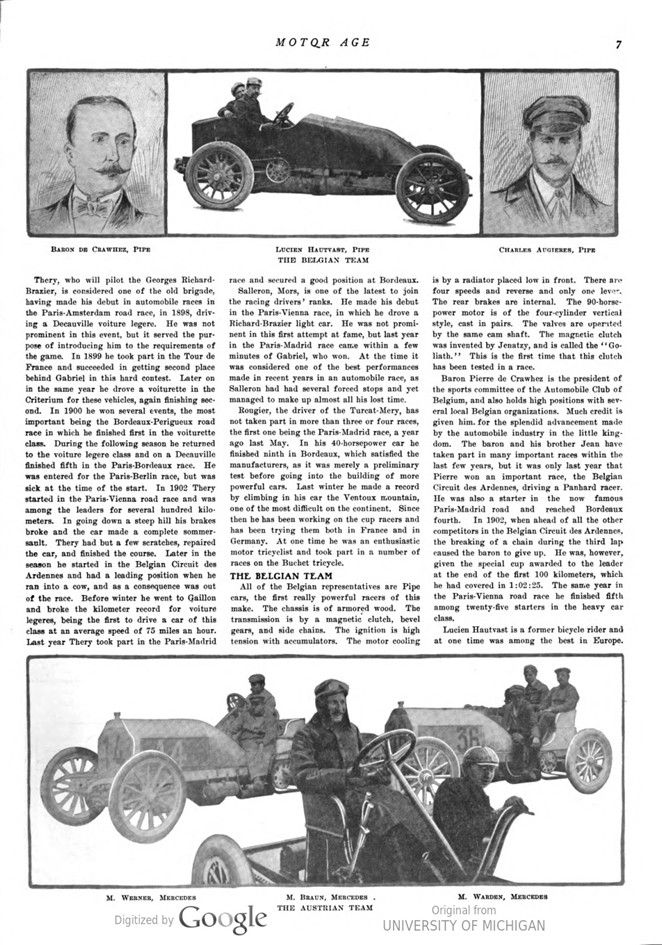
All of the Belgian representatives are Pipe cars, the first really powerful racers of this make. The chassis is of armored wood. The transmission is by a magnetic clutch, bevel gears, and side chains. The ignition is high tension with accumulators. The motor cooling is by a radiator placed low in front. There are four speeds and reverse and only one lever. The rear brakes are internal. The 90-horsepower motor is of the four-cylinder vertical style, cast in pairs. The valves are operated by the same cam shaft. The magnetic clutch was invented by Jenatzy and is called the „Goliath.“ This is the first time that this clutch has been tested in a race.
Baron Pierre de Crawhez is the president of the sports committee of the Automobile Club of Belgium, and also holds high positions with several local Belgian organizations. Much credit is given him. for the splendid advancement made by the automobile industry in the little kingdom. The baron and his brother Jean have taken part in many important races within the last few years, but it was only last year that Pierre won an important race, the Belgian Circuit des Ardennes, driving a Panhard racer. He was also a starter in the now famous Paris-Madrid Road and reached Bordeaux fourth. In 1902, when ahead of all the other competitors in the Belgian Circuit des Ardennes, the breaking of a chain during the third lap caused the baron to give up. He was, however, given the special cup awarded to the leader at the end of the first 100 kilometers, which he had covered in 1:02:25. The same year in the Paris-Vienna Road race he finished fifth among twenty-five starters in the heavy car class.
Lucien Hautvast is a former bicycle rider and at one time was among the best in Europe. He has taken part in many local events and in the Circuit des Ardennes, in which he was eleventh in 1902 and ninth last year. In the first of these races, he drove a 12-horsepower touring car, his 40-horsepower Pipe racer not having been completed in time.
Augieres is one of the old timers in the automobile riders‘ ranks. He took part in the Paris-Vienna Road race and finished tenth on a Mors in the heavy car class. The same year, in the Belgian Circuit des Ardennes, he was seventh. Last year he ran in the Paris-Madrid race and reached Bordeaux thirteenth, while at the Ostend track meeting he Won second prize in the mile standing start event, and fourth prize in the flying kilometer race.
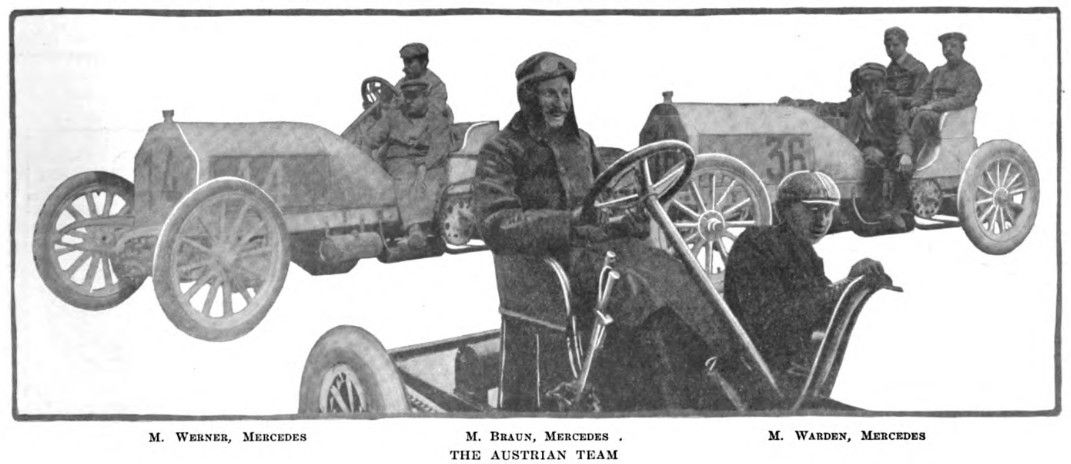
THE AUSTRIAN TEAM
The three Mercedes which compose the Austrian team are substantially like the German Mercedes, being the product of the Austrian Mercedes company, which builds Mercedes cars from the designs of the parent company. Werner, Braun and Warden have been driving German Mercedes cars for several years and are especially known on account of their performances at the annual Nice week meeting and for having figured well in the Semmering and Exelberg hill climb contests which are annually run in Austria, and in the Paris-Madrid race.
To Werner belongs the honor of having made the fastest time in the mile competition at the first Nice meeting in 1901. Braun was so seriously injured in the Nice-La Turbie hill climbing contest in 1900 that he was considered dead when picked up. He recuperated, however, but it is claimed that he lost much of his nerve thereafter. Last year he finished sixteenth on a Mercedes in the Paris-Madrid race. Warden, in the Paris-Madrid, was the best of the Mercedes team of twelve starters, finishing first of this crew and fifth in the race.
THE ITALIAN TEAM
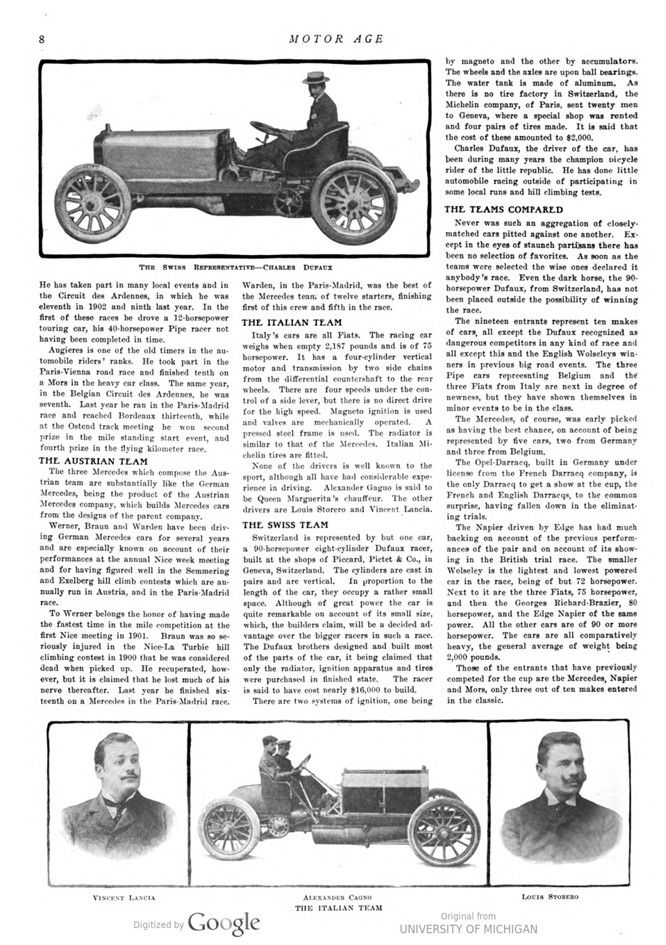
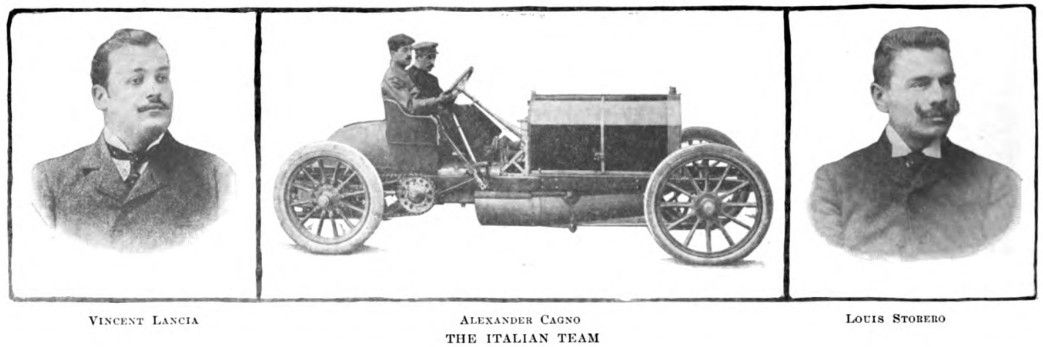
Italy’s cars are all Fiats. The racing car weighs when empty 2,187 pounds and is of 75 horsepower. It has a four-cylinder vertical motor and transmission by two side chains from the differential countershaft to the rear wheels. There are four speeds under the control of a side lever, but there is no direct drive for the high speed. Magneto ignition is used and valves are mechanically operated. A pressed steel frame is used. The radiator is similar to that of the Mercedes. Italian Michelin tires are fitted. None of the drivers is well known to the sport, although all have had considerable experience in driving. Alexander Gaguo is said to be Queen Marguerita ’s chauffeur. The other drivers are Louis Storero and Vincent Lancia.
THE SWISS TEAM
Switzerland is represented by but one car, a 90-horsepower eight-cylinder Dufaux racer, built at the shops of Piccard, Pictet & Co., in Geneva, Switzerland. The cylinders are cast in pairs and are vertical. In proportion to the length of the car, they occupy a rather small space. Although of great power the car is quite remarkable on account of its small size, which, the builders claim, will be a decided advantage over the bigger racers in such a race. The Dufaux brothers designed and built most of the parts of the car, it being claimed that only the radiator, ignition apparatus and tires were purchased in finished state. The racer is said to have cost nearly $16,000 to build.
There are two systems of ignition, one being by magneto and the other by accumulators. The wheels and the axles are upon ball bearings. The water tank is made of aluminum, there is no tire factory in Switzerland, the Michelin company, of Paris, sent twenty men to Geneva, where a special shop was rented, and four pairs of tires made. It is said that the cost of these amounted to $2,000. Charles Dufaux, the driver of the car, has been during many years the champion bicycle rider of the little republic. He has done little automobile racing outside of participating in some local runs and hill climbing tests.
THE TEAMS COMPARED
Never was such an aggregation of closely- matched cars pitted against one another. Except in the eyes of staunch partisans there has been no selection of favorites. As soon as the teams were selected the wise ones declared it anybody’s race. Even the dark horse, the 90- horsepower Dufaux, from Switzerland, has not been placed outside the possibility of winning the race.
The nineteen entrants represent ten makes of cars, all except the Dufaux recognized as dangerous competitors in any kind of race and all except this and the English Wolseleys winners in previous big road events. The three the Pipe cars representing Belgium and three Fiats from Italy are next in degree of newness, but they have shown themselves in minor events to be in the class.
The Mercedes, of course, was early picked as having the best chance, on account of being represented by five cars, two from Germany and three from Belgium.
The Opel-Darracq, built in Germany under license from the French Darracq company, is the only Darracq to get a show at the cup, the French and English Darracqs, to the common surprise, having fallen down in the eliminating trials.
The Napier driven by Edge has had much backing on account of the previous performances of the pair and on account of its showing in the British trial race. The smaller Wolseley is the lightest and lowest powered car in the race, being of but 72 horsepower. Next to it are the three Fiats, 75 horsepower, and then the Georges Richard-Brazier, 80 horsepower, and the Edge Napier of the same power. All the other cars are of 90 or more horsepower. The cars are all comparatively heavy, the general average of weight being 2,000 pounds.
Those of the entrants that have previously competed for the cup are the Mercedes, Napier and Mors, only three out of ten makes entered in the classic.
Photos.
FRITZ OPEL, OPEL-DARRACQ CAMILLE JENATZY, MERCEDES BARON DE CATERS, MERCEDES – THE GERMAN TEAM
S. F. EDGE, NAPIER CHARLES JARROTT, WOLSELEY SIDNEY GIRLING, WOLSELEY – THE ENGLISH TEAM
THERY, GEORGES RICHARD-BRAZIER M. SALLERON, MORS M. ROUGIER, TURCAT-MERY – THE FRENCH TEAM
BARON DE CRAWHEZ, PIPE LUCIEN HAUTVAST, PIPE CHARLES AUGIERES, PIPE – THE BELGIAN TEAM
M. WERNER, MERCEDES M. BRAUN, MERCEDES. M. WARDEN, MERCEDES – THE AUSTRIAN TEAM
THE SWISS REPRESENTATIVE – CHARLES DUFAUX
VINCENT LANCIA ALEXANDER CAGNO LOUIS STORERO – THE ITALIAN TEAM