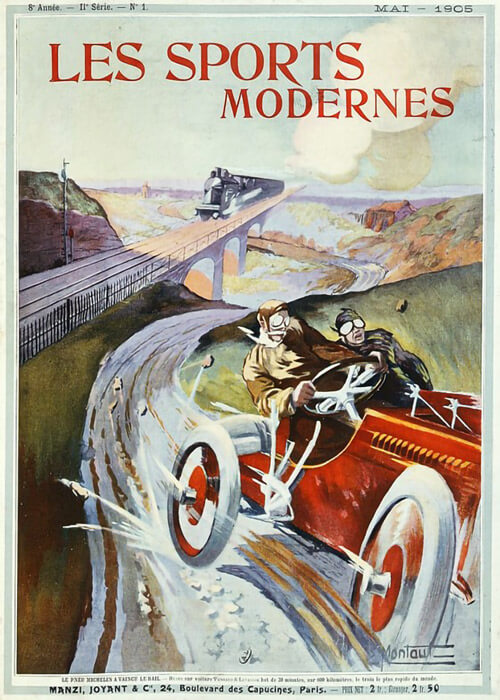
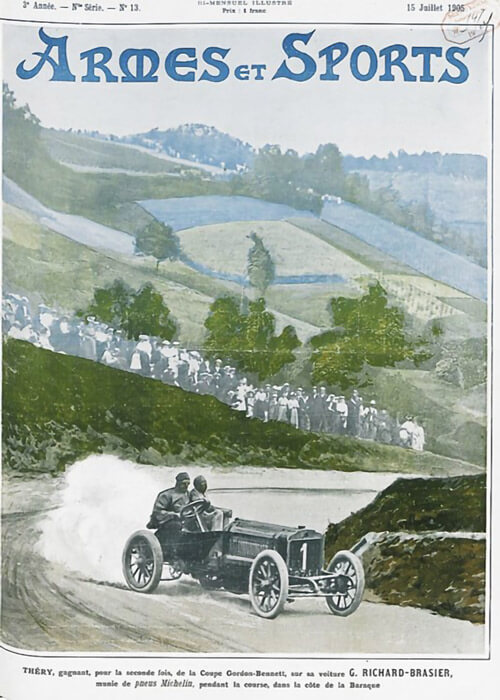
The American automotive magazine „Motor Age“ covered the 1904 Gordon Bennet Cup race as well as its preparations in a really thoroughly manner. This June 17 article briefly summarizes the preparations and the many work that has been completed to assure a fair and good running of the Cup Race. Not only that, but it was quite an operation over many months that required a tough and stringent organisation.

Text and photos with courtesy of hathitrust hathitrust.org, compiled by motorracingistory.com.
MOTOR AGE VOL. V. NO. 24. JUNE 17, 1904.
THE CONCLUDING PREPARATIONS
HOMBURG, Germany, June 3-With the automobile classic, the Gordon Bennett cup race, just 2 weeks away, every preparation for the big event is either completed or so well planned and so far along that the great part may be called finished. So carefully has every detail been considered that there seems now no possibility that the public can suffer harm or even discomfort, and barring breakdowns, collisions, or something of the sort, not a driver of a car should receive a scratch.
The soldiery will be placed on the course at midnight and at 4 o’clock on the morning of June 17 the road will be closed to all save those who are to take part in the race. At 7 o’clock sharp the first car is to be sent away, and the others will follow at intervals of 7 minutes, so that it is expected the last will be on its journey before 9:30 o’clock. All traffic on the circuit will be suspended from 4 o’clock in the morning until the race is over. Only the contestants, guards and officials wearing special badges will be permitted on the road.
It was the intention of the committee having charge of the arrangements to close the entire road by erecting a wire fence on each side. This would mean over 175 miles of fencing and the erection of about 60,000 posts. The task was found to be almost impossible and consequently there are only about 22 miles of fencing, mainly at street crossings and in the controls. A change has also been made with regard to the patrolling of the course. Instead of 5,000 to 7,000 soldiers, there will be at the most 2,500 from several garrison towns nearby. The local police officials, together with private citizens who have volunteered their ser- vices, will constitute the principal force to watch the course.
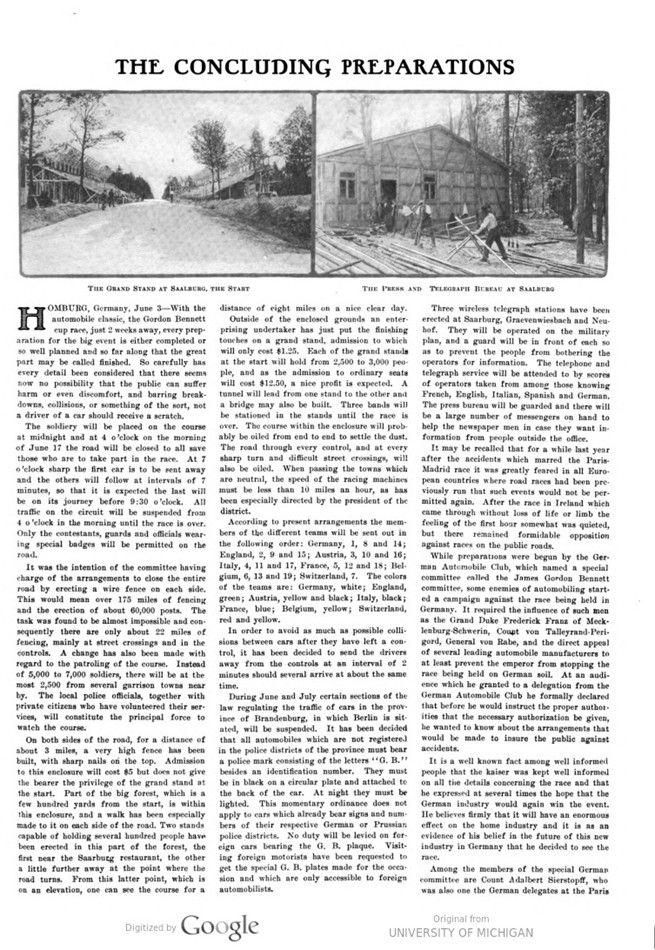
On both sides of the road, for a distance of about 3 miles, a very high fence has been built, with sharp nails on the top. Admission to this enclosure will cost $5 but does not give the bearer the privilege of the grand stand at the start. Part of the big forest, which is a few hundred yards from the start, is within this enclosure, and a walk has been especially made to it on each side of the road. Two stands capable of holding several hundred people have been erected in this part of the forest, the first near the Saarburg restaurant, the other a little further away at the point where the road turns. From this latter point, which is on an elevation, one can see the course for a distance of eight miles on a nice clear day.
Outside of the enclosed grounds an enterprising undertaker has just put the finishing touches on a grand stand, admission to which will only cost $1.25. Each of the grand stands at the start will hold from 2,500 to 3,000 people, and as the admission to ordinary seats will cost $12.50, a nice profit is expected. A tunnel will lead from one stand to the other and a bridge may also be built. Three bands will be stationed in the stands until the race is over. The course within the enclosure will probably be oiled from end to end to settle the dust. The road through every control, and at every sharp turn and difficult street crossings, will also be oiled. When passing the towns which are neutral, the speed of the racing machines must be less than 10 miles an hour, as has been especially directed by the president of the district.
According to present arrangements the members of the different teams will be sent out in the following order: Germany, 1, 8 and 14; England, 2, 9 and 15; Austria, 3, 10 and 16; Italy, 4, 11 and 17, France, 5, 12 and 18; Belgium, 6, 13 and 19; Switzerland, 7. The colors of the teams are: Germany, white; England, green; Austria, yellow and black; Italy, black; France, blue; Belgium, yellow; Switzerland, red and yellow.
In order to avoid as much as possible collisions between cars after they have left a control, it has been decided to send the drivers away from the controls at an interval of 2 minutes should several arrive at about the same time.
During June and July certain sections of the law regulating the traffic of cars in the province of Brandenburg, in which Berlin is situated, will be suspended. It has been decided that all automobiles which are not registered in the police districts of the province must bear a police mark consisting of the letters „G. B.“ besides an identification number. They must be in black on a circular plate and attached to the back of the car. At night they must be lighted. This momentary ordinance does not apply to cars which already bear signs and numbers of their respective German or Prussian police districts. No duty will be levied on foreign cars bearing the G. B. plaque. Visiting foreign motorists have been requested to get the special G. B. plates made for the occasion and which are only accessible to foreign automobilists.
Three wireless telegraph stations have been erected at Saarburg, Graevenwiesbach and Neuhof. They will be operated on the military plan, and a guard will be in front of each so as to prevent the people from bothering the operators for information. The telephone and telegraph service will be attended to by scores of operators taken from among those knowing French, English, Italian, Spanish and German. The press bureau will be guarded and there will be a large number of messengers on hand to help the newspaper men in case they want information from people outside the office.
It may be recalled that for a while last year after the accidents which marred the Paris- Madrid race it was greatly feared in all European countries where road races had been previously run that such events would not be permitted again. After the race in Ireland which came through without loss of life or limb the feeling of the first hour somewhat was quieted, but there remained formidable opposition against races on the public roads.
While preparations were begun by the German Automobile Club, which named a special committee called the James Gordon Bennett committee, some enemies of automobiling started a campaign against the race being held in Germany. It required the influence of such men as the Grand Duke Frederick Franz of Mecklenburg-chwerin, Count von Talleyrand-Perigord, General von Rabe, and the direct appeal of several leading automobile manufacturers to at least prevent the emperor from stopping the race being held on German soil. At an audience which he granted to a delegation from the German Automobile Club he formally declared that before he would instruct the proper authorities that the necessary authorization be given, he wanted to know about the arrangements that would be made to insure the public against accidents.
It is a well-known fact among well informed people that the kaiser was kept well informed on all the details concerning the race and that he expressed at several times the hope that the German industry would again win the event. He believes firmly that it will have an enormous effect on the home industry and it is as an evidence of his belief in the future of this new industry in Germany that he decided to see the race.
Among the members of the special German committee are Count Adalbert Sierstopff, who was also one the German delegates at the Paris congress which was held December 16 last year, Dr. Levin-Stoelping, of the technical commit- tee; Private Counselors Goldberger and Friedleander; Edouard Endler, also a member of the Automobile Club of Frankfurt-on-Main; Chevalier von Brandestein, secretary general of the German Automobile Club; Count Clement von Schoenborn-Wiesenheid.
At the Paris congress, where the general dispositions for the race were made, eight countries were represented. Clarence Gray Dinsmore represented the Automobile Club of America; Enrico Marchesi the Automobile Club of Turin, Italy; Baron de Sulzer-Wart the Automobile Club of Switzerland, Count Adalbert Sierstorpff and Chevalier von Brandenstein the German Automobile Club, Count Leopold Kolowrat and Secretary Carl Fasbender the Automobile Club of Austria, Baron de Crawhez the Automobile Club of Belgium, Count de Vogue and Chevalier Rene de Knyff the Automobile Club of France.
The emperor is coming. The emperor is not coming. The emperor is likely to come. Any one who will affirm something concerning Emperor William, unless it is a few hours before it happens, takes a very big chance. There is no man in Germany upon whom one can depend less than upon the kaiser, because he must often change his plans some half a dozen times within 24 hours. It has happened many times that the day before a certain event was to take place officials would inform the press that his majesty would be there and less than 6 hours later the contrary information would be sent out.
If nothing mars the present plans it is probable that the emperor will come to Homburg the day before the race and be present when the first car is sent away from Saarburg. Officials claim that if he comes he will probably remain several hours and return to the castle for rest and be back by the time the winner is supposed to have completed the last lap.
Some of those who will be present are: The Grand Duke of Mecklenburg-Schwerin, with the Princess of Cumberland, Grand Duchess Anastasia of Mecklenburg-Schwerin, Prince and Princess Frederick Leopold, of Prussia; Prince Joachim Albrecht of Prussia, Prince and Princess von Pless, Prince and Princess Frederick Carl Hohenlohe; Prince Hohenlohe-Oehringen, Duke von Ratibor, president of the German Automobile Club; Count and Countess Manfred Matuschka, Count Voss-Schonau, Count von Frankenberg, Count Felix Chamaree, Count Tiele-Winkler, Count and Countess Johann Sierstorpff, Baron Dr. von Bleichroder. Among others will be Marquis Chasseloup-Loubat, Paris; Baron de Rothschild, London; Clarence Gray Dinsmore, Automobile Club of America; Baron and Baroness de Zuylen, president Automobile Club of France; Mrs. P. Leigh, vice-president Ladies Automobile Club of Great Britain and Ireland; Baron and Baroness Leitenberger, Vienna; Count Graniedo, Paris; Lieutenant-Colonel Holden, president Automobile Club‘ of Great Britain and Ireland; Count Wimpfen, Vienna; United States Ambassador Tower.
If all the automobile clubs which are planning to make runs to the Taunus district to see the race reach their destination, the total number of motor cars within the district will not be much less than 2,500 to 3,000, while the number of passengers thus coming over the road will be from 7,500 to 12,000. The following is a partial list of clubs which have made elaborate preparations for this purpose: Automobile Club of France, Automobile Club of Belgium, Automobile Club of Austro-Hungary, Automobile Club of Italy, German Automobile Club, Ladies‘ Automobile Club of Great Britain and Ireland, and about forty local organizations in Germany, France, Belgium, Austria and Italy.
The French club’s tour is expected to be the largest in number and will start from Paris June 13, by way of Reims, Treves, Frankfurt and Homburg. The return trip to Paris will be over a different route. Another French caravan has been arranged by l’Auto. The members of this party will leave Paris June 12, via Nancy, Strassburg, Heidelberg and Homburg. The run of the members of the Auto- mobile Club of Italy will start June 13 by way of Airolo, Arth, Zurich, Carlsruhe, Frankfurt and Homburg. The Ladies‘ Automobile Club of Great Britain and Ireland will come by way of Rotterdam, Utrecht, Cologne, Mainz, Frankfurt and Homburg.
Individual motorists of Great Britain have arranged a caravan which will start from London June 11. This will be the longest run, extending over 630 miles and passing through Newhaven, Dieppe, Rouen, Nantes, Paris, Metz, Luxemburg, Mainz and Homburg. The run of the members of the German Automobile Club will start June 12 from Berlin by way of Halle-am-Saar, Eisenach and Frankfurt for the small cars and by way of Weimar and Frankfurt for the fast cars.
Railway excursions have been organized by a great many of the important railway companies of France, Belgium, Germany, Italy, Austria, Great Britain, Holland and even Russia. The Automobile Club of France, and the Automobile Club of Belgium have arranged for a special train for their members exclusively. In Belgium railroad companies stipulated that there would have to be at least sixty applications.
There is little evidence at present that there will be reason to complain about overcharges in hotels. Months ago, all kinds of statements were published concerning enormous charges, but investigation by members of the German Automobile Club, as well as of organizations with the purpose of seeing to it that tourists were not robbed, have reported that the hotelkeepers and private citizens were remaining within the bounds of reason. Rooms will be found at $1 and upwards. Of course, at the former price the room will not have hardwood floor, beautifully decorated walls and rich furniture, but they will have everything that is necessary for a night’s stay. In the big hotels, where the prices will range from $2.50 to $25, the most modern furnishings will be found. For 50 cents one will be able to get a dinner, supper or breakfast which even a king would be willing to eat.
If every temporary garage should be filled with automobiles, there would probably be between 5,000 and 6,000 cars. The largest garage will be near the two grand stands at the start, and there will be room for about 2,000 machines. A force of 200 men will be on hand in this particular garage.
How many restaurants and buffets there will be is hard to tell, as they are being built almost daily. At present three large restaurants are ready. The management of the latter stated that he would complete arrangements to attend to 20,000 people. The other two expect more than 5,000 customers. There will be a regular scale of prices and it is expected the usual com- plaints of overcharge will be avoided in this way.
The program of events during the week of the race consists of the following events: June 16, weighing the racing cars; June 17, the race; June 18, excursion over the race course and banquet given by the German Automobile Club at Homburg; June 19, international track race meeting at Frankfurt-on-Main; June 20, automobile congress at Homburg; June 21, flower parade and elegance competition at Homburg.
In connection with the banquet, arrangements will be made for at least 500 people. It will be given in the banquet hall of the Kurhaus. The president and vice-presidents of the principal automobile clubs of Europe and of the Automobile Club of America have been invited as guests of the German Automobile Club. About 150 other prominent persons connected with the industry, sport and press have been invited.
Photos.
THE GRAND STAND AT SAALBURG, THE START – THE PRESS AND TELEGRAPH BUREAU AT SAALBURG
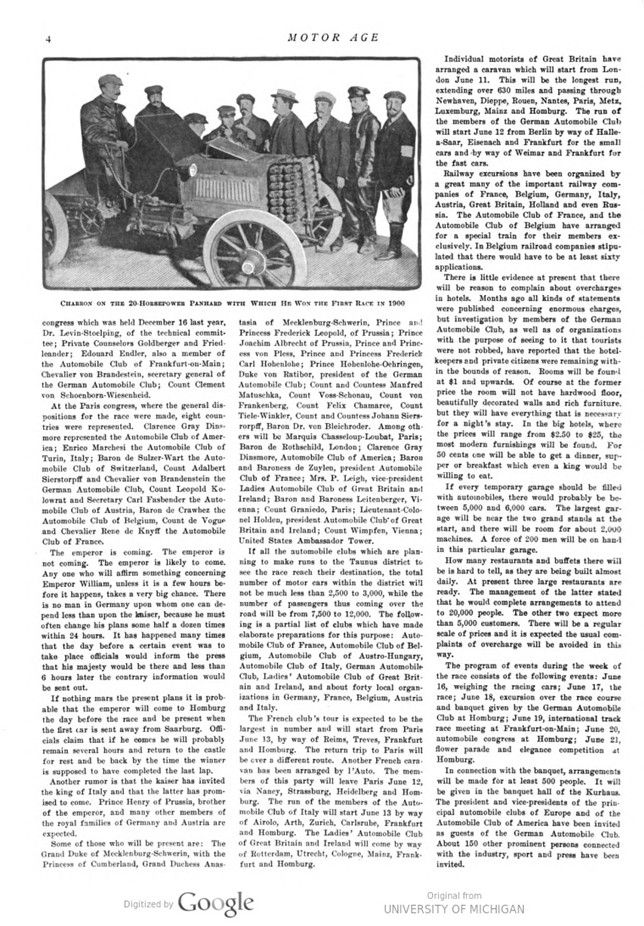
CHARRON ON THE 20-HORSEPOWER PANHARD WITH WHICH HE WON THE FIRST RACE IN 1900