
Text and pictures with courtesy of Hathitrust.org hathitrust.org; compiled by motorracinghistory
MoToR, Vol. VI, November 1906
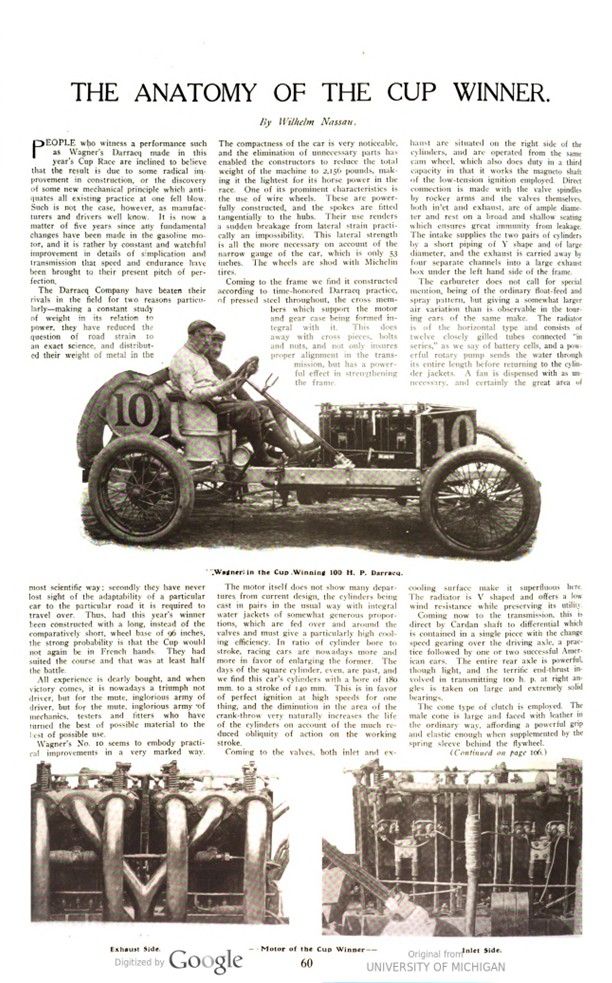
THE THE ANATOMY OF THE CUP WINNER.
By Wilhelm Nassau
Cup Race are inclined to believe that the result is due to some radical improvement in construction, or the discovery of some new mechanical principle which antiquates all existing practice at one fell blow. Such is not the case, however, as manufacturers and drivers well know. It is now a matter of five years since any fundamental changes have been made in the gasoline motor, and it is rather by constant and watchful improvement in details of simplification and transmission that speed and endurance have been brought to their present pitch of perfection.
The Darracq Company have beaten their rivals in the field for two reasons particularly – making a constant study of weight in its relation to power, they have reduced the question of road strain to an exact science, and distributed their weight of metal in the most scientific way: secondly, they have never lost sight of the adaptability of a particular car to the particular road it is required to travel over. Thus, had this year’s winner been constructed with a long, instead of the comparatively short, wheelbase of 96 inches, the strong probability is that the Cup would not again be in French hands. They had suited the course and that was at least half the battle.
All experience is dearly bought, and when victory comes, it is nowadays a triumph not driver, but for the mute, inglorious army of driver, but for the mute, inglorious army of mechanics, testers and fitters who have turned the best of possible material to the best of possible use.
Wagner’s No. 10 seems to embody practical improvements in a very marked way.
The compactness of the car is very noticeable, and the elimination of unnecessary parts has enabled the constructors to reduce the total weight of the machine to 2,156 pounds, making it the lightest for its horsepower in the race. One of its prominent characteristics is the use of wire wheels. These are powerfully constructed, and the spokes are fitted tangentially to the hubs. Their use renders a sudden breakage from lateral strain practically an impossibility. This lateral strength is all the more necessary on account of the narrow gauge of the car, which is only 53 inches. The wheels are shod with Michelin tires.
Coming to the frame we find it constructed according to time-honored Darracq practice, of pressed steel throughout, the cross members which support the motor and gear case being formed integral with it. This does away with cross pieces, bolts and nuts, and not only insures proper alignment in the transmission, but has a powerful effect in strengthening the frame.
The motor itself does not show many departures from current design, the cylinders being cast in pairs in the usual way with integral water jackets of somewhat generous proportions, which are fed over and around the valves and must give a particularly high cooling efficiency. In ratio of cylinder bore to stroke, racing cars are nowadays more and more in favor of enlarging the former. The days of the square cylinder, even, are past, and we find this car’s cylinders with a bore of 180 mm. to a stroke of 140 mm. This is in favor of perfect ignition at high speeds for one thing, and the diminution in the area of the crank-throw very naturally increases the life of the cylinders on account of the much-reduced obliquity of action on the working stroke.
Coming to the valves, both inlet and exhaust are situated on the right side of the cylinders, and are operated from the same cam wheel, which also does duty in a third capacity in that it works the magneto shaft of the low-tension ignition employed. Direct connection is made with the valve spindles by rocker arms and the valves themselves, both inlet and exhaust, are of ample diameter and rest on a broad and shallow seating which ensures great immunity from leakage. The intake supplies the two pairs of cylinders by a short piping of Y shape and of large diameter, and the exhaust is carried away by four separate channels into a large exhaust box under the left-hand side of the frame.
The carbureter does not call for special mention, being of the ordinary float-feed and spray pattern, but giving a somewhat larger air variation than is observable in the touring cars of the same make. The radiator is of the horizontal type and consists of twelve closely gilled tubes connected „in series,“ as we say of battery cells, and a powerful rotary pump sends the water through its entire length before returning to the cylinder jackets. A fan is dispensed with as unnecessary, and certainly the great area of cooling surface make it superfluous here. The radiator is V shaped and offers a low wind resistance while preserving its utility.
Coming now to the transmission, this direct by Cardan shaft to differential which is contained in a single piece with the change speed gearing over the driving axle, a practice followed by one or two successful American cars. The entire rear axle is powerful, though light, and the terrific end-thrust in- volved in transmitting 100 h. p. at right angles is taken on large and extremely solid bearings. The cone type of clutch is employed. The male cone is large and faced with leather in the ordinary way, affording a powerful grip and elastic enough when supplemented by the spring sleeve behind the flywheel.
(Continued on page 106.) THE ANATOMY OF THE CUP WINNER. (Continued from page 60.)
This year the three forward speeds and reverse are actuated by side levers instead of by sector on the steering pillar, as was the case in Hemery’s 80 h. p., the winner of last year’s race, the reverse lever being separate and spark and throttle control are placed some three inches under the steering wheel and are simple and accessible.
Lubrication „goes back to nature,“ inasmuch as the fashionable force-feed is entirely dispensed with, and a hand pump leading from a 3-gallon tank in front of the driver’s seat takes its place. The gasoline feed is also by gravity, and the tank, which is placed behind the driver’s seat, is elevated to a sufficient height to give a considerable „head“ to the fluid as it enters the carbureter. Truffault suspensions are used throughout, and the long elliptical springs allow easy play, particularly over the back axle, where the frame is furnished with an uptake, a practice increasingly followed in all makes of cars during the last two years.
Other points to be noticed are the narrowing of the frame in front, which gives a wide „lock“ to the steering wheels, and a slight departure in fore axle construction, which here is straight from seat to seat and of I section. Powerful internal expanding brakes are fitted to the driving hubs, and another is situated at the rear of the flywheel actuated by a pedal on the footboard. The entire machine is signalized by extreme simplicity combined with strength and was entirely undamaged by the race.
Photo captions.
Page 60.
Wagner in the Cup Winning 100 H. P. Darracq.
Motor of the Cup Winner – Exhaust Side. – Inlet Side.