
Text and pictures with courtesy of Hathitrust.org hathitrust.org; compiled by motorracinghistory
MoToR, Vol. VI, October 1906
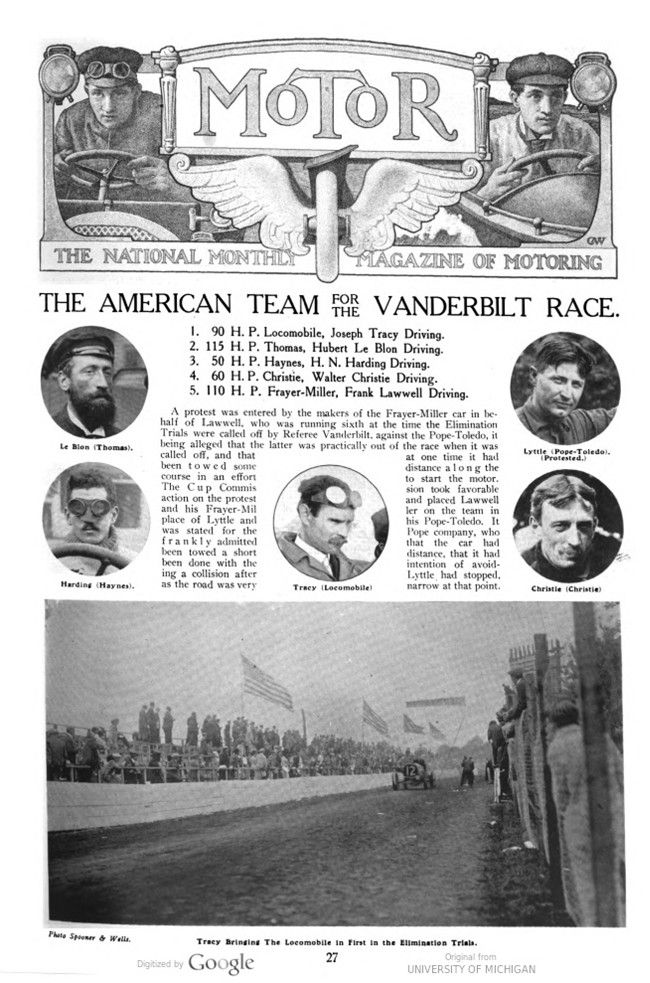
THE AMERICAN TEAM FOR VANDERBILT RACE.
1. 90 H. P. Locomobile, Joseph Tracy Driving.
2. 115 H. P. Thomas, Hubert Le Blon Driving.
3. 50 H. P. Haynes, H. N. Harding Driving.
4. 60 H. P. Christie, Walter Christie Driving.
5. 110 H. P. Frayer-Miller, Frank Lawwell Driving.
A protest was entered by the makers of the Frayer-Miller car in be- half of Lawwell, who was running sixth at the time the Elimination Trials were called off by Referee Vanderbilt, against the Pope-Toledo, it being alleged that the latter was practically out of the race when it was called off, and that at one time it had been towed some distance along the course in an effort to start the motor. The Cup Commission took favorable action on the protest and placed Lawwell and his Frayer-Miller on the team in place of Lyttle and his Pope-Toledo. It was stated for the Pope company, who frankly admitted that the car had been towed a short distance, that it had been done with the intention of avoiding a collision after Lyttle had stopped, as the road was very narrow at that point.
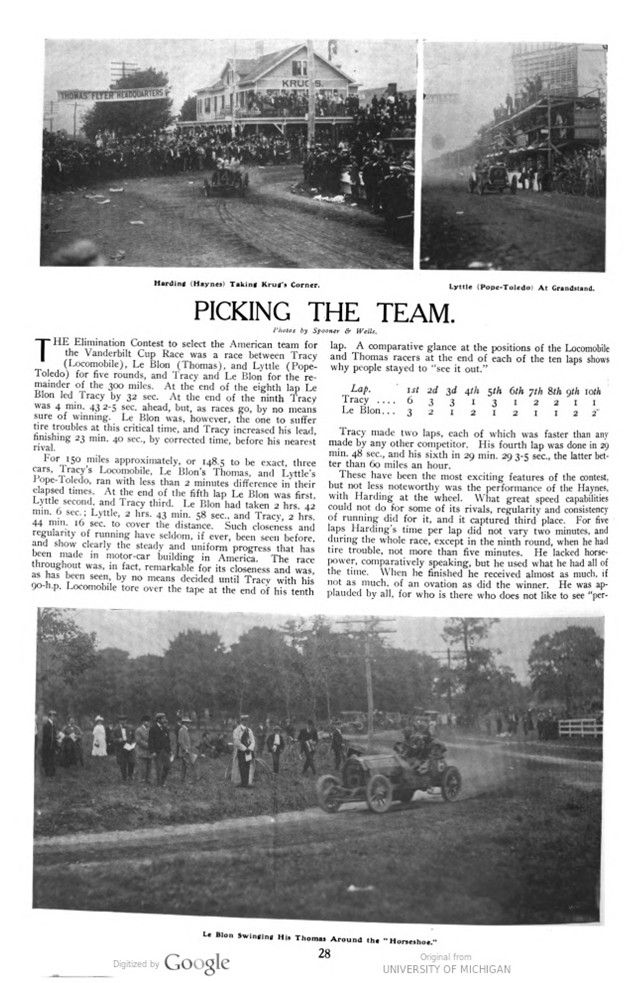
PICKING THE TEAM. Photos by Spooner & Wells.
THE Elimination Contest to select the American team for the Vanderbilt Cup Race was a race between Tracy (Locomobile), Le Blon (Thomas), and Lyttle (Pope-Toledo) for five rounds, and Tracy and Le Blon for the remainder of the 300 miles. At the end of the eighth lap Le Blon led Tracy by 32 sec. At the end of the ninth Tracy was 4 min. 43 2-5 sec. ahead, but, as races go, by no means sure of winning. Le Blon was, however, the one to suffer tire troubles at this critical time, and Tracy increased his lead, finishing 23 min. 40 sec., by corrected time, before his nearest rival.
For 150 miles approximately, or 148.5 to be exact, three cars, Tracy’s Locomobile, Le Blon’s Thomas, and Lyttle’s Pope-Toledo, ran with less than 2 minutes difference in their elapsed times. At the end of the fifth lap Le Blon was first, Lyttle second, and Tracy third. Le Blon had taken 2 hrs. 42 min. 6 sec.; Lyttle, 2 hrs. 43 min. 58 sec., and Tracy, 2 hrs. 44 min. 16 sec. to cover the distance. Such closeness and regularity of running have seldom, if ever, been seen before, and show clearly the steady and uniform progress that has been made in motorcar building in America. The race throughout was, in fact, remarkable for its closeness and was, as has been seen, by no means decided until Tracy with his 90-h.p. Locomobile tore over the tape at the end of his tenth lap. A comparative glance at the positions of the Locomobile and Thomas racers at the end of each of the ten laps shows why people stayed to „see it out.“
Lap. 1st 2nd 3rd 4th 5th 6th 7th 8th 9th 10th
Tracy 6 3 3 1 3 1 2 2 1 1
Le Blon… 3 2 1 2 1 2 1 1 2 2
Tracy made two laps, each of which was faster than any made by any other competitor. His fourth lap was done in 29 min. 48 sec., and his sixth in 29 min. 29 3-5 sec., the latter better than 60 miles an hour.
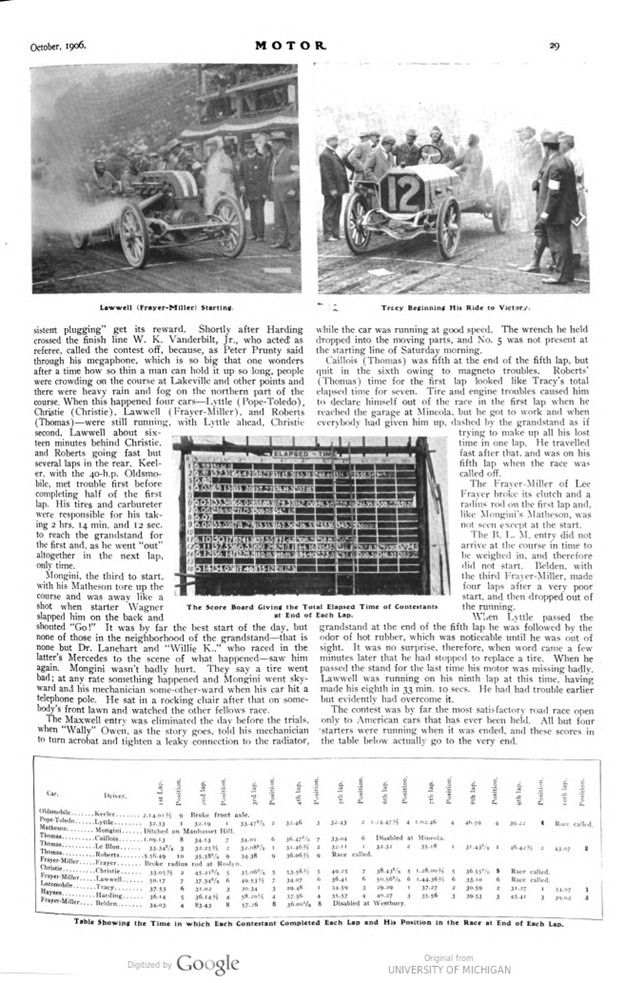
These have been the most exciting features of the contest, but not less noteworthy was the performance of the Haynes, with Harding at the wheel. What great speed capabilities of running did for it, and it captured third place. For five could not do for some of its rivals, regularity and consistency laps Harding’s time per lap did not vary two minutes, and during the whole race, except in the ninth round, when he had tire trouble, not more than five minutes. He lacked horse- power, comparatively speaking, but he used what he had all of the time. When he finished, he received almost as much, if not as much, of an ovation as did the winner. He was applauded by all, for who is there who does not like to see „persistent plugging“ get its reward. Shortly after Harding crossed the finish line W. K. Vanderbilt, Jr., who acted as referee, called the contest off, because, as Peter Prunty said through his megaphone, which is so big that one wonders. after a time how so thin a man can hold it up so long, people were crowding on the course at Lakeville and other points and there were heavy rain and fog on the northern part of the course. When this happened four cars – Lyttle (Pope-Toledo), Christie (Christie), Lawwell (Frayer-Miller), and Roberts (Thomas) – were still running, with Lyttle ahead, Christie second, Lawwell about sixteen minutes behind Christie, and Roberts going fast but several laps in the rear. Keeler, with the 40-h.p. Oldsmobile, met trouble first before completing half of the first lap. His tires and carbureter were responsible for his taking 2 hrs. 14 min. and 12 sec. to reach the grandstand for the first and, as he went „out“ altogether in the next lap, only time.
Mongini, the third to start, with his Matheson tore up the course and was away like a shot when starter Wagner slapped him on the back and shouted „Go!“ It was by far the best start of the day, but none of those in the neighborhood of the grandstand – that is none but Dr. Lanehart and „Willie K.,“ who raced in the latter’s Mercedes to the scene of what happened – saw him again. Mongini wasn’t badly hurt. They say a tire went bad; at any rate something happened and Mongini went skyward and his mechanician some-other-ward when his car hit a telephone pole. He sat in a rocking chair after that on somebody’s front lawn and watched the other fellow’s race.
The Maxwell entry was eliminated the day before the trials, when „Wally“ Owen, as the story goes, told his mechanician to turn acrobat and tighten a leaky connection to the radiator, while the car was running at good speed. The wrench he held dropped into the moving parts, and No. 5 was not present at the starting line of Saturday morning.
Caillois (Thomas) was fifth at the end of the fifth lap but quit in the sixth owing to magneto troubles. Roberts‘ (Thomas) time for the first lap looked like Tracy’s total elapsed time for seven. Tire and engine troubles caused him to declare himself out of the race in the first lap when he reached the garage at Mineola, but he got to work and when everybody had given him up, dashed by the grandstand as if trying to make up all his lost time in one lap. He travelled fast after that and was on his fifth lap when the race was called off.
The Frayer-Miller of Lee Frayer broke its clutch and a radius rod on the first lap and, like Mongini’s Matheson, was not seen except at the start.
The B. L. M. entry did not arrive at the course in time to be weighed in, and therefore did not start. Belden, with the third Frayer-Miller, made four laps after a very poor start, and then dropped out of the running.
When Lyttle passed the grandstand at the end of the fifth lap he was followed by the odor of hot rubber, which was noticeable until he was out of sight. It was no surprise, therefore, when word came a few minutes later that he had stopped to replace a tire. When he passed the stand for the last time his motor was missing badly. Lawwell was running on his ninth lap at this time, having made his eighth in 33 min. 10 secs. He had had trouble earlier but evidently had overcome it.
The contest was by far the most satisfactory road race open only to American cars that has ever been held. All but four starters were running when it was ended, and the table below actually go to the very end.
Photo captions.
Page 26. The Horseshoe Turn in the Vanderbilt Cup Course Old Westbury – White at Arrows Show How the is Turn Made. Photo by Spooner & Wells.
Page 27. Le Blon (Thomas). – Harding (Haynes). – Lyttle (Pope-Toledo). (Protested.) – Christie (Christie) – Tracy (Locomobile)
Photo Spooner & Wells. Tracy Bringing The Locomobile in First in the Elimination Trials.
Page 28. Harding (Haynes) Taking Krug’s Corner. – Lyttle (Pope-Toledo) At Grandstand.
Le Blon Swinging His Thomas Around the „Horseshoe.“
Page 29. Lawwell (Frayer-Miller) Starting. – Tracy Beginning His Ride to Victory.
The Score Board Giving the Total Elapsed Time of Contestants at End of Each Lap.
Table Showing the Time in which Each Contestant Completed Each Lap and His Position in the Race at End of Each Lap.