
Text and jpegs by courtesy of hathitrust.org www.hathitrust.org, compiled by motorracinghistory.com
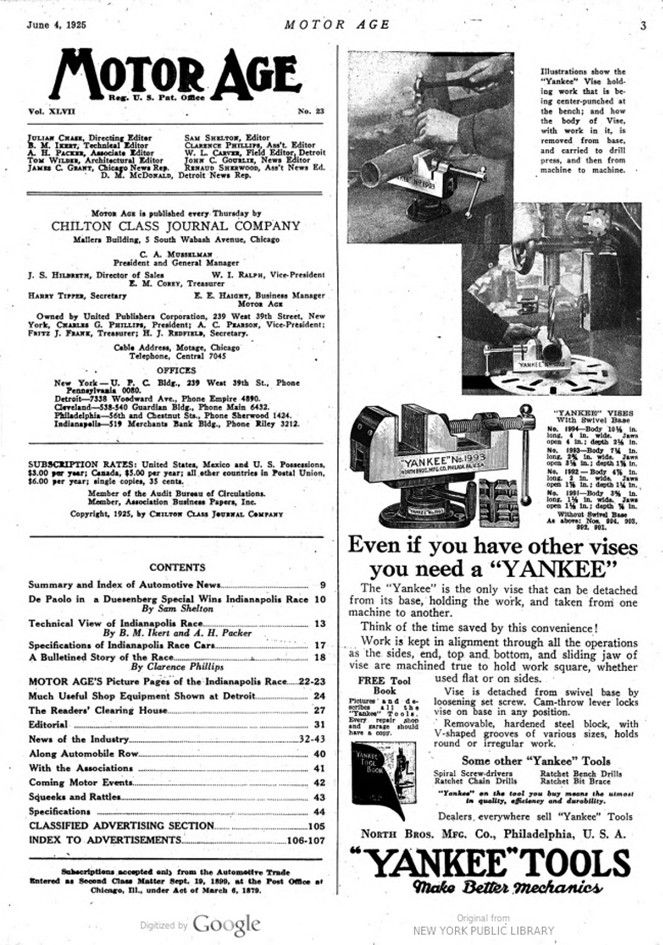
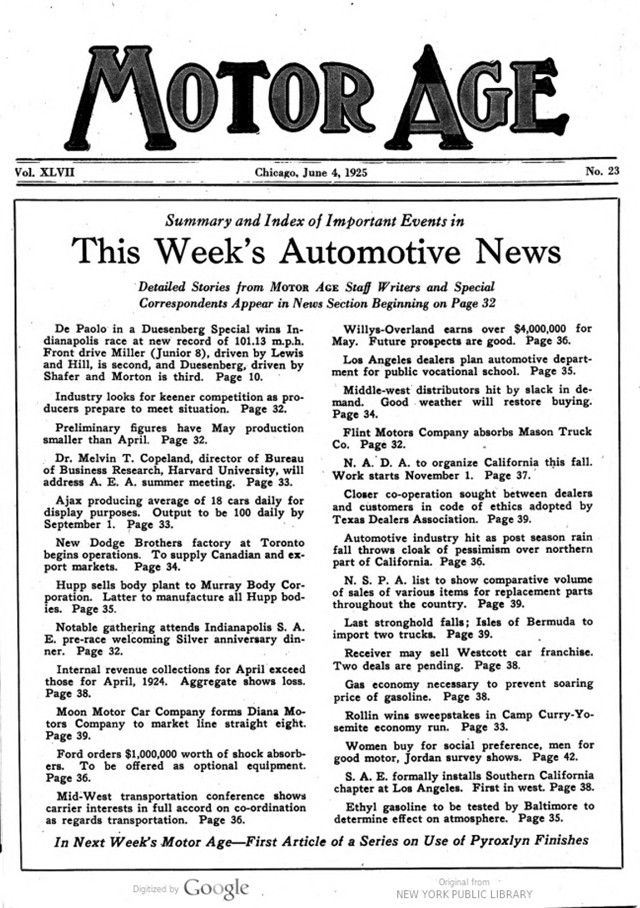
Motor Age, Vol. XLVII (47), No. 23, June 4, 1925
Technical View of Indianapolis Race
Race as Seen From the Pits Shows Notable Lack of Former Troubles. Thirty-Six Tires Changed. No Mechanical Difficulties From Superchargers.
By B. M. IKERT and A. H. PACKER
THERE were those who said the little 122-cubic inch race cars day was m which competed in this year’s 500-mile Indianapolis race would „burn up“ because of the superchargers.
There were also those who said the front wheel drive Miller, entered as the Junior Eight Special, would be tricky on the turns, and there was considerable doubt likewise in the minds of many, experts included, that the balloon tires would not come through such terrific punishment imposed by a long distance race over the heated bricks of the Hoosier oval.
But the cars did not burn up and the supercharger theory once more proved its worth. The front-wheel drive Miller proved conclusively that you can combine drive and steering in the front axle of a racing car and not have the car tricky at the turns.
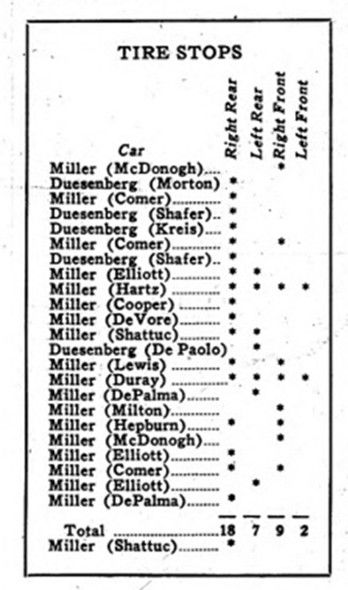
And that balloon tires are practical for high sustained speeds such as they never encounter in commercial passenger cars is proved by the fact that in this year’s race 36 tires were changed as compared with 37 last year. Besides, in last year’s race the average miles per hour of the winner was 98.23 for the 500 miles, whereas, this year it was 101.13 m.p.h., and the day was much warmer than at last year’s race.
Aside from being an outstanding victory, therefore, for the eight-cylinder Duesenberg which started its record-smashing business last year in the 500-mile race, we have three big achievements in the way of, first, the application of the supercharger to maintain compression; second, the driving of the front wheels of a race car, and third, the use of balloon tires in racing.
Three Outstanding Features
Regarding supercharging the race showed that only a year was necessary to develop and perfect this mechanism. It will be recalled that the winning Duesenberg last year was a supercharged car and when it so ably demonstrated its superior speed and performance last year, it naturally followed, that superchargers came into general use in all race cars of worth. And so, while all of the cars in this year’s race were supercharge-engined jobs, the remarkable thing is that in no case did the supercharger mechanism give any trouble, nor can the supercharger be blamed directly or indirectly for any mechanical troubles which either put the cars far back in the running or eliminated them.
In fact, the supercharger makes possible several things that ordinarily cannot be had without such a mechanism. One has but to recall the many instances of valve trouble in the old days of cams which quickly opened the valves and just as quickly seated them, imposing a terrific hammering or pounding on the valves and seats. All this is done away with when the supercharger is used, because it allows the use of cams with easy opening and closing characteristics, saving the valves and springs materially. That is one reason why in this year’s race there was not a single case of valve trouble on any of the cars.
And that is not all. Valve timing does not have to be set to a hair as in the days before the supercharger and it may be surprising to many to know that the timing of these special race creations is practically the same as in stock engines of passenger cars. Mr. Duesenberg ably expresses it „Valve timing doesn’t seem to make much difference one way or another, the supercharger takes care of it.“
While the Duesenberg, Miller and Fiat cars are agreed on the use of superchargers they differ greatly in the type and location of the mechanism which forces the mixture under pressure to the cylinder. In all cases the superchargers, meaning the blower proper, are driven by mechanical means from the engine, but in the Duesenberg, it is placed. alongside the engine and in the Miller cars, behind the engine,‘ while in the Fiat it is directly in front of the engine and driven from off the nose of the crankshaft. The Duesenberg and Miller superchargers are of the centrifugal type and that of the Fiat of the Root’s blower type. The various types of superchargers are of the centrifugal tail in a previous issue of MOTOR AGE, with the exception of the Fiat.
The Fiat Supercharger
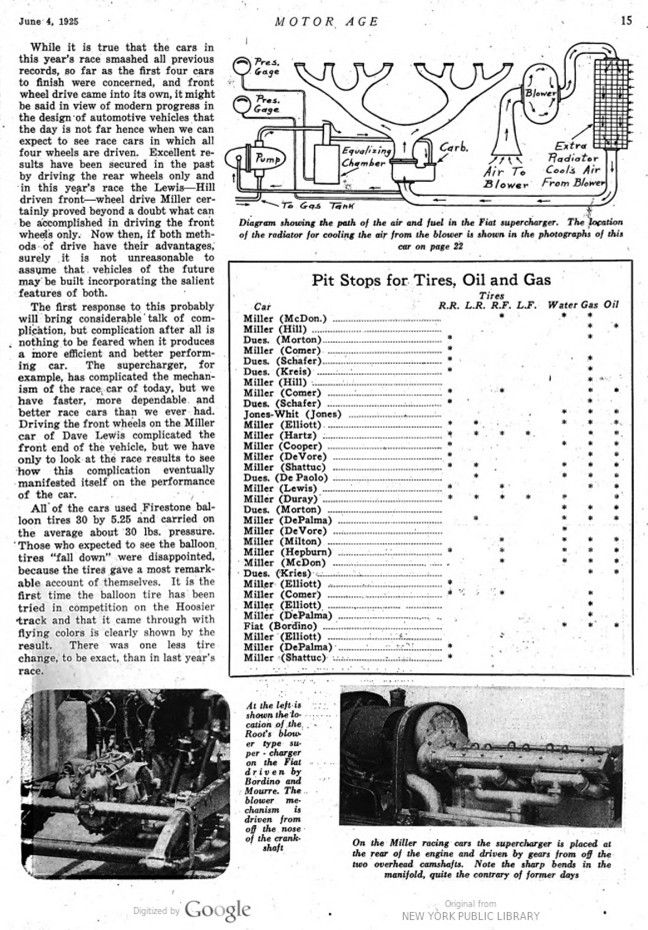
The Fiat blower draws in air through a funnel shaped pipe, which is located at the right of the engine near the front, this air then being passed through a special radiator below the regular one. This is done to cool off the air which is heated due to being compressed, for the air if excessively heated when entering the engine would reduce the efficiency.
From this radiator a large pipe in the right frame channel carries air back to the carbureter, through which it passes up through the intake manifold to the eight cylinders.
At the rear of the engine, however, is a pump, driven from the crankshaft by means of gears and taking a portion of the air which comes back from the air radiator. This pump also operates to draw gasoline from the tank and mix the two, sending a rich mixture of air and gasoline to the carbureter. Here the rich mixture Under pressure from the pump meets the air stream from the blower, also under pressure, and the combination serves as fuel for the engine.
The mixture on its way to the carbureter must pass through a tube at the top of an equalizing chamber in order that the impulses of the pump may not be transmitted to the carbureter and cause erratic action. From the bottom of this equalizing chamber, a pipe connection leads to a gage on the instrument board, while another gage is connected to the air pipe, just before it reaches the carbureter. This enables the driver to see that the proper pressure ratio is maintained at all times.
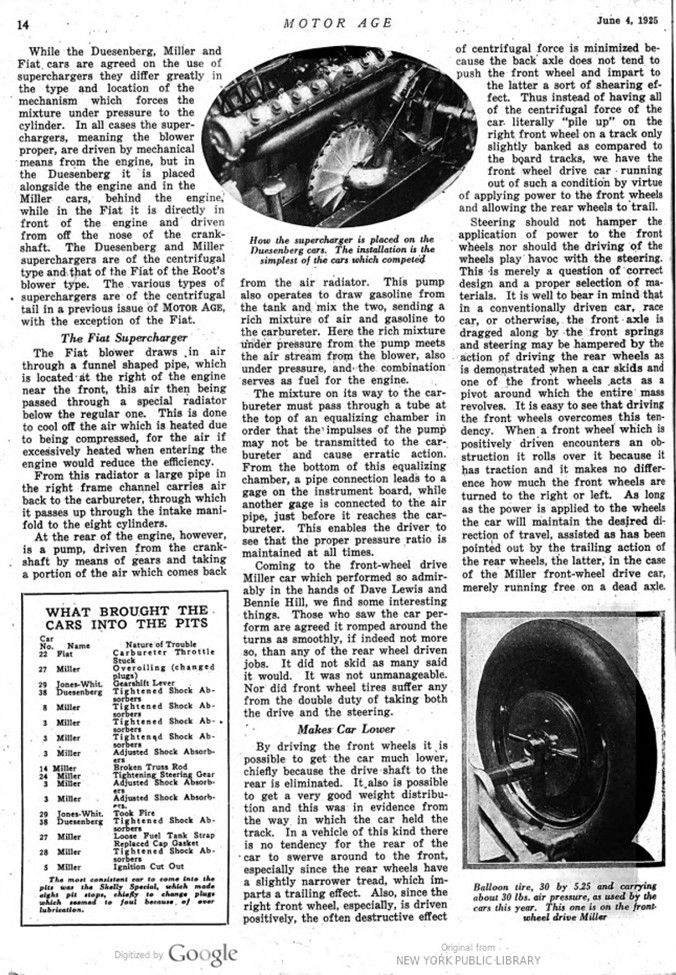
Coming to the front-wheel drive Miller car which performed so admirably in the hands of Dave Lewis and Bennie Hill, we find some interesting things. Those who saw the car perform are agreed it romped around the turns as smoothly, if indeed not more so, than any of the rear wheel driven jobs. It did not skid as many said it would. It was not unmanageable. Nor did front wheel tires suffer any from the double duty of taking both the drive and the steering.
Makes Car Lower
By driving the front wheels, it is possible to get the car much lower, chiefly because the drive shaft to the rear is eliminated. It also is possible to get a very good weight distribution, and this was in evidence from the way in which the car held the track. In a vehicle of this kind there is no tendency for the rear of the car to swerve around to the front, especially since the rear wheels have a slightly narrower tread, which im- parts a trailing effect. Also, since the right front wheel, especially, is driven positively, the often destructive effect of centrifugal force is minimized because the back axle does not tend to. push the front wheel and impart to the latter a sort of shearing effect. Thus, instead of having all of the centrifugal force of the car. literally „pile up“ on the right front wheel on a track only slightly banked as compared to the board tracks, we have the front wheel drive car running out of such a condition by virtue of applying power to the front wheels and allowing the rear wheels to trail.
Steering should not hamper the application of power to the front wheels, nor should the driving of the wheels play havoc with the steering. This is merely a question of correct design and a proper selection of materials. It is well to bear in mind that in a conventionally driven car, race car, or otherwise, the front axle is dragged along by the front springs and steering may be hampered by the action of driving the rear wheels as is demonstrated when a car skids and one of the front wheels acts as a pivot around which the entire mass revolves. It is easy to see that driving the front wheels overcomes this tendency. When a front wheel which is positively driven encounters an obstruction it rolls over it because it has traction, and it makes no difference how much the front wheels are turned to the right or left. As long as the power is applied to the wheels the car will maintain the desired di- rection of travel, assisted as has been pointed out by the trailing action of the rear wheels, the latter, in the case of the Miller front-wheel drive car, merely running free on a dead axle.
While it is true that the cars in this year’s race smashed all previous records, so far as the first four cars to finish were concerned, and front wheel drive came into its own, it might be said in view of modern progress in the design of automotive vehicles that the day is not far hence when we can expect to see race cars in which all four wheels are driven. Excellent results have been secured in the past by driving the rear wheels only and in this year’s race the Lewis – Hill driven front-wheel drive Miller certainly proved beyond a doubt what can be accomplished in driving the front wheels only. Now then, if both methods of drive have their advantages, surely it is not unreasonable to assume that vehicles of the future may be built incorporating the salient features of both.

The first response to this probably will bring considerable talk of complication, but complication after all is nothing to be feared when it produces a more efficient and better performing car. The supercharger, for example, has complicated the mechanism of the race car of today, but we have faster, more dependable and better race cars than we ever had. Driving the front wheels on the Miller car of Dave Lewis complicated the front end of the vehicle, but we have only to look at the race results to see how this complication eventually manifested itself on the performance of the car.
All of the cars used Firestone balloon tires 30 by 5.25 and carried on the average about 30 lbs. pressure. Those who expected to see the balloon tires „fall down“ were disappointed, because the tires gave a most remarkable account of themselves. It is the first time the balloon tire has been tried in competition on the Hoosier track and that it came through with flying colors is clearly shown by the result. There was one less tire change, to be exact, than in last year’s race.
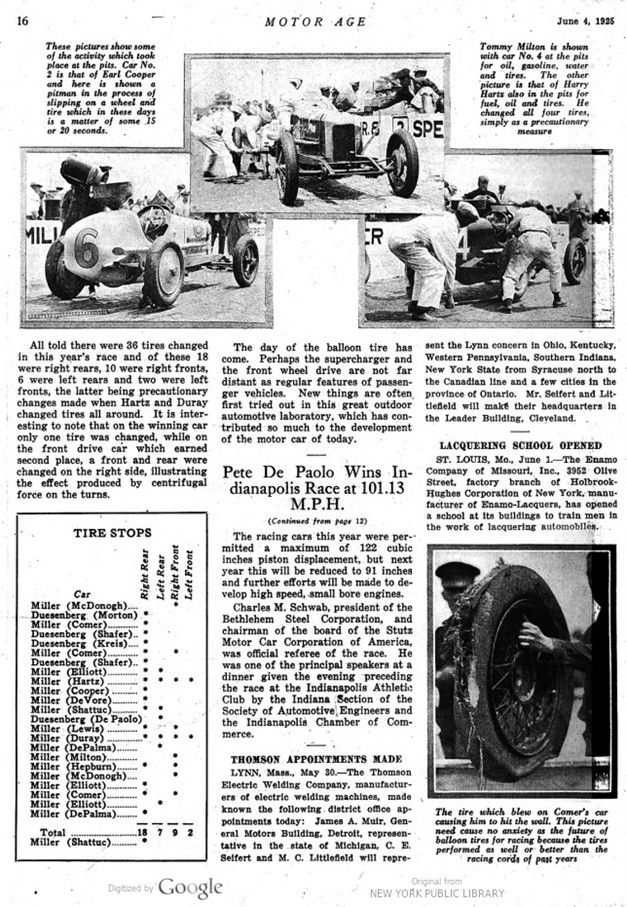
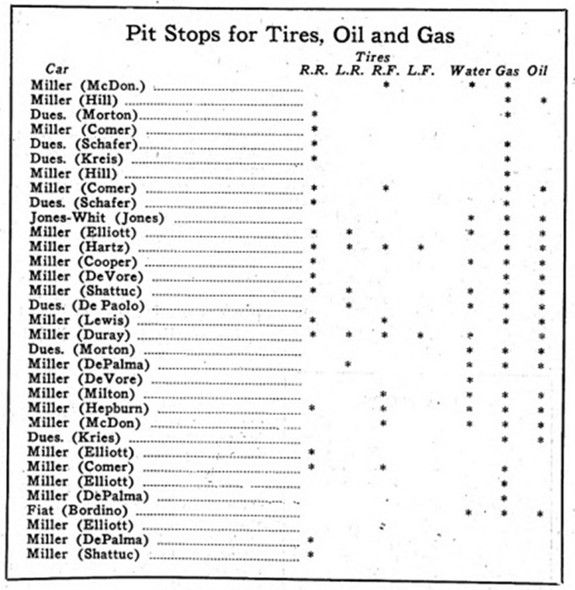
All told there were 36 tires changed in this year’s race and of these 18 were right rears, 10 were right fronts, 6 were left rears and two were left fronts, the latter being precautionary changes made when Hartz and Duray changed tires all around. It is interesting to note that on the winning car only one tire was changed, while on the front drive car which earned second place, a front and rear were changed on the right side, illustrating the effect produced by centrifugal force on the turns.
The day of the balloon tire has come. Perhaps the supercharger and the front wheel drive are not far distant as regular features of passenger vehicles. New things are often first tried out in this great outdoor automotive laboratory, which has contributed so much to the development of the motor car of today.
Photo captions.
Page 13.
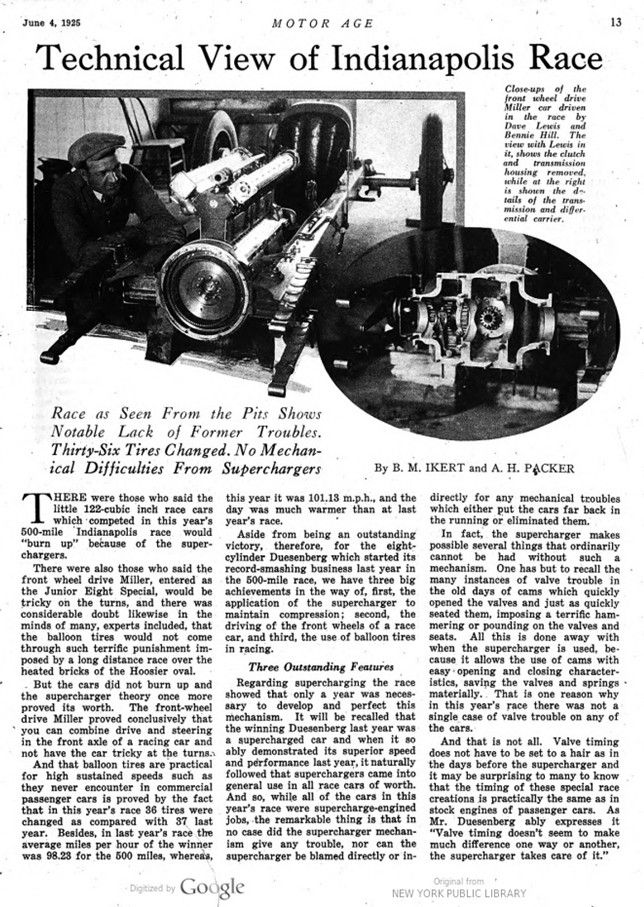
Close-ups of the front wheel drive Miller car driven in the race by Dave Lewis and Bennie Hill. The view with Lewis in it, shows the clutch and transmission housing removed, while at the right is shown the details of the transmission and differential carrier.
Page 14.
How the supercharger is placed on the Duesenberg cars. The installation is the simplest of the cars which competed.
Balloon tire, 30 by 5.25 and carrying about 30 lbs. air pressure, as used by the cars this year. This one is on the front-wheel drive Miller.
Page 15.
Diagram showing the path of the air and fuel in the Fiat supercharger. The location. of the radiator for cooling the air from the blower is shown in the photographs of this car on page 22.
At the left is shown the location of the Root’s blower type supercharger on the Fiat driven by Bordino and Mourre. The blower mechanism is driven from off the nose. of the crankshaft.
On the Miller racing cars, the supercharger is placed at the rear of the engine and driven by gears from off the two overhead camshafts. Note the sharp bends in the manifold, quite the contrary of former days.
Page 16.
These pictures show some of the activity which took place at the pits. Car No. 2 is that of Earl Cooper and here is shown pitman in the process of slipping on a wheel and tire which in these days is a matter of some 15 or 20 seconds.
Tommy Milton is shown with car No. 4 at the pits for oil, gasoline, water and tires. The other picture is that of Harry Hartz also in the pits for fuel, oil and tires. He changed all four tires, simply as a precautionary measure.
The tire which blew on Comer’s car causing him to hit the wall. This picture need cause no anxiety as the future of balloon tires for racing because the tires performed as well or better than the racing cords of past years.
WHAT BROUGHT THE CARS INTO THE PITS
Car
No. Name Nature of Trouble
22 Fiat Carbureter Throttle Stuck
27 Miller Overoiling (changed plugs)
29 Jones-Whit. Gearshift Lever
38 Duesenberg Tightened Shock Absorbers
8 Miller Tightened Shock Absorbers
3 Miller Tightened Shock Absorbers
3 Miller
3 Miller Adjusted Shock Absorbers
14 Miller Truss Rod
24 Miller Tightening Steering Gear
3 Miller Adjusted Shock Absorbers
29 Jones-Whit. Took Fire
38 Duesenberg Tightened Shock Absorbers
27 Miller Loose Fuel Tank Strap, Replaced Cap Gasket
28 Miller Tightened Shock Absorbers
5 Miller Ignition Cut Out
The most consistent car to come into the pits was the Skelly Special, which made eight pit stops, chiefly to change plugs which seemed to foul because of lubrication.