In this article preceding the 1916 Indianapolis Sweepstakes, The Automobile Journal introduces many aspects of preparation for the race. The European cars, Peugeots, Delages and Sunbeams that will be participating as well as the American cars, Frontenacs, Maxwells, Duesenbergs and Premiers are discussed.



Text and jpegs by courtesy of hathitrust.org www.hathitrust.org, compiled by motorracinghistory.com
THE AUTOMOBILE JOURNAL – Vol. XLI, No. 9, June 10, 1916
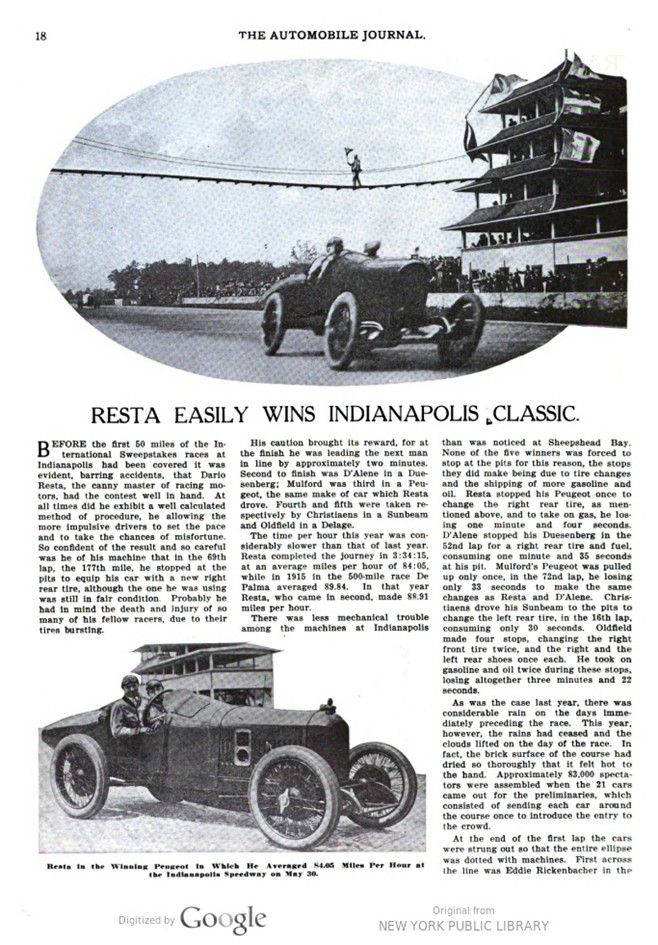
RESTA EASILY WINS INDIANAPOLIS CLASSIC.
BEFORE the first 50 miles of the International Sweepstakes races at Indianapolis had been covered it was evident, barring accidents, that Dario Resta, the canny master of racing motors, had the contest well in hand. At all times did he exhibit a well calculated method of procedure, he allowing the more impulsive drivers to set the pace and to take the chances of misfortune. So confident of the result and so careful was he of his machine that in the 69th lap, the 177th mile, he stopped at the pits to equip his car with a new right rear tire, although the one he was using was still in fair condition. Probably he had in mind the death and injury of so many of his fellow racers, due to their tires bursting.
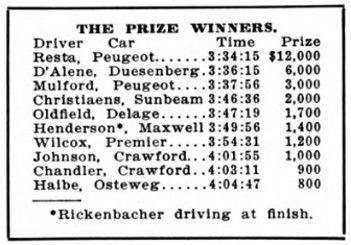
His caution brought its reward, for at the finish he was leading the next man in line by approximately two minutes. Second to finish was D’Alene in a Duesenberg; Mulford was third in a Peugeot, the same make of car which Resta drove. Fourth and fifth were taken respectively by Christiaens in a Sunbeam and Oldfield in a Delage.
The time per hour this year was considerably slower than that of last year. Resta completed the journey in 3:34:15, at an average miles per hour of 84:05, while in 1915 in the 500-mile race De Palma averaged 89.84. In that year Resta, who came in second, made 88.91 miles per hour.
There was less mechanical trouble among the machines at Indianapolis than was noticed at Sheepshead Bay. None of the five winners was forced to stop at the pits for this reason, the stops they did make being due to tire changes and the shipping of more gasoline and oil. Resta stopped his Peugeot once to change the right rear tire, as mentioned above, and to take on gas, he losing one minute and four seconds. D’Alene stopped his Duesenberg in the 52nd lap for a right rear tire and fuel, consuming one minute and 35 seconds at his pit. Mulford’s Peugeot was pulled up only once, in the 72nd lap, he losing only 33 seconds to make the same changes as Resta and D’Alene. Christiaens drove his Sunbeam to the pits to change the left rear tire, in the 16th lap, consuming only 30 seconds. Oldfield made four stops, changing the right front tire twice, and the right and the left rear shoes once each. He took on gasoline and oil twice during these stops, losing altogether three minutes and 22 seconds.
As was the case last year, there was considerable rain on the days immediately preceding the race. This year, however, the rains had ceased and the clouds lifted on the day of the race. In fact, the brick surface of the course had dried so thoroughly that it felt hot to the hand. Approximately 83,000 spectators were assembled when the 21 cars came out for the preliminaries, which consisted of sending each car around the course once to introduce the entry to the crowd.
At the end of the first lap the cars were strung out so that the entire ellipse was dotted with machines. First across the line was Eddie Rickenbacher in the Maxwell, which he piloted to victory at Sheepshead Bay. In the order mentioned followed Aitken (Peugeot), Resta (Peugeot), Anderson (Premier), Rooney (Premier), Merz (Peugeot), Wilcox (Premier) and Arthur Chevrolet (Frontenac), with the rest of the starters trailing far behind.
At the end of the second lap, five miles, Rickenbacher had opened a gap of 300 yards between his car and Aitken and Resta. In the 13th mile the flying Maxwell, which was doing about 90 miles an hour, lapped Johnson’s Crawford, and continued to mow down the field. About a half mile separated Rickenbacher from his nearest follower. Aitken and Resta were battling, wheel to wheel, for supremacy, and when Rickenbacher’s white Maxwell met grief in the ninth lap through a broken steering knuckle, Aitken shot to the front. With Rickenbacher out the two Peugeots were left a quarter of a lap ahead of the next driver, Mulford, in another Peugeot.
Many cars were falling by the wayside, going to the pits for tire changes, repairs and fuel replenishments. Conspicuous among these were the Premiers, Frontenacs and Crawfords, the first two being troubled by sooty plugs.
In the 45th mile Aitken was forced to surrender the lead to the persistent Resta, the former going to the pits to change the right rear tire. Though it required but 20 seconds, the delay was sufficient to allow the Italian-American speed king to gain a lead that he held thereafter throughout the contest.
Resta covered the first 50 miles in 32 minutes and 17 seconds, and the field had been cut down to 19 contestants, Rickenbacher and Franchi, who drove a Peusun, having dropped out. At 100 miles, which the leader had covered in one hour, seven minutes and 20 seconds, two other drivers, Merz and Wilcox, had been eliminated. Merz drove a Peugeot and Wilcox a Premier.
Between the 75th and 100-mile mark various drivers tried to wrest the lead from Resta by exceedingly clever driving and great bursts of speed. One of these was Louis Chevrolet, in a Frontenac, who brought prolonged cheers from the spectators, partly because of his exhibition and also because the car is an American made product. Aitken grimly hung onto second position, while D’Alene, who had developed an astonishing sprint, held third place. Back among the trailers was Mulford, who was gradually coming to the front.
In the laps between the 100 and 150-mile mark, Mulford took the curves in wonderful sweeps, daring where others were cautious and speeding up to the limit of capacity on the straightaways. He passed D’Alene and several others in the front rank and snuggled into third position, where he waited for the break among the leading group that would allow him to shoot to the front and win the race.
It was on the 64th lap that the most serious accident of the afternoon occurred. While circling the south turn of the course, Jack LeCain lost control of his Delage and crashed into the retaining wall. The car overturned and LeCain sustained internal injuries and a broken. back. The speedway management announced his injuries as „very serious.“ His mechanician, Bob Moore, escaped ninjured.
The second accident of the day occurred about the same time and in about the same manner. Tom Rooney, driving a Premier, crashed into the wall, suffering a broken hip. Thane Houser, his mechanician, was seriously injured.
In the 68th lap Aitken took another trip to the pits, and Resta took occasion to increase his lead to a safer margin. On the next lap Resta made his first and only visit to the pits, to change the right rear tire and fill his gasoline tank. His delay was one minute and four seconds, and yet he still retained the lead. In the next lap Aitken lost his chance for the winning position, through a broken valve that put him out of the race.
With 100 miles to go the race developed into a close fight for third position between Henderson and D’Alene. Resta had a comfortable lead and Mulford seemed to have clinched second place. But at the end of 250 miles D’Alene had pushed his car to the limit and outdistanced Mulford, who fell back to third position. Christiaens held fourth and Oldfield fifth. Behind them came Rickenbacher in sixth position, he having taken the wheel of the Maxwell driven by Henderson. Next in the order named was Haibe (Osteweg), Wilcox (Premier), Alley (Ogren) and Johnson (Crawford).
It was in this order that the race was finished, excepting that Wilcox crowded Haibe out of seventh and Chandler nosed in ahead of Alley for ninth place.

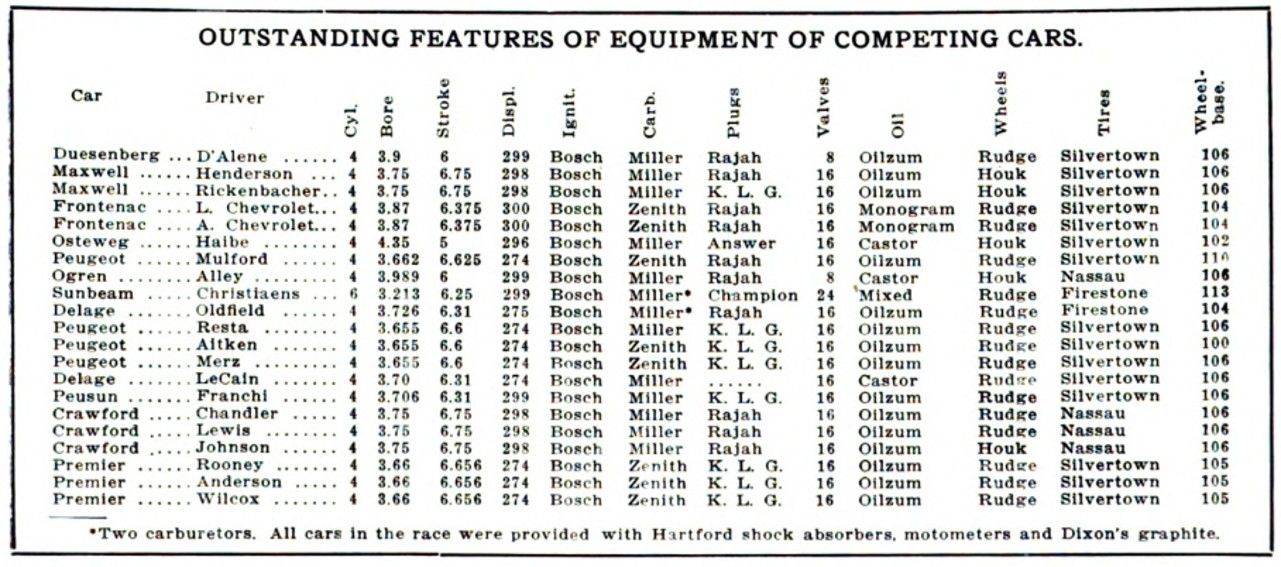
Photo captions.
Page 18
Resta in the Winning Peugeot in Which He Averaged 84.05 Miles Per Hour at the Indianapolis Speedway on May 30.
19
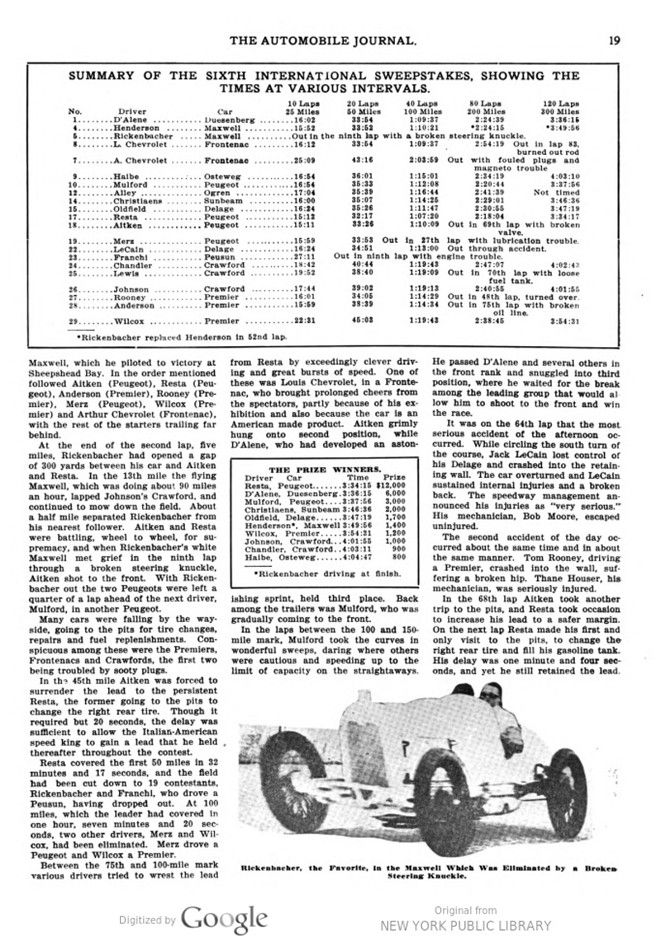
SUMMARY OF THE SIXTH INTERNATIONAL SWEEPSTAKES, SHOWING THE TIMES AT VARIOUS INTERVALS. – THE PRIZE WINNERS.
Rickenbacher, the Favorite, in the Maxwell Which Was Eliminated by a Broken Steering Knuckle.
Page 20
Mulford in the Peugeot with which He Captured Third Position After Plucky Race.
OUTSTANDING FEATURES OF EQUIPMENT OF COMPETING CARS.