Text and photo with authorisation of Bibliothèque national francais, gallica.bnf.fr, www.gallica.bnf.fr, compiled by motorracinghistory.com
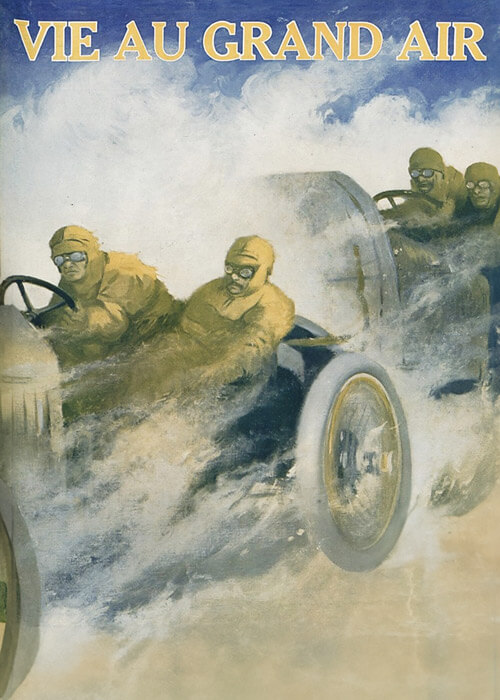
La Vie au Grand Air, 6e Année, No. 247, 6 juin 1903
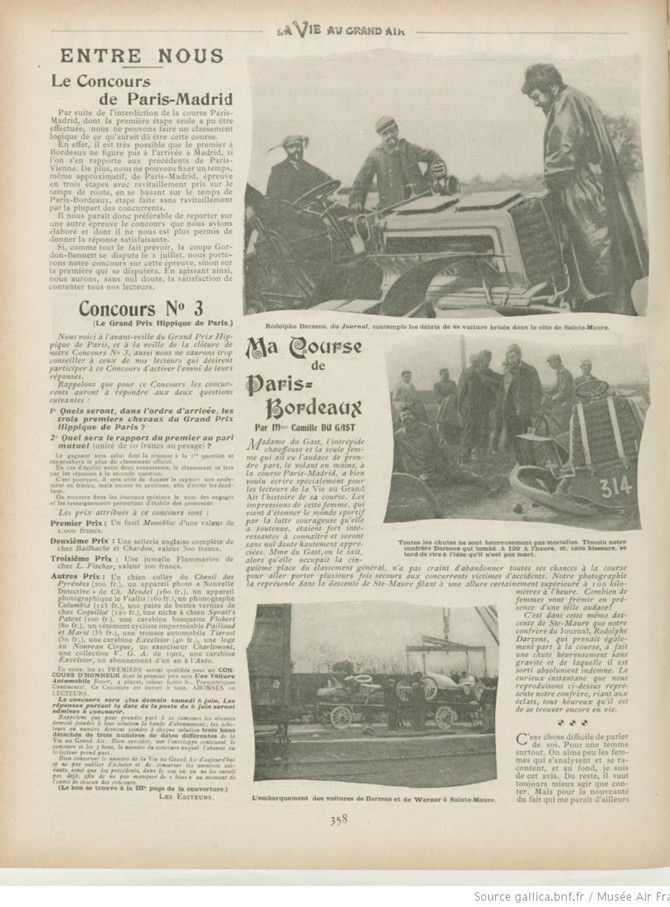
BETWEEN US – The Paris-Madrid Race
Following the ban on the Paris-Madrid race, of which only the first stage was completed, we are unable to make a logical classification of what the race should have been.
Indeed, it is very possible that the first to reach Bordeaux will not be among those arriving in Madrid, if we refer to the precedents of Paris-Vienna. Furthermore, we cannot set a time, even an approximate one, for Paris-Madrid, a three-stage event with refueling taken during the road time, based on the time of Paris-Bordeaux, a stage done without refueling by most of the competitors.
It therefore seems preferable to us to transfer the competition we had developed to another event, for which we are no longer allowed to give a satisfactory answer.
If, as is widely expected, the Gordon Bennett Cup is contested on July 2, we will focus our competition on this event, otherwise on the first one to be contested. By doing so, we will undoubtedly have the satisfaction of pleasing all our readers.
My Paris-Bordeaux Race by Ms. Camille Du Gast
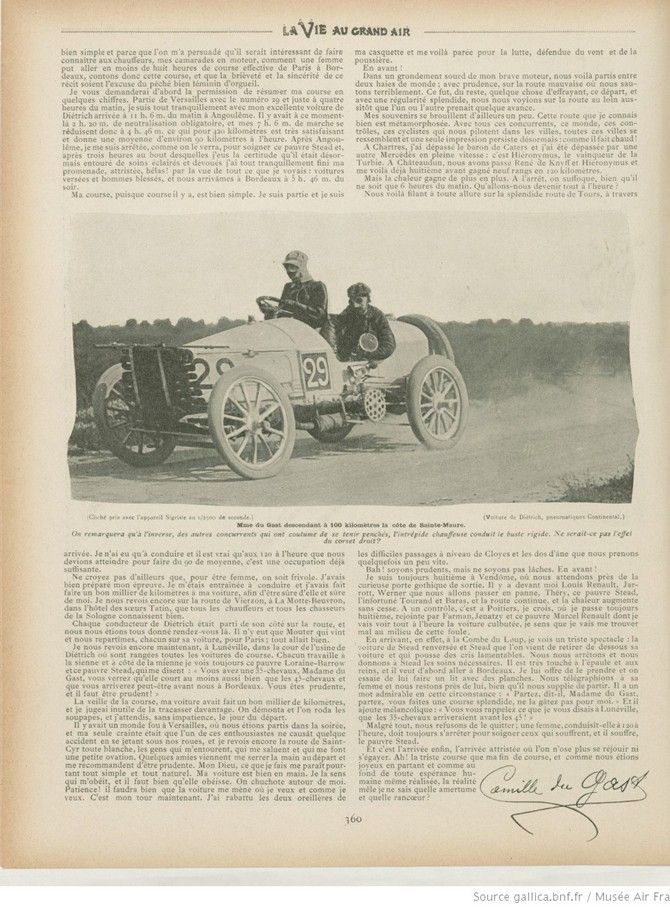
Madame du Gast, the intrepid chauffeur and the only woman who had the audacity to take part in the Paris-Madrid race, steering wheel in hand, kindly wrote the story of her race especially for the readers of La Vie au Grand Air. The impressions of this woman, who has just astonished the sporting world with the courageous struggle she has sustained, were very interesting to learn about and will undoubtedly be highly appreciated. As we know, Mrs. du Gast, while she was in fifth place in the general classification, did not fear to abandon all her chances in the race in order to go several times to the aid of competitors who were victims of accidents. Our photograph shows her in your descent of Ste-Maure, speeding at a rate of well over 700 kilometers per hour. How many women would quiver in the presence of such audacity!
It was on this same descent of Ste-Maure that our colleague from the Journal, Rodolphe Darrens, who was also taking part in the race, had a fall, fortunately without serious consequences and from which he emerged completely unharmed. The curious snapshot that we reproduce above shows our colleague, laughing out loud, delighted to be alive and well.
***
It’s difficult to talk about yourself. Especially for a woman. We don’t like women who analyze and talk about themselves, and deep down, I agree. Besides, it’s always better to act than to talk. But because of the novelty of the event, which seems quite simple to me, and because I was persuaded that it would be interesting to let drivers, my fellow motorists, know how a woman could go from Paris to Bordeaux in less than eight hours of actual racing, let us tell the story of this race, and let the brevity and sincerity of this account be an excuse for the very feminine sin of pride.
I will first ask your permission to summarize my race in a few figures. I left Versailles with the number 29 at just four o’clock in the morning, and arrived at 11:06 a.m. in Angoulême, quite comfortably in my excellent Dietrich car. At that moment, there was a 2 hour and 20-minute mandatory neutralization, and my 7 hour and 6-minute walk was therefore reduced to 4 hours and 46 minutes, which is very satisfactory for 420 kilometers and gives an average of about 19 kilometers per hour. After Angoulême, as we shall see, I stopped to look after poor Stead and, after three hours, at the end of which I was certain that he was now receiving expert and devoted care, I calmly finished my walk, saddened, alas, by the sight of everything I saw: crashed cars and injured men, and we arrived in Bordeaux at 5:46 in the evening.
My race, since it was a race, was very simple. I left and I arrived. All I had to do was drive, and it’s true that at 120 kilometers per hour, which we had to reach to average 90, it was already enough to keep me busy.
Don’t think that just because I’m a woman, I’m frivolous. I had prepared well for my challenge. I had trained to drive and had driven my car a good thousand kilometers, so that I could be sure of it and sure of myself. I can still see us on the road from Vierzon to La Motte-Beuvron, at the hotel of the Tatin sisters, which all drivers and hunters in the Sologne are familiar with.
Each Dietrich driver had set off down the road on his own, and we had all arranged to meet there. Only Mouter turned up and we set off again, each in our own car, for Paris; everything was going well.
I can still see us now, in Lunéville, in the courtyard of the Dietrich factory where all the racing cars are parked. Everyone was working on their own car and next to mine I could still see poor Loraine-Barrow and poor Stead, who said to me: “You have a 35-horsepower, Madame du Gast, you’ll see that it runs at least as well as the 45-horsepower and that you might even get to Bordeaux before us. You’re being careful, and you have to be careful!”
The day before the race, my car had travelled a good thousand kilometres, and I thought it unnecessary to bother it any further. The valves were disassembled and turned, and I waited, without impatience, for the day of departure.
There was a mad crowd at Versailles, where we had gone in the evening, and my only fear was that one of these enthusiasts would cause an accident by throwing himself under our wheels, and I can still see the road to Saint-Cyr all white, the people around me, greeting me and giving me a little ovation. Some friends come to shake my hand at the start and urge me to be careful. My goodness, what I’m doing seems so simple and natural. I have the car well under control. I can feel it obeying me, and it has to obey. People are whispering around me.

Patience! The car will have to take me where I want to go and how I want to go. It’s my turn now. I have folded down the two ear flaps of my cap and now I am ready for the fight, protected from the wind and the dust.
Forward!
With a dull rumble from my trusty engine, we set off between two hedges of people; cautiously, on the bad road where we jump terribly. It was, moreover, something frightening, this start, and with splendid regularity, we saw each other on the road in the distance as soon as one or other took some advance.
My memories are becoming a bit hazy. The road I know so well has been transformed. With all the competitors, the crowds, the checkpoints, the cyclists piloting us through the towns, all the towns look the same and one impression now remains: how hot it is!
In Chartres, I overtook Baron de Caters and was overtaken by another Mercedes at full speed: it was Hiéronymus, the winner of La Turbie. In Châteaudun, we passed René de Knvff and Hiéronymus and here I was already in eighth place, having gained nine places in 120 kilometers.
But the heat is getting worse and worse. When we stop, we suffocate, even though it’s only 6 o’clock in the morning. What will happen to us later on?
Here we are speeding along the splendid road to Tours, through the difficult level crossings of Cloyes and the speed bumps that we sometimes take a little too fast.
Well, let’s be careful, but let’s not be cowards.
Onwards:
I’m still eighth in Vendôme, where we’re waiting near the curious Gothic exit gate. In front of me are Louis Renault, Jarrott, Werner, whose car we’re going to break down, Théry, poor Stead, unfortunate Tourand and Baras, and the road goes on, and the heat increases steadily. At a checkpoint, it’s in Poitiers, I think, where I’m still in eighth place, joined by Farman, Jenatzy and poor Marcel Renault, whose car I’ll see later on with its roof upside down. I feel like I’m going to be sick in the middle of this crowd.
When we arrived at the Combe du Loup, I saw a sad sight: Stead’s car had overturned and Stead had just been pulled out from under his car and was crying piteously. We stopped and gave Stead the necessary care. He had been badly hurt in the shoulder and back, and he wanted to go to Bordeaux first. I offer to take him and we try to make a bed for him with some planks. We send a telegram to his wife and we stay with him, even though he begs us to leave. He has an admirable word in these circumstances: “Go, Madame du Gast, go, you are doing a splendid race, don’t spoil it for me.” And he adds melancholically: “Do you remember what I told you in Lunéville, that the 35-horsepower cars would arrive before the 45!”
Despite everything, we refuse to leave him; a woman, even if she drives at 120 kilometers per hour, must always stop to care for those who are suffering, and poor Stead is suffering.
And then finally the finish, the sad finish where one no longer dares to rejoice or be cheerful. Ah! what a sad end to my race, and how joyful we were when we set off, and how, at the end of all human hope, even when it is fulfilled, reality adds a certain bitterness and resentment, I know not what.
Camille du Gast.
Foto captions.
Page 358:
Rodolphe Darzens, of the Journal, contemplates the wreckage of his car broken on the Sainte-Maure hill. Fortunately, not all falls are fatal. Witness our colleague Darzens, who fell at 120 kilometers per hour and, uninjured, is doubled up with laughter at the thought that he did not die. The loading of the cars of Darzens and Werner in Sainte-Maure.
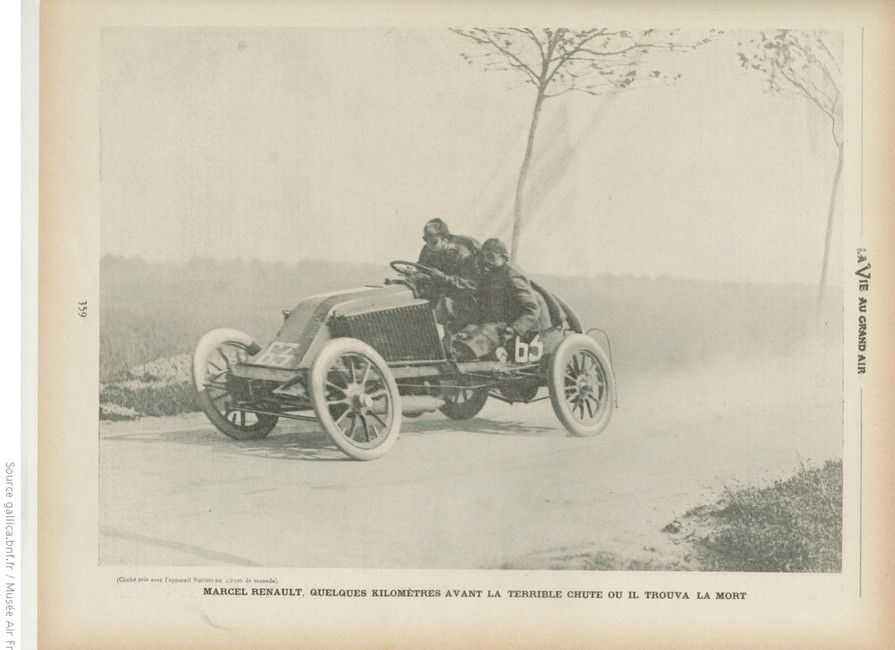
Page 359: MARCEL RENAULT, A FEW KILOMETERS BEFORE THE TERRIBLE CRASH WHERE HE DIED (Shot taken with the Sigriste camera at 1/2500 of a second).
Page 360: Mme du Gast descending the Sainte-Maure hill at 100 kilometers per hour.
Note that, in contrast, the other competitors, who tend to hold themselves in a bent position, the intrepid driver holds her torso rigid. Could this be the effect of the straight corset? (Photo taken with the Sigriste camera at 1/2500 of a second. Dietrich car, Continental tires.)
Page 361: RACING CARS IN BORDEAUX
While the drivers freshen up, the agents conscientiously guard the cars.
The de Dion cars guarded by the agents inside the newspaper property.
The parade of racing monsters in front of the Monument des Girondins. – Even the motorcycles had to be led by hand; and, for added safety, their drive belts had been removed. – A hundred horsepower pitifully pulled by a simple carriage is heading for the station. It will return to Paris slower than it came.
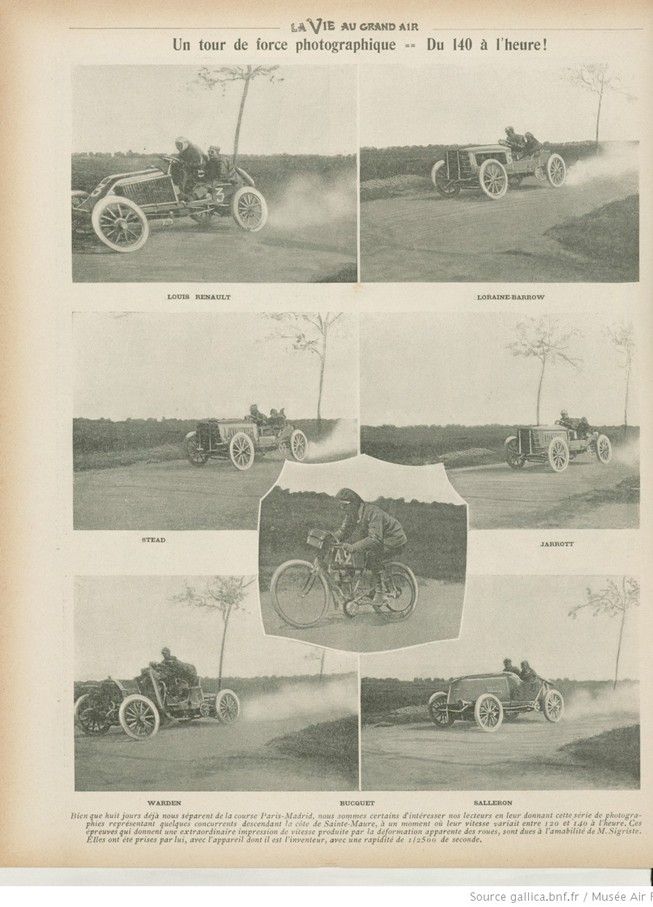
Page 362: A Photographic Feat ** 140 km/h!
LOUIS RENAULT – LORAINE-BARROW – STEAD – JARROTT – WARDEN – BUCQUET – SALLERON
Although the Paris-Madrid race is already a week away, we are sure that our readers will be interested in this series of photographs showing some of the competitors going down the Sainte-Maure hill at a speed of between 120 and 140 kph. These events, which give an extraordinary impression of speed produced by the apparent deformation of the wheels, are courtesy of Mr. Sigriste. They were taken by him, with the camera he invented, at a speed of 1/2500 of a second.
Page 272: MARCEL RENAULT (Photo J. Beau.)
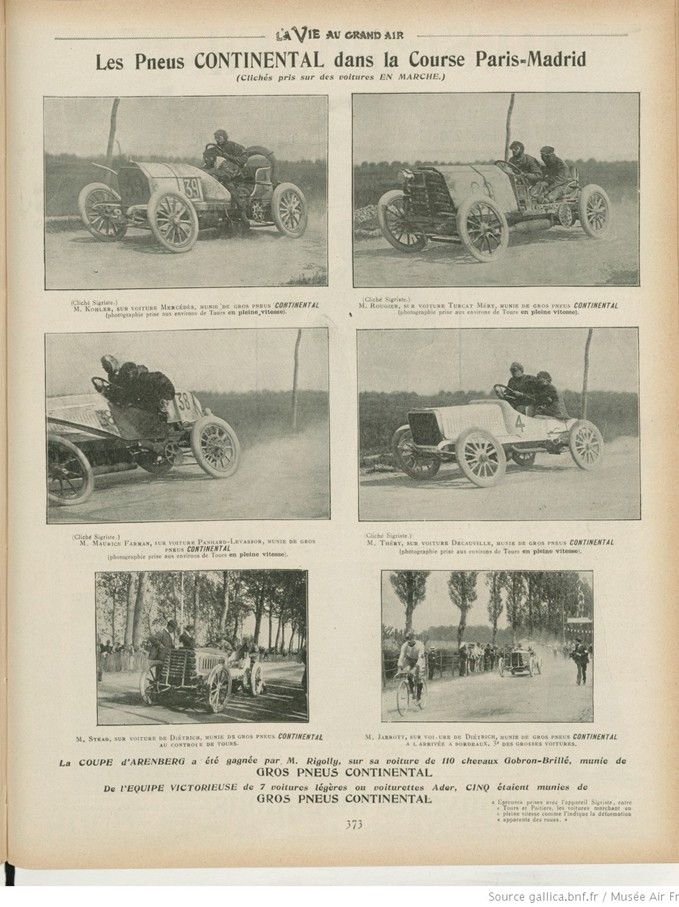
Page 373: CONTINENTAL Tires in the Paris-Madrid Race
Supplement to La Vie au Grand Air of June 3, 1901. – (Photos taken on cars IN MOTION.)
M: KOBLER IN A MERCEDES CAR WITH LARGE ‚CONTINENTAL‘ TIRES (photo taken at full speed near Tours). (Photo by Sigriste.)
MR. MAURICE FARMAN, IN A PANHARD-LEVASSOR CAR, WITH LARGE CONTINENTAL TIRES (photograph taken in the vicinity of Tours at full speed).
MR. STEAD, IN A DIETRICH CAR, WITH LARGE CONTINENTAL TIRES AT THE TOURS CHECKPOINT. (Sigriste photo.)
Mr. Rougier in a Turcat Mery with large Continental tires
(photograph taken in the vicinity of Tours at full speed). (Sigriste print.)
Mr. Théry in a Decauville with large Continental tires (photograph taken in the vicinity of Tours at full speed).
Mr. JARROTT, IN A DIÉTRICH CAR, WITH LARGE CONTINENTAL TIRES, ON ARRIVAL IN BORDEAUX. 3rd IN THE BIG CARS.
The ARENBERQ CUP was won by Mr. Rigolly in his 110-horsepower Gobron-Brillé car with BIG CONTINENTAL TIRES.
Of the WINNING TEAM of 7 light cars or Ader buggies, FIVE were equipped with BIG CONTINENTAL TIRES.
* Evidence taken with the Sigriste device, between Tours and Poitiers, the cars traveling at full speed as indicated by the apparent deformation of the wheels.