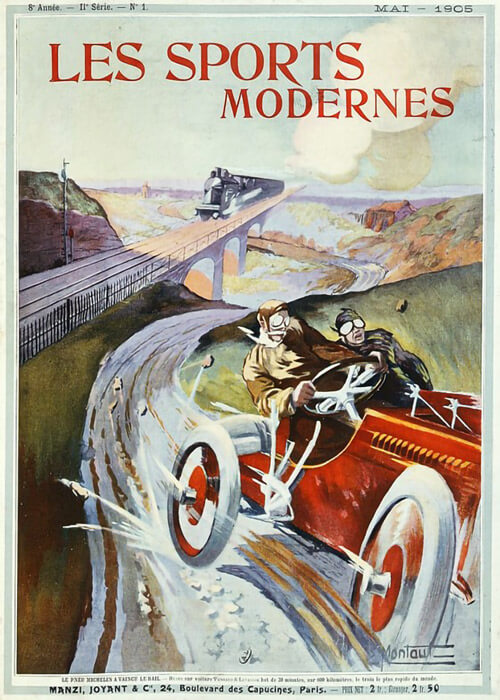
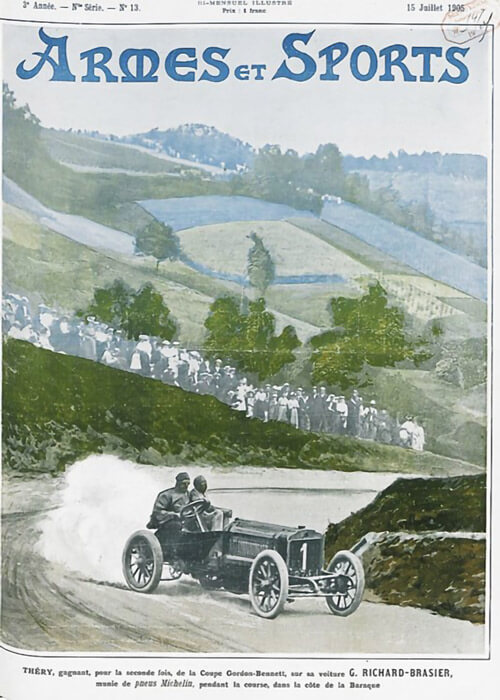
One day after the 1921 French Grand Prix on the la Sarthe road course, the daily magazine or newspaper l’Auto published an extended report on the race. Again, written by none other than Charles Faroux. Here the second part of that report (translated by DeepL.com) in the Tuesday 26th July issue of L’Auto.
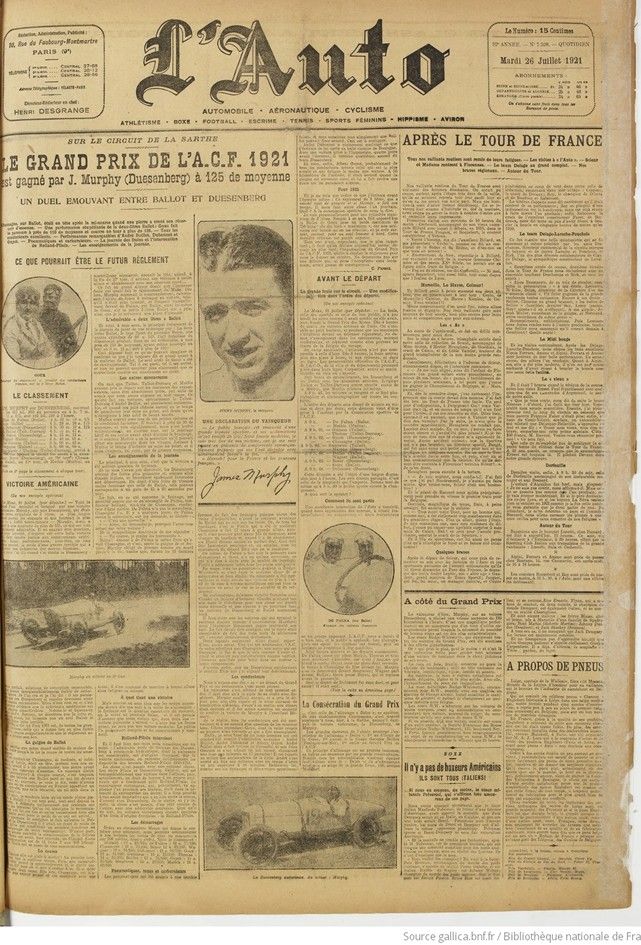
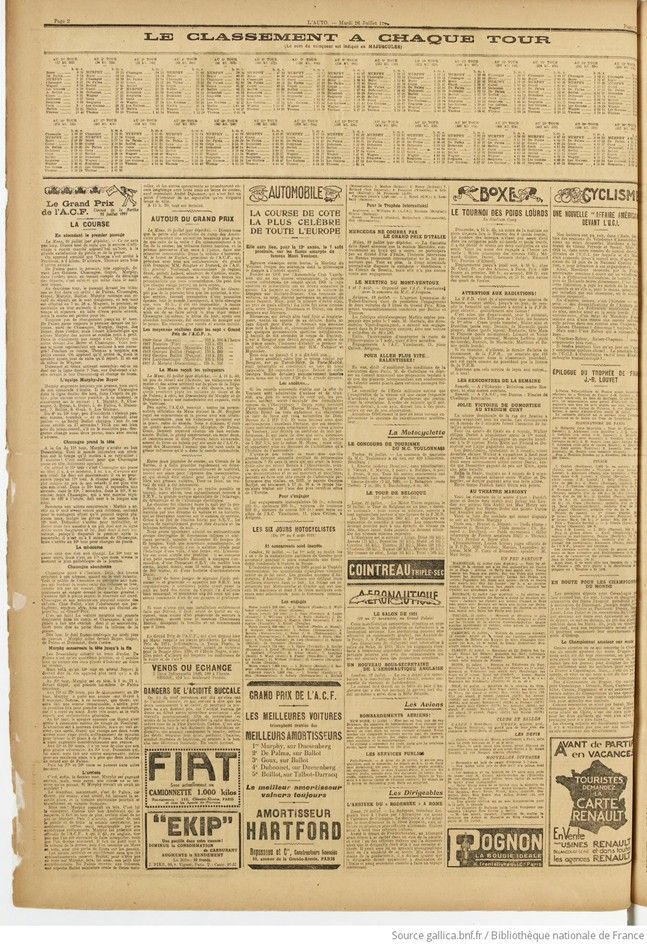
Text and jpegs by authorisation of the Bibliothèque national francais, gallica.bnf.fr www.gallica.bnf.fr compiled by motorracinghistory.com
L’Auto, Vol. 22, No. 7.528, Tuesday, july 26, 1921 – Part 2.
ON THE CIRCUIT DE LA SARTHE – 25 JULY 1921
The A.C.F. Grand Prix 1921.
THE RACE
BEFORE THE START
The large crowd at the circuit. — A change in the starting order.
(From our special correspondents)
Le Mans, July 25 (by dispatch). — The crowd, made up of sports fans and the general public, did not snub the cars as it seemed to have snubbed the Motorcycle Grand Prix yesterday. Cars began arriving from Paris at 4 a.m. People settled in as best they could, and while the men sat down to a hearty breakfast, the women dozed in the often comfortable car interiors, recovering as best they could from the fatigue of the journey.
At the American camp, the atmosphere was not as lively as yesterday. By 8 a.m., the crowds had arrived; and there are no seats left, either in the stands or in the boxes. The official representatives of the A.C.F., the A.O.O., the city, and the department take their places in their boxes. Carpentier, who arrived this morning, searches in vain for a place to sit.
In the refueling pits, the Duesenbergs and the Ballots are the first to arrive. The Talbot and Talbot-Darracq team arrives next, followed by the Mathis, which Mathis himself will drive.
At 8:45 a.m., the cars line up and are photographed and filmed from every angle.
The starting order will be given minute by minute, two by two; this decision having just been taken by the A.C.F. Sports Commission.
At 9 a.m. — De Palma (Ballot).
— — Mathis (Mathis).
At 9:01 a.m. — Guiness (Talbot),
— — Thomas (Talbot-Darracq).
At 9:02 a.m. — Guyot (Duesenberg).
— — Chassagne (Ballot).
At 9:03 a.m. — Seegraves (Talbot).
—- Murphy (Duesenberg).
— — Wagner (Ballot).
At 9:05 a.m. — Boyer (Duesenberg).
— — Goux (Ballot).
At 9:06 a.m. — Dubonnet (Duesenberg).
This decision was the subject of a lengthy discussion earlier. Opinions were divided. Simplicity prevailed. It should be noted, however, that at 8:50 a.m. the public was still unaware of the change.
What is the announcer’s role?
How they started
An excellent innovation by L’Auto was to bring the competitors and their mechanics together in a large group when we organized races. The A.C.F. imitated us; it was well done, and the public applauded. The photographers took pictures, the movie cameras rolled, and then the men returned to their machines.
Nine o’clock struck and the races began.
De Palma held Mathis in place. Thomas and Guiness seemed to wait for each other, as it was the Englishman who took the lead; Guyot stayed in place for two seconds, giving Chassagne time to pull ahead of him. Murphy slowly pulled ahead of Seegraves; Wagner started ahead of Boillot; Goux passed Boyer, who passed him back before the footbridge.
Only Dubonnet’s start was uncontested, and for good reason! He was alone…
(See the rest on page two)
Waiting for the first lap
Le Mans, July 25 (by dispatch). — It won’t be long. Let’s say right away that the display service worked better today than yesterday, much to the satisfaction of the public and the press.
We immediately learn that Thomas has stopped at Pontlieue, 2 kilometers away. Moreover, Thomas will have many other problems…
De Palma passes first, to loud applause, ahead of Lee Guiness, Chassagne, Guyot, and Murphy, in that order; but, taking into account the staggered start, it is Murphy who leads with the best time.
On the second lap, the cars pass the stands in this order: De Palma, Chassagne, Guyot, Murphy, Boillot. Murphy makes up for his slow start; he feels dangerous and completes the lap in 7 min. 58 sec. Wagner is the first to refuel on the next lap; he stops for longer and hastily repairs various minor problems, but the race is lost for him.
Still no change until the sixth lap. De Palma is still the first to pass in front of the stands, followed by Chassagne, Murphy, Guyot, and Joe Boyer, in that order; but the gap between Murphy and the others gradually is closing.
In the time rankings, Murphy leads ahead of Joe Boyer and Chassagne. You can imagine how our representative is cheered on as he passes! Meanwhile, Thomas is still having his little problems. We learn that he has stopped there, but the announcer immediately adds that he is starting again. The same goes for Wagner.
Dubonnet and Goux arrive together; is it a duel on the straight? No, because Dubonnet stops in front of the Duesenberg pit and changes wheels.
The Murphy-Joe Boyer team
Murphy continues to increase his lead, closely followed by his teammate. He catches up with Chassagne on the straight; from then on, in the minds of the public, there is no room for error. At this point, the standings are as follows: 1. Murphy, 2. Chassagne, 3. Boyer, 4. Guyot, 5. de Palma, 6. Dubonnet, 7. Boillot, 8. Goux, 9. Lee Guiness.
From the 6th to the 10th lap, there were few incidents; however, it should be noted—and rightly applauded—that André Boillot changed one of his rear wheels in 17 seconds! That is very close to the record time, if not the record itself. Seegraves also changed two tires, but with less skill.
Chassagne takes the lead
At the end of the 11th lap, Murphy stopped at the Duesenberg pit. Everyone focused their attention on how long it would take him to refuel: 2 minutes! That was enough time for Chassagne to take the lead, to wild applause.
We wait for the 12th lap: Chassagne takes the lead; at this point, he is 1 m 4 s ahead of his rival. The duel is thrilling; it will continue until the 17th lap. With each lap, Murphy makes up a little ground; he is faster than his rival. In the 14th lap, he gains a second, in the 15th, 7 seconds, in the 16th, 8 seconds; but Chassagne, who maintains a steady speed of 122 km/h, is bound to wear his rival down in the long run.
Let’s return to the other competitors: Mathis stopped on the 6th lap and returned to the stands, cheered for the courageous effort he has been making for several months, despite the strikes at his factories. On the same lap, Dubonnet stops to refuel, and Boyer treated us to a thrilling duel on the straight between Seegraves and himself, a duel from which he emerged victorious, as he was the first to disappear after the footbridge; he was only 2 minutes behind Chassagne, but stopped on lap 1413 to change tires
Halfway point
arrived with no change in the standings. The 16th lap passes without incident, but it is on the 17th that we experience the most poignant moment of the day.
Chassagne abandons
Chassagne appears on the horizon. Already, cheers are ringing out for him when we see him slow down. The entire crowd in the enclosure rushes to the barriers lining the road; those in the stands rise as if propelled by a spring. But the Ballot sadly pulls up in front of headquarters: gasoline is leaking out in buckets; the tank is punctured. Chassagne and his mechanic cry like children. At Ballot, it is despondency that is shared, rest assured, by all those who were at the Grand Prix today.
It’s over! The battered car is gently pushed into a camp, and Chassagne, who received a standing ovation from the crowd that he will never forget, comes to tell us of his sorrow in the press box.
From then on, the Franco-American duel loses its passion: Murphy leads ahead of Boyer, Guyot, de Palma, and Dubonnet, in that order.
Murphy will remain in the lead until the end
The Duesenbergs are driving like hell. De Palma is only in fourth position, and it seems unlikely that he will finish in one of the top three places.
But then, on lap 18, Boyer is expected; he should be there. We later learn that he had to retire.
On lap 20, Murphy is in the lead, 1 m 21 s ahead of Guyot, who is himself ahead of de Palma in third.
On the 21st and 22nd laps, there is no change; on the 23rd lap, Murphy has increased his lead over Guyot to 2 minutes. At this point, it should be noted that Goux, who has had a remarkable race, stops for the first time to pick up a spare wheel, as he has had a puncture en route. It is a very short stop, and he is off again to general cheers.
On the 24th lap, the announcer announced that Guyot had stopped fifty meters from the Pontlieue turn. Attention was once again focused on the race, but shortly afterwards, Guyot arrived and changed his two rear wheels without losing enough time to let de Palma take second place. However, Murphy had considerably increased his lead.
On laps 25 and 26, he was one lap ahead of his closest rival. On lap 20, Dubonnet, who had also had a surprising race, even for his closest friends, was only two minutes behind de Palma. Laps 27 and 28 passed without further incident.
The finish
It’s finally the last lap. Murphy is the clear winner, but, you know, a race isn’t over until it’s over. What if Murphy gets a flat tire or has an accident?
Second place now belongs to de Palma, because Guyot mistakenly stopped, leaving him in second place, and the American victory could turn into a French victory.
But no! Murphy appears in the distance. He is the winner. Like any self-respecting American, he does one more lap, making sure he doesn’t make a mistake. Then he stops, cheered on by the entire crowd and the entire American colony, which is small in number, but remarkable for its enthusiastic exuberance. Murphy is introduced to the A.C.P. officials, to whom he expresses his joy in English, which has to be interpreted but is easy to guess. He makes a quick trip to the press box, then returns to Le Mans by car with a bouquet of flowers on his lap.
The other finishers follow one after another, with the applause continuing unabated. Boillot, not to be outdone by Murphy, also takes a little extra lap. De Palma receives a superb miniature Ballot decorated with fresh flowers in the stands, and the other competitors continue to walk around with their friends in their racing suits for a long time, except for André Dubonnet, who makes a point of only reappearing in elegant street clothes.
At 3:30 p.m., it was all over.
——
AROUND THE GRAND PRIX
Le Mans, July 25 (by dispatch). — Shall we say that the small artificial city of the American camp was much livelier than the day before? From start to finish, the stands were packed, and the lawn was covered in unspeakable dust. In the VIP stand were Baron de Zuylen, president of the A.C.F., who presided with all his colleagues from the great French club; Messrs. Singher and Durand, from the A.C.O.; General Vuillemot, commander of the region; Steck, prefect; Lebert, senator; de Castille, mayor, etc., etc. We will refrain from listing all the personalities we encountered. Suffice it to say that every face bore a familiar name.
Around the time of the finish, the buffet was constantly busy throughout the day; although the plates were covered with a thick layer of dust at each serving, everyone was crowding around it, to such an extent that, by around 10 a.m., it would have been impossible to get even the slightest sandwich or the lightest meal without going to Le Mans!
Even Chassagne himself, the hero of the day, was forced to eat on the go after his unfortunate retirement. In short, it was a huge and well-deserved success.
The average speeds achieved in the seven “Grand Prix de l’A.C.F.”
1906 Szisz (Renault) 101 k. 300 per hour
1907 Nazzaro (Fiat) 113 k. 621 —
1908 Lautenschlager (Mercedes) 111 k. 276 —
1919 Georges Boillot (Peugeot). 110 k. 260 —
1913 Georges Boillot (Peugeot). 116 k. 190 —
1914 Lautenschlager (Mercedes).105 k. 550 —
1921 J. Murphy (Duesenberg). 125 k. 702 —
Le Mans welcomes the winners
Le Mans, July 25 (by dispatch). — At 6:40 p.m., slightly behind schedule, the winners of the motorcycle and car races arrive at Place de la République. A small stage has been set up, on which the cars of Goux and Palma take their places; next to them are the Duesenbergs of Murphy and J. Dubonnet; only one motorcycle is on display, that of Vernisse.
Shortly afterwards, the A.C.O. welcomed all the official dignitaries from Le Mans. Mr. Singher received the competitors and the press with his usual affability, then the winners appeared on the square, which was packed with people. We went there. It was a nice show. Jimmy Murphy* de Palma, Goux, and Bennett each received an enthusiastic ovation. Ballot, the great manufacturer, received two, and (dare we say it) Faroux, our comrade, who was forcibly brought to the balcony by his friends from the A.C.O., received from the people of Le Mans the welcome that his great influence in the automotive world earned him.
——
Between two days of racing at the Circuit de la Sarthe, it was necessary to quickly remove a huge pile of equipment that had been brought in for the motorcycle race and had to be cleared away to make room for the big cars. This required working through the night.
Only the magic of electricity made this work possible, so it was only natural to turn to S.E.V., the leading brand specializing in electric lighting, starting, and ignition.
The site was lit up all night by four pairs of car headlights, powered by a car dynamo and battery mounted on the service truck.
Thanks to this flood of light provided by S.E.V., the refueling stations could be evacuated and the stands cleaned at night.
We also admired an extraordinary generator, tiny in size and easily portable, capable of powering 25 lamps of 25 candles. This is a sensational innovation that will catch on; it is the ideal solution for lighting a villa, a farm, etc. The whole thing is as simple as it is practical: it consists of a small Renault single-cylinder engine with controlled valves, an S.E.V. Dynastart (the well-known model, which provides 300 watts of power at 12 volts), and a Dinin storage battery.
It is only fair to mention the valuable—and gracious—assistance provided by S.E.V. to the organizers; the large crowd that spent the night along the roads of the Circuit noticed this, and many placed orders for one of these practical units.
xxx
If you do not have a system made entirely by Blériot, before going on vacation, you should equip yourself with an acetylene emergency projector, fitted with the new Blériot torch, which increases the light tenfold and consumes only 8 liters.
xxx
The A.C.F. Grand Prix, which took place yesterday in Le Mans, was reminiscent of previous successes. The 1914 Grand Prix, Indianapolis, the Targa Florio, and the Gordon Bennett Cup were all victories for the Bougie Oléo. Have it and Huile Négro not always been the masters of the road and the air?
The photos.
Page 1. – GOUX – Third in the standings and first among French drivers, in the 2-liter Ballot. – Murphy in the lead on lap 51. – DE PALMA (in Ballot) – First among French cars – The victorious Duesenberg. At the wheel: Murphy.